


Introduction
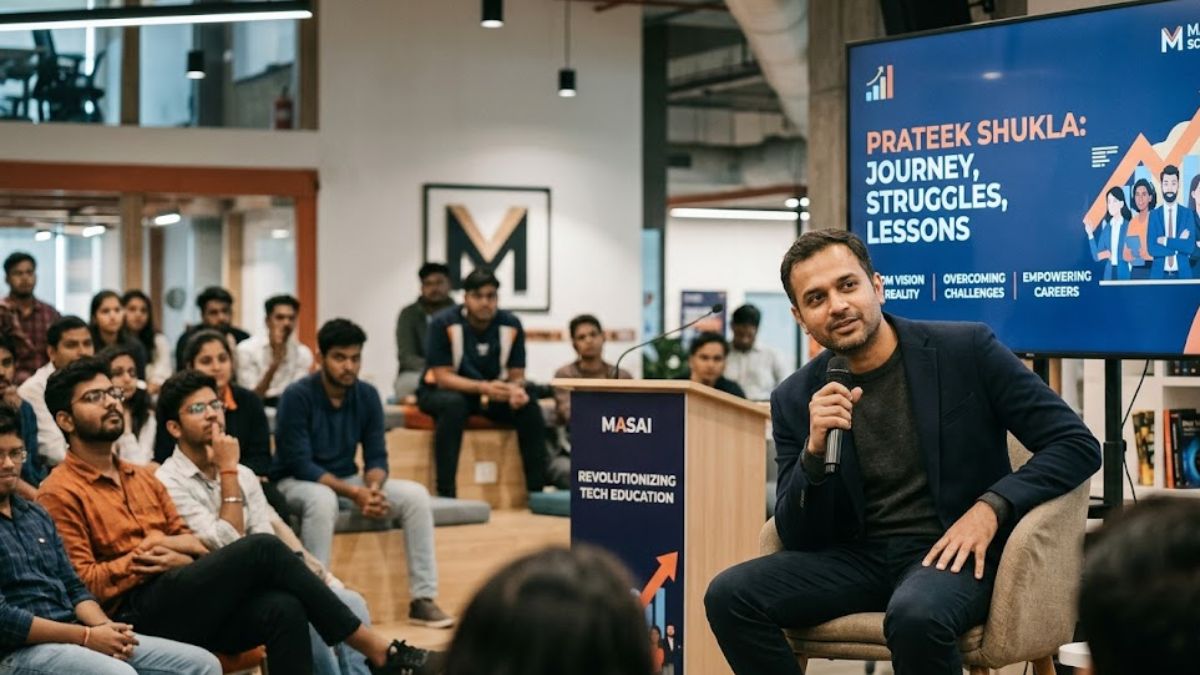
Masai School Prateek Shukla founder story is one of the most defining narratives in India’s modern edtech ecosystem. Founded in 2019, Masai School is a coding bootcamp that introduced the pay after placement model in India, challenging the traditional upfront fee structure of education. The startup was built with a bold mission: to make high-quality tech education accessible to anyone, regardless of their financial background.
Prateek Shukla, along with co-founders Nishant Chandra and Ankur Kumar, started Masai School to solve a deep-rooted problem in India’s education system high costs, low employability, and a disconnect between learning and jobs. Based in Bengaluru, Masai School operates at the intersection of education and employment, offering programs in software development, data analytics, and other in-demand skills.
The company works on an income share agreement India model, where students pay fees only after securing a job above a certain salary threshold. This approach aligns the institution’s success with student outcomes, making it one of the most talked-about edtech startup India experiments in recent years. Masai School has raised funding from investors like India Quotient and Unitus Ventures, among others, and has scaled its programs across India with both online and offline learning formats. This article explores the Prateek Shukla entrepreneur story in depth, from early struggles and failures to building a scalable education model that challenges conventional systems.
1. Background and Early Life
The early journey of Prateek Shukla reflects a very familiar Indian middle-class reality, where education is not just a choice but almost a responsibility. Like many others, he grew up in an environment where stability was valued more than experimentation, and engineering was seen as one of the safest routes toward a secure future. He followed that path and pursued engineering, stepping into a system that millions of students go through every year. On paper, it looked like the right decision. But during his academic years, something started to feel slightly disconnected. The classroom knowledge was structured and logical, but when it came to real-world application, there was a visible gap that kept growing louder in his mind.
That gap was not just academic. It was emotional too. It created a quiet frustration that many students feel but rarely articulate. You study, you pass exams, but you are still unsure whether you can actually do the job outside. As he moved into early professional exposure and observed startup environments, that feeling became even more intense. Unlike traditional systems, startups demanded speed, adaptability, and real skills. Degrees mattered far less than execution. This contrast made a strong impression on him. Slowly, his thinking started shifting from “what is taught” to “what is actually needed.” That shift became the foundation of everything that followed in his journey.
2. Founder and Company Overview
2.1 Introduction to Prateek Shukla and Masai School
The story of Masai School Prateek Shukla founder journey is closely tied to a deeper question in India’s education system: why do so many graduates still struggle to find jobs despite having degrees? Masai School was built around that exact question. Instead of focusing on certificates or academic completion, the platform focuses on something much more direct and measurable: job readiness.
It is not a traditional institute. It behaves more like a training system built around outcomes. Students are not just taught concepts; they are trained to think, build, and solve problems like working professionals. What makes this model stand out is its intensity. It is designed for transformation, not comfort. Students often enter with uncertainty and leave with structured skills that align with industry expectations.
2.2 Company Offerings and Market Served
Masai School offers structured programs in software development, data analytics, and other job-oriented tech domains. But the real focus is not just what is taught, it is how it is taught. The audience is very specific. It includes students from non-elite educational backgrounds, individuals from smaller towns, and people who feel left behind by traditional education systems. It also includes career switchers who want a second chance in the tech industry.
For many learners, this is not just education. It is a turning point. A decision to restart their career with a more practical direction. The emotional weight of this is often underestimated. Many students come in with self-doubt, financial pressure, and uncertainty about the future. The platform is built to convert that uncertainty into skill and direction.
2.3 Founding Year and Business Stage
Founded in 2019, Masai School emerged at a time when India’s edtech ecosystem was expanding rapidly, but most platforms were still heavily content-driven rather than outcome-driven. From the beginning, it positioned itself differently. Instead of measuring success by course completion, it focused on job placements and career outcomes. That simple shift changed the entire structure of learning.
As a growing edtech startup in India, its model also required rapid scalability. But unlike typical online learning platforms, this approach demanded high accountability from both students and instructors. The growth of Masai School reflects a deeper shift in India’s education mindset, where outcomes are starting to matter as much as access.
3. The Problem, Insight, and Trigger
The core problem identified by Masai School was not new, but it was becoming more visible every year. Millions of students graduate, yet a large portion still struggle to find meaningful employment aligned with their education. This gap between education and employability creates frustration at multiple levels. Students feel unprepared. Employers feel candidates lack practical skills. And the system in between feels disconnected from real industry needs.
Prateek Shukla observed this pattern closely. Traditional education systems were strong in theory, but weak in execution-based learning. Students could explain concepts, but often could not apply them in real-world scenarios. That observation led to a very simple but powerful insight: education only has real value when it leads to employability.
This insight became the foundation of Masai School’s model. Instead of asking “what should be taught,” the question became “what skills actually get someone hired.” The trigger for action came from observing global coding bootcamps and alternative learning systems that were already showing success. Models like income share agreements and intensive job-focused training proved that education could be redesigned around outcomes rather than time spent in classrooms. That realization shaped the direction of Masai School and eventually influenced its core philosophy: learning should directly translate into opportunity, not just information.ents who could not afford upfront fees.
4. Early Days and Initial Struggles
The early phase of Masai School was not smooth or glamorous. It was uncertain, fragile, and honestly quite stressful for everyone involved. There was a clear idea, but turning that idea into something people would trust in real life was the real battle. One of the biggest hurdles was belief. The concept of “pay after placement” sounded almost too good to be true for many students. In a country where education is usually paid upfront and outcomes are never guaranteed, this model naturally triggered doubt. Many students hesitated, asking themselves if there was a hidden risk they were missing.
At the same time, building trust internally was just as hard as convincing students. The team had to constantly prove that this model could actually work at scale, not just in theory. Every small success mattered because it helped reduce skepticism step by step. Another major challenge was curriculum design. There was no fixed blueprint to copy from. The team had to constantly study industry needs, talk to recruiters, and update content repeatedly. In many cases, what worked for one batch had to be changed for the next. It was an ongoing cycle of testing, failing, and rebuilding.
On the operational side, things were equally demanding. Setting up a structured learning environment, hiring the right instructors, and managing students from very different backgrounds required constant coordination. Expectations were high, and every batch felt like a live test of the entire system. Even investors and external stakeholders were not immediately convinced. Explaining a revenue model that depended on future placements was not easy. It required patience, clarity, and a lot of proof over time.
5. Failures, Setbacks, and Self Doubt
The journey of Prateek Shukla and Masai School is not a straight success story. It includes moments that were uncomfortable, uncertain, and mentally exhausting. In the early batches, outcomes were inconsistent. Some students performed well and got placed quickly, while others struggled to reach the required skill level. This inconsistency created pressure because the entire model depended on real job outcomes, not just course completion.
There were also scaling mistakes. In the rush to grow, certain processes were expanded before they were fully stabilized. That created gaps in training quality in some cases, which directly affected student performance. These were not small issues; they forced the team to step back and rethink their approach. Self-doubt was not occasional. It was part of the process. When you build something that does not have a proven roadmap, every failure feels personal. There is no benchmark to compare against, no established system to copy from. Everything has to be created from scratch, and that creates constant mental pressure.
But instead of ignoring these failures, the team used them as feedback loops. Admission criteria were refined. Training methods were adjusted. Instructor quality was improved. Slowly, the system started becoming more stable, but only after going through repeated cycles of correction. These early struggles became a hidden foundation. They were not visible from the outside, but they shaped the structure that later supported growth.
6. Validation and Early Traction
The real turning point for Masai School came when the first successful placements started happening. When early students got placed in tech roles and began repaying through the income share model, it created something powerful: proof. Until that moment, the idea was still experimental. After that, it became believable. This validation changed everything. It showed that the income share agreement India model was not just theoretical but practically workable in the Indian education context. That single proof point helped reduce skepticism across students, parents, and even industry observers.
What followed was organic growth driven by trust. Students who got placed became living examples of the system working. They shared their experiences with friends, families, and online communities. This word-of-mouth effect was far more powerful than traditional marketing. Each successful placement acted like a signal. It told others that this system could actually change careers. That emotional shift mattered more than any advertisement or pitch deck. Over time, Masai School started being seen as a credible alternative to traditional education, especially for people looking for direct job outcomes rather than just certificates.
7. Funding, Money, and Growth Constraints
In its early stage, Masai School operated under tight financial constraints. Unlike traditional edtech models where revenue comes upfront, this model delayed income until students were placed. That created a constant cash flow challenge. Every batch essentially represented an investment. Resources were spent on training, infrastructure, and mentorship long before any financial return was realized. This made financial planning extremely delicate.
The pressure increased because growth and sustainability had to be balanced at the same time. Scaling too fast could compromise quality, but scaling too slowly could limit impact and visibility. Finding that balance was one of the hardest parts of the journey. To support this model, the company raised funding from investors such as India Quotient and Unitus Ventures. This funding was not just for expansion, but for survival during the long gap between training and revenue realization.
Even after funding, discipline remained critical. Every decision had to consider long-term sustainability. Hiring, batch sizes, curriculum expansion, everything had to be carefully aligned with placement outcomes. This phase shaped the financial DNA of the company. It taught the importance of patience in a model where success is delayed but deeply outcome-driven. In many ways, these constraints were not just challenges. They were the reason the system became more efficient, focused, and disciplined over time.ility.
8. Team Building and Leadership Evolution
One of the most critical phases in the journey of Masai School was building the right team. In the early days, everything depended on a small group of people who were not just employees, but believers in an untested idea. Hiring was not simple. The requirement was not just technical knowledge or teaching ability. The real need was people who could connect with outcomes. In a traditional classroom, success is measured by completion. Here, success was measured by whether a student could actually get hired. That shift changed everything about how talent was evaluated.
Finding instructors who could teach with industry relevance, patience, and accountability was difficult. Many candidates were strong technically but struggled to translate knowledge into structured learning outcomes. Others were good communicators but lacked real-world tech depth. The balance was rare, and building that balance took time. As the company grew, leadership had to evolve quickly. Prateek Shukla moved from being deeply involved in daily operations to stepping into a more strategic role. This transition was not easy. When you build something from scratch, letting go of control feels uncomfortable. But scaling makes it necessary.
Delegation became a survival skill rather than a choice. New layers of leadership were created across training, operations, placements, and student success. Each function had to be strong enough to operate independently while still staying aligned with the core mission. This shift slowly transformed the company from a founder-driven setup into a system-driven organization, where outcomes depended on processes rather than individual effort.
9. Growth, Scaling, and Operational Challenges
Scaling Masai School was never just about adding more students. It was about protecting quality while growing fast, and that is one of the hardest problems in education. As batches increased, maintaining consistent learning outcomes became more complex. A system that worked well for 50 students behaved differently at 500. Small gaps in teaching or support started becoming visible at scale, and those gaps directly affected student confidence.
To solve this, the company had to standardize everything. Curriculum design became more structured, training delivery became more uniform, and evaluation systems became stricter. Flexibility was reduced in some areas, but consistency improved significantly. Positioning also played a major role during this phase. Masai School positioned itself clearly as a results-driven institution, not a content platform. This clarity helped set expectations correctly for students from the beginning.
Operationally, placement management became one of the most sensitive areas. Every hiring outcome carried emotional weight because students were not just customers, they were individuals betting their careers on the program. Managing employer relationships, preparing students for interviews, and matching talent with opportunities required constant coordination. As demand increased, the company also expanded into new courses and learning formats. This was not just expansion for growth’s sake, but a response to evolving industry needs and learner expectations.
10. Personal Sacrifices and Burnout
Behind the structured success of Masai School lies a very human story that is often invisible from the outside. Building something of this scale requires emotional endurance as much as strategic thinking. Entrepreneurship in education is particularly demanding because the impact is personal. When a student struggles, it is not just a metric on a dashboard. It feels real. That emotional responsibility adds constant pressure on founders and early team members.
There were phases of burnout, especially during periods of rapid scaling. Long working hours, constant problem-solving, and the pressure of outcomes created mental fatigue that is hard to explain unless experienced directly. Balancing personal life with this intensity was not easy. Work and life often blended into one continuous responsibility cycle. There were moments where stepping back felt necessary, but the mission kept pulling the team forward. What kept the system alive was belief. The idea that education could actually change real lives gave meaning to the exhaustion. That sense of purpose became the emotional anchor during difficult phases.
11. Lessons, Beliefs, and Values
The journey of Prateek Shukla and Masai School carries lessons that go beyond business strategy. It reflects a deeper philosophy about how education and opportunity should connect. One of the strongest lessons is incentive alignment. The pay after placement model is not just a business structure. It is a trust system. The company only succeeds when students succeed. That creates a natural accountability loop that keeps quality at the center of everything.
Another important lesson is persistence in uncertainty. When you build something new without an existing roadmap, failure is not occasional. It is expected. What matters is how quickly you learn and adjust without losing direction. Prateek Shukla’s approach also highlights continuous learning. The education industry itself keeps changing, and the company has to evolve with it. Static systems do not survive long in this space.
Core values such as transparency, accountability, and student-first thinking became non-negotiable principles. These values were not just written in documents. They were tested daily through real student outcomes. Over time, these beliefs shaped the identity of the organization more than any strategy or funding milestone ever could.
12. Present Challenges and Future Vision
Even today, Masai School continues to operate in a highly competitive and fast-changing education landscape. New platforms, new technologies, and shifting learner expectations constantly reshape the environment. One of the ongoing challenges is maintaining consistent placement outcomes at scale. As student numbers grow, ensuring that every individual receives the same level of support and opportunity becomes increasingly complex.
Competition is also intensifying. Many new edtech and bootcamp models are entering the market, each trying to solve the same problem of employability in different ways. This makes differentiation even more important. Despite these challenges, the company continues to focus on expanding its offerings and improving its learning systems. The goal is not just to teach skills, but to build a structured pathway from learning to employment that works reliably.
The long-term vision of Masai School is clear. It aims to become a leading institution for job-ready education, where outcomes are not uncertain but expected. At the center of this vision is Prateek Shukla’s continued focus on one problem that has not changed since the beginning: how to make education directly translate into opportunity in a way that is fair, scalable, and real.
Future Outlook
The future of Masai School looks promising as demand for skill-based education continues to grow. The Masai School Prateek Shukla founder journey highlights the potential of innovative models in transforming traditional industries. As the edtech startup India ecosystem evolves, Masai School is well-positioned to lead the shift toward outcome-based education. In the coming years, the company is expected to expand its programs, strengthen employer partnerships, and refine its model. This story is not just about building a startup. It is about rethinking how education works in India.
About foundlanes.com
foundlanes.com is India’s leading startup idea discovery platform. It helps entrepreneurs find actionable startup opportunities, market insights, and industry-specific guidance to turn ideas into real businesses. With deep research and practical resources, foundlanes supports founders at every stage, from idea validation to launch and growth.