


Summary
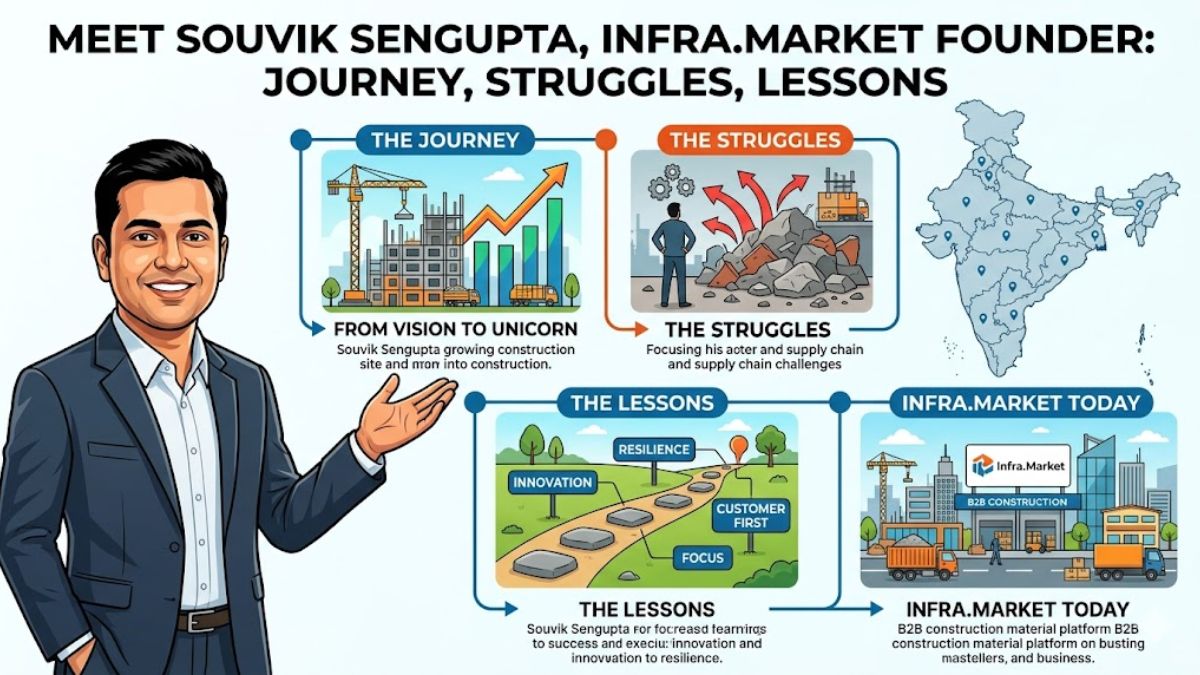
The story of the Infra.Market founder Souvik Sengupta is closely tied to the transformation of India’s fragmented construction materials industry into a tech-enabled, data-driven ecosystem. Souvik Sengupta, co-founder of Infra.Market, built one of India’s fastest-growing B2B platforms by rethinking how building materials are sourced, priced, and delivered across the country. Infra.Market was founded in 2016 by Souvik Sengupta along with Aaditya Sharda, with its headquarters in Mumbai. The company operates as a B2B marketplace India platform that connects real estate developers, contractors, and institutional buyers with manufacturers of construction materials such as cement, steel, tiles, and chemicals. The goal was to simplify procurement in a sector known for inefficiency, price opacity, and inconsistent quality.
Souvik Sengupta’s journey into entrepreneurship was shaped by his experience in consulting and his exposure to supply chain inefficiencies in large-scale infrastructure projects. He identified a clear gap in the building materials industry India, where procurement was largely unorganized and dependent on local vendors. Infra.Market works by leveraging technology, supply chain integration, and private label manufacturing. The platform aggregates demand, optimizes pricing, and ensures quality control through its own network of suppliers and factories.
Within a few years, Infra.Market scaled rapidly, achieving unicorn status and raising funding from global investors. The company’s growth story reflects how data, logistics, and execution can transform even the most traditional sectors. This article dives deep into the Infra.Market founder journey, exploring Souvik Sengupta’s early life, struggles, failures, leadership evolution, and the lessons he learned while building one of India’s most influential startups.
1. Background and Early Life
When you look at the journey of Souvik Sengupta, it doesn’t begin with a dramatic origin story or a sudden breakthrough moment. Instead, it’s shaped quietly through years of education, observation, and exposure to real-world systems. While detailed accounts of his early life are not widely documented, what becomes clear is the kind of mindset he developed early on. A mindset that leans toward structure, logic, and understanding complexity rather than avoiding it.
His academic path played a significant role in building that foundation. An engineering background is not just about learning formulas or technical concepts. It trains you to break down problems, to look at systems in parts, and to find solutions that are practical, not just theoretical. Later, his time at a top business school added another dimension. It expanded his view from solving problems to understanding markets, behavior, and scale. This combination, technical depth and business perspective, is often what separates operators from thinkers. In his case, it helped him become both.
Before stepping into entrepreneurship, Souvik Sengupta spent time in consulting roles. This phase is where things start to become more real. Consulting exposes you to how businesses actually function, not how they are supposed to function on paper. You see inefficiencies up close. You see delays, cost overruns, broken processes, and gaps that people have simply learned to live with. For Sengupta, much of this exposure came from industries that were heavy on operations and procurement. Infrastructure, construction, supply chains, areas that are massive in scale but often ignored when it comes to innovation. These experiences didn’t just teach him about problems. They showed him how deeply those problems were embedded in the system.
2. Founder and Company Overview
2.1 Who is Souvik Sengupta
Souvik Sengupta stands out because of the kind of path he chose. At a time when many founders were building consumer apps or chasing rapid digital adoption, he moved in the opposite direction. He focused on a sector that most people considered too complex, too unorganized, and frankly, too difficult to fix. The B2B construction and procurement space is not glamorous. It doesn’t generate headlines the way consumer tech does. But it is fundamental to how economies grow.
What defines him as a founder is not just the idea he built, but the lens through which he looked at the problem. He wasn’t trying to create something new for the sake of it. He was trying to bring structure to something that lacked it. That requires patience, deep understanding, and a willingness to engage with problems that don’t have quick solutions. It also requires a certain level of conviction, because when you work in such sectors, progress is often slow and invisible in the early stages.
2.2 Company Overview and Offerings
Infra.Market was built with a very clear objective: simplify and organize the way construction materials are sourced and supplied. At its core, it operates as a supply chain platform, but what it really does goes deeper than that. It connects demand and supply in a way that reduces friction, improves transparency, and brings consistency to a system that has historically lacked all three.
The company deals with a wide range of products, cement, steel, ready-mix concrete, tiles, construction chemicals. These are not small-ticket items. They are critical inputs in large-scale projects where even minor inefficiencies can lead to significant cost overruns. One of the most interesting aspects of the model is the use of private label brands. By controlling manufacturing and quality, Infra.Market is able to offer better margins while ensuring consistency for its customers. Its clients are not individual consumers. They are real estate developers, contractors, and institutional buyers. These are customers who operate at scale, and for them, reliability matters more than anything else. A delay in material supply can halt entire projects. By positioning itself as a dependable, technology-driven partner, Infra.Market carved out a space where it is not just a supplier, but a critical part of the construction ecosystem.
2.3 Year of Founding and Business Stage
Founded in 2016, Infra.Market entered the market at a time when B2B startups in India were still gaining traction. The early years were focused on building the foundation, understanding demand patterns, setting up supply networks, and ensuring that the model worked on the ground.
What followed was rapid scaling. Within a few years, the company achieved unicorn status, a reflection not just of investor confidence, but of the value it was creating in the market. Growth at this pace in a sector like construction is not easy. It requires strong execution, deep relationships, and the ability to manage complexity at scale. Today, Infra.Market is considered one of the most significant B2B startups in India, operating across multiple categories and expanding into new geographies.
3. The Problem, Insight, and Trigger
The idea behind Infra.Market didn’t come from brainstorming sessions or abstract thinking. It came from observation. The building materials industry in India is massive, but it has long been fragmented. Procurement is often messy. Pricing lacks transparency. Quality is inconsistent. And most importantly, there is very little standardization across the system. For someone working closely with large-scale projects, these inefficiencies are impossible to ignore. Souvik Sengupta saw how these gaps affected timelines and costs. A delay in sourcing materials could slow down an entire project. Variations in quality could lead to rework. Lack of pricing clarity could inflate budgets. These were not isolated issues. They were systemic problems that affected the entire industry.
The real insight was recognizing that despite the scale of the construction sector, there was no organized, reliable way to procure materials at scale. That gap represented an opportunity, but also a challenge. Fixing it would require more than just a platform. It would require building trust, ensuring quality, and creating a system that stakeholders could rely on consistently. The trigger to start Infra.Market came from this realization. Instead of trying to improve individual parts of the system, Sengupta aimed to bring structure to the entire process. It wasn’t about incremental change. It was about creating a more efficient, transparent, and reliable ecosystem for construction materials. And that vision became the foundation on which the company was built.
5. Early Days and Initial Struggles
5.1 Entering a Traditional Industry
Stepping into the construction materials space with Infra.Market was not like launching a modern app where users sign up in minutes. This was a world built on relationships, habits, and years of trust between buyers and suppliers. People didn’t just switch vendors because something new came along. They stayed with what they knew, even if it was inefficient, because it felt safe.
For Souvik Sengupta and his co-founder, this meant starting from zero in a space where credibility had to be earned slowly. Every conversation with a contractor or supplier was not just about pitching a platform. It was about convincing them to change how they had been working for years. That’s not easy. It requires patience, consistency, and a willingness to hear “no” repeatedly. Trust in B2B ecosystems is built transaction by transaction. One successful delivery leads to another, and over time, that becomes a relationship. But in the early days, there is no shortcut to that process.
5.2 Operational Complexity
What looked clean and efficient on a whiteboard quickly turned into something far more complicated in reality. Infra.Market wasn’t just connecting buyers and sellers. It was taking responsibility for the entire experience, sourcing, logistics, quality, and delivery timelines. And in a sector like construction, even small disruptions can have large consequences.
Ensuring consistent quality across different suppliers was a constant challenge. Managing logistics across cities, sometimes across states, required coordination at a level that is hard to fully appreciate until you’re in it. Delays, supply mismatches, last-minute changes from clients, these were not exceptions, they were part of daily operations. What seemed like a straightforward aggregation model demanded intense execution behind the scenes. Every successful order carried the weight of multiple moving parts working in sync. And in the beginning, getting that sync right took time, effort, and a lot of learning the hard way.
6. Failures, Setbacks, and Self-Doubt
No matter how strong the idea is, the journey of Souvik Sengupta was never free from setbacks. There were moments when growth felt uneven, when scaling supply while maintaining quality became difficult. As demand increased, the pressure on operations increased with it. And in a system that depends on multiple external players, controlling every variable is simply not possible.
Balancing growth with stability became one of the toughest challenges. Expand too quickly, and the system starts to strain. Hold back, and you risk losing momentum. Finding that balance is not a one-time decision. It’s something that has to be managed constantly. There are phases where things feel under control, and then suddenly, a new challenge emerges, forcing you to rethink your approach.
And then there’s the part that rarely gets discussed openly, self-doubt. In B2B businesses, especially those with long sales cycles, validation doesn’t come quickly. You don’t get instant feedback. Deals take time. Relationships take time. Revenue takes time. In those quiet periods, when progress feels slow and outcomes are uncertain, doubt naturally creeps in. You start questioning whether the model will scale, whether the market is ready, whether you are pushing in the right direction. For Souvik Sengupta, these moments were part of the journey. And like most founders, pushing through them required resilience more than anything else.
7. Validation and Early Traction
In a business like Infra.Market, validation doesn’t come from downloads or sign-ups. It comes from something much harder to earn, repeat business. The first real signal that things were working was when developers and contractors didn’t just place one order, they came back for more. That shift, from trial to trust, is one of the most important turning points in any B2B startup.
Repeat orders mean that the platform is delivering real value. It means materials are arriving on time, quality is meeting expectations, and the overall experience is reliable. In industries where delays can cost lakhs or even crores, reliability becomes the biggest differentiator. And that’s exactly where Infra.Market started to stand out.
What’s interesting is that this growth was not driven by aggressive marketing or hype. It was driven by execution. One successful project led to referrals. One satisfied client brought in another. Slowly, momentum built. This phase may not look dramatic from the outside, but it is where the foundation of the business is truly established. It proved that the model, built on aggregation, efficiency, and control over supply, was not just an idea. It worked in the real world, where expectations are high and margins for error are low.
8. Funding, Money, and Growth Constraints
As Infra.Market began to scale, attracting investment from global investors became a natural step. Capital provided the ability to expand operations, strengthen supply chains, and invest in private label manufacturing. It allowed the company to move faster and build capabilities that would have taken much longer through organic growth alone. But funding also brought its own set of challenges. B2B businesses, especially in construction, operate very differently from consumer startups. Payment cycles are longer. Clients may take weeks or months to clear invoices. At the same time, inventory has to be maintained, suppliers have to be paid, and operations have to continue without interruption. This creates a constant pressure on cash flow.
Managing this requires discipline. It’s not just about how much money you raise, but how you use it. Every decision, whether to expand into a new category, invest in manufacturing, or scale operations, has financial implications that play out over time. For Souvik Sengupta, maintaining growth while ensuring financial stability became a careful balancing act. It required not just ambition, but control. Because in businesses like this, sustainability is not optional. It is what determines whether growth can continue or not.
9. Team Building and Leadership Evolution
9.1 Early Hiring Challenges
In the early days of Infra.Market, building the right team was not just a task, it was one of the biggest unknowns. This wasn’t a typical startup environment where you could hire only engineers or marketers and scale quickly. The business sat at the intersection of construction, supply chains, and technology. That meant every hire had to understand complexity, not avoid it.
Finding people who could operate in such an environment was difficult. Industry veterans often had deep knowledge but were used to traditional ways of working. On the other hand, startup talent brought speed and adaptability but lacked ground-level understanding of construction and procurement. Bridging this gap required careful hiring, and like most startups, not every decision worked out. Some hires looked perfect on paper but struggled with the pace or the ambiguity. Others couldn’t adapt to the cultural shift that a startup demands.
These early mistakes were not failures in the usual sense. They were lessons in understanding what the company truly needed. Over time, Souvik Sengupta and his team began to prioritize adaptability, ownership, and alignment with the mission over just experience. Because in a business like this, skills can be developed, but mindset is much harder to change.
9.2 Leadership Learnings
As Infra.Market started to grow, the role of Souvik Sengupta had to evolve with it. In the beginning, like most founders, he was deeply involved in execution. Every deal, every operational issue, every decision required his attention. That level of involvement is necessary in the early stages, but it becomes unsustainable as the company scales.
The transition from doing everything yourself to trusting others to do it is one of the hardest shifts a founder has to make. Delegation is not just about reducing workload. It’s about building systems and people who can operate independently. It requires letting go of control, which is never easy when you’ve built something from scratch.
Over time, the focus moved from solving day-to-day problems to thinking about the bigger picture. Strategy, team building, long-term vision, these became the priorities. Leadership, in this phase, is less about action and more about direction. It’s about ensuring that the organization moves in the right direction, even when you’re not directly involved in every step.
10. Growth, Scaling, and Operational Challenges
Scaling Infra.Market was not a single challenge. It was a series of challenges layered on top of each other. Every time the company expanded into a new product category, whether it was steel, tiles, or construction chemicals, it had to build new supply chains, establish new quality standards, and understand new market dynamics.
Geographical expansion brought its own complexities. What works in one region doesn’t always work in another. Supplier networks differ. Customer expectations vary. Logistics challenges change. Each new market required fresh learning, new relationships, and adjustments in execution. Growth, in this sense, was not just about increasing numbers. It was about adapting continuously without losing control.
At the same time, the company’s identity began to evolve. Initially, Infra.Market was seen primarily as a procurement platform, a way to source materials more efficiently. But as it matured, the focus shifted toward quality and reliability. It wasn’t enough to supply materials. The expectation was to supply materials that met consistent standards, every single time.
This is what defines the growth story. Not just expansion, but controlled expansion. The ability to scale while maintaining operational discipline. Because in industries like construction, one mistake can have a ripple effect across entire projects. Maintaining that balance between growth and control is what separates sustainable companies from those that struggle under their own weight.
11. Personal Sacrifices and Burnout
Behind the growth of Infra.Market is a reality that most people don’t see. Building a company in a high-pressure, operationally intense environment comes with personal costs. There are no fixed hours. Decisions don’t stop at the end of the day. Problems don’t wait for the right time to appear. For Souvik Sengupta, this likely meant long stretches of work where personal time took a back seat. It’s not always visible, but it’s there, missed moments, delayed plans, constant mental engagement with the business. Entrepreneurship at this level is not just a career choice. It becomes a way of life.
Burnout, in such journeys, is rarely dramatic. It builds slowly. It shows up in fatigue, in the weight of continuous decision-making, in the pressure of responsibility. And yet, most founders keep going. Not because it’s easy, but because they feel accountable, to their team, their customers, and the system they are trying to build. Balancing this with personal well-being is one of the hardest, and often most overlooked, challenges in entrepreneurship.
12. Lessons, Beliefs, and Values
The journey of Souvik Sengupta offers lessons that go beyond business theory. One of the strongest beliefs that stands out is the importance of solving real problems. The construction materials industry was not trending. It didn’t attract attention in the way consumer startups did. But it had deep inefficiencies that affected an entire ecosystem. Choosing to focus on that required clarity and conviction. Another key lesson is about execution. Ideas are easy to talk about, but much harder to implement. Infra.Market succeeded because it focused relentlessly on delivery. Ensuring that materials reached on time, that quality was maintained, that customers could rely on the system. These are not glamorous achievements, but they are what build real businesses.
Patience is another theme that runs through the journey. B2B businesses take time. Relationships take time. Trust takes time. Growth may not look explosive in the beginning, but when the foundation is strong, it becomes sustainable. And finally, there is a quiet discipline in not chasing trends. While others focused on what was popular, Sengupta focused on what was necessary. That difference in approach is what created long-term value.
13. Present Challenges and Future Vision
Today, Infra.Market operates in an environment that is both full of opportunity and intense competition. Scaling operations while maintaining quality continues to be a challenge. As the company grows, the complexity of managing supply chains, ensuring consistency, and meeting customer expectations only increases. Competition is also evolving. New players are entering the market, and existing ones are becoming more organized. This means the company cannot rely solely on its early advantages. It has to keep improving, keep refining its systems, and keep strengthening its relationships with both suppliers and customers.
At the same time, the foundation that has been built over the years provides a strong base for the future. The long-term vision appears to be clear, to become a comprehensive supply chain platform for the construction industry. Not just a marketplace, but an integrated system that handles procurement, quality, logistics, and reliability at scale. Looking ahead, the role of technology and data will only grow stronger. Decision-making will become more precise. Operations will become more optimized. But at its core, the mission remains the same: to bring structure and efficiency to a fragmented industry.
About foundlanes.com
foundlanes.com is India’s leading startup idea discovery platform. It helps entrepreneurs find actionable startup opportunities, market insights, and industry-specific guidance to turn ideas into real businesses. With deep research and practical resources, foundlanes supports founders at every stage, from idea validation to launch and growth.