


Summary
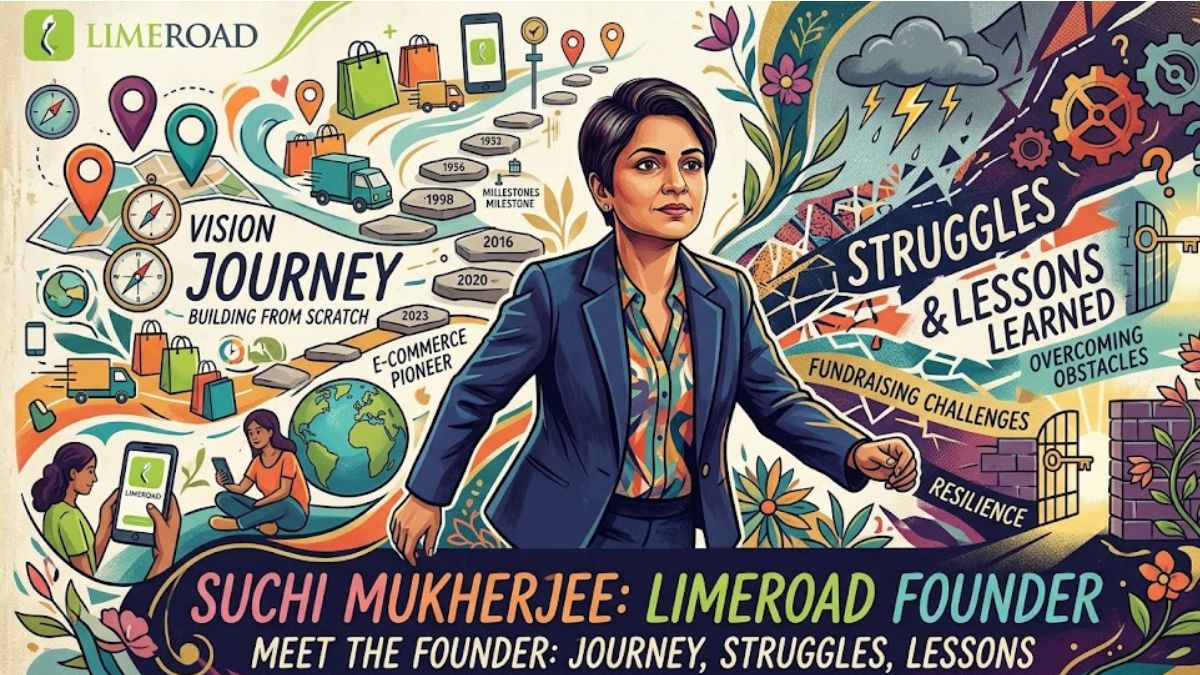
The story of the Suchi Mukherjee LimeRoad founder journey is one of ambition shaped by global exposure, sharp insight into Indian consumer behavior, and the grit to build a fashion commerce platform in one of the world’s most complex markets. Suchi Mukherjee is the founder and CEO of LimeRoad, a social discovery-based fashion marketplace launched in 2012 and headquartered in Gurgaon. Born and raised in India, Mukherjee went on to study at the prestigious London School of Economics and later attended Stanford Graduate School of Business. Before founding LimeRoad, she built an impressive corporate career working with global giants such as eBay, Skype, and Gumtree.
The idea for LimeRoad emerged from a gap she identified in India’s growing online fashion market. While e-commerce platforms were scaling, there was little focus on discovery-driven, personalized fashion shopping for women outside metro cities. Mukherjee saw an opportunity to create a platform that blended content, community, and commerce.
Starting a fashion marketplace in India came with significant challenges. From building supply chains to understanding diverse consumer preferences, the early days were filled with uncertainty. Yet, through persistence and strategic pivots, LimeRoad gained traction and attracted funding from global investors. This is not just a startup story. It is a deeper narrative about resilience, self-belief, and the realities of building a consumer internet company in India. The LimeRoad founder Suchi Mukherjee story offers valuable lessons for aspiring entrepreneurs navigating the Indian startup ecosystem.
2. Background and Early Life
2.1 Early Life and Family Background
Suchi Mukherjee was born and raised in India in a middle-class family that valued education and intellectual growth. Her upbringing was not rooted in business legacy or entrepreneurship. Instead, it emphasized academic excellence and discipline. Growing up, she was exposed to a structured environment where curiosity was encouraged. This early exposure shaped her analytical thinking and her ability to question existing systems. There was no immediate roadmap toward entrepreneurship in her early life. Like many from similar backgrounds, the expectation was to pursue higher education and build a stable career.
2.2 Education and Early Influences
Mukherjee pursued Economics at the London School of Economics, one of the most prestigious institutions globally. This experience exposed her to global markets, economic thinking, and international perspectives. Later, she attended the Stanford Graduate School of Business. This phase proved to be transformational. Being in Silicon Valley during the rise of consumer internet companies influenced her understanding of startups and innovation. At Stanford, she witnessed firsthand how ideas were turned into scalable businesses. This environment planted the early seeds of entrepreneurship in her mind.
3. Founder and Company Overview
3.1 Introduction to the Founder
The journey of Suchi Mukherjee doesn’t feel like a straight line. It’s layered with global exposure, sharp observation, and a quiet confidence that came from actually understanding how people behave online. Before stepping into entrepreneurship, she built her career across companies that were shaping the early internet economy. At Skype, she was part of a phase where the product wasn’t just growing, it was redefining how people connected. Later, at eBay and Gumtree, she went deeper into marketplace dynamics.
These weren’t just job titles. They were environments where she saw, up close, what makes users stay, what makes them trust a platform, and what ultimately drives transactions. Over time, this built a strong instinct for digital consumer behavior. But what makes her story compelling is not just experience. It’s how she translated that experience into something relevant for India. She didn’t just copy what worked globally. She adapted it with context, something many founders struggle to do.
3.2 Company Overview and Offerings
When LimeRoad launched in 2012, it didn’t try to be another marketplace. It tried to feel different. At a time when most e-commerce platforms were focused on listings, discounts, and transactions, LimeRoad introduced something softer, more human, discovery. The idea was simple but powerful. Shopping, especially fashion, isn’t always about knowing what you want. It’s about finding it along the way.
The platform allowed users to create “scrapbooks,” essentially personal style boards where they could mix and match products, experiment with looks, and share their creativity. It blurred the line between content and commerce. You weren’t just buying clothes, you were engaging with fashion. From a real user perspective, this changed the experience. Instead of scrolling endlessly through products, users could explore curated styles, get inspired, and feel part of a community. It made the platform feel less transactional and more expressive.
3.3 Target Audience and Market Served
One of the most thoughtful decisions Mukherjee made was choosing who to build for. LimeRoad didn’t chase only metro cities. It leaned into a much larger, often ignored audience, women from non-metro and smaller cities. These were users who were aspirational, curious, and increasingly coming online, but didn’t feel fully represented by existing fashion platforms.
There’s a certain emotional nuance here. Fashion for these users wasn’t just about trends, it was about identity, confidence, and access. They wanted variety, but also affordability. They wanted inspiration, but also relatability. Mukherjee recognized that the next wave of internet growth in India would not come from saturated urban markets. It would come from these emerging users. And she built LimeRoad with that belief at its core. This focus gave the company a distinct positioning. It wasn’t trying to compete head-on with everyone. It was building its own space within the larger fashion e-commerce landscape.
3.4 Year of Founding and Business Stage
Launching in 2012 meant stepping into a market that was already heating up. Giants like Flipkart and Snapdeal were expanding aggressively, backed by heavy funding and rapid scale. For a new entrant, this could have been intimidating. And honestly, it probably was. But LimeRoad didn’t try to outspend or outscale them. It chose differentiation over direct competition. By focusing on discovery, community, and a specific audience, it carved out a niche that felt fresh at the time. It was a bold move, not because it guaranteed success, but because it required patience. Building a differentiated product often takes longer to show results.
4. The Problem, Insight, and Trigger
4.1 Core Problem Identified
The starting point of LimeRoad was not a grand vision. It was a simple, almost obvious observation that others had overlooked. E-commerce was growing, yes. But fashion discovery was still broken. Most platforms treated fashion like any other category. Search, filter, buy. But fashion doesn’t work like that. People don’t always know what they’re looking for. They want to browse, explore, and get inspired. For many women, shopping is not just a task. It’s an experience. It’s emotional. creative. And that layer was missing. Mukherjee saw this gap clearly. And instead of building another transactional platform, she chose to build something that felt more alive.
4.2 Personal Insight Behind the Idea
Her insight came from connecting two worlds. On one hand, she had seen how global platforms were starting to blend content with commerce. On the other, she deeply understood that Indian consumers behave differently. Price sensitivity is real. Diversity in taste is massive. Cultural influences vary across regions. What works in one city might not work in another. So the idea wasn’t just to replicate a Western model. It was to localize it deeply. To create a platform where users could engage, express, and still find products that felt accessible. That balance between inspiration and affordability became the heart of LimeRoad.
4.3 Trigger Moment to Start
There wasn’t a dramatic “aha” moment. It was more gradual, almost inevitable. After years of observing the market, Mukherjee reached a point where the gap was too clear to ignore. The Indian startup ecosystem was evolving, internet adoption was rising, and consumer behavior was shifting. Waiting longer would mean watching someone else build the same idea. So she made the decision many founders eventually face, stepping away from stability and into uncertainty. It wasn’t about timing the market perfectly. It was about believing the opportunity was real enough to take the risk.
5. Early Days and Initial Struggles
5.1 Early Assumptions and Naivety
Like most founders, Mukherjee started with a few assumptions that reality quickly challenged. One of the biggest was believing that a strong product would naturally attract users. It sounds logical, but in practice, it rarely works that way. User acquisition is hard. Retention is harder. And building trust, especially in e-commerce, takes time. The early days were filled with constant learning. What users said they wanted and what they actually did were often different. That gap forced the team to iterate, adjust, and sometimes rethink entire approaches.
5.2 Entrepreneurial Initial Struggles
Building a fashion marketplace in India is not just about technology. It’s deeply operational. Vendors need to be onboarded and managed. Quality needs to be consistent. Logistics need to be reliable. And all of this has to happen at scale. On top of that, LimeRoad was introducing a new concept, social discovery. For many users, this wasn’t immediately intuitive. They had to be educated, guided, and gradually brought into the experience. These challenges weren’t glamorous. They were messy, time-consuming, and often frustrating. But they were also necessary.
5.3 What Turned Out to Be Harder Than Expected
If there’s one thing that proved tougher than expected, it was scaling. It’s one thing to build a product that works for a few thousand users. It’s a completely different challenge to make it work seamlessly for millions. Inventory management became more complex. Delivery timelines had to be maintained. Customer expectations kept rising. And all of this was happening in a highly competitive environment with well-funded players pushing aggressively.
There were moments when strategies had to be reworked quickly. Decisions had to be made with incomplete information. And the pressure to keep moving forward never really eased. But that’s the reality behind most startup stories. Growth is rarely smooth. It’s uneven, unpredictable, and often uncomfortable. And yet, it’s in those exact moments that companies begin to find their real strength.y.
6. Failures, Setbacks, and Self-Doubt
6.1 The Toughest Phase of the Journey
The story of Suchi Mukherjee isn’t just about building a company. It’s about holding your ground when things stop going the way you planned. There were phases when growth slowed down, almost unexpectedly. Metrics that once moved quickly started flattening. At the same time, expectations from investors didn’t slow down. If anything, they grew louder.
That combination creates a very specific kind of pressure. It’s not just external. It becomes internal. You start questioning decisions, timelines, even your own judgment. For LimeRoad, this phase wasn’t just about numbers. It was about belief. When growth stalls, it forces you to confront a difficult question: is the model flawed, or is it just early? Those are not easy questions to answer when you’re in the middle of it.
6.2 Early Failures and Major Setbacks
Not every idea worked. And that’s putting it mildly. Some product features that seemed promising internally simply didn’t connect with users. Features that the team had spent months building were quietly ignored. Marketing campaigns that looked strong on paper failed to deliver meaningful traction. Each of these missteps had a cost. Financially, yes. But more than that, emotionally. Because behind every failed experiment is time, effort, and expectation.
But here’s what stands out. These weren’t wasted efforts. Over time, they became data points. Patterns started to emerge. The team began to understand what users actually valued versus what they assumed users would value. In real startup journeys, failure is rarely dramatic. It’s usually quiet. A feature that doesn’t work. A campaign that underperforms. But when these small failures stack up, they force clarity.
6.3 Moments of Self-Doubt and Emotional Lows
Entrepreneurship has a way of isolating you, even when you’re surrounded by people. There are moments when everything looks uncertain. The roadmap isn’t clear. The outcomes are unpredictable. And the responsibility sits heavily on your shoulders.
Mukherjee went through those moments like any founder would. There were phases where the direction ahead wasn’t obvious, where every decision felt heavier than usual. But what kept her moving wasn’t blind optimism. It was conviction. A quiet, steady belief that the core idea still made sense, even if the execution needed adjustment. That distinction matters. Because belief in the vision is often what carries founders through phases where results alone aren’t enough to justify the effort.
7. Validation and Early Traction
7.1 First Real Validation
Every startup waits for that first real signal, the moment when the idea stops being theoretical and starts becoming real. For LimeRoad, that moment came when users began engaging deeply with the scrapbook feature. It wasn’t just usage. It was participation. People were creating, curating, and sharing styles. They were spending time on the platform, not just completing transactions and leaving. That kind of engagement is hard to fake. It showed that the platform wasn’t just functional, it was resonating.
7.2 Early Revenue Growth and Feedback
As engagement grew, revenue followed. Not in a sudden spike, but steadily, in a way that felt sustainable. More importantly, the feedback started to align with the original vision. Users appreciated the curated experience. They liked that the platform didn’t feel overwhelming. And for many, the pricing made fashion feel accessible without sacrificing variety. From a real-world standpoint, this phase is critical. It’s where assumptions start turning into evidence. Where you begin to see that the problem you identified actually exists for others, not just in theory.
7.3 Why This Moment Changed Everything
This wasn’t just about numbers improving. It was about belief getting reinforced. Until this point, the idea could still have gone either way. But once users started engaging consistently, it changed the internal narrative. It told the team that differentiation works. That you don’t always have to follow the dominant model to succeed. And perhaps most importantly, it gave Mukherjee the confidence to scale. Because scaling without conviction is risky. But scaling with validated belief changes how decisions are made.
8. Funding, Money, and Growth Constraints
8.1 Funded Journey
LimeRoad was not built in isolation. It attracted backing from global investors like Lightspeed Venture Partners and Tiger Global Management. This funding played a crucial role. It allowed the company to invest in technology, expand operations, and build the kind of platform it envisioned. But funding also comes with expectations. Growth targets, timelines, and performance metrics become part of everyday decision-making.
8.2 Capital Challenges and Cash Flow Reality
Even with funding, managing cash is never easy. Growth demands constant investment. Marketing, technology, logistics, hiring, every piece requires capital. And in e-commerce, the burn rate can rise quickly if not managed carefully.
There’s a constant balancing act between spending enough to grow and conserving enough to survive. From experience across startups, this is where many founders feel the most tension. Because every decision has a trade-off. Spend more and grow faster, or spend carefully and extend your runway. Mukherjee had to navigate this balance repeatedly, adjusting strategies based on both opportunity and constraint.
8.3 Early Growth Limitations
Scaling wasn’t just limited by money. It was also constrained by operations. Expanding too quickly without strong systems can create bigger problems later. Inventory issues, delivery delays, inconsistent quality, these are the kinds of cracks that show up when growth outpaces infrastructure. So the team had to make deliberate choices. Focus on certain markets. Prioritize specific features. Build depth before chasing breadth. These limitations, while frustrating at the time, actually shaped a more disciplined growth strategy.
9. Team Building and Leadership Evolution
9.1 Early Hiring Mistakes
Building a team sounds straightforward until you actually start doing it. In the early days, not every hire worked out. Some people had the right skills but didn’t align with the culture. Others struggled with the pace and uncertainty that startups demand. These mistakes are common, but they are rarely easy to handle. Letting people go, re-hiring, rebuilding momentum, it all takes a toll. Over time, Mukherjee began to prioritize not just capability, but alignment. Because in a startup, how someone works matters just as much as what they can do.
9.2 Delegation Challenges
One of the hardest transitions for any founder is letting go. In the beginning, you’re involved in everything. Product decisions, hiring, marketing, operations. It feels natural because the company is still small. But as it grows, that approach becomes unsustainable. Delegation becomes necessary. And with delegation comes trust. For Mukherjee, this was a gradual shift. Learning to step back without losing control, to trust others while still guiding the vision, it didn’t happen overnight.
9.3 Leadership Learnings Over Time
Over time, her leadership style evolved. It became less about doing everything herself and more about enabling others to perform at their best. Less about reacting quickly and more about thinking strategically. She learned to balance vision with execution. To stay grounded during highs and composed during lows. And perhaps most importantly, to adapt. Because in a startup environment, rigidity rarely works. What works is the ability to learn, adjust, and keep moving forward, even when the path isn’t perfectly clear.
10. Growth, Scaling, and Operational Challenges
10.1 Brand Positioning and Go-To-Market Learnings
Positioning LimeRoad as a discovery platform wasn’t as simple as putting it in a tagline. It required changing how people thought about online shopping. Most users were conditioned to search, compare, and buy. LimeRoad was asking them to slow down, explore, and engage. That shift doesn’t happen overnight. It had to be explained, demonstrated, and reinforced at every touchpoint.
Early on, the team realized that marketing wasn’t just about acquisition. It was about education. Campaigns had to show how to use the platform, not just why to use it. Over time, messaging evolved based on real user behavior. What people clicked on, where they dropped off, what they shared, all of it shaped how LimeRoad spoke to its audience. The learning here was simple but hard-earned. You can build something unique, but if users don’t understand it, the uniqueness doesn’t matter.
10.2 Scaling Challenges
Scaling is where things start to get real. It’s one thing to delight a small group of users. It’s another to deliver the same experience consistently as numbers grow. For LimeRoad, growth brought complexity at every level. Vendors had to be onboarded faster, but without compromising quality. Logistics had to become more reliable, even as order volumes increased. Customer service had to handle more queries without losing the personal touch that early users appreciated. There’s a certain pressure in this phase. Every small mistake becomes visible at scale. A delayed shipment, a poor-quality product, or a slow response can impact hundreds or thousands of users at once. So the team had to constantly refine systems. Not once, but repeatedly. Scaling wasn’t a milestone. It was an ongoing process of fixing, improving, and sometimes rebuilding.
10.3 Operational Breakdowns and Fixes
No startup scales without things breaking along the way. And LimeRoad was no exception. There were moments when operations didn’t hold up. Deliveries got delayed. Vendor inconsistencies showed up. Customer complaints increased. These weren’t just operational issues. They were trust issues. Because in e-commerce, every failure directly affects how a customer feels about the brand.
But what matters is how those moments are handled. Instead of ignoring or patching over problems, the team leaned into them. Processes were reworked. Technology was upgraded. Vendor checks became stricter. Each breakdown, as frustrating as it was, added a layer of strength to the system. Over time, the platform became more resilient, not because things never went wrong, but because it learned how to recover better.
11. Personal Sacrifices and Burnout
11.1 The Personal Cost of Building Something
The story of Suchi Mukherjee is not just about strategy and execution. It’s also about what it takes personally to build something from scratch. Startups don’t follow fixed hours. They take over your time, your thoughts, and often your emotional energy. Days blur into nights. Weekends stop feeling like weekends. For Mukherjee, like many founders, this meant sacrificing personal time, moments with family, and the kind of balance most people take for granted. And while it may look like dedication from the outside, it often feels like a trade-off on the inside. One that you keep making, again and again.
11.2 Burnout and Emotional Pressure
There’s a point in every founder’s journey where the pace and pressure catch up. Burnout doesn’t arrive suddenly. It builds quietly. Through constant decision-making, endless problem-solving, and the weight of responsibility that never really switches off. Mukherjee experienced these phases too. Moments where the pressure felt overwhelming, where stepping back wasn’t easy because too much depended on staying in control. Managing stress became less of a choice and more of a necessity. Because when a founder burns out, it doesn’t just affect them, it ripples through the entire organization.
11.3 Impact on Personal Life
Entrepreneurship doesn’t stay confined to the office. It spills into everything. Balancing professional responsibilities with personal life is one of the hardest parts of the journey. There are missed events, postponed plans, and conversations cut short because something urgent comes up. For Mukherjee, this balance was never perfect. Few founders would say it is. But what stands out is the commitment to keep going, even when the personal cost is real. Because at some level, building something meaningful often demands more than what feels comfortable.
12. Lessons, Beliefs, and Values
12.1 Core Lessons Learned
If there’s one lesson that comes through clearly, it’s persistence. Building a company like LimeRoad is not about quick wins. It’s about staying in the game long enough to figure things out. Adaptability comes right after. Markets change. User behavior evolves. Strategies that worked yesterday may stop working tomorrow. The ability to adjust without losing direction becomes critical.
12.2 Beliefs That Changed Over Time
Like most founders, Mukherjee’s beliefs evolved with experience. In the early days, it’s easy to expect a certain path, build, launch, grow. But reality rarely follows that sequence. Growth is uneven. Progress is unpredictable. Over time, she learned that success is not linear. It comes with setbacks, pauses, and sometimes even steps backward. And perhaps more importantly, she accepted that failure is not a sign of something going wrong. It’s part of how things move forward.
12.3 Non-Negotiable Values
Amid all the changes and challenges, some things stayed constant. Integrity became non-negotiable. In decisions, in communication, in how the company operated. Customer focus remained central. Because at the end of the day, everything comes back to whether users find value in what you’re building. And resilience tied it all together. The ability to keep going, especially when things don’t go as planned. These weren’t just values written somewhere. They showed up in everyday decisions.
13. Present Challenges and Future Vision
13.1 Ongoing Struggles Today
Even today, LimeRoad operates in a market that is constantly shifting. The fashion e-commerce space in India is crowded, competitive, and evolving fast. New players emerge, customer expectations rise, and trends change quickly. Staying relevant in this environment is not easy. It requires constant innovation, continuous listening, and the willingness to evolve without losing identity.
13.2 Current Leadership Philosophy
Mukherjee’s approach today feels more grounded. Less about chasing rapid growth at any cost, and more about building something sustainable. The focus has shifted toward long-term value. Stronger fundamentals. Smarter decisions. It’s a mindset that often comes from experience, from seeing both highs and lows, and understanding what actually lasts.
13.3 Long-Term Vision
The vision behind LimeRoad hasn’t changed at its core. It’s still about empowering women. About giving them a platform where they can explore fashion, express themselves, and feel represented. But over time, that vision has expanded. It’s no longer just about selling products. It’s about building a community, a space where fashion feels accessible, relatable, and personal.
13.4 The Problem That Still Matters
Despite everything that has changed, one thing hasn’t. Mukherjee is still deeply focused on simplifying fashion discovery. Because even today, with all the options available online, finding something that truly fits your style, budget, and personality can feel overwhelming. That problem, the gap between choice and clarity, continues to drive the platform’s direction. And in many ways, that’s what keeps the journey alive. Not just growth or competition, but an unresolved problem that still feels worth solving.
About foundlanes.com
foundlanes.com is India’s leading startup idea discovery platform. It helps entrepreneurs find actionable startup opportunities, market insights, and industry-specific guidance to turn ideas into real businesses. With deep research and practical resources, foundlanes supports founders at every stage, from idea validation to launch and growth.