


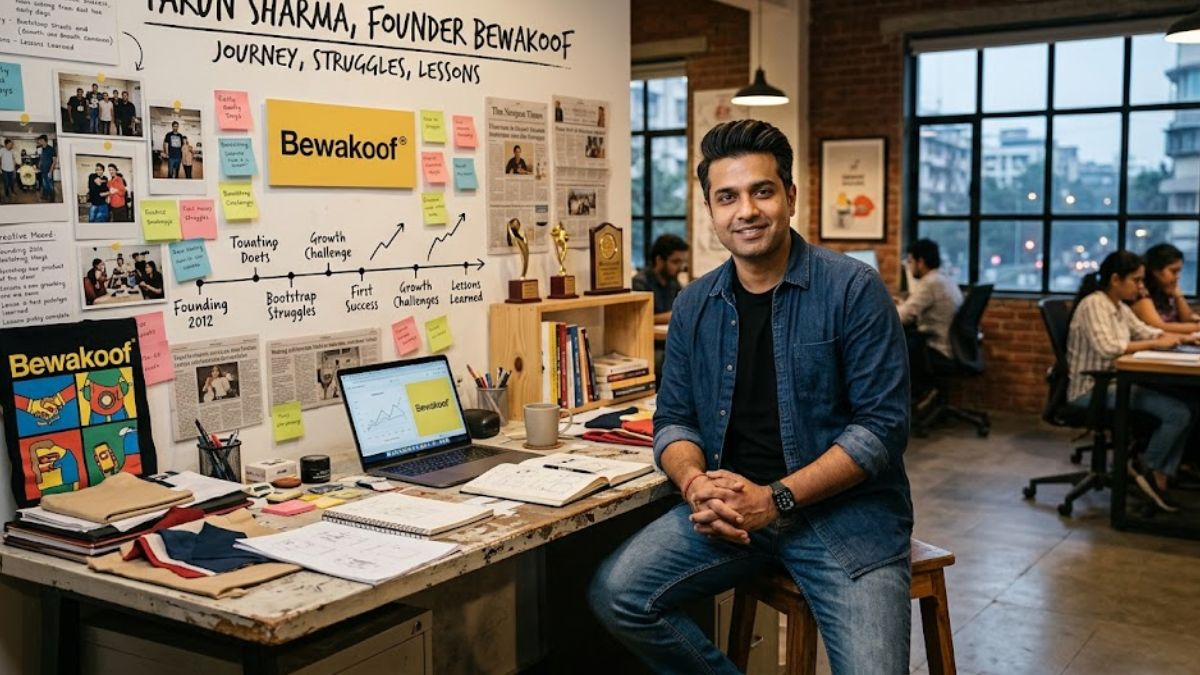
The story of Tarun Sharma, widely recognized as one of the key minds behind Bewakoof, is a reflection of how modern Indian startups are built on culture, relatability, and deep consumer understanding. As a co-founder of Bewakoof, Sharma played a critical role in shaping one of India’s most recognizable youth-focused fashion brands. Founded in 2012 and headquartered in Mumbai, Bewakoof emerged at a time when India’s online fashion ecosystem was still evolving. The brand focused on affordable, expressive apparel that connected with young consumers through humor and pop culture. While the founding team included multiple co-founders, Tarun Sharma’s role in building the brand, scaling operations, and navigating early-stage uncertainty has been central to its journey.
The “why” behind Bewakoof was rooted in a clear observation. Young Indians wanted clothing that felt personal and expressive, but most available options were either expensive or lacked originality. Sharma and his co-founders saw an opportunity to create a brand that was not just about fashion but about identity. The “how” was through a direct-to-consumer model, strong digital presence, and a relentless focus on design and customer engagement. Over time, Bewakoof evolved into a well-known D2C apparel startup, reaching millions of customers across India. This article explores the Tarun Sharma Bewakoof founder journey in depth, focusing on his background, struggles, decision-making, and the lessons that shaped one of India’s most relatable fashion startups.
2. Background and Early Life
2.1 Early Life and Education
Tarun Sharma’s early life followed a relatively conventional path compared to many startup founders. He pursued engineering, which provided him with a structured and analytical approach to problem-solving. Like many founders in the Indian startup ecosystem, his academic journey played an important role in shaping his thinking. However, it was not the classroom alone that defined his trajectory. Exposure to real-world challenges and early professional experiences contributed significantly to his entrepreneurial mindset.
2.2 Early Influences
Before entering the startup world, Sharma was exposed to the dynamics of business, technology, and consumer behavior through his work experiences. These early influences helped him understand how markets evolve and where gaps exist. They also gave him a sense of how digital platforms could transform traditional industries. This combination of technical grounding and business exposure laid the foundation for his future role in building an online fashion brand India.
3. Founder and Company Overview
The Tarun Sharma entrepreneur story is deeply intertwined with the growth of Bewakoof. Bewakoof was launched in 2012 as a digital-first fashion brand targeting young consumers. The company initially focused on graphic T-shirts and gradually expanded into a full-fledged apparel and lifestyle brand.
The target audience was clear from the beginning. The brand spoke to college students, young professionals, and digital-native consumers who valued self-expression. Over time, Bewakoof positioned itself as a youth-focused fashion brand that blended humor, relatability, and affordability. The company operates primarily as a D2C apparel startup, selling through its own website and app while also exploring marketplace channels. This positioning helped it stand out in the crowded e-commerce startup India landscape.
4. The Problem, Insight, and Trigger
The Tarun Sharma Bewakoof founder story begins with a simple but powerful observation. India’s fashion market was dominated by either premium global brands or generic local offerings. There was very little space for brands that truly connected with youth culture. Young consumers were increasingly influenced by social media, memes, and pop culture. However, their clothing options did not reflect this shift.
Sharma and his co-founders identified this gap. They realized that fashion could be more than just utility. It could be a medium of expression. The trigger came from understanding that digital platforms could amplify this idea. If the right product met the right audience, scale was possible.
5. Early Days and Initial Struggles
The early phase of the Bewakoof startup founder story was marked by experimentation and uncertainty. Like many first-time entrepreneurs, the founders had assumptions about customer behavior. Not all of these assumptions were correct.
One of the biggest challenges was building a brand from scratch. Without large marketing budgets, they had to rely on creativity and organic growth. Operational challenges also emerged. Managing inventory, ensuring quality, and handling logistics required constant attention. What seemed like a straightforward idea quickly turned into a complex execution challenge.
6. Failures, Setbacks, and Self-Doubt
The journey of Tarun Sharma was anything but smooth. From the outside, it might look like steady growth, but behind the scenes, there were phases that tested patience, confidence, and belief. There were moments when growth simply slowed down. Not because the team wasn’t working hard, but because the market was getting crowded. The D2C apparel space became intensely competitive, with new brands entering almost every month, each trying to grab attention in the same crowded digital space. Some product experiments didn’t land the way they were expected to. Designs that looked promising internally failed to connect with customers. Campaigns that seemed creative and well thought out didn’t deliver results. And when that happens repeatedly, it starts to affect how you think.
Self-doubt creeps in quietly. Questions start forming. Is the product strong enough? Is the brand actually scalable? Are we missing something obvious? These are not easy questions to sit with, especially when you’re responsible for a growing business and a team that believes in you. But what stands out is how those moments were handled. Instead of reacting emotionally, the team chose to learn. They went back to data, to customer feedback, to first principles. They refined designs, adjusted messaging, and became more disciplined in decision-making. Those tough phases didn’t break the company. They made it sharper, more aware, and more grounded in reality.
7. Validation and Early Traction
Every startup waits for that moment when things start to click. For Bewakoof, that moment came when customers didn’t just notice the brand, they connected with it. Early traction didn’t come from big budgets or aggressive expansion. It came from understanding the audience. The brand’s designs, tone, and personality felt relatable, especially to younger consumers who were looking for something different from traditional fashion labels. Social media played a huge role here. Engagement wasn’t just about likes, it was about conversations. People reacted, shared, and engaged in a way that felt organic. That’s when you know something is working.
But the real validation wasn’t in the first purchase. It was in the second and third. Repeat customers changed everything. They proved that this wasn’t just curiosity, it was preference. People were choosing the brand again, which is far harder to achieve. Word-of-mouth started kicking in naturally. Customers shared products with friends, recommended the brand, and became unofficial advocates. This kind of growth is powerful because it’s built on trust, not just marketing. That phase gave the team something invaluable, belief backed by evidence. Not just hope, but proof that the idea had real potential in the market.
8. Funding, Money, and Growth Constraints
Like most startups, Bewakoof didn’t start with unlimited resources. In the early days, every decision around money mattered. There was no room for waste. The team had to think carefully about where to spend and where to hold back. Whether it was marketing, inventory, or operations, every investment had to justify itself. This kind of constraint, while stressful, often builds discipline that stays with a company for years. As the business started gaining traction, external funding came into the picture. It helped accelerate growth, expand reach, and strengthen operations. But funding doesn’t remove pressure, it changes it. Now the expectations are higher, and the margin for error becomes smaller.
Growth itself became a balancing act. Move too fast, and operations start breaking, supply chains get messy, and customer experience suffers. Move too slow, and you risk losing relevance in a fast-moving market. Managing this tension requires clarity and patience. It’s not about chasing growth blindly, it’s about building something that can sustain it. Bewakoof’s journey reflects that constant push and pull between ambition and control.
9. Team Building and Leadership Evolution
No company scales without the right people, and building that team is rarely straightforward. In the early stages, hiring is often driven by urgency. You need people quickly, roles are not always clearly defined, and sometimes you make calls based on instinct. That can lead to mismatches, not because people aren’t capable, but because alignment isn’t there.
Over time, Tarun Sharma and his co-founders started refining how they approached hiring. Skills were important, but cultural fit and long-term alignment became even more critical. They began looking for people who not only understood the work but believed in what the brand was trying to build. Leadership also had to evolve. In the beginning, founders are involved in everything. Every decision, every detail. But as the company grows, that approach stops working. Delegation becomes necessary, not as a choice but as a survival strategy.
Letting go is not easy. Trusting others to take ownership takes time. But it’s a turning point in any founder’s journey. It allows the company to grow beyond the founders themselves. The story here isn’t just about building a brand, it’s about growing into the kind of leader the business needs at each stage. And that evolution, shaped by mistakes, learning, and experience, is what truly defines long-term success.ce, not just intention.
10. Growth, Scaling, and Operational Challenges
Scaling a brand like Bewakoof isn’t just about selling more t-shirts. It’s about managing complexity that quietly builds up with every step forward. In the early days, handling a few designs is manageable. But as categories expand, from casual wear to accessories and beyond, inventory becomes a serious challenge. You’re no longer guessing what might sell, you’re making high-stakes decisions on what will sell. Too much stock means dead inventory. Too little means missed opportunities and unhappy customers.
Demand forecasting becomes both an art and a science. Data helps, but consumer behavior, especially among younger audiences, can shift overnight. What’s trending today might feel outdated next week. Staying relevant requires constant attention, not just to numbers, but to culture. One thing Bewakoof got right was its brand voice. Even as it scaled, it didn’t lose its personality. The humor, relatability, and slightly rebellious tone stayed intact. That consistency built trust. Customers didn’t feel like the brand was changing as it grew, which is rare.
Growth was heavily driven through digital channels. Social media wasn’t just a marketing tool, it was the brand’s playground. It’s where conversations happened, where trends were spotted early, and where the brand stayed connected to its audience in real time. Behind all of this, operations had to keep evolving. Supply chains needed to become faster, logistics more reliable, and processes more structured. These aren’t glamorous parts of the business, but they’re what keep everything running when scale kicks in.
11. Personal Sacrifices and Burnout
The story of Tarun Sharma isn’t just about building a company, it’s also about what it takes on a personal level. Startups demand more than time. They demand attention, energy, and emotional investment. Long hours become normal. Weekends blur into weekdays. There’s always something that needs fixing, improving, or deciding. And over time, that pressure builds up. There are phases where it becomes overwhelming. Not because something is going wrong, but because everything depends on you. Every decision carries weight. Every mistake feels personal.
Burnout is not a dramatic moment, it’s gradual. It shows up as exhaustion, as lack of clarity, as the feeling of constantly running without slowing down. Managing that becomes just as important as managing the business itself. Like many founders, Sharma had to find ways to push through these phases while still showing up for the team and the company. That’s the part people don’t always see. The quiet resilience, the ability to keep going even when you’re mentally drained. This side of entrepreneurship is rarely talked about openly, but it’s real. And it’s often what shapes leaders the most.
12. Lessons, Beliefs, and Values
If you look at the journey closely, a few clear lessons stand out. Not the kind you read in books, but the kind you learn the hard way. Persistence is one of them. Building a brand doesn’t happen quickly. There are slow phases, setbacks, and moments where progress feels invisible. The ability to stay consistent during those times is what separates those who last from those who fade out. Understanding the customer deeply is another. Trends will keep changing, especially in fashion. But if you truly understand your audience, what they like, how they think, what they relate to, you can adapt without losing direction.
Over time, Tarun Sharma’s approach also evolved. Flexibility became important. The willingness to change strategies, rethink assumptions, and accept when something isn’t working. That kind of adaptability is what keeps a company relevant. At the same time, some values stayed constant. Authenticity in how the brand communicates. A strong focus on customers, not just as buyers but as a community. And operational discipline, because without it, growth can quickly turn into chaos. These values act like anchors. They keep the company steady, even when everything around it is changing.
13. Present Challenges and Future Vision
Even today, the journey is far from over. If anything, the challenges are becoming more complex. The online fashion space in India is evolving at a rapid pace. New brands are entering constantly, each trying to stand out with pricing, design, or marketing. The competition is no longer just about products, it’s about experience. Customers now expect more. Personalization, faster delivery, better quality, and a seamless shopping experience. Technology is playing a bigger role than ever in meeting these expectations.
For Bewakoof, the focus going forward is clear. Strengthen what already works, its brand identity, its connection with the audience, and its distinct voice. At the same time, expand thoughtfully into new categories without diluting what made it special in the first place. The vision isn’t just growth for the sake of numbers. It’s about building something that lasts. A brand that stays relevant, adapts with time, and continues to resonate with new generations of customers. And as Tarun Sharma continues this journey, the story keeps evolving, shaped by new challenges, new learnings, and the same relentless drive to build something meaningful.allenges and opportunities emerge.
14. Future Outlook: The Next Chapter of Tarun Sharma Bewakoof Founder
The future of the Tarun Sharma Bewakoof founder journey reflects broader trends in India’s consumer market. As D2C brands gain traction, the focus will shift toward differentiation and customer loyalty. Bewakoof’s ability to stay relevant to youth culture will be critical. Innovation in design and engagement will play a key role. The company’s journey offers valuable lessons for anyone looking to build a brand in the digital age. The Tarun Sharma Bewakoof founder story is not just about scaling a business but about understanding culture, adapting to change, and building something that resonates deeply with people.
About foundlanes.com
foundlanes.com is a platform that documents, analyzes, and publishes in-depth startup case studies, founder journeys, and business insights across India’s startup ecosystem. It focuses on delivering research-driven, editorial-quality content that helps readers understand how real businesses are built and scaled.