


Summary
The story of Tushar Vashisht HealthifyMe founder is closely tied to the evolution of India’s digital health ecosystem. Over the past decade, the rise of smartphones, wearable devices, and growing awareness around fitness created the perfect environment for health technology startups. Among the companies that rode this wave successfully is HealthifyMe, a platform that blended artificial intelligence, human coaching, and data-driven nutrition guidance.
Tushar Vashisht co-founded HealthifyMe in 2012 in Bengaluru with a clear mission: make health and fitness accessible to millions of Indians through technology. At the time, India lacked localized digital health solutions. Global apps existed, but they did not understand Indian food habits, cultural lifestyles, or regional dietary patterns. Vashisht and his co-founders saw this gap and built a product that could track Indian meals, offer personalized diet advice, and provide digital coaching.
Before becoming the Tushar Vashisht founder of HealthifyMe, he worked at consulting firm McKinsey & Company and later spent time with healthcare organizations. These experiences helped him understand the scale of lifestyle diseases in India. Rising obesity, diabetes, and heart-related problems were becoming national concerns. HealthifyMe emerged as a fitness and nutrition app designed specifically for Indian users. Over time, it evolved into a powerful AI fitness platform powered by artificial intelligence coach Ria, wearable integrations, and personalized coaching programs.
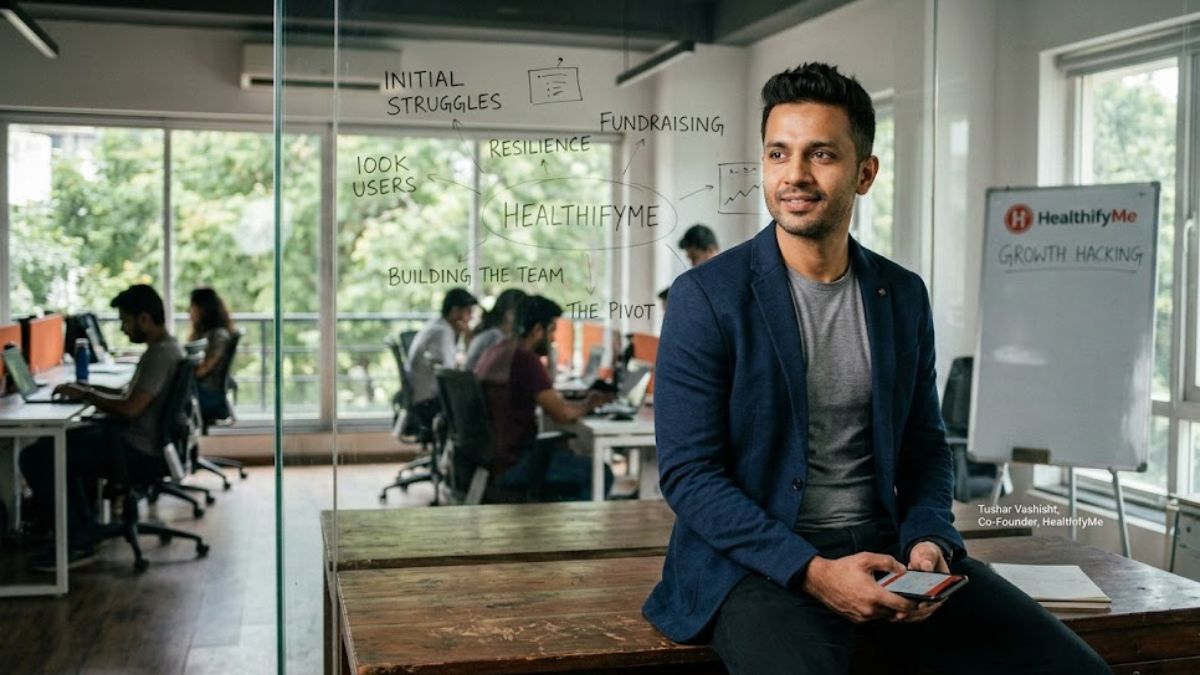
The Tushar Vashisht startup journey reflects the classic path of a modern Indian startup founder. There were early struggles around product-market fit, funding challenges, and the difficulty of building a scalable digital health business in a market that was still discovering preventive healthcare. Yet through persistence, HealthifyMe grew into one of India’s most recognized healthtech startup success stories. The company expanded globally, raised significant venture capital, and built a strong user base across multiple countries. This founder story explores the full journey of Tushar Vashisht from his early life and education to building one of India’s leading digital health platforms.
1. Background and Early Life
1.1 Early Life and Family Background
The story behind the Tushar Vashisht HealthifyMe founder begins long before the startup itself. Like many Indian entrepreneurs who eventually build technology companies, his early years were shaped by curiosity, education, and exposure to complex problem-solving environments. Tushar Vashisht grew up in India in a family that valued education and intellectual discipline. His upbringing encouraged analytical thinking and exposure to real-world challenges. These early influences would later shape his ability to approach large-scale problems with a systematic mindset.
Health and lifestyle issues were already becoming more visible in India during the 1990s and early 2000s. Rapid urbanization, sedentary jobs, and fast-changing food habits were quietly transforming public health patterns. Although these societal shifts were not yet mainstream topics, they would eventually become central to the HealthifyMe founder story.
1.2 Education and Early Influences
Tushar Vashisht studied engineering at the Indian Institute of Technology Delhi (IIT Delhi), one of India’s most prestigious institutions. The rigorous academic environment exposed him to analytical thinking, technology innovation, and entrepreneurial ambition. IIT Delhi has historically produced many Indian startup founders and technology leaders. The ecosystem encouraged experimentation and problem-solving, qualities that later became critical in building a startup.
During his academic years, Vashisht developed a strong interest in data-driven thinking. Engineering education trained him to analyze systems, identify inefficiencies, and design scalable solutions. After completing his degree, he pursued further education in management and business strategy. These academic experiences helped him build a broader perspective on technology, economics, and entrepreneurship. Education alone did not define his path. Exposure to global business practices also played a significant role in shaping the Tushar Vashisht entrepreneur story.
2. Founder and Company Overview
2.1 Introduction to the Founder
Before becoming the Tushar Vashisht founder of HealthifyMe, he worked as a consultant at McKinsey & Company. Consulting roles often expose professionals to complex organizational challenges across industries. At McKinsey, Vashisht worked on projects involving healthcare systems, policy frameworks, and large-scale data analysis. These experiences helped him understand how technology could be used to address structural healthcare problems. During this time, he observed a major trend emerging in India. Lifestyle diseases were rising rapidly, but preventive healthcare solutions were limited. The insight would later become the foundation of his startup.
2.2 Company Overview and Offerings
HealthifyMe launched in 2012 as a healthtech startup India focused on digital fitness and nutrition coaching. The platform started as a simple calorie tracking and fitness monitoring app designed for Indian users. Over time, it expanded into a comprehensive digital health platform India offering multiple features. The platform provides diet tracking tools, personalized coaching, workout programs, and data analytics based on user behavior. It also integrates wearable fitness devices and health tracking systems.
A defining feature of the platform is its AI-powered coach called Ria. The assistant helps users track meals, monitor progress, and receive personalized recommendations. This combination of technology and human coaching helped the company stand out among other fitness app startups.
2.3 Target Audience and Market Served
HealthifyMe initially targeted urban professionals in India who wanted to improve their health but lacked guidance. Busy work schedules, poor eating habits, and lack of access to nutrition experts created a large opportunity. Over time the platform expanded its audience.
Users now include individuals managing weight loss, athletes seeking fitness optimization, and people monitoring chronic conditions such as diabetes. The broader market includes anyone seeking personalized health management through digital tools. This positioning helped HealthifyMe become a major player in the digital healthcare innovation landscape.
2.4 Year of Founding and Business Stage
HealthifyMe was officially founded in 2012 in Bengaluru. The founding team included Tushar Vashisht along with co-founders Sachin Shenoy and Mathew Cherian. Together they combined expertise in technology, data science, and product design. In its early years, the company operated as a startup experimenting with product features and business models. Today it operates as a global AI fitness platform, serving millions of users across several countries.
3. The Problem, Insight, and Trigger
3.1 Core Problem Identified
India has witnessed a dramatic rise in lifestyle diseases over the past two decades. Conditions such as obesity, diabetes, and hypertension are now common among urban populations. Despite this trend, access to personalized health guidance remained limited. Traditional healthcare systems focused primarily on treatment rather than prevention. Nutrition advice was often generic and lacked personalization. This gap represented a major opportunity for digital health platform India startups. The Tushar Vashisht HealthifyMe founder journey began with recognizing this gap.
3.2 Personal Insight Behind the Idea
While working in consulting, Vashisht analyzed healthcare data and policy trends. He observed that millions of Indians lacked access to affordable nutrition and fitness guidance. At the same time, smartphone usage in India was rising rapidly. This convergence of two trends growing health concerns and increasing mobile adoption created the foundation for a technology solution. The insight was simple but powerful. A mobile app could become a personal health companion for millions of people.
3.3 Trigger Moment to Start
The real trigger came when the founding team began exploring how food tracking apps worked internationally. Many global platforms existed, but they did not understand Indian food. Indian meals involve complex combinations of spices, oils, and regional ingredients. Western calorie trackers could not accurately capture these dietary patterns. This realization sparked the idea behind HealthifyMe. The platform would build a database specifically for Indian food and provide culturally relevant diet recommendations. This insight turned into the core vision of the startup.
4. Early Days and Initial Struggles
4.1 Early Assumptions and Naivety
Like many tech startup founders India, the HealthifyMe team began with optimistic assumptions. They believed building a useful product would naturally attract users. However, the digital health industry proved more complex than expected. Convincing users to track their diet daily required behavioral change. Building such habits was far harder than simply launching an app. Early product iterations had to evolve significantly.
4.2 Entrepreneurial Initial Struggles
The early startup phase involved long hours and limited resources. Building the first version of the HealthifyMe app India required collecting detailed nutritional data for thousands of Indian dishes. This process was labor intensive. The team had to work with nutritionists, researchers, and dieticians to build a reliable database. At the same time they needed to design an app interface that was easy for everyday users. Balancing accuracy and simplicity became a major challenge.
4.3 What Turned Out Harder Than Expected
User engagement emerged as the biggest difficulty. Downloading a fitness app is easy. Continuing to use it daily requires motivation. The team experimented with multiple engagement strategies including reminders, personalized coaching, and goal tracking. These experiments eventually helped refine the product experience.
5. Failures, Setbacks, and the Quiet Weight of Self-Doubt
Every founder story that eventually becomes inspirational usually hides a difficult truth. The journey rarely feels inspiring while it is actually happening. For Tushar Vashisht, building HealthifyMe was not a straight climb upward. The early years were filled with experiments that did not work, ideas that looked promising but failed in the real world, and long periods where progress felt frustratingly slow. When the team first started building the platform, they were trying to solve a complicated problem. Fitness is not just about workouts or calorie tracking. It is deeply connected to habits, culture, food preferences, motivation, and daily routines. And in India, those factors are incredibly diverse.
What works for a fitness enthusiast in Bangalore might not work for someone in Delhi or Pune. Diet habits differ. Work schedules differ. Even the understanding of nutrition differs widely. The team initially experimented with several product features that seemed exciting during development. Some were designed to simplify calorie tracking. Others focused on building social motivation among users. But once those features went live, reality was different. Users did not always behave the way the product team expected. Some features that the engineers were proud of barely got used. Others created confusion rather than clarity. Certain engagement tools simply failed to motivate people to maintain healthy habits.
This is a common but painful phase in startup building. Founders spend months designing a feature, testing it internally, and imagining how users will respond. Then the product launches, and the response is silence. For a founder, that silence can be unsettling. There were also bigger strategic questions that the team had to confront. A digital health platform sounds promising, but turning that idea into a sustainable business is far more complicated. Health and wellness apps face a difficult challenge. Users expect guidance and results, but they are often reluctant to pay for something that feels intangible.
This created an ongoing tension within the business model. How do you price a subscription in a way that feels fair to users while still supporting the costs of coaches, technology, and platform development? These questions were not solved overnight. Like many startup founders, Vashisht experienced moments when doubt quietly crept in. Was the original idea strong enough? Were people truly willing to change their habits through a digital platform? Could a mobile app realistically guide someone through something as personal as health and fitness? Those moments of uncertainty are rarely discussed publicly, but they are a natural part of building something new. What mattered was how the team responded.
Instead of abandoning the vision, they treated every setback as data. Each failed feature revealed something about user behavior. Each weak growth period forced the team to rethink assumptions. Over time, those lessons slowly began shaping a stronger product.
6. Validation and the First Signs of Real Traction
In the early life of a startup, validation rarely arrives as a dramatic moment. It often appears quietly, through small signals that gradually build confidence. For HealthifyMe, those signals began appearing through the voices of its users. People started sharing personal stories about how the platform had helped them understand their health better. Some users reported losing weight for the first time in years. Others spoke about finally understanding the nutritional value of everyday Indian meals.
That last point turned out to be particularly important. Many global fitness apps were built around Western diets. Their food databases included salads, protein bowls, and meals that did not always reflect what people actually eat in Indian households. HealthifyMe approached the problem differently. The platform focused heavily on Indian foods. Dal, roti, dosa, biryani, idli, sabzi. Meals that people grew up eating. For users, this small detail made a huge difference.
Instead of forcing people to abandon their cultural food habits, the platform helped them understand how to balance those meals in a healthier way. As users started seeing results, they began sharing their experiences with friends and family. Word of mouth became one of the strongest growth drivers. Someone would lose weight, talk about the app in their office, and suddenly a few more colleagues would try it. A user might recommend it to a sibling struggling with fitness goals. These organic conversations helped the platform reach new audiences without massive marketing budgets.
At the same time, the startup began attracting attention from investors who were watching the health technology space closely. Digital health was becoming an increasingly important sector. Rising lifestyle diseases, growing smartphone adoption, and increasing awareness about wellness were creating new opportunities for technology-driven solutions. HealthifyMe’s early traction signaled that the problem it was solving was not theoretical. It was real. And people were willing to engage with the solution.
7. Funding, Financial Pressure, and the Reality of Scaling
Building a technology product is expensive. But scaling that product into a large platform requires an entirely different level of resources. As the user base of HealthifyMe started growing, the team faced a familiar challenge that almost every startup eventually encounters. Growth requires money. The platform needed stronger infrastructure to handle rising user activity. Engineers had to be hired to improve the app experience. Data scientists were needed to build smarter nutrition insights. Marketing efforts had to expand to reach more people across India.
All of this required capital. Over time, HealthifyMe secured investment from several venture capital firms, including IDG Ventures and Inventus Capital Partners. These investments provided the company with the resources to accelerate its growth. Funding allowed the team to expand its engineering capabilities, refine its product features, and explore new innovations in health technology. But funding also introduces a different kind of pressure.
When investors enter the picture, expectations grow. Growth targets become more ambitious. Strategic decisions carry greater consequences. For founders, this stage often becomes a balancing act. On one side lies the need to scale quickly and capture market opportunities. On the other lies the responsibility to manage resources carefully and build a sustainable business. HealthifyMe’s leadership had to navigate that tension carefully. Spending aggressively might drive short-term growth but create financial instability. Moving too cautiously could slow momentum in a rapidly evolving industry. This constant balancing act became part of the company’s operational reality. Yet through these challenges, one principle remained consistent.
The team continued focusing on the same mission that had started the journey in the first place: helping people live healthier lives through accessible technology. That clarity of purpose often becomes the anchor that helps startups survive difficult phases. Because in the end, the strongest companies are not built only on technology or funding. They are built on persistence, learning, and the willingness to keep moving forward even when the path ahead feels uncertain.
8. Team Building and the Evolution of Leadership
In the earliest days of a startup, the founder is everywhere. They sit with engineers debating product features. They jump into marketing discussions. Talk to early users personally. They even handle operational problems that most people would never associate with a founder’s role. For Tushar Vashisht, the early days of building HealthifyMe looked exactly like that.
He was deeply involved in almost every decision the company made. Product design, user experience, partnerships, hiring, strategy. When a startup is small, that level of involvement is not just natural, it is necessary. The founder’s energy often becomes the glue that holds everything together. But something interesting happens as a startup begins to grow. The very qualities that helped build the company in the beginning can start becoming a bottleneck later.
When a team grows from a handful of people to dozens and eventually hundreds, one person simply cannot make every decision anymore. The founder must evolve from being the “doer” to becoming the person who shapes the vision. For many entrepreneurs, that transition is surprisingly difficult. Letting go of control does not come easily. Founders often feel personally responsible for the product they built. Delegating important decisions can feel uncomfortable, even risky. But scaling a company requires trust.
As HealthifyMe expanded, Vashisht had to gradually shift his focus away from daily execution and toward something bigger: building a strong leadership culture within the organization. That meant hiring people who were better than him in specific domains. Experienced engineers who could design complex systems. Product leaders who understood user behavior deeply. Nutrition experts who could guide the platform’s health science. This phase is where many startups either accelerate or struggle.
If founders fail to build strong teams, growth eventually slows. But when the right people come together, the company begins to operate like a coordinated system rather than a small group fighting fires every day. Leadership also becomes less about giving instructions and more about creating alignment.
A founder must constantly answer questions like:
- What is the long-term vision for the company?
- What kind of culture do we want to build?
- How do we make sure every team understands the mission?
For Vashisht, this stage marked a shift from building a product to building an organization capable of building many products over time. And that is a major milestone in any founder’s journey.
9. Growth, Scaling, and the Complex Reality of Operations
Once a startup proves that its idea works, the next challenge begins: scaling it. Growth sounds exciting from the outside. More users, more visibility, more revenue. But inside the company, scaling often introduces a new layer of complexity. For a platform like HealthifyMe, scaling meant supporting millions of people trying to improve their health at the same time. Health and fitness are deeply personal journeys. No two users have identical needs. Some want to lose weight. Others want to gain muscle. Some are managing diabetes. Others are simply trying to maintain a healthier lifestyle.
Providing meaningful guidance to such a diverse user base required constant innovation. The team began investing heavily in technology that could personalize health recommendations at scale. This led to the development of one of the platform’s most important innovations: an AI-powered health coach called Ria.
Ria represented a major leap forward in how digital health platforms could support users.
Instead of relying solely on human coaches, the system could analyze user behavior, dietary patterns, activity levels, and health goals. Based on that data, it could provide tailored advice instantly.
Imagine a user logging their breakfast and immediately receiving feedback on how the meal fits into their daily calorie goals. Or a person trying to manage their weight receiving gentle reminders and suggestions throughout the day. That kind of real-time guidance would be nearly impossible to deliver manually to millions of users. Artificial intelligence made it scalable. The introduction of Ria also signaled something bigger about the company’s direction. HealthifyMe was no longer just a calorie-counting app. It was evolving into a technology platform where AI, data science, and behavioral psychology worked together to guide healthier lifestyles. At the same time, the team expanded the platform’s capabilities through integrations with wearable devices.
Fitness trackers and smartwatches allowed users to automatically sync their activity data with the app. Steps, workouts, heart rate patterns. All of this information helped the system build a more accurate picture of a person’s health habits. These innovations strengthened the platform’s position in the growing digital health ecosystem. But building and maintaining such systems requires enormous operational effort behind the scenes. Engineers continuously improve algorithms. Nutrition experts refine food databases. Customer support teams help users navigate challenges in their health journeys. Scaling a health platform is not just about acquiring users. It is about maintaining trust with every single person who depends on the platform for guidance.
10. Personal Sacrifices and the Hidden Weight of Entrepreneurship
Behind every startup success story lies a quieter, more personal story that rarely gets enough attention. The human cost of building something from scratch. For Tushar Vashisht, the journey of building HealthifyMe demanded far more than business strategy or technical knowledge. It demanded years of relentless focus. Startups do not operate on predictable schedules. There are product launches to prepare for, investor meetings to attend, hiring decisions to make, and crises that appear without warning. Days often stretch into nights. Weekends blur into workdays.
Many founders describe a strange paradox during this period. They are building something meaningful and exciting, yet their personal lives slowly shrink as the company consumes most of their attention. The pressure can be intense. Investors expect growth. Employees depend on leadership decisions. Users rely on the product to solve real problems. Carrying those responsibilities simultaneously can be emotionally exhausting.
Burnout is not uncommon in the startup world. Founders sometimes push themselves beyond healthy limits because they feel personally responsible for the company’s success. There are moments when the excitement of entrepreneurship collides with fatigue. Moments when the questions become difficult. Is the effort worth it? Will the company succeed? How long can this pace continue?
Yet what keeps many founders going is a sense of purpose. For Vashisht, the mission of helping people improve their health provided that motivation. When users shared stories about weight loss, improved fitness, or better lifestyle habits, it reminded the team why the company existed in the first place. Those moments matter more than any growth metric. Because at the heart of every successful startup lies something deeply human: the belief that the work being done is making someone’s life a little better. And for founders, that belief often becomes the strength that carries them through the hardest phases of the journey. 💡
11. Lessons, Beliefs, and the Values That Shaped the Journey
Every long entrepreneurial journey leaves behind lessons that cannot be learned in classrooms or business books. They come from years of experimentation, difficult decisions, unexpected failures, and moments when persistence becomes the only option. For Tushar Vashisht, the journey of building HealthifyMe gradually shaped a set of beliefs that define how he thinks about startups, technology, and long-term impact.
One of the most important lessons revolves around solving real problems. In the startup world, trends change quickly. One year the focus might be on social media platforms. The next year everyone might be chasing blockchain, artificial intelligence, or some new digital wave. It is easy for founders to get distracted by what appears fashionable in the technology ecosystem.
But HealthifyMe’s growth did not come from chasing trends. It came from focusing on a problem that millions of people quietly struggle with every day: maintaining a healthy lifestyle in the middle of busy, modern lives. Across India and many other countries, lifestyle diseases such as obesity, diabetes, and heart conditions have been rising steadily. People want to take control of their health, but they often lack clear guidance. Diet advice can be confusing. Fitness routines can feel overwhelming. And traditional healthcare systems tend to focus more on treatment than prevention.
HealthifyMe stepped into that gap. By combining nutrition tracking, fitness guidance, and behavioral insights, the platform helped people understand their habits in a way that felt practical rather than intimidating. The product did not promise miracles. Instead, it focused on small, consistent improvements that users could integrate into their daily routines. That approach reinforced a powerful entrepreneurial lesson. Startups become meaningful when they address real, persistent problems. When a product genuinely improves people’s lives, growth tends to follow naturally.
Another belief that shaped the company’s evolution is the power of data-driven decision making. From the beginning, the platform collected insights about how users interacted with their health routines. What foods were most commonly logged? When did people tend to skip workouts? What types of reminders actually motivated users to stay consistent? These behavioral signals became incredibly valuable. Instead of relying purely on assumptions, the team could analyze real user patterns and refine the platform accordingly. Features that helped users stay engaged were strengthened. Features that created confusion were redesigned or removed. Over time, this constant feedback loop helped HealthifyMe become smarter and more personalized. Data was not treated as an abstract metric. It became a tool for understanding human behavior.
Perhaps the most important belief that emerged from this journey, however, was the value of long-term thinking. Technology startups often operate in an environment obsessed with speed. Rapid growth, rapid funding, rapid expansion. But building something truly impactful rarely happens overnight. Platforms that aim to influence people’s health, habits, or lifestyles require patience. Behavior change does not happen instantly. For Vashisht, this meant focusing less on short-term hype and more on building a system that could improve continuously over time. That mindset required resilience. There were moments when growth slowed. Moments when product decisions had to be reconsidered. Moments when competitors entered the market with aggressive strategies. But long-term thinking allowed the team to stay focused on the broader mission rather than reacting to every temporary shift in the industry. And over time, that patience helped the company evolve into a much stronger platform.
12. Present Challenges and the Vision for the Future
Today, HealthifyMe has grown far beyond its early startup phase. What began as a simple idea about improving fitness awareness has gradually developed into a global digital health platform serving millions of users across multiple countries. Yet for Tushar Vashisht, the journey still feels unfinished. If anything, the scale of the challenge has only become clearer over the years. Modern lifestyles are changing rapidly. People spend longer hours sitting at desks, consume more processed foods, and face increasing stress from work and daily responsibilities. These changes have contributed to a growing global health crisis centered around preventable lifestyle diseases.
Traditional healthcare systems often intervene only after problems become serious. The long-term vision behind HealthifyMe is different. The company aims to strengthen preventive healthcare, helping individuals understand and improve their habits before serious health issues develop. Technology plays a critical role in this vision. In the coming years, the platform is expected to deepen its focus on artificial intelligence, advanced analytics, and personalized wellness programs.
AI systems will likely become even more sophisticated in analyzing health data. Instead of offering general advice, the platform could provide deeply customized insights based on an individual’s diet patterns, activity levels, sleep cycles, and metabolic indicators. The goal is to create a digital health companion that understands each user’s lifestyle and offers guidance tailored specifically to them. Another important area of development involves integrating broader health data sources. Wearable devices, fitness trackers, and health monitoring tools are becoming increasingly common. These devices generate valuable information about heart rate, physical activity, sleep patterns, and recovery cycles.
By integrating this data more deeply into the platform, HealthifyMe could build a much richer understanding of each user’s health profile. That level of personalization has the potential to transform how people manage their well-being. Instead of reacting to health problems after they arise, individuals could receive early signals about habits that need adjustment. In many ways, this represents a shift in how healthcare itself is delivered. It moves from reactive treatment toward proactive lifestyle management. For Vashisht, this mission remains deeply personal. The goal has never been simply to build another successful technology company. The larger ambition is to create a platform that helps millions of people make healthier choices every day. That vision continues to guide the company’s direction. And in many ways, the story of Tushar Vashisht is still unfolding.
Because the most meaningful entrepreneurial journeys are not defined by a single milestone or funding round. They are defined by a long-term commitment to solving problems that genuinely matter. For HealthifyMe, that problem is clear. Helping people live healthier, more balanced lives in a world where maintaining those habits has never been more challenging.building a startup. It is about reshaping how millions of people approach fitness and nutrition.
About foundlanes.com
foundlanes.com is India’s leading startup idea discovery platform. It helps entrepreneurs find actionable startup opportunities, market insights, and industry-specific guidance to turn ideas into real businesses. With deep research and practical resources, foundlanes supports founders at every stage, from idea validation to launch and growth.