


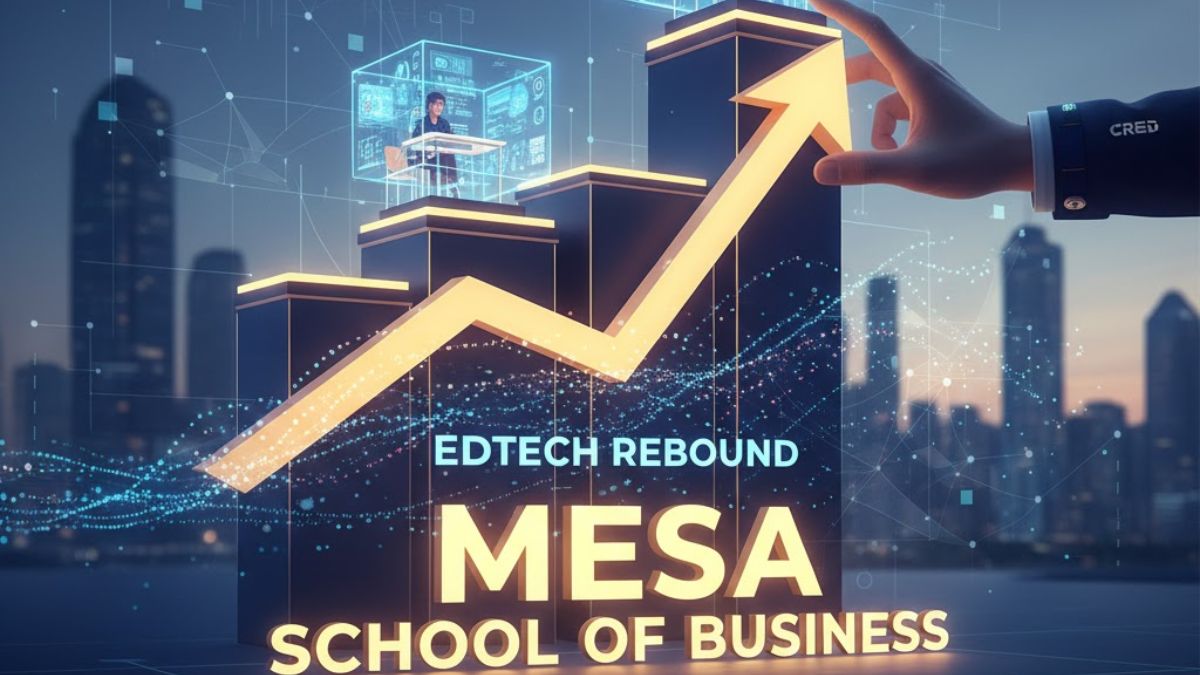
News Summary
The Indian edtech sector is entering a fresh phase of revival, and the launch of Mesa School of Business Raises a clear signal of that momentum. The Bengaluru-based institution recently secured INR 34 crore (about $4.2 million) in its latest funding round, drawing the confidence of prominent investors including CRED founder Kunal Shah, Elevation Capital, and several others. Their backing reflects a growing belief that India needs a new generation of business leaders shaped by real startup experiences instead of classroom theory alone.
Mesa School is positioning itself as a startup-first B-school with a 12-month, full-time postgraduate program in Startup Leadership. What makes this model different is that the curriculum is co-built with founders, operators, and investors who understand what it takes to build a company in India’s fast-moving market. The program prioritizes exposure, mentorship, and real problem-solving rather than traditional case studies.
This funding round arrives at a time when investor confidence in edtech is gradually stabilizing after years of turbulence. Analysts point out that upskilling, reskilling, and entrepreneurship-focused institutions are drawing new interest because they respond directly to the talent gaps that startups have struggled with for years. Mesa School aims to fill that gap by blending academic rigor with lived startup reality, giving students not just knowledge but the guidance, scars, and wisdom that come with building something from scratch.
1. Introduction
India’s edtech landscape is shifting, and the Mesa School of Business reflects the sector’s renewed sense of purpose. The Mesa School of Business Raises expectations by offering a B-school experience built specifically for the startup generation—people who dream of creating companies, leading teams, and navigating the unpredictable world of entrepreneurship. Its arrival in Bengaluru, the country’s startup capital, feels almost symbolic. The city has shaped founders for more than a decade, and now Mesa aims to shape the leaders who will define the decade ahead.
Investors like Kunal Shah and Elevation Capital aren’t just funding another educational institution; they’re backing a belief that India’s founders deserve a place where leadership is taught not as theory but as a craft. Their involvement signals a conviction that the next wave of successful startups will be built by individuals who understand markets, people, and execution at a much deeper, more personal level than most traditional programs ever attempt to teach.
2. About Mesa School of Business
2.1 Founding and Mission
Mesa School was created with a simple but bold mission: build a generation of leaders who think like founders from day one. The idea took shape after years of observing the same problem—many young professionals had talent and ambition but lacked the lived experience needed to navigate the high-pressure environment of early-stage companies.
The 12-month postgraduate program in Startup Leadership is built around experiential learning. Students work with real founders, sit inside real strategy rooms, and solve active challenges that startups face every day. Industry leaders help design the curriculum, ensuring it evolves with the changing dynamics of markets, technology, and customer behavior. At its core, Mesa’s mission is about giving students a place where theory meets action, and where leadership is learned through doing rather than memorizing.
2.2 Working Model and Revenue Strategy
Mesa operates on a hybrid model that blends academic programs with industry partnerships. Its primary revenue comes from tuition fees for the postgraduate course, but the school also runs customized executive programs tailored for startup teams looking to sharpen their skills. These programs often focus on leadership development, scaling operations, and building resilient teams.
Partnerships with startups create additional revenue streams. Companies collaborate with Mesa on mentorship initiatives, structured problem-solving labs, and short-term consulting engagements run by students under faculty supervision. This not only offers the school financial stability but also ensures that students gain exposure to real operational challenges, not hypothetical scenarios. For many of them, these projects become turning points—moments where they learn what it actually feels like to tackle product, growth, fundraising, or people issues under pressure.
2.3 Services and Programs
Mesa’s program is built around the realities of the startup world. Students dive into modules on strategy, product development, fundraising, operations, and leadership, but the real learning often happens outside the classroom. Pitch sessions mimic the intensity of investor meetings. Live projects expose students to messy, real-time problem-solving. Mentoring circles with seasoned founders create the kind of honest, vulnerable conversations that rarely happen in traditional B-schools.
What sets Mesa apart is its commitment to hands-on learning. The school acknowledges that leadership can’t be memorized; it has to be lived. Students leave with more than a certificate—they leave with confidence, resilience, and a sense of what it means to build something meaningful in a world where nothing is guaranteed.
3. Funding and Investor Support
3.1 Funding Round Highlights
Mesa School of Business closed its recent funding round with INR 34 crore, backed by Elevation Capital, Kunal Shah, and a select group of seasoned angel investors. For the founders, this wasn’t just capital; it was validation. It reflected confidence in their belief that business education must adapt to an era where startups move faster than most classrooms can keep up.
The investment will fuel several core expansions. Infrastructure development is one of the biggest priorities as the school builds an environment where students can collaborate, prototype, debate, and learn from visiting founders. Faculty recruitment comes next, as Mesa is assembling a roster of educators who have lived the founder journey themselves, people who can teach not from slides but from scars and victories.
Technology-enabled learning platforms are another significant focus. The team wants to ensure that students don’t just hear about startup tools—they use them daily. Mesa is also in early conversations with institutions abroad, exploring global collaborations that could give students a broader perspective, access to international mentors, and a deeper understanding of markets outside India. For a school built on the belief that leadership is borderless, this global exposure could shape the next generation of startup builders.
3.2 Role of Kunal Shah
Kunal Shah’s involvement is more than a headline. His backing brings credibility and a sense of direction rooted in firsthand startup experience. Shah has long believed that India needs leaders who understand how to build from zero, who aren’t afraid of failure, and who know when to rely on intuition over instruction. His guidance helps ensure that the curriculum reflects the messy, unpredictable world founders operate in.
With Shah’s network, Mesa’s students gain access to venture capitalists, accelerators, and founder communities that would otherwise take years to break into. He encourages students to think beyond safe career choices and pushes them to question the assumptions many business programs never challenge. For students, interactions with him serve as a reminder that entrepreneurship is not glamorous—it is demanding, humbling, and deeply human.
4. The Problem Mesa Aims to Solve
4.1 Gap in Traditional Business Education
Traditional business schools often teach management as a structured discipline with predictable outcomes. But anyone who has worked in a startup knows that reality rarely matches formulas. Founders juggle uncertainty, tight timelines, incomplete data, and pressures that case studies cannot capture.
Mesa was created to fill that gap. The program immerses students in real startup environments where theory quickly meets reality. Through mentorship from operators who’ve built and broken companies, students learn not just what works, but why it works—and what to do when it doesn’t. Mesa reframes business education as something alive, something shaped by people rather than presentations.
4.2 Upskilling and Reskilling Needs
India’s startup ecosystem is expanding rapidly, but the shortage of experienced leadership is becoming increasingly clear. Many young professionals are smart and ambitious, but they lack exposure to the unstructured, high-intensity nature of building a company. Startups need leaders who can solve problems in real time, manage chaos, and still keep teams inspired.
Mesa focuses on developing exactly that talent. Students learn how to manage uncertainty and scale products, but they also learn the human side of leadership—how to make decisions under pressure, how to navigate team conflicts, and how to bounce back when things break unexpectedly. These skills prepare them not just to lead startups, but to bring entrepreneurial thinking into any organization they join.
5. Industry Context and Growth Trends
India’s edtech sector has seen more than $2.6 billion in investments between 2014 and Q1 2023, much of it flowing into upskilling, reskilling, and higher education initiatives. After a period of volatility, the market is stabilizing, and investors are showing renewed interest—especially in focused programs that address real industry needs instead of offering generic degrees.
Analysts believe niche, high-impact programs will define the next wave of edtech growth. As startups evolve into mainstream employers, the demand for leadership talent that understands innovation, strategy, and execution is growing. Mesa stands at the center of this trend by blending foundational management principles with the flexibility and pace required in early-stage ventures. Mesa’s model reflects the future of education: fast, practical, deeply connected to industry, and shaped by the lived experiences of people who’ve built companies from the ground up. In a landscape hungry for leaders who can turn ideas into action, the school offers a path that feels both timely and necessary.
6. Competitor Landscape
Mesa operates in a competitive and rapidly evolving space. On one end, it faces traditional B-schools with decades of legacy and established networks. On the other, it competes with the new wave of edtech platforms that promise entrepreneurship education through online modules. Accelerator cohorts, and short executive programs. Many of these platforms offer flexibility and affordability, but they often lack the immersive. High-pressure environment that mimics real startup life.
What sets Mesa apart is its commitment to full-time, experiential learning. The program is not built around passive instruction; it is shaped by founders. Operators, and investors who understand the emotional and strategic demands of building a company from scratch. Mesa’s approach draws students into the world of startup creation. Where decisions are messy, stakes are high, and growth happens only when theory gives way to lived experience. This human-centered, immersive model is something online programs cannot replicate. It gives Mesa an edge that resonates with students seeking authenticity rather than convenience.
7. Journey and Background of Mesa School
The origins of Mesa lie in a simple but powerful observation: India’s startup ecosystem was expanding faster than its leadership pipeline. The founders saw talented graduates entering the workforce armed with credentials but lacking exposure to the uncertainty, instinct, and resilience required in early-stage companies. It wasn’t that these graduates lacked ability; they lacked context.
Mesa was conceived as a response to this gap. The founders wanted to create a place where students could experience the emotional weight and intellectual challenge of building something real. The school’s program was shaped around mentorship from entrepreneurs who were willing to share not just their success but also the difficult chapters—the failures, the pivots, the nights spent questioning everything. In building Mesa, the founders leaned heavily on their own experiences in the startup world. They understood that leadership cannot be taught solely through frameworks. It has to be lived. And that is what Mesa offers: a chance to walk through the entire journey of startup creation, from the spark of an idea to the complexities of fundraising and scaling.
8. Impact on Students and Startups
8.1 Student Outcomes
Students who complete the program walk away with more than academic knowledge. They leave with a sense of conviction shaped by real-world exposure. They learn how fundraising works by meeting investors face-to-face. understand product strategy by working through actual challenges alongside founders. These interactions often change how students see themselves. For many, this is the first time they feel fully immersed in a world where ambition is encouraged, experimentation is welcomed, and failure is treated as data rather than judgment.
The connections students build—mentors, peers, investors—become part of their long-term professional network. Many graduates step into leadership roles at early-stage startups, while others use Mesa as a launchpad to build ventures of their own. The program’s emphasis on hands-on learning allows students to enter the workforce with the kind of confidence that only comes from doing, not just knowing.
8.2 Startup Ecosystem Contribution
Mesa’s impact extends beyond classrooms and career outcomes. By nurturing talent capable of navigating uncertainty, leading teams, and driving growth, the school is contributing directly to the health of India’s startup ecosystem. Startups benefit from graduates who already understand the intensity of early-stage environments and can handle the pace without losing perspective.
The program also fosters student-led entrepreneurship. Many participants build their own ventures with guidance from Mesa’s mentors. They receive support in shaping their ideas, testing markets, and preparing for investor conversations. The school’s ecosystem encourages a blend of creativity and discipline, helping students learn how to scale responsibly, interpret risks, and stay grounded even when ambitions grow big. Mesa’s contribution is both structural and emotional. It is helping shape leaders who are more self-aware, more resilient, and more prepared to build companies that reflect both innovation and empathy. In a startup landscape where culture matters as much as business strategy, this combination is invaluable.
9. Mesa in the Edtech Revival
Mesa enters the scene at a moment when India’s edtech sector is regaining its balance after a turbulent few years. The pandemic brought the industry to an unexpected peak, only for it to face equally steep corrections. Now, the landscape is settling into a more thoughtful, sustainable rhythm. Investors are moving away from mass-market offerings and gravitating toward programs that solve real skill gaps—leadership, strategic thinking, and hands-on business capability.
Mesa’s launch fits into this revival almost perfectly. It represents a shift from theoretical education to something more grounded, more personal, and far more aligned with the realities of modern work. By focusing on entrepreneurship and the emotional, intellectual, and strategic demands of building a company, Mesa bridges a gap that traditional education has struggled to address.
The school has become a symbol of what the next phase of edtech could look like: smaller, sharper, niche-focused institutions that create real transformation rather than broad, ambiguous promises. Students gravitate toward Mesa because it acknowledges their ambition and prepares them not just for jobs, but for journeys—often unpredictable, often difficult, but deeply meaningful. Investors appreciate that clarity, and their confidence signals a renewed belief in edtech done right.
10. Learning for Startups and Entrepreneurs
Mesa’s evolution offers lessons far beyond the education sector. For startups and entrepreneurs, the school’s journey shows the power of building something with intention and listening closely to what an industry truly needs. Mesa didn’t start with the goal of disrupting education. It began with a simple question: Why do so many talented people struggle to navigate the realities of startup life? From that question came a model built on mentorship, experiential learning, and niche positioning.
Mesa demonstrates how aligning a product with real-world demands can create meaningful impact. The program is designed around measurable outcomes—students who can lead, think, adapt, and execute. The founders understood that mentorship isn’t a “value-add”; it’s a foundational need. They brought in operators and investors who could offer honesty, not just optimism. This created a culture where learning happens through stories, challenges, and shared experiences.
Startups can draw inspiration from Mesa’s approach. Instead of trying to be everything to everyone, focus on doing one thing with depth and clarity. Build experiences instead of lectures. Invite customers directly into the creation process. And most importantly, stay anchored in purpose. Mesa’s growth is a reminder that sustainable success comes from serving a need deeply, not broadly.
11. The Startups News
At TheStartupsNews.com, we track the pulse of India’s evolving startup and edtech landscape. Stories like Mesa’s reflect a broader truth about where the ecosystem is headed. Entrepreneurs are no longer satisfied with generic solutions; they seek authenticity, relevance, and expertise. Mesa School of Business stands out as an example of how education can evolve when innovation meets human insight.
Our platform continues to spotlight ventures that are reshaping industries, from early-stage startups raising their first round to institutions like Mesa that redefine what learning can look like. We cover funding trends, emerging business models, and the subtle shifts that influence how India builds its next generation of companies. For entrepreneurs, investors, and students, these stories offer guidance and inspiration. They reveal how ideas grow, how markets shift, and how innovation takes shape through the decisions of real people. Mesa’s journey reminds us that the future of edtech—and the startup ecosystem as a whole—will be shaped by those who blend discipline with imagination, and education with lived experience.
About foundlanes.com
foundlanes.com is India’s leading startup idea and deep-dive platform built for founders, operators, and serious entrepreneurs. We go beyond surface-level advice to deliver grounded, research-backed, and experience-driven startup content.
Every guide on foundlanes.com is designed to help readers think clearly, act strategically, and build sustainably. This cloud kitchen startup guide is part of our mission to document real business pathways in India’s evolving startup ecosystem.