


News Summary
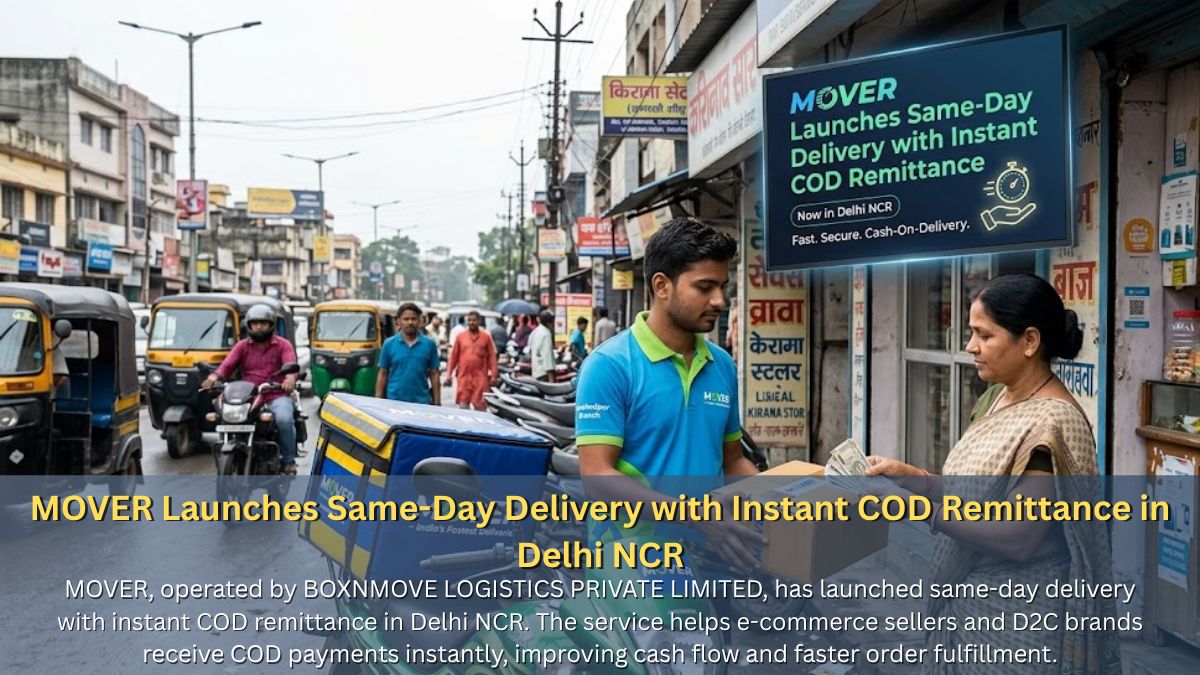
The Indian logistics startup ecosystem continues to witness rapid innovation as delivery companies race to build faster, more reliable, and tech-driven supply chains. In the latest development, MOVER launches same-day delivery with instant COD remittance in Delhi NCR, aiming to address one of the biggest operational pain points for e-commerce sellers and direct-to-consumer (D2C) brands. The service allows businesses to receive cash-on-delivery (COD) payments instantly after a delivery is completed, instead of waiting several days for settlements. This capability can significantly improve cash flow for online sellers, especially small and medium businesses that rely on fast working capital cycles.
Founded in 2021 and operated by BOXNMOVE LOGISTICS PRIVATE LIMITED, MOVER is a technology-driven logistics platform that provides intracity and intercity delivery solutions, including bike delivery, truck transport, courier services, and packers and movers support. The company focuses on simplifying urban logistics for businesses by enabling quick, on-demand transportation of goods. With the launch of its same-day logistics service in the Delhi NCR region, MOVER is positioning itself as a key player in the growing last-mile delivery and quick commerce ecosystem. Delhi NCR remains one of the largest logistics markets in India due to its high concentration of e-commerce sellers, warehouses, and distribution hubs.
The new service is expected to benefit D2C brands, e-commerce sellers, marketplaces, and small retailers that require faster order fulfillment and immediate payment settlement. Additionally, the move highlights a broader industry trend where logistics startups are integrating fintech-like features such as instant payments and digital settlements to support online commerce. As Indian startups continue to innovate in logistics and supply chain technology, initiatives like this demonstrate how delivery platforms are evolving from simple courier providers into technology-driven infrastructure for the digital economy.
1. Introduction: MOVER Launches Same-Day Delivery to Transform Logistics
1.1 The Latest Startup News from India’s Logistics Sector
In a major update from the Indian startup ecosystem, MOVER Launches Same-Day Delivery services in the Delhi NCR region with a unique feature instant COD remittance for businesses. The announcement reflects a growing shift toward faster logistics solutions in India’s expanding digital commerce economy. E-commerce brands and online sellers are increasingly demanding rapid order fulfillment, same-day shipping, and quicker payment cycles. Therefore, the new service is expected to help businesses scale their operations with improved cash flow and efficient delivery infrastructure. Moreover, this launch highlights how tech-driven logistics startups are building innovative business models to compete in India’s crowded delivery market.
2. Background of the Startup
2.1 The Founding of MOVER
Every startup begins with a problem that refuses to be ignored. For MOVER, that problem was urban logistics. The company was founded by Praveen Kumar and operates under BOXNMOVE LOGISTICS PRIVATE LIMITED. From the beginning, the vision was clear. Logistics in Indian cities was broken. Businesses struggled to move goods quickly, delivery timelines were unpredictable, and sellers often had little control over how their products reached customers.
Praveen Kumar saw this gap not just as a business opportunity but as a real pain point for thousands of small and mid-sized businesses. Shop owners, e-commerce sellers, and local retailers all faced the same challenge. Getting a product from point A to point B inside a busy city could be surprisingly complicated. MOVER was built to change that. The startup focused on creating a technology-driven logistics platform that connects businesses and individuals with drivers, vehicles, and delivery services in real time.
Instead of relying on traditional, fragmented logistics networks, the platform aims to make deliveries faster, transparent, and predictable. A business should be able to book a vehicle, track the shipment, and ensure delivery without endless calls, confusion, or delays. At its core, MOVER is trying to simplify something that most businesses deal with every day: moving goods efficiently inside a city.
2.2 Vision Behind the Startup
If you speak with small business owners in Indian cities, the frustration becomes clear very quickly. Logistics often feels like an obstacle rather than a support system.
Many businesses face issues such as:
- Deliveries that arrive late or at unpredictable times
- A lack of reliable logistics partners
- Cash flow problems due to delayed COD settlements
- Transportation costs that keep rising
For a growing business, these problems are more than operational headaches. They directly affect revenue, customer satisfaction, and long-term growth. The founders of MOVER understood this reality from the ground level. Their vision was not just to build another delivery company. They wanted to digitize intracity logistics, bringing structure and transparency to a system that has historically been fragmented.
The idea was simple but powerful:
- Businesses should be able to move goods across a city quickly.
- Delivery tracking should be clear and reliable.
- Logistics should be affordable for small businesses, not just large enterprises.
In many ways, the startup is attempting to do for logistics what ride-hailing platforms did for transportation. Instead of calling multiple vendors or negotiating with local operators, a business should be able to open an app, book a delivery vehicle, and trust that the job will be completed efficiently. This vision reflects a broader shift happening across India, where technology is increasingly transforming traditional industries. Logistics is one of the sectors where this transformation is still unfolding, and startups like MOVER are trying to lead that change.
2.3 Early Growth of the Company
Like many startups, MOVER started small. In its early days, the company focused primarily on intracity deliveries, helping customers transport goods within a single city. This initial phase allowed the team to understand how urban logistics actually works on the ground. Traffic patterns, delivery timelines, driver availability, and customer expectations all shape how logistics platforms operate.
As the platform gained traction, businesses began to rely on it for daily operations. Retailers used it to deliver orders to customers. Online sellers used it for same-day shipping. Even individuals started using the service to move goods quickly within the city. Over time, this growing demand pushed the company to expand. The platform gradually extended its services to support businesses across multiple major cities in India. Each expansion brought new operational challenges, but it also reinforced the company’s belief that efficient urban logistics is a massive opportunity.
Today, according to company information, MOVER serves more than 50,000 customers and continues to scale its delivery infrastructure. For many startups, reaching this stage is significant. It means the platform has moved beyond the early experimental phase and has started building real operational depth. What makes this growth particularly interesting is the type of customers the company serves. A large portion consists of small and medium-sized businesses, the backbone of India’s commerce ecosystem. These businesses rely heavily on fast and affordable logistics, making them ideal users for a platform like MOVER.
3. MOVER Launches Same-Day Delivery in Delhi NCR
3.1 What the New Service Offers
The latest development from MOVER focuses on speed and financial efficiency. The startup has launched same-day delivery with instant COD remittance in the Delhi NCR region. For businesses operating in a competitive market, speed can make the difference between winning and losing a customer. Same-day delivery addresses this need directly. With the new service, orders can be picked up and delivered across Delhi NCR within the same day, allowing businesses to fulfill customer expectations much faster than traditional delivery timelines.
However, the real innovation lies in the instant COD remittance system. Cash-on-Delivery (COD) remains one of the most widely used payment methods in India. Even with the growth of digital payments, many customers still prefer paying cash when the product arrives. The problem is that COD payments often move slowly through the logistics chain. In many cases, businesses wait several days before the collected cash is transferred back to them. MOVER’s system aims to remove this delay. Once a delivery is completed, the COD payment is transferred to the seller almost immediately. For businesses that operate on tight margins, this small change can make a surprisingly large difference.
3.2 Why Instant COD Remittance Matters
To understand the importance of instant COD remittance, it helps to look at how small businesses actually operate. Many sellers manage their inventory and marketing budgets on very tight cash cycles. When COD payments are delayed by three to seven days, that money remains locked in the logistics system. This creates a chain reaction.
A seller who cannot access their revenue quickly may struggle to:
- Replenish inventory on time
- Pay suppliers promptly
- Invest in marketing campaigns
- Expand product lines
Over time, these delays can slow down the growth of even successful businesses. Instant remittance changes that equation. By transferring funds immediately after delivery, businesses regain control over their working capital. They can reinvest their earnings almost instantly, keeping their operations running smoothly. From a broader perspective, this feature represents a subtle but important intersection between logistics and fintech. The logistics platform is no longer just moving goods. It is also helping businesses manage cash flow more efficiently.
For many entrepreneurs, especially those running small online stores, this kind of support can feel transformative. Instead of waiting days for payments to arrive, they gain immediate access to the revenue they have already earned. In a fast-moving market, that kind of liquidity can make all the difference.
4. How the MOVER Logistics Platform Works
4.1 Technology-Driven Logistics Infrastructure
Behind every successful logistics company is a system that quietly manages thousands of moving parts. For MOVER, that system is a technology-driven logistics platform designed to simplify what has traditionally been a chaotic process. Instead of relying on manual coordination, endless phone calls, and fragmented local transport networks, the platform functions as a digital logistics marketplace. Businesses and individuals can open the platform, enter delivery details, and instantly book the vehicle or service they need. But the real strength of the system lies in how it connects multiple participants in the logistics chain.
The platform brings together three key groups:
- Businesses that need to deliver goods
- Drivers looking for delivery opportunities
- Logistics operators who manage transportation capacity
When these three elements come together through technology, logistics becomes far more efficient. A retailer who needs a delivery vehicle no longer has to search through local transport providers. The system automatically identifies available drivers nearby and assigns the order in seconds.
This kind of infrastructure creates what experts call an on-demand supply chain network. For businesses, the experience becomes simple and predictable. They can track deliveries in real time, estimate arrival times, and ensure that customers receive products quickly. For drivers, the platform offers a steady flow of delivery requests, allowing them to earn more consistently without spending time searching for work. In many ways, the model mirrors what ride-hailing platforms did for passenger transportation. By digitizing the process, MOVER is trying to remove the friction that has long slowed down urban logistics in India.
4.2 Types of Delivery Services Offered
Logistics needs vary widely depending on the type of customer and the size of the shipment. A small online seller might need to deliver a package weighing a few hundred grams, while a retailer might need to transport dozens of boxes across the city. Recognizing this diversity, MOVER offers multiple delivery solutions designed to handle different types of shipments. One of the most commonly used services is bike delivery, which is ideal for small parcels and urgent shipments. Bikes can navigate crowded streets quickly, making them perfect for same-day or even rapid deliveries within busy urban areas.
For slightly larger shipments, businesses often choose mini truck transport. These vehicles allow retailers to move bulk orders, inventory stock, or multiple packages in a single trip. For small and medium-sized businesses, this option offers an affordable way to move goods without owning their own fleet. The platform also supports courier delivery for documents, a service often used by offices, legal firms, and corporate clients who need secure and timely document transfers.
Beyond standard deliveries, the company also offers packers and movers services, helping customers relocate goods safely from one location to another. This feature expands the platform’s reach beyond simple parcel delivery into full-service logistics support. Another important capability is the platform’s ability to support both intracity and intercity logistics. While many deliveries happen within a single city, businesses frequently need to move goods between nearby urban centers. By offering both options, the platform becomes a one-stop logistics solution for many customers.
This flexibility is one of the reasons the platform appeals to a wide range of users. Individual consumers use it for personal shipments. Retailers rely on it for local deliveries. E-commerce sellers depend on it to fulfill customer orders quickly. By supporting such varied logistics needs, the platform creates a service ecosystem rather than a single delivery product.
4.3 Operational Model
At the heart of MOVER’s operations is a driver-partner model, a structure that has become common among technology-enabled logistics platforms. Instead of maintaining a large in-house fleet of vehicles, the company collaborates with independent drivers who register on the platform as partners. These drivers bring their own vehicles and gain access to delivery opportunities through the system. Once registered, driver partners receive delivery requests directly through the platform. The system uses location data and availability signals to match drivers with nearby orders. This automated matching process offers several advantages. First, it significantly reduces waiting time. Drivers can quickly receive orders that are geographically close to them, minimizing empty travel and increasing efficiency.
Second, businesses benefit from faster pickup and delivery times because the system selects the most suitable driver available at that moment. Finally, the model allows the platform to scale rapidly. Instead of purchasing and maintaining thousands of vehicles, the company can expand its network simply by onboarding more driver partners.
For drivers themselves, the platform can create a sense of financial stability. Rather than depending on irregular work from local contacts, they gain access to a digital marketplace where delivery requests appear consistently. This balance between technology and human participation is what makes the operational model effective. The platform provides the digital infrastructure, while driver partners bring the physical mobility needed to move goods across the city.
5. Revenue Model of the Startup
5.1 Commission-Based Delivery Fees
Every logistics platform ultimately needs a sustainable revenue model, and MOVER generates income primarily through delivery service fees. Whenever a customer books a delivery, the price is calculated based on several factors. Distance is one of the most important elements. Naturally, longer routes require more time, fuel, and operational effort. Another factor is the type of vehicle selected. A bike delivery typically costs less than a mini truck transport because the operating expenses are lower.
Delivery speed also influences pricing. Faster services, such as same-day or priority deliveries, may involve additional costs because they require immediate vehicle allocation and quicker routing. After calculating the final delivery charge, the platform takes a commission from the transaction. The remaining amount goes to the driver partner who completed the delivery. This model allows the company to earn revenue while ensuring drivers are compensated for their work. As order volumes grow, the platform benefits from increasing transaction flow without needing to own a large physical fleet.
5.2 Subscription Plans for Businesses
For businesses that rely on logistics every day, paying for each individual delivery can become expensive and difficult to manage. To address this, many logistics startups introduce subscription-based packages designed specifically for regular business users. Platforms like MOVER may offer plans that provide businesses with several operational advantages. These packages often include discounted delivery rates, allowing frequent users to reduce their logistics costs over time. Businesses that ship dozens or even hundreds of orders each week can benefit significantly from such pricing models.
Subscription plans may also include dedicated customer support, which helps businesses resolve delivery issues quickly. When a shipment is delayed or a customer requests changes, having priority support can save valuable time. Another powerful feature is logistics analytics. Businesses can track delivery performance, analyze order patterns, and identify areas where logistics efficiency can improve. For growing e-commerce brands, this kind of data becomes extremely valuable. It helps them understand where their customers are located, how delivery speed affects customer satisfaction, and how logistics costs influence overall profitability.
5.3 Value-Added Logistics Services
Beyond delivery and transportation, logistics platforms often expand into additional services that increase the value they provide to customers. One example is storage and warehousing support. Businesses sometimes need temporary storage before shipping products to customers. By offering storage facilities, logistics platforms become a larger part of the supply chain rather than just the transportation layer. Another important service is packing and handling assistance. Proper packaging ensures products remain safe during transit. Businesses that lack professional packing infrastructure can rely on logistics providers to manage this process.
Technology solutions also play a growing role in the logistics industry. Platforms increasingly offer tools that help businesses automate shipping workflows, manage delivery tracking, and integrate logistics operations with their e-commerce systems. These value-added services do more than increase revenue. They deepen the relationship between the platform and its customers. Instead of being just a delivery service, the logistics provider becomes a trusted operational partner that supports multiple aspects of a business’s supply chain. For startups like MOVER, this broader ecosystem approach can be the key to long-term growth. As businesses depend on the platform for more services, loyalty increases and the platform becomes an essential part of their daily operations.
6. The Problem MOVER Is Trying to Solve
6.1 Challenges in India’s Logistics Sector
To truly understand why startups like MOVER exist, you first have to look closely at the reality of logistics in India. On paper, the country has one of the largest transportation networks in the world. In practice, however, the system often feels fragmented and unpredictable. For decades, the logistics industry has been dominated by small, independent transport operators. These operators form the backbone of the supply chain, but the lack of coordination between them creates a number of everyday challenges.
Businesses frequently struggle with unpredictable delivery timelines. A shipment that should take a few hours may end up taking an entire day, simply because there is no centralized system to track and optimize the process. Another persistent issue is the lack of technology integration. Many logistics providers still rely on manual coordination, phone calls, and paper-based processes. While these methods have worked for years, they simply cannot keep up with the speed and scale of modern commerce. Transparency is also limited. Once a package leaves the warehouse, businesses often have very little visibility into where it actually is or when it will arrive. For companies trying to build customer trust, this uncertainty becomes a serious problem.
When these factors combine, the result is operational inefficiency. Retailers and online sellers spend valuable time chasing delivery updates instead of focusing on growing their businesses. This is exactly the gap that technology-driven logistics platforms aim to fill. By digitizing the entire delivery process, companies like MOVER are attempting to bring structure, transparency, and reliability to a system that has historically operated in a scattered way.
6.2 Cash Flow Issues for E-commerce Sellers
While logistics challenges affect many industries, the impact is especially visible in the world of e-commerce. Online sellers in India rely heavily on Cash-on-Delivery (COD) orders. Even as digital payments grow, a large number of customers still prefer paying in cash when the product arrives at their doorstep. For many sellers, COD orders represent a significant portion of daily revenue. But COD comes with a hidden challenge. Payment settlements often move slowly through the logistics chain. After a package is delivered, the cash collected from the customer must be processed and transferred back to the seller.
This process can take three to seven days, sometimes even longer. For large corporations, such delays may be manageable. But for small and medium-sized sellers, the impact can be surprisingly severe. Their businesses often run on tight working capital cycles. The money from today’s sales is often needed to purchase tomorrow’s inventory. When those funds remain locked in the system for several days, growth slows down. Sellers may struggle to restock popular products, run promotional campaigns, or expand their offerings.
This is why instant COD settlement has become such an attractive feature in modern logistics platforms. When sellers receive their payments immediately after delivery, the entire business cycle becomes more efficient. They can reinvest revenue faster, maintain healthier cash flow, and scale their operations with greater confidence. For many entrepreneurs, this kind of financial flexibility is not just convenient, it is essential for survival in a competitive online marketplace.
6.3 Demand for Faster Delivery
Consumer expectations have changed dramatically over the past few years. What once felt like an impressive delivery speed now feels painfully slow. There was a time when customers were comfortable waiting three to five days for an online order. Today, many expect their purchases to arrive within the same day, sometimes even within a few hours. This shift is largely driven by the rise of quick commerce and hyperlocal delivery services. Platforms such as Blinkit have completely reshaped customer expectations by promising groceries and everyday essentials in just minutes.
Once consumers experience that level of convenience, their expectations naturally expand to other types of products as well. For businesses, this change creates enormous pressure. Retailers and online sellers must now compete not only on price and product quality but also on delivery speed. If one company can deliver in a few hours while another takes two days, the faster option often wins the customer’s loyalty.
This growing demand for speed has triggered an intense race within the logistics industry. Startups are investing heavily in infrastructure, technology, and driver networks to reduce delivery times as much as possible. Same-day delivery, once considered a premium feature, is quickly becoming a standard expectation in many urban markets. Companies that fail to adapt risk falling behind in a market that moves faster every year.
7. Industry Trends Driving the Logistics Startup Boom
7.1 Growth of India’s E-commerce Market
The rapid rise of logistics startups cannot be separated from the explosive growth of India’s e-commerce ecosystem. Over the past decade, online shopping has moved from a niche habit to a daily routine for millions of people. Platforms such as Amazon and Flipkart have played a major role in bringing e-commerce to households across the country. As internet access expanded and smartphone usage increased, more consumers began turning to online marketplaces for everything from electronics to groceries. This shift has created a massive surge in delivery demand. Every online order represents a physical product that must travel through a logistics network before reaching the customer’s doorstep.
The scale of this demand is enormous. Millions of packages move across Indian cities every single day. Managing this volume requires efficient transportation networks, reliable drivers, and advanced technology systems capable of coordinating thousands of deliveries simultaneously. For startups entering the logistics space, this growing demand represents a huge opportunity. Companies that can build faster, smarter delivery systems have the potential to become critical infrastructure providers for the entire e-commerce ecosystem.
7.2 Rise of Quick Commerce
Another powerful force shaping the logistics industry is the rise of quick commerce. Unlike traditional e-commerce, which focuses on scheduled deliveries, quick commerce promises near-instant gratification. Consumers can order groceries, snacks, or daily essentials and receive them within minutes. Companies like Blinkit have pioneered this model using a network of dark stores, small fulfillment centers located close to residential neighborhoods.
These facilities allow delivery partners to pick up products quickly and reach customers within extremely short timeframes. The success of quick commerce has had a ripple effect across the logistics industry. Even companies that do not operate in the grocery segment now feel pressure to accelerate their delivery speeds. Customers who are used to receiving groceries in 10 minutes naturally begin expecting faster delivery for other products as well. As a result, logistics startups are redesigning their systems to support same-day and hyperlocal deliveries. Faster routing, improved inventory management, and larger driver networks have become critical elements of modern logistics strategies.
7.3 Technology in Logistics
Perhaps the most transformative change in the logistics sector is the growing role of technology. Modern logistics startups rely heavily on digital tools to manage operations that would otherwise be impossible to coordinate manually. Artificial intelligence and advanced algorithms help platforms analyze traffic patterns, driver availability, and delivery routes in real time. By optimizing these variables, the system can determine the fastest and most efficient way to complete each delivery.
Route optimization technology plays a particularly important role. Instead of drivers choosing routes based on instinct or experience, algorithms calculate the best path based on traffic conditions, distance, and delivery urgency. This reduces travel time and fuel consumption while increasing the number of deliveries that can be completed in a day. Real-time tracking systems also improve transparency. Businesses and customers can see exactly where their packages are and when they are likely to arrive. This level of visibility helps build trust and reduces the anxiety that often comes with waiting for an important delivery.
Mobile applications further simplify communication between drivers, businesses, and customers. Delivery partners receive instructions directly through their smartphones, while customers receive notifications and updates throughout the journey. Together, these technologies are transforming logistics from a traditionally manual industry into a data-driven, highly coordinated ecosystem. Startups that successfully combine technology with operational expertise are redefining how goods move through cities, making deliveries faster, smarter, and more reliable than ever before.
8. Competitors in the Logistics Market
8.1 Direct Competitors
No startup operates in isolation, especially in a sector as competitive as logistics. As companies race to build faster and more efficient delivery networks across Indian cities, platforms like MOVER find themselves competing with several established intracity logistics providers. Some of the most notable competitors include companies such as Blowhorn, Porter, Borzo, and the logistics services offered by Rapido. Each of these platforms is trying to solve a similar problem: how to move goods across busy cities quickly and reliably.
Take Blowhorn as an example. The company has built a strong presence by connecting businesses with mini-truck drivers who can handle bulk deliveries across urban areas. For retailers and e-commerce sellers who need to move inventory quickly, this kind of service can be extremely valuable. Porter operates on a similar principle but has expanded aggressively across multiple cities. The platform allows customers to book everything from bikes to larger vehicles, depending on the size of the shipment. Over time, Porter has become one of the most recognizable names in India’s intracity logistics space.
Borzo, previously known as WeFast in some markets, focuses heavily on courier-style deliveries. Its network of delivery partners enables businesses to move parcels quickly within cities, making it particularly popular among online sellers and small retailers. Meanwhile, Rapido, originally known for bike taxi services, has gradually expanded into logistics support by leveraging its network of riders. This move reflects a broader trend where mobility platforms are exploring delivery services as a natural extension of their infrastructure. For startups like MOVER, competing in this environment requires more than simply offering delivery services. Success depends on building a platform that delivers speed, reliability, and financial efficiency for businesses that depend on logistics every day.
8.2 Indirect Competitors
Beyond intracity logistics startups, MOVER also faces competition from much larger logistics players with national-scale operations. Companies like Delhivery and Shadowfax have built extensive delivery networks across India. Their infrastructure includes warehouses, distribution centers, and massive fleets of delivery partners capable of handling millions of shipments each month. Another powerful competitor comes from the logistics operations of Amazon itself. Over the years, Amazon has invested heavily in building its own delivery network, allowing it to control large parts of the fulfillment and shipping process.
These companies benefit from scale, capital, and operational experience. They have raised significant funding, built nationwide networks, and developed sophisticated technology systems to manage logistics at enormous volumes. However, scale can sometimes create limitations as well. Large networks are excellent for long-distance shipping and nationwide distribution, but they may not always offer the flexibility required for hyperlocal or same-day deliveries within dense urban areas. This is where newer logistics startups attempt to carve out their space. By focusing on speed, local optimization, and technology-driven operations, they try to offer services that traditional logistics networks may struggle to provide efficiently.
9. Funding and Growth Potential
9.1 Startup Funding Landscape
Over the past decade, logistics has quietly become one of the most attractive sectors for venture capital investors in India. While the spotlight often shines on consumer apps and fintech platforms, logistics technology plays an equally critical role behind the scenes. Every online purchase, every marketplace order, and every direct-to-consumer shipment ultimately depends on a logistics network to reach the customer. Investors understand that without efficient logistics, the entire e-commerce ecosystem slows down. Because of this, many logistics startups have successfully raised millions of dollars in venture funding from both domestic and international investors. Funding rounds have supported the development of advanced technology platforms, large driver networks, and nationwide infrastructure.
These investments signal a strong belief that logistics technology will remain a key pillar of India’s digital economy. As online commerce continues to expand, the demand for smarter and faster delivery solutions will only increase. For emerging startups like MOVER, this environment creates both opportunity and pressure. On one hand, the market is growing rapidly. On the other, competition is becoming more intense as well-funded players enter the space.
9.2 Growth Opportunities
Despite the growing competition, the logistics sector still offers enormous growth potential. In many ways, the industry is only beginning its transformation. Several powerful forces are driving this expansion. One of the most important is the continued growth of online shopping across India. Millions of new consumers are joining e-commerce platforms every year, particularly from smaller cities and semi-urban regions. Each new customer adds additional demand for delivery infrastructure.
Another factor is the rapid rise of direct-to-consumer (D2C) brands. These companies sell products directly to customers through online channels, bypassing traditional retail distribution systems. As a result, they depend heavily on reliable logistics partners to deliver orders quickly and safely. The increasing penetration of smartphones and mobile internet is also reshaping consumer behavior. With shopping apps available at their fingertips, customers can place orders anytime, creating a constant flow of delivery requests.
Finally, the expectation of faster deliveries continues to reshape the logistics landscape. Customers who once waited several days for shipments now expect products to arrive within hours or by the end of the day. For startups that can successfully build technology-driven delivery networks, these trends represent an enormous opportunity. Companies that solve real operational challenges while improving delivery speed could become essential infrastructure providers for the digital economy.
10. Impact on the Startup Ecosystem
10.1 Strengthening India’s Logistics Infrastructure
The launch of services like same-day delivery is more than just a product announcement. It reflects a broader transformation taking place across the logistics sector in India. For years, logistics infrastructure struggled to keep pace with the growth of e-commerce. As more consumers began shopping online, the pressure on delivery networks increased dramatically. Startups entering the logistics space have played a crucial role in addressing this gap. By introducing digital platforms, automated routing systems, and flexible driver networks, they have helped modernize an industry that once relied heavily on manual processes.
When companies like MOVER introduce faster delivery solutions, the benefits ripple outward across the entire startup ecosystem. E-commerce companies gain more reliable delivery partners. Small online sellers can reach customers faster. Direct-to-consumer brands can promise shorter delivery timelines without building their own logistics networks. In this way, logistics startups become part of the invisible infrastructure that supports countless other digital businesses.
10.2 Supporting Small Businesses
One of the most meaningful impacts of innovations like instant COD remittance is the support they provide to small businesses. Many entrepreneurs in India operate with extremely limited financial buffers. They rely on daily sales revenue to maintain inventory, pay suppliers, and manage operating expenses. When payment settlements take several days, that money becomes temporarily unavailable. For a growing business, even short delays can create operational stress.
Instant COD settlement changes this dynamic dramatically. By transferring payments immediately after delivery, logistics platforms give sellers faster access to their earnings. This simple improvement can have a powerful effect. Businesses gain better cash flow visibility, can restock inventory more quickly, and can reinvest profits into marketing or expansion. For many small entrepreneurs, this kind of financial efficiency can mean the difference between struggling to survive and building a sustainable, growing business.
11. Lessons for Startups and Entrepreneurs
The story behind MOVER’s expansion into same-day logistics offers several valuable lessons for entrepreneurs building new startups. The first lesson is the importance of solving a real operational problem. Many successful startups begin by identifying a frustration that people deal with every day. In this case, delayed COD payments and slow delivery timelines were genuine pain points for sellers. By addressing these challenges directly, the company created a service that businesses genuinely value.
Another lesson is the power of combining different industries into a single solution. Logistics and fintech may appear unrelated at first glance, but instant COD remittance shows how financial innovation can strengthen a logistics platform. When startups integrate complementary technologies, they often unlock entirely new value for customers. Technology-driven efficiency is another key takeaway. Digital platforms allow companies to automate order matching, optimize delivery routes, and provide real-time tracking. These capabilities dramatically improve customer experience while reducing operational friction.
Finally, successful founders pay close attention to changing consumer expectations. The rise of fast delivery services has shown that customers increasingly value speed and convenience. Businesses that recognize these shifts early are better positioned to build products that match future demand. For entrepreneurs watching the logistics industry evolve, one lesson stands out clearly. Behind every delivery, every online order, and every package arriving at a doorstep lies a complex system working quietly in the background. The startups that build and refine that system are not just solving logistics problems, they are helping shape the future of commerce itself.
About foundlanes.com
foundlanes.com is India’s leading startup idea discovery platform. It helps entrepreneurs find actionable startup opportunities, market insights, and industry-specific guidance to turn ideas into real businesses. With deep research and practical resources, foundlanes supports founders at every stage, from idea validation to launch and growth.