


1. News Summary
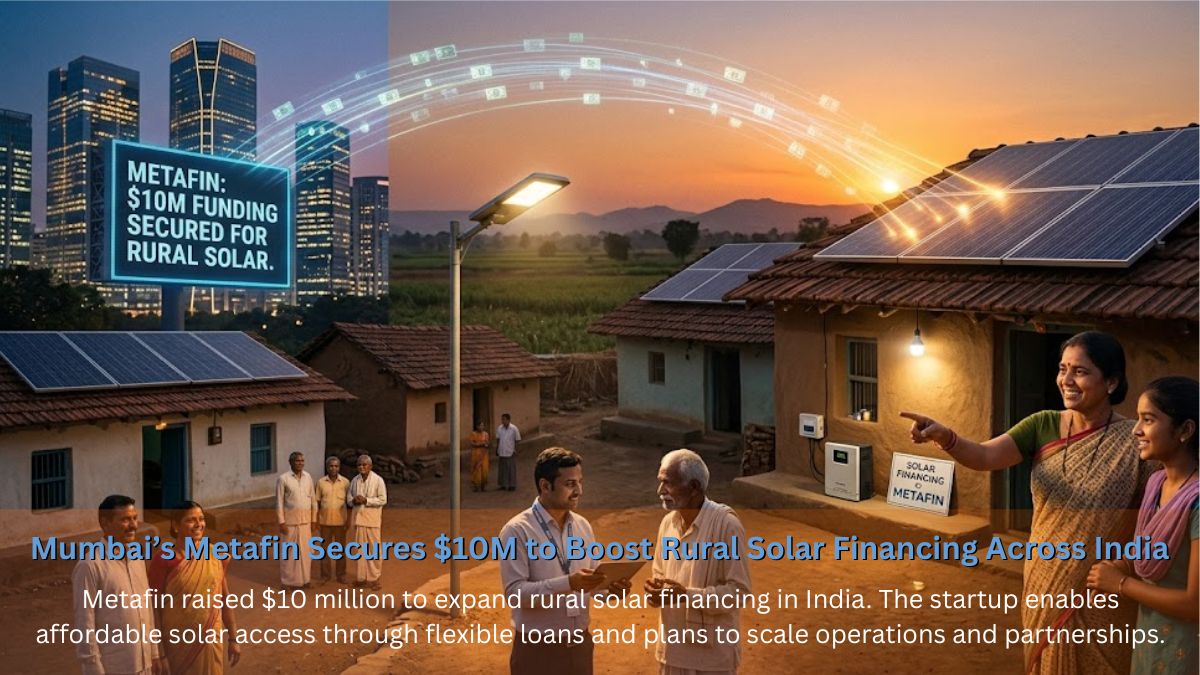
Metafin Secures $10M in fresh funding to accelerate rural solar adoption across India, marking a significant development in the clean energy and fintech space. The Mumbai-based solar financing platform has raised $10 million in structured debt and funding support to expand its reach in underserved and rural markets. This investment reflects growing investor confidence in climate-focused Indian startups that are solving real infrastructure gaps through innovative business models.
Metafin operates at the intersection of clean energy and financial inclusion. It enables access to solar energy solutions for small businesses, households, and rural entrepreneurs who often lack access to traditional financing. By offering structured loans and flexible repayment options, the company is helping bridge the affordability gap in solar adoption. The funding round, backed by prominent venture capital firms such as Vertex Ventures Southeast Asia and India, highlights a broader shift in the startup ecosystem. Investors are increasingly focusing on sustainable businesses that combine impact with scalable revenue models. Rural solar financing is emerging as a high-potential sector, especially in a country like India where energy access and affordability remain key challenges.
With this new capital, Metafin plans to deepen its presence across rural India, strengthen its lending infrastructure, and scale partnerships with solar installers and distributors. The company aims to expand beyond its current footprint and tap into the vast untapped market for decentralized solar solutions. This development positions Metafin among the fastest-growing startups in India’s clean energy financing sector, reinforcing the importance of innovation and venture-backed growth in solving large-scale societal challenges.
2. Metafin Secures $10M: A Major Boost for Rural Solar Financing
Some funding rounds are just numbers on paper. This one feels different. Metafin securing $10 million isn’t just another headline in the startup ecosystem. It’s a signal that the focus is shifting toward solving real, ground-level problems, not just building convenience-driven apps for urban users. Think about rural India for a moment. In many areas, reliable electricity is still inconsistent or expensive. For families and small businesses, that’s not just an inconvenience, it directly affects income, education, and quality of life.
This is where Metafin steps in. By financing solar solutions, it’s not just selling a product. It’s enabling access to something fundamental. Light for homes, power for small shops, stability for communities. The timing of this funding matters too. Investors are becoming more selective. They’re looking beyond flashy growth and asking deeper questions. Does this startup solve a real problem? Can it scale sustainably? Does it create long-term impact? Metafin checks those boxes. It sits at a powerful intersection, combining fintech, climate tech, and infrastructure. And that combination is exactly where the next wave of meaningful innovation is happening in India. This $10 million isn’t just capital. It’s confidence. Confidence that rural India is not a side market, but a massive opportunity waiting to be unlocked.
3. Understanding Metafin’s Business Model
At its core, Metafin has built a model that feels simple but is actually quite thoughtful. Instead of trying to manufacture solar panels or build large-scale infrastructure, the company focuses on what often becomes the biggest barrier, affordability. Here’s how it works in real life. A small shop owner in a semi-urban town wants to install a solar system. The long-term benefits are clear, lower electricity costs, fewer power cuts, more reliable operations. But the upfront cost is a problem. Metafin removes that barrier.
It partners with local solar installers and distributors who already understand the market and have customer relationships. These partners bring in demand. Metafin brings in financing. The customer doesn’t have to pay everything upfront. Instead, they pay in manageable monthly installments, similar to a loan. That small shift changes everything. What once felt unaffordable suddenly becomes possible.
What makes this model even more powerful is its use of data. Traditional banks often hesitate to lend in rural areas because they lack formal credit histories. Metafin takes a different approach. It uses alternative data and tech-driven underwriting to assess risk. This means people who were invisible to the formal financial system now have access to credit. And that’s where the real impact lies. It’s not just about selling solar panels. It’s about expanding financial inclusion while accelerating clean energy adoption at the same time.
4. Revenue Model and Monetization Strategy
From a business standpoint, the model is designed to be both impactful and sustainable. Metafin primarily earns through interest on the loans it provides. Customers repay over time, creating a steady and predictable revenue stream. But there’s more happening beneath the surface. Partnerships with solar providers open up additional income opportunities. These collaborations are not just transactional. They create an ecosystem where installers, financiers, and customers all benefit.
There’s also a policy tailwind working in the background. Governments, both central and state, are actively promoting clean energy adoption. Subsidies and incentives for solar installations can improve affordability for customers and enhance the company’s overall economics. Still, this isn’t a risk-free model. The biggest challenge is repayment. If customers default, the entire system comes under pressure. That’s why credit assessment isn’t just a backend function, it’s the backbone of the business. Strong underwriting, local insights, and efficient collection mechanisms are what will ultimately decide whether this model scales successfully.
5. Founders and Startup Background
Behind Metafin is a team that seems to understand both sides of the problem, finance and energy access. While the spotlight often stays on funding numbers, what really stands out is the intent. The company didn’t start by chasing trends. It started with a clear mission: make solar energy accessible to people who need it the most but can least afford it upfront. In the early days, operations were limited. Small geographies, controlled experiments, learning what works and what doesn’t. That phase is rarely glamorous, but it’s where real understanding is built.
Over time, the company expanded by building strong partnerships and using technology to scale efficiently. Each new region wasn’t just expansion, it was a test of whether the model could adapt to different local realities. This journey reflects something bigger happening in India’s startup ecosystem. A new generation of companies is emerging, not just to serve convenience, but to solve infrastructure gaps that have existed for decades. And that’s what makes Metafin’s story worth paying attention to. It’s not just about growth. It’s about impact that you can actually see, in homes that stay lit longer, in businesses that run without interruption, and in communities that slowly become more self-reliant.
6. The Problem Metafin Solves
To understand why Metafin matters, you have to look beyond cities. In many parts of rural India, electricity is still unreliable. Power cuts aren’t rare events, they’re part of daily life. For a small shop owner, that could mean losing evening business. For a student, it could mean studying under dim light or not studying at all. When the grid fails, people turn to diesel generators. They’re noisy, expensive, and harmful to the environment. But for many, there’s no real alternative.
Now here’s the irony. Solar energy is available. The technology exists. The long-term savings are obvious. But the upfront cost stops people in their tracks. Paying tens of thousands at once just isn’t realistic for most households or small businesses. This is the gap Metafin steps into. Instead of asking people to pay everything up front, it breaks the cost into manageable monthly payments. That one change shifts solar from “out of reach” to “within reach.” And the impact goes beyond just electricity. It reduces dependence on diesel, lowers monthly expenses over time, and gives people a sense of control over something as basic as power. It’s not just about energy access. It’s about dignity, stability, and opportunity.
7. Industry Trends in Clean Energy and Fintech
What Metafin is doing isn’t happening in isolation. It’s part of a much larger wave. Clean energy is no longer a niche conversation. Globally, there’s a clear push toward renewable sources, and India is right at the center of that shift. Policy support, subsidies, and growing awareness are accelerating adoption faster than ever before. At the same time, fintech is quietly reshaping how people access money. Traditional banking systems often miss large segments of the population, especially in rural areas. Fintech fills that gap by using technology to assess risk differently and deliver services faster.
Now, when you combine these two forces, clean energy and fintech, something powerful happens. You don’t just create a business. You unlock access. That’s why investors are paying attention. Startups operating at this intersection aren’t just scalable, they’re solving real, structural problems. Globally, climate tech funding continues to rise, even when other sectors slow down. There’s a growing belief that businesses addressing climate and infrastructure challenges will define the next decade. And companies like Metafin are right in the middle of that story.
8. Funding Details and Investor Confidence
When Metafin secured $10 million, it wasn’t just about the amount. It was about who believed in the idea. Vertex Ventures Southeast Asia & India leading this round sends a strong signal. Investors at that level don’t just look at numbers. They look at long-term potential, execution capability, and market depth. What makes this funding particularly interesting is its structure. It’s not just equity. Structured debt plays a key role, which is critical for a lending-focused business.
Why does that matter? Because lending businesses need capital to lend. The more efficiently they can raise and deploy that capital, the faster they can scale. Structured debt allows Metafin to expand its loan book without diluting ownership too much. It’s a smarter way to grow. More importantly, this investment reflects confidence in a segment that was often overlooked, rural solar financing. It shows that investors now see both impact and profitability in serving these markets. That shift in perception is as important as the funding itself.
9. Competitive Landscape
Metafin operates in a space that is still developing, which makes it both exciting and challenging. Direct competition comes from other startups trying to solve similar problems, financing solar adoption through innovative models. These players are also exploring rural and semi-urban markets, trying to build trust and scale quickly. Then there are indirect competitors. Traditional banks and NBFCs do offer loans for solar installations, but they often struggle with reach and flexibility in rural areas. Their processes can be rigid, and their risk models don’t always work well for customers without formal financial histories.
This is where Metafin has an edge. Its focus on rural markets isn’t just a strategy, it’s a specialization. Understanding local behavior, building partnerships on the ground, and using alternative data for credit decisions gives it a level of insight that larger institutions often lack. But the window won’t stay open forever. As the market grows, more players will enter. Competition will intensify. The real test will be how well Metafin can maintain its early advantage while scaling responsibly.
10. Growth Strategy and Expansion Plans
With fresh capital in hand, Metafin is stepping into its next phase. And growth, in this case, isn’t just about numbers. It’s about reach. The focus is clear, expand deeper into rural and semi-urban regions where demand already exists but access is still limited. These are markets where even small improvements can create meaningful change. But expansion alone isn’t enough. Technology will play a bigger role going forward. Improving underwriting models, making the loan process faster, and creating a smoother customer experience will be critical. When you’re serving customers who may be new to formal financing, simplicity and trust matter more than anything else.
Partnerships will also be key. Solar installers and distributors act as the last-mile connection. Strengthening these relationships ensures a steady flow of customers and smoother execution on the ground. What’s interesting is how closely this strategy mirrors some of the most successful startup playbooks, focus on a clear problem, build strong partnerships, use technology to scale, and expand only when the foundation is solid. If executed well, this isn’t just about growing a company. It’s about lighting up more homes, powering more businesses, and quietly transforming parts of the country that have waited a long time for reliable energy.
11. Challenges in Scaling Solar Financing
Building something like Metafin sounds powerful in theory. In reality, it’s a constant balancing act. The biggest challenge is trust, and it shows up as credit risk. When you’re lending to customers who may not have formal credit histories, you’re stepping into uncertainty. Repayments can’t be taken for granted. One delay, one default, and the impact isn’t isolated. It affects the entire lending cycle. Then comes the operational side, which is often underestimated. Managing partnerships across different regions means dealing with varying service quality, local issues, and execution gaps. A solar installation delayed in a remote village isn’t just a logistics problem, it’s a broken promise to a customer who invested their trust and money.
Regulation adds another layer. Policies around lending, clean energy subsidies, and financial compliance can shift. And when they do, companies have to adapt quickly or risk slowing down. Despite all this, the opportunity remains strong. The difference between success and failure here isn’t the idea, it’s execution. The companies that win will be the ones that stay disciplined, manage risk smartly, and keep their focus on the ground reality.
12. Role of Technology and Innovation
For Metafin, technology isn’t just support, it’s the backbone. Think about credit assessment. Traditional systems rely heavily on formal financial data, which many rural customers simply don’t have. Metafin uses data analytics to look beyond that, understanding behavior, patterns, and alternative signals to make lending decisions. This doesn’t just reduce risk. It opens doors. People who were earlier invisible to the system now have a chance to access financing.
Digital platforms make the process smoother from start to finish. Onboarding a customer, verifying details, tracking repayments, everything happens faster and with fewer errors. For someone in a rural area, this can mean the difference between weeks of paperwork and a quick, clear process. Technology also helps control costs. Better routing, smarter decision-making, and automation reduce the need for heavy manual operations. Over time, this efficiency becomes a major advantage. What’s happening here reflects a larger shift. The most impactful startups today aren’t just using tech for convenience, they’re using it to solve access problems at scale.
13. Impact on the Startup Ecosystem
When Metafin secures $10 million, it sends a message far beyond its own business. It tells the market that impact-driven startups are no longer a side story. They’re becoming central to how investors think. Clean energy and fintech are not just trends, they’re priorities. This shift changes what founders choose to build. Instead of focusing only on urban convenience or short-term growth hacks, more entrepreneurs are starting to look at deeper problems, energy access, financial inclusion, infrastructure gaps. It also strengthens India’s position globally. The country is no longer just producing high-growth startups. It’s producing solutions that can be replicated in other emerging markets facing similar challenges. There’s a quiet confidence building in the ecosystem. The belief that you can build something meaningful and still build something scalable.
14. Learning for Startups and Entrepreneurs
There’s a lot founders can take away from this journey. The first lesson is simple but powerful. Real problems create real opportunities. Metafin didn’t chase trends. It focused on a gap that was already there, waiting to be solved. Second, combining sectors can unlock entirely new markets. Fintech alone is powerful. Clean energy alone is powerful. But when you bring them together in the right way, the impact multiplies.
Third, partnerships matter more than most people think. Growth doesn’t always come from doing everything yourself. Sometimes it comes from working with the right people who already understand the ground reality. And finally, execution is everything. Ideas can attract attention, but only consistent, disciplined execution builds a business that lasts. That’s the underlying theme here. Not just ambition, but responsibility. Not just growth, but sustainability. And that’s what will define the next generation of successful startups.
About foundlanes.com
foundlanes.com is India’s emerging startup idea platform dedicated to helping aspiring entrepreneurs discover practical business opportunities. The platform publishes detailed startup guides, founder stories, market insights, and execution strategies designed for students, professionals, and early-stage founders. By simplifying complex business concepts and presenting them in accessible formats, foundlanes aims to empower individuals to explore entrepreneurship and launch successful ventures in India’s rapidly evolving startup ecosystem.