


Summary
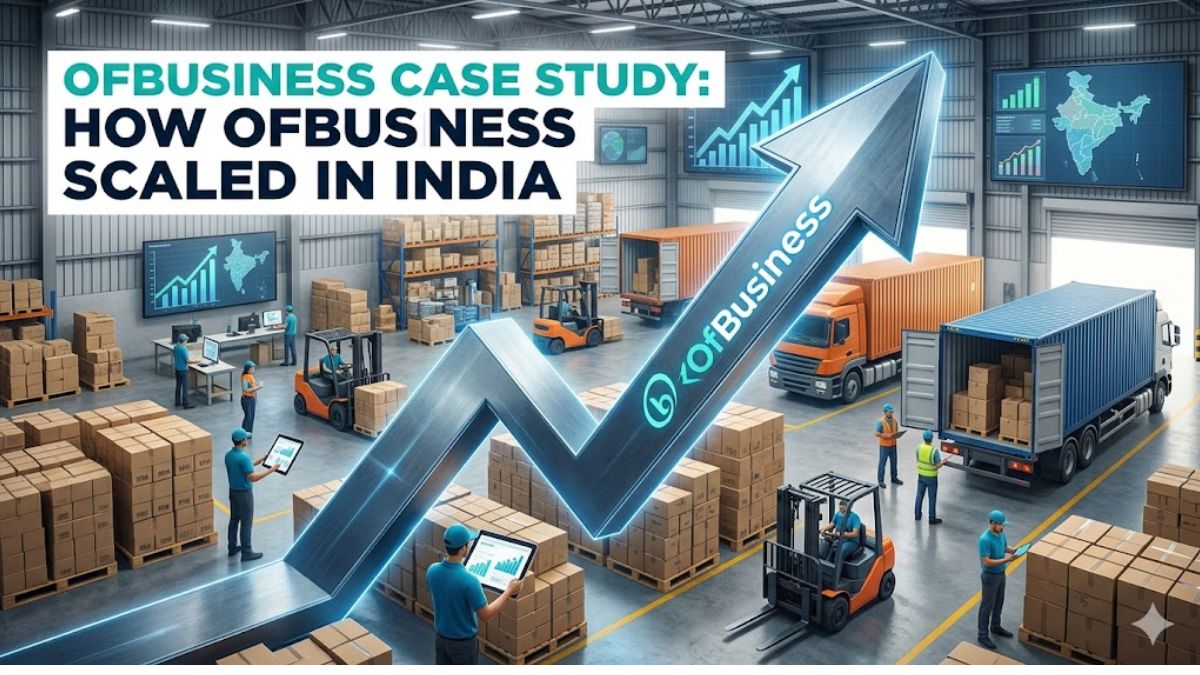
This OfBusiness Case Study examines how a startup built a large digital platform to solve one of the most overlooked problems in India’s industrial economy: the fragmented and inefficient procurement process for small and medium-sized enterprises (SMEs). OfBusiness operates as a B2B commerce and fintech platform that helps businesses purchase raw materials and industrial supplies while also offering credit solutions that support working capital needs. The company was founded in 2015 by Asish Mohapatra, Ruchi Kalra, and Bhuvan Gupta. Headquartered in Gurugram, the startup set out to modernize procurement for SMEs by combining technology, supply chain infrastructure, and financial services.
The founders recognized that thousands of Indian manufacturing and infrastructure businesses struggled to buy raw materials efficiently. Procurement processes were largely offline, supplier networks were fragmented, and access to working capital was limited. As a result, many businesses paid higher prices for materials and faced delays in operations. OfBusiness introduced a digital procurement platform where SMEs could source materials such as steel, chemicals, polymers, and industrial equipment. Beyond procurement, the company also developed a fintech layer that offered credit to businesses based on transaction data and supply chain activity.
This integrated model helped the company rapidly gain traction among manufacturing firms, infrastructure contractors, and mid-sized enterprises across India. Over time, OfBusiness expanded its platform to include logistics services, supplier discovery, and financial products tailored to SME buyers. The startup attracted significant investor attention and eventually reached unicorn status with multi-billion-dollar valuation levels during later funding rounds. The OfBusiness startup case study offers valuable insights into how digital platforms can transform traditional industries. By combining e-commerce, fintech, and supply chain intelligence, the company created a new category within India’s B2B commerce ecosystem.
1. Origin Story and Early Background
The story of OfBusiness began with a simple but important observation about India’s industrial economy. Small and medium-sized enterprises form the backbone of manufacturing and infrastructure sectors. These businesses contribute significantly to economic output, yet their procurement systems remained largely inefficient and outdated. Many SME owners relied on personal networks to source materials. Orders were often placed through phone calls, local distributors, or informal trading relationships.
This lack of transparency created pricing inefficiencies and supply chain delays. The founders of OfBusiness believed that technology could transform this process. Instead of relying on traditional intermediaries, businesses could use a digital platform to discover suppliers, compare prices, and place orders efficiently. The founders had prior entrepreneurial and consulting experience, which helped them understand operational inefficiencies within industrial supply chains. Their goal was not just to build another marketplace. They aimed to create a full-stack platform that integrated procurement, logistics, and financing. This vision eventually evolved into one of India’s most influential B2B commerce startups.
2. Founder Journey and Motivation
The founding team behind OfBusiness brought diverse professional backgrounds. Asish Mohapatra had experience in consulting and operations. Before launching OfBusiness, he worked with consulting firms where he gained exposure to large-scale industrial supply chains. Ruchi Kalra had a background in financial services and investment banking. Her experience in credit and finance later influenced the fintech component of the company’s business model. Bhuvan Gupta brought technical and operational expertise to the founding team. The trio had previously worked together in professional environments and shared a common interest in building technology-driven businesses.
They noticed that while consumer e-commerce had advanced significantly in India, the B2B sector remained largely untouched by digital innovation. This gap presented a major opportunity. The founders decided to focus specifically on SME procurement, where inefficiencies were most visible. The early stages of the company involved extensive research into supplier networks and industrial procurement processes. Understanding how SMEs purchased materials was critical to designing the platform.
3. Identifying the Market Problem
India’s SME sector faces numerous structural challenges. Access to reliable suppliers is one of them. Many businesses rely on regional distributors or informal supplier relationships, which limits price transparency and bargaining power. Procurement delays can disrupt production cycles, particularly in industries that depend heavily on raw materials. Another major challenge involves financing. Banks often hesitate to lend to small businesses due to perceived credit risk. Without access to working capital, SMEs struggle to purchase materials in bulk or negotiate better pricing. This situation creates a cycle where businesses operate with limited efficiency and high operational costs.
The OfBusiness company case study demonstrates how a digital platform can address both procurement inefficiencies and financing constraints simultaneously. By combining a B2B e-commerce platform India model with fintech services, the company created a comprehensive solution for industrial buyers.
4. Building the Product and Platform
OfBusiness began by developing a technology platform designed specifically for industrial procurement. Unlike traditional consumer marketplaces, this platform focused on bulk orders and specialized materials. The system allowed businesses to browse suppliers, compare prices, and place procurement orders digitally. The platform also provided supply chain visibility, which helped companies track orders and deliveries more efficiently.Over time, the product evolved into a sophisticated digital procurement platform serving multiple industries.
The company expanded into categories such as metals, chemicals, polymers, agricultural products, and construction materials. To improve service quality, OfBusiness also invested in logistics coordination and supplier partnerships. This ensured reliable delivery timelines for industrial buyers. The company’s platform essentially became an operating system for SME procurement.
5. Early Traction and Validation
The early validation phase for OfBusiness involved onboarding a small group of SME customers. The founders worked closely with these businesses to understand their procurement workflows. This direct engagement helped refine the platform’s features. Early customers appreciated the ability to compare supplier prices and place orders digitally. The addition of financing solutions significantly increased platform adoption.
Businesses that previously struggled to access credit could now purchase materials with flexible payment options. As more SMEs joined the platform, supplier networks also expanded. This created a network effect that strengthened the platform’s value proposition. The OfBusiness growth story demonstrates how solving a real operational problem can drive rapid adoption in traditional industries.
6. Business Model and Revenue Strategy
The OfBusiness business model explained revolves around two major revenue streams. The first is transaction-based revenue from procurement activities. When businesses purchase materials through the platform, OfBusiness earns margins on the transaction. The second revenue stream comes from financial services.
The company provides credit to SMEs purchasing materials through the platform. These financing products generate interest income and financial service fees. This dual model integrates commerce with fintech. By analyzing procurement data, the platform can assess creditworthiness more effectively than traditional lenders. This data-driven approach forms the backbone of the company’s fintech for SMEs strategy. The integrated model also increases customer loyalty because businesses rely on both procurement and financing services.
7. Funding and Investor Support
As OfBusiness started gaining traction among Indian SMEs, investors began to notice something important. This was not just another B2B marketplace trying to connect buyers and sellers. The company was solving a deep structural problem in industrial procurement and financing. In India, millions of small and medium-sized manufacturers struggle with two major challenges: finding reliable suppliers and accessing working capital. OfBusiness built a platform that addressed both. When the model started showing strong adoption among businesses, venture capital firms quickly recognized its potential.
Over several funding rounds, OfBusiness raised capital from prominent venture investors who believed in the long-term opportunity of digitizing India’s massive industrial supply chain. This funding allowed the company to accelerate its growth in multiple directions. One major area of investment was supplier network expansion. Industrial buyers depend heavily on consistent product quality and reliable delivery timelines. The company invested heavily in onboarding verified suppliers across sectors such as metals, chemicals, polymers, and industrial equipment. Building a trustworthy supply ecosystem was essential to maintaining customer confidence.
Another major focus was technology infrastructure. Handling large B2B transactions requires robust systems capable of managing complex pricing structures, logistics coordination, credit risk assessment, and transaction processing. Capital from investors enabled OfBusiness to strengthen these technical capabilities and build a scalable digital platform. Funding also supported geographic expansion. India’s industrial activity is spread across hundreds of regional clusters. Reaching these markets requires localized teams, strong logistics partnerships, and deep understanding of sector-specific procurement patterns.
As the company scaled rapidly, later funding rounds pushed its valuation into unicorn territory. This milestone was more than just a headline number. It reflected investor belief that OfBusiness had the potential to become a central infrastructure layer for B2B commerce in India. The funding journey of OfBusiness shows how venture capital often follows real market validation. Once investors saw that SMEs were actively using the platform to manage procurement and access financing, confidence in the company’s long-term potential grew significantly.
8. Go-to-Market Strategy
Instead of trying to conquer the entire B2B commerce market at once, OfBusiness chose a far more disciplined approach. The company started by focusing on specific industrial clusters. This decision turned out to be incredibly strategic. Industrial procurement in India is highly localized. Manufacturing hubs tend to specialize in particular sectors. Some clusters focus on steel fabrication, others on chemicals, construction materials, or polymers. Businesses within these clusters often share suppliers, logistics networks, and procurement practices. OfBusiness entered these clusters one at a time, building deep relationships within each ecosystem. Sales teams played a critical role in the early stages. Many SMEs had never used a digital procurement platform before. Business owners were accustomed to working with familiar distributors and local suppliers. Convincing them to shift toward an online system required patience and personal engagement.
Instead of relying purely on digital marketing, the company sent teams directly into industrial areas. Sales representatives met business owners, explained the platform, demonstrated how procurement could be simplified, and addressed concerns about reliability and pricing. These conversations were essential for building trust. Once early adopters began using the platform successfully, the benefits became clear. Businesses could compare supplier prices more easily, reduce procurement delays, and manage orders more efficiently. Positive experiences within one company often influenced neighboring businesses in the same cluster.
Supplier onboarding was equally important. A marketplace is only as strong as the reliability of its supply network. OfBusiness worked carefully to partner with credible suppliers who could maintain consistent quality and competitive pricing. By balancing buyer acquisition with strong supplier relationships, the company gradually built a healthy marketplace ecosystem. After establishing a strong presence in initial sectors, the strategy expanded into additional industries and regions. This methodical approach allowed OfBusiness to scale without losing control over service quality or supply reliability.
9. Competitive Landscape
India’s B2B commerce sector has attracted significant attention from entrepreneurs and investors. Many startups have attempted to digitize industrial procurement by building online marketplaces that connect businesses with suppliers. At first glance, these platforms often appear similar. Most promise better pricing, easier supplier discovery, and improved logistics coordination. However, the real difference between platforms often lies in how deeply they solve the financial realities of industrial businesses.
This is where OfBusiness created a powerful advantage. The founders recognized early that procurement challenges were closely tied to financing constraints. Many SMEs operate with tight working capital cycles. Even when a business identifies a reliable supplier, it may not have enough liquidity to place large orders immediately. Traditional bank loans can be slow and difficult to obtain for smaller companies. As a result, procurement decisions are often limited by cash flow rather than demand.
OfBusiness integrated fintech solutions directly into its marketplace. Businesses using the platform could not only source materials but also access credit lines that allowed them to complete purchases more easily. This integration transformed the platform from a simple procurement marketplace into a financial enabler for SMEs. While several competitors focused only on connecting buyers and suppliers, OfBusiness addressed the entire transaction lifecycle. From supplier discovery and price comparison to financing and logistics coordination, the platform offered a more comprehensive solution. This combination of commerce and fintech significantly strengthened its competitive position in India’s rapidly evolving B2B ecosystem.
10. Technology and Supply Chain Insights
Running a digital marketplace for industrial procurement involves far more complexity than a typical consumer e-commerce platform. Industrial supply chains include multiple stakeholders. Manufacturers depend on raw material suppliers, distributors, transport companies, warehouses, and financial institutions. Coordinating these moving parts requires sophisticated technology infrastructure. OfBusiness built its platform to handle this complexity.
Every transaction generates large amounts of data related to product demand, supplier performance, logistics timelines, and payment cycles. The company processes this data to gain deeper insights into how industrial supply chains operate. Advanced analytics systems help identify procurement trends across sectors. For example, the platform can analyze demand patterns for specific raw materials, detect seasonal fluctuations, and identify emerging supply shortages before they become major disruptions.
These insights are extremely valuable for both buyers and suppliers. Businesses can use digital dashboards to track procurement performance, monitor pricing trends, and plan inventory more efficiently. Instead of relying on fragmented information or manual record-keeping, decision-makers gain access to real-time data that supports smarter purchasing strategies. At the same time, analytics tools help optimize logistics and supplier coordination. The platform can evaluate supplier reliability, delivery timelines, and transaction histories to improve overall supply chain efficiency.
This technological backbone has become one of the company’s strongest assets. By combining big data analytics with supply chain management tools, OfBusiness is gradually transforming how industrial procurement decisions are made. In many ways, the platform is not just digitizing procurement. It is helping businesses understand their supply chains more clearly and operate them more intelligently.
11. Team Building and Leadership
As OfBusiness started scaling across industries and geographies, one thing became very clear to the founders: technology alone would not be enough to run such a complex business. Industrial procurement sits at the intersection of logistics, finance, manufacturing, and supply chain management. Managing that ecosystem required a team with deep expertise across multiple disciplines. The leadership team therefore focused on building a balanced organization rather than simply hiring more engineers or salespeople. Professionals with backgrounds in technology, logistics, finance, operations, and risk management were brought together to solve different parts of the problem.
Engineers focused on building the digital infrastructure that powers the marketplace. Operations teams worked on ensuring that suppliers could fulfill orders reliably and that deliveries reached businesses on time. Finance experts helped design credit models that could support SMEs without exposing the company to excessive risk. Meanwhile, supply chain specialists worked closely with both buyers and suppliers to understand the practical realities of industrial procurement. What made this structure effective was the constant collaboration between these teams.
For example, when the company introduced financing solutions for procurement, it required coordination between product teams, risk analysts, and supply chain experts. Credit decisions could not be based purely on financial data. They also needed insights into supplier reliability, buyer demand patterns, and sector-specific procurement cycles. Leadership encouraged a strong culture of data-driven decision-making. Instead of relying on assumptions, teams analyzed transaction data, supply chain patterns, and customer behavior before expanding into new sectors or markets.
Another key priority was internal talent development. As the company grew, it invested in training programs designed to help employees understand the nuances of industrial commerce. Many team members needed to learn about manufacturing processes, commodity markets, and logistics systems to perform their roles effectively. By combining technological expertise with real industry knowledge, OfBusiness built a team capable of managing one of the most complex areas of the digital economy.
12. Challenges and Turning Points
Building a B2B platform for industrial procurement is very different from launching a consumer technology product. The challenges are often slower, more operational, and deeply rooted in traditional business practices. One of the earliest hurdles for OfBusiness was convincing SMEs to adopt a digital procurement system. Many small and medium-sized manufacturers had relied on the same suppliers and distributors for years. These relationships were built on familiarity and trust. Shifting procurement decisions to a digital platform required businesses to rethink how they sourced raw materials.
For the founders, this meant investing significant time in education and relationship building. Sales teams spent hours visiting factories, meeting business owners, and explaining how the platform could simplify procurement while improving pricing transparency. Trust did not appear overnight. It developed gradually as early users began experiencing the benefits.
Another major operational challenge involved logistics coordination. Industrial materials are not simple consumer products that can be shipped in small packages. Steel, chemicals, polymers, and construction materials often require specialized transportation, bulk handling, and secure storage. Delivering these materials across different regions of India required strong logistics partnerships and careful planning. Any disruption in delivery schedules could impact production timelines for businesses relying on those materials.
The company also had to navigate the unpredictable nature of commodity markets. Prices of industrial materials such as metals and chemicals can fluctuate significantly due to global supply and demand factors. These fluctuations influence procurement decisions, supplier behavior, and credit risk exposure. Despite these complexities, the company continued expanding its platform and strengthening its supplier network. Each challenge forced the team to refine its systems, improve logistics coordination, and deepen its understanding of industrial supply chains. In many ways, these difficult moments became important turning points that helped shape a stronger and more resilient business model.
13. Regulatory and Industry Considerations
Operating within industrial supply chains involves navigating a complex regulatory landscape. Unlike many digital platforms that operate primarily in software environments, OfBusiness deals with real-world commodities that are subject to industry-specific regulations. Materials such as metals, chemicals, and industrial components often fall under regulatory frameworks related to safety standards, transportation requirements, and environmental compliance. Ensuring that transactions comply with these rules requires strong operational oversight.
The company also operates financial services that provide credit to SMEs. Lending activities introduce another layer of regulatory responsibility. Financial operations must follow strict guidelines related to risk assessment, credit monitoring, and compliance with financial regulations. To manage these requirements, OfBusiness developed structured compliance frameworks that operate alongside its technology platform. Risk teams continuously monitor transactions, credit exposure, and supplier activity to ensure that operations remain aligned with industry and financial regulations.
Strong governance practices became essential as the company attracted institutional investors and expanded its financing operations. Transparency, internal controls, and risk management systems helped build confidence among stakeholders. Maintaining this balance between rapid growth and responsible governance has been critical for sustaining long-term credibility in both the industrial and financial ecosystems.
14. Current Status of the Startup
Today, OfBusiness stands as one of the most influential digital procurement platforms serving small and medium-sized enterprises in India. The platform connects thousands of businesses with suppliers across a wide range of industrial categories. These include metals, chemicals, polymers, construction materials, and other essential inputs used by manufacturers and infrastructure companies. What truly distinguishes the company is the integration of commerce and finance.
SMEs using the platform can not only source materials but also access credit that allows them to manage procurement more effectively. For many businesses, access to working capital determines whether they can accept large orders or expand production capacity. By embedding financing directly into the procurement workflow, OfBusiness helps businesses overcome one of the most persistent barriers to growth. The platform continues to expand its supplier base, strengthen logistics partnerships, and refine its analytics capabilities. As more businesses adopt digital procurement systems, the company is positioning itself as a central infrastructure layer within India’s B2B commerce ecosystem.
15. Future Outlook
Looking ahead, the long-term opportunity for OfBusiness appears closely tied to the digital transformation of industrial commerce. Historically, procurement in many sectors has been fragmented and largely offline. Business owners relied on personal networks, local distributors, and manual negotiation processes. While these systems worked for decades, they often lacked transparency, efficiency, and access to financing.
Digital platforms are gradually changing that reality. As more SMEs adopt digital tools to manage procurement and operations, demand for integrated supply chain platforms will continue to grow. Businesses increasingly want systems that combine sourcing, financing, logistics coordination, and data insights in a single environment. OfBusiness appears to be moving toward that broader vision.
Beyond procurement, the company has the potential to expand deeper into fintech services that support SME growth. Credit solutions, payment systems, and working capital management tools could become even more integrated into the platform’s ecosystem. Data will also play a larger role in shaping the future of the business. With access to large volumes of supply chain and transaction data, the platform can generate valuable insights about demand patterns, pricing trends, and operational efficiency.
These insights could help businesses make smarter decisions about purchasing, production planning, and inventory management. The story of OfBusiness illustrates something powerful about modern entrepreneurship. Even industries that appear traditional and slow-moving can be transformed through technology when founders identify structural inefficiencies and build solutions that truly address them. By combining marketplace infrastructure, fintech capabilities, and supply chain intelligence, OfBusiness is gradually reshaping how industrial businesses in India buy, sell, and grow.
About foundlanes.com
foundlanes.com is a platform dedicated to documenting and analyzing startup journeys, founder stories, and business strategies within India’s startup ecosystem. The publication focuses on in-depth case studies, entrepreneurial insights, and startup knowledge designed to help founders, operators, and business enthusiasts understand how modern startups are built and scaled.