


Introduction
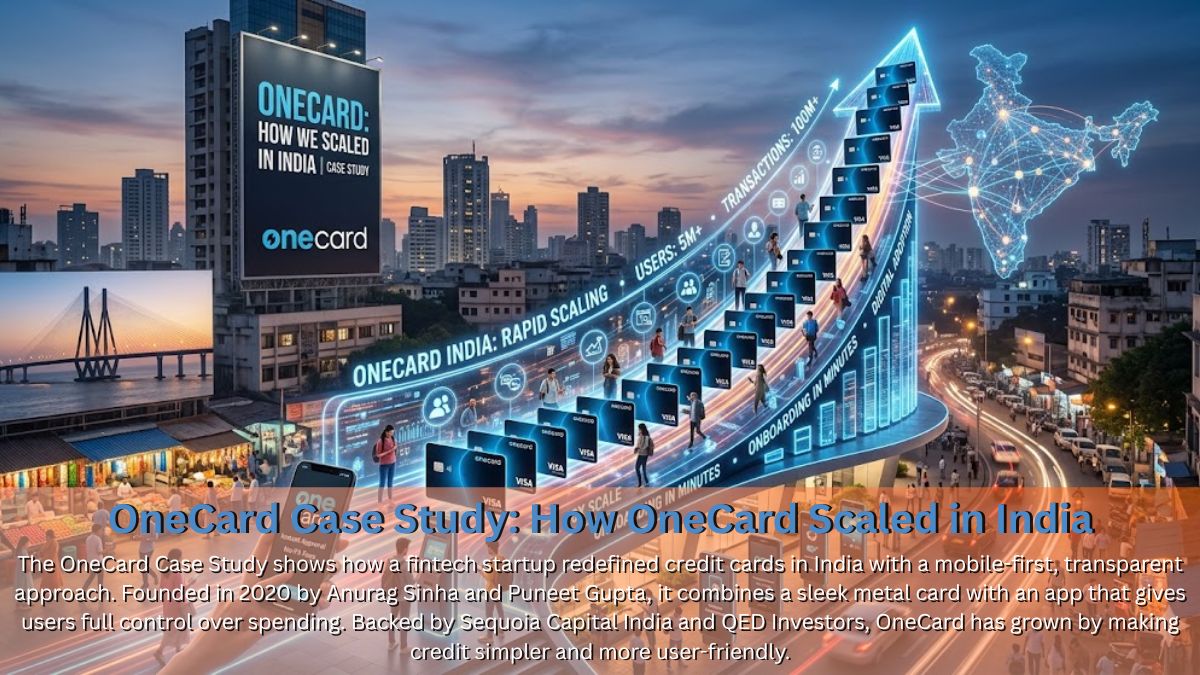
The OneCard Case Study offers a compelling look into how a new-age fintech startup built a premium yet accessible credit experience in India’s highly competitive financial services market. OneCard is an app-based credit card platform that combines a mobile-first user experience with a sleek metal credit card, targeting digitally savvy consumers. It was founded by Anurag Sinha and Puneet Gupta, both former senior executives at large fintech companies, and is backed by FPL Technologies. The company is headquartered in Pune, India, and was launched in 2020.
The idea behind OneCard emerged from a clear gap in India’s credit card ecosystem. While millions of Indians were becoming comfortable with digital payments, credit cards still felt outdated, opaque, and difficult to manage. The founders saw an opportunity to create a transparent, fully digital credit experience that puts control back in the hands of users. OneCard operates through a mobile application that allows users to manage their credit cards entirely from their smartphones. From tracking spending to controlling card usage, the platform emphasizes simplicity, transparency, and user empowerment. The metal card acts as both a status symbol and a functional tool, reinforcing its premium positioning.
While exact revenue figures are not publicly disclosed, OneCard has raised significant funding from investors such as Sequoia Capital India and QED Investors. Its growth reflects rising demand for app-based credit cards in India, especially among younger users seeking control and clarity in financial products. What makes this story worth studying is not just growth, but how OneCard positioned itself differently in a crowded market and executed with precision.
1. Origin Story and Early Background
The story of OneCard begins with frustration, not ambition. The founders had spent years in the fintech space, working on products that served millions of users. During this time, they kept noticing a recurring issue. Credit cards, despite being one of the most widely used financial products, were still confusing, rigid, and often frustrating for users. Most people didn’t fully understand how their credit cards worked. Hidden charges, unclear billing cycles, and lack of real-time visibility created anxiety instead of convenience. At the same time, India was witnessing a massive shift toward digital behavior. UPI payments were exploding. People were getting comfortable managing money through apps. But credit cards had not evolved at the same pace.
This disconnect created an opportunity. The founders didn’t want to build just another credit card. They wanted to redesign the entire experience from scratch. The goal was simple but ambitious: make credit cards transparent, intuitive, and fully controlled by the user. That vision became OneCard.
1.1 Founder Journey, Motivation, and Early Struggles
Anurag Sinha and Puneet Gupta were not outsiders trying to disrupt fintech. They had deep experience in building financial products at scale. This experience gave them two advantages. First, they understood the regulatory and operational complexities of the industry. Second, they had a clear sense of what users actually struggled with. But experience doesn’t eliminate challenges. Starting OneCard meant stepping into a space dominated by banks and large financial institutions. Trust is everything in financial services, and building that trust from scratch is not easy.
In the early days, one of the biggest hurdles was credibility. Why would users trust a new player with their credit needs? Then came the operational challenges. Issuing credit cards in India requires partnerships with regulated entities. Building these partnerships takes time, negotiation, and alignment. There were also product challenges. Creating a seamless app experience while ensuring compliance and security required careful balancing. Progress was slow in the beginning. But the founders stayed focused on one thing, building something that genuinely improves the user experience.
2. Problem Identification in India’s Credit Ecosystem
To understand why OneCard exists, you have to step into the mindset of a typical Indian credit card user, or more importantly, someone who chose not to become one. For years, credit cards in India carried a strange mix of aspiration and hesitation. On one hand, they represented financial access and flexibility. On the other, they came with confusion, hidden charges, and a constant fear of “something going wrong.” Despite the rapid growth of digital payments, especially with UPI transforming everyday transactions, credit cards never felt equally approachable. Millions of Indians were comfortable sending money through apps, scanning QR codes, and managing bank accounts digitally. But when it came to credit cards, the experience still felt stuck in another era.
This is the gap OneCard noticed. Not just a gap in adoption, but a gap in trust. The first issue was transparency. Most users didn’t fully understand how their credit card actually worked. Billing cycles felt confusing. Interest calculations were unclear. Fees would appear on statements without context. Even financially aware users often found themselves double-checking charges, unsure if everything was correct. Over time, this created a quiet but persistent discomfort.
Then came the issue of control. Traditional credit cards were rigid. Once issued, users had very limited ability to manage how the card behaved. You couldn’t easily adjust limits, restrict spending categories, or instantly respond to suspicious activity without calling customer support. It felt like the card was in charge, not the user. The third problem was experience.
In a world where apps like Google Pay and PhonePe made transactions seamless and instant, credit card interactions still relied heavily on outdated systems. Logging into web portals, waiting on customer care calls, or navigating clunky interfaces felt frustratingly slow. And then there was access. For many young professionals, especially those early in their careers, getting a credit card was not easy. Eligibility requirements were strict. Credit history expectations created a catch-22 situation. You needed credit history to get a card, but you needed a card to build credit history.
These weren’t new problems. They had existed for years. But what changed was user expectation. As digital adoption increased, people began expecting the same level of simplicity and control across all financial products. And credit cards were clearly lagging behind. OneCard didn’t invent a new problem. It simply looked at an old one through a modern lens and asked a simple question: Why should managing credit feel harder than sending money through an app? That question became the starting point.
3. Product Development and Evolution
Building OneCard was less about innovation for the sake of it and more about removing friction. The founders didn’t sit down to list features. They started by rethinking the entire experience from the user’s perspective. What does someone actually want when they use a credit card? Not rewards. Not complexity. Just clarity and control. That thinking led to one fundamental decision.
The credit card would not be the product. The app would be the product. From day one, OneCard was designed as an app-first platform. The physical card existed, but it was almost secondary. The real experience lived inside the mobile interface. Users could apply for a card directly through the app, without paperwork or long waiting periods. Once onboarded, everything they needed was right there, spending insights, transaction history, controls, and settings.
But what truly made the product feel different was the sense of ownership it gave users. You could track every transaction in real time. didn’t have to wait for a monthly statement to understand your spending. could control where and how your card was used. could respond instantly if something felt off. It shifted the relationship between the user and the card. Instead of reacting to the card, users could now actively manage it. And then came the metal card.
At first glance, it might seem like a branding decision. Aesthetic, maybe even superficial. But in reality, it played a deeper role. In India, credit cards have always carried a certain psychological weight. They’re not just financial tools, they’re symbols of access, status, and credibility. By introducing a metal card, OneCard tapped into that emotion. It gave users something tangible that felt premium, something they could hold and feel proud of.
But importantly, this premium feel was not disconnected from the digital experience. It complemented it. Over time, the product continued to evolve. Features were added, refined, and sometimes removed based on user feedback. Spend tracking became more intuitive. Reward systems became more relevant. Security controls became sharper. But through all these changes, one thing stayed consistent. Simplicity. The team resisted the urge to overload the product. Every addition had to serve a purpose. Every feature had to make the experience better, not more complicated. Because in fintech, complexity is easy to add but very hard to remove.
4. Early Traction and Validation Phase
The early days of OneCard were not about chasing scale. They were about understanding behavior. Instead of aggressively acquiring users, the company focused on onboarding a smaller, controlled group. This allowed them to observe how people interacted with the product in real situations. And what they learned was revealing. Users didn’t just use the app, they checked it. Frequently. They were curious about their spending. They explored controls. engaged with features that gave them visibility. This level of interaction was a strong signal that the product was doing something right. More importantly, it was building trust. When users can see exactly what’s happening with their money, in real time, something shifts. The anxiety reduces. The uncertainty fades. They feel more in control. And that feeling is powerful.
Feedback loops were tight during this phase. Every complaint, every suggestion, every small confusion was treated seriously. The product was shaped not just by internal decisions, but by real user experiences. There were, of course, challenges. Not everything worked perfectly. Some features needed rethinking. Some flows created friction. But that’s exactly why this phase mattered. It allowed the team to fix issues before scaling. Then something organic started happening. Users began talking about the product.
Not because they were incentivized, but because they genuinely found it different. They shared their experiences with friends. They recommended it within their circles. This kind of word-of-mouth is difficult to manufacture. It comes only when the product resonates. And for OneCard, it became the first real validation. It showed that the problem they were solving was real. And more importantly, that their solution was working.
5. OneCard Business Model Analysis
The OneCard business model analysis becomes more interesting when you look beyond the surface. At a structural level, the revenue model is familiar. Like most credit card providers, OneCard earns through interchange fees, interest on outstanding balances, and partnerships. But what’s different is how these elements are experienced by the user.
Traditional credit card models often rely on complexity. Charges are layered. Benefits are bundled in ways that are not always easy to understand. This can drive revenue, but it also creates friction and mistrust. OneCard takes a different approach. It leans into transparency. Charges are clearly communicated. Transactions are instantly visible. Users don’t have to wait or guess. This reduces confusion and builds confidence over time. Now, from a business perspective, this might seem counterintuitive. Wouldn’t transparency limit revenue opportunities?
In the short term, maybe. But in the long term, it builds something far more valuable, trust. And trust drives usage. When users feel comfortable, they use the card more often. Higher usage leads to higher transaction volumes. And higher volumes directly impact interchange revenue. So instead of maximizing revenue per transaction, OneCard focuses on increasing the number of transactions. It’s a subtle but important shift.
The app also opens up additional revenue opportunities. Partnerships, offers, and targeted experiences can be integrated seamlessly into the user journey. But again, the key is balance. If monetization starts affecting user experience, it breaks the core promise of the product. And that’s something OneCard seems careful about. In many ways, the model reflects a modern fintech philosophy. Don’t extract value aggressively. Create value consistently, and revenue will follow.
6. Funding History and Investor Backing
Building a fintech company is not cheap. There are regulatory requirements, technology investments, risk management systems, and operational complexities that demand significant capital. From early on, OneCard attracted attention from serious investors. Firms like Sequoia Capital India and QED Investors came on board, bringing not just funding but also credibility. And in fintech, credibility matters almost as much as the product itself. When users trust that a company is backed by reputable investors, it reduces hesitation. When partners see strong backing, it makes collaboration easier.
But funding is not just about optics. It enables execution. It allows the company to invest in technology, improve product quality, hire better talent, and expand responsibly. At the same time, it brings expectations. Investors look for growth, scalability, and long-term sustainability. This creates pressure, but also discipline. For OneCard, funding has been both an enabler and a responsibility. It has allowed them to move faster, but it has also pushed them to stay focused on building something that lasts.
7. Go-to-Market Strategy and Distribution
OneCard’s go-to-market strategy feels simple on the surface, but when you look closely, it’s built on a very sharp understanding of user behavior. Instead of trying to capture the entire market, the company made a conscious decision to focus on a specific kind of user. Not everyone who needs a credit card, but those who were already living a digital-first life. People who were comfortable using apps to manage money, make payments, and track expenses. This decision mattered. Because when you target users who already believe in digital products, you don’t have to convince them of the format. You only have to prove that your product is better.
The onboarding experience reflects this thinking. Applying for a credit card has traditionally been a slow, paperwork-heavy process. It often involves documentation, waiting periods, and multiple verification steps that feel disconnected. OneCard stripped that down to the essentials. The application happens inside the app. The journey feels guided, not confusing. And most importantly, it feels quick. That speed creates a strong first impression.
7.1 How OneCard treats its product as a distribution engine
But what really stands out is how OneCard treats its product as a distribution engine. Instead of depending heavily on large marketing spends, the company leaned into user experience as a growth driver. When someone uses the product and feels a genuine sense of control and clarity, they talk about it. Not because they’re asked to, but because it feels worth sharing. This kind of referral is very different from traditional marketing. It carries trust. A recommendation from a friend or colleague doesn’t feel like an advertisement. It feels like advice. And in financial products, that difference is huge.
Digital marketing still plays an important role. Campaigns help create awareness. They bring users into the funnel. But the real conversion often happens after the user interacts with the product. And once that experience is positive, acquisition becomes more efficient. Because the cost of convincing the next user goes down. Over time, this creates a compounding effect. More users lead to more conversations. More conversations lead to more sign-ups. And all of this happens without aggressively pushing the product. It’s a quieter kind of growth, but often more sustainable.
8. Brand Positioning and Messaging Evolution
OneCard’s brand doesn’t try to shout. It speaks clearly. From the beginning, the positioning has been deliberate. It is not presented as just another credit card with rewards and offers. It is framed as a smarter way to manage credit. That distinction might sound subtle, but it changes how users perceive the product. Traditional credit card messaging often revolves around spending. More cashback. rewards. More benefits. The underlying tone is usually about encouraging usage.
OneCard takes a different route. It focuses on control. The messaging consistently highlights transparency, simplicity, and user empowerment. It tells users that they are in charge of their money, not the system. This creates a very different emotional response. Instead of excitement mixed with caution, it builds confidence. The metal card plays an interesting role in this narrative. On one level, it reinforces a sense of premium quality. It feels solid, different, and intentional. But beyond that, it adds a layer of identity. It becomes something users associate with a certain mindset, someone who is financially aware, digitally comfortable, and values control. At the same time, the app balances this premium feel with practicality.
8.1 The interface is designed to be clean and functional
The interface is designed to be clean and functional. It doesn’t overwhelm users with unnecessary features. It focuses on clarity. Every interaction is meant to feel simple and intuitive. Over time, the messaging has evolved. In the early stages, the emphasis was on introducing a new kind of credit card experience. As the product matured, the narrative shifted toward empowerment. It’s no longer just about what the product does. It’s about how it makes users feel.
There’s a clear shift from “use this card” to “take control of your spending.” That shift resonates strongly with younger users. This generation has grown up with technology. They expect transparency. They question systems. And they prefer tools that give them visibility and control rather than just benefits. OneCard’s positioning aligns naturally with these expectations. And that alignment is what makes the brand feel authentic, not forced.
9. Competitive Landscape and Differentiation
The Indian credit card space is not easy to enter, and even harder to stand out in. On one side, you have large banks with decades of trust, massive distribution networks, and deep financial backing. These institutions dominate the market in terms of scale and reach. On the other side, a new wave of fintech startups is trying to redefine user experience. They move faster, experiment more, and focus heavily on design and usability. OneCard sits somewhere in between.
It doesn’t try to compete with banks on legacy trust alone. And it doesn’t position itself as just another fintech experiment either. Instead, it blends elements of both worlds. This positioning is intentional. By partnering with regulated entities, OneCard ensures that it operates within a trusted financial framework. At the same time, its app-first approach allows it to deliver a modern user experience. But the real differentiation goes deeper than structure.
Most credit card providers compete on rewards, discounts, and offers. These are easy to communicate and often drive short-term usage. But they don’t always create long-term loyalty. OneCard focuses on experience. It prioritizes how the user feels when interacting with the product. Are they confused or clear? Are they reacting or in control? they hesitant or confident? These are harder things to measure, but they matter more over time. By building around these factors, OneCard creates a different kind of value. It’s not trying to be the card with the highest rewards. It’s trying to be the card that users trust the most. And in a crowded market, trust becomes a powerful differentiator.
10. Key Challenges and Turning Points
Fintech is not a forgiving space. It operates at the intersection of money, technology, and regulation. And any mistake in any of these areas can have serious consequences. For OneCard, one of the biggest ongoing challenges has been regulation. Financial products in India are governed by strict guidelines. These rules are not static. They evolve as the market changes. Staying compliant while continuing to innovate requires constant attention. It’s not just about following rules. It’s about building systems that can adapt to new ones.
Then there’s the challenge of trust. Convincing someone to try a new app is easy. Convincing them to trust that app with their credit is much harder. Trust is not built through campaigns. It’s built through consistent experience. Every transaction that goes through smoothly, every issue that gets resolved quickly, every feature that works as expected, all of these contribute to building that trust. And the opposite is also true. One bad experience can undo a lot of progress.
There were also moments when the company had to make difficult decisions. Balancing growth with risk is never easy in lending. Expanding too fast can lead to problems. Growing too slowly can mean losing momentum. Finding that balance is an ongoing process. One of the most important turning points for OneCard came from outside the company. The rapid adoption of digital financial services in India changed user behavior at scale. Platforms like Google Pay and PhonePe made people comfortable with managing money through their phones. This shift created the perfect environment for a product like OneCard. Suddenly, the idea of controlling a credit card through an app didn’t feel new. It felt natural. What might have seemed like a niche offering earlier started making sense to a much larger audience. And that shift accelerated adoption.
11. Operational Execution and Scaling
Behind the clean interface and smooth user experience, there is a layer of complexity that most users never see. Scaling a credit card platform is not just about adding more users. It’s about managing risk, ensuring compliance, and maintaining performance at every step. In the early stages, operations can be flexible. Teams can manually handle exceptions. Processes can be adjusted quickly. But as the user base grows, that flexibility becomes a risk. OneCard had to transition from manual execution to system-driven operations. This meant building infrastructure that could handle onboarding at scale without compromising verification standards. It meant creating systems that could process transactions reliably, detect anomalies, and respond in real time. Automation became essential.
Tasks that were once handled manually, onboarding checks, transaction alerts, basic support queries, were gradually moved into automated workflows. This improved speed and consistency. But automation alone is not enough. In financial services, there is always a need for human oversight. Edge cases, complex issues, and risk scenarios require judgment. So the challenge is not replacing people, but enabling them to focus where they are needed most.
Partnerships also played a key role in scaling. Instead of building every component internally, OneCard collaborated with regulated entities and infrastructure providers. This allowed the company to expand faster while staying compliant with financial regulations. It’s a practical approach. Build what differentiates you. Partner for what doesn’t. As the platform scaled, maintaining user experience became even more critical. Because growth brings pressure. More users mean more transactions. More transactions mean more chances for something to go wrong. And in fintech, even small issues can impact trust. So scaling is not just about growth metrics. It’s about ensuring that the experience remains consistent, reliable, and trustworthy, no matter how big the platform becomes. And that’s where real execution shows.
12. Technology and Platform Insights
If you strip everything down, OneCard is not really a credit card company in the traditional sense. It is a technology company that happens to deliver a credit product. That distinction matters because it shapes how every part of the experience is designed. For most legacy credit cards, the app or website is an add-on. It exists to support the card. With OneCard, the equation is reversed. The app is the center of gravity, and everything else orbits around it. This becomes obvious the moment a user starts interacting with the platform.
Every transaction reflects instantly. There is no waiting, no refreshing, no uncertainty about whether something has gone through. That real-time visibility changes how people behave. They become more aware of their spending, more conscious of patterns, and in many cases, more disciplined. It’s a small shift, but it has a psychological impact. Then come the notifications. Not the noisy, unnecessary kind, but the ones that actually matter. A transaction alert that arrives immediately. A reminder before a due date. A subtle nudge when spending crosses a certain level. These interactions create a sense of presence, like the system is quietly working in the background, keeping the user informed without overwhelming them.
12.1 Security is another area where the platform shows its depth
Security is another area where the platform shows its depth. Instead of treating security as something hidden in the backend, OneCard brings it into the user’s hands. Controls are visible. Actions are immediate. If something feels off, the user doesn’t have to call a helpline and wait. They can act instantly. That kind of control builds confidence. But all of this only works if the underlying system is strong. Scalability is not just a technical requirement here, it’s a trust requirement. When more users join, when transaction volumes increase, when peak usage hits, the platform has to perform exactly the same way as it did on day one.
There is no room for visible cracks. Behind the scenes, this means building systems that can handle high loads, process data quickly, and maintain uptime without compromise. It also means constantly testing, refining, and preparing for scenarios that users never even think about. Because in fintech, reliability is invisible until it fails. And OneCard’s approach to technology reflects a clear understanding of that reality. It doesn’t try to impress with complexity. It focuses on making things work smoothly, consistently, and quietly. That’s what good technology feels like to the end user, almost invisible, but always dependable.
13. Regulatory and Industry Considerations
Operating in fintech in India means operating under constant scrutiny, and for good reason. When you’re dealing with people’s money, there is no margin for carelessness. Institutions like the Reserve Bank of India set the rules that govern how financial products are built, distributed, and managed. These rules are not static. They evolve with the market, responding to new risks, new technologies, and new behaviors. For a company like OneCard, this creates a dual responsibility.
On one side, there is the need to innovate. To build better experiences, introduce new features, and stay ahead of user expectations. On the other side, there is the need to comply. To ensure that every part of the product meets regulatory standards, from data security to lending practices. Balancing these two is not easy. Every new feature has to be evaluated not just for usability, but also for compliance. Every process has to be designed with safeguards. decision has to consider long-term implications.
This often slows things down. But it also builds discipline. Because in the long run, shortcuts in fintech don’t just create problems, they create risks that can damage trust permanently. Another important aspect is transparency. Regulators are increasingly focused on ensuring that users understand what they are signing up for. Hidden charges, misleading communication, and unclear terms are being questioned more aggressively. Interestingly, this aligns well with OneCard’s philosophy. By focusing on clarity and openness from the beginning, the company is not just improving user experience, it is also positioning itself well for a more regulated future. But adaptability remains key. As the industry matures, new guidelines will emerge. New expectations will be set. And companies that can adjust quickly without disrupting their core experience will have a clear advantage.
14. Current Status of OneCard
Today, OneCard sits in a space that is both promising and demanding. It has moved beyond the early validation stage. It is no longer just an idea being tested. a product that has found a place in the lives of a growing number of users. You can see this in how it is being talked about. Not as an experiment, but as an alternative. Users who once relied only on traditional credit cards are now open to trying something different. And in many cases, they are sticking with it.
The platform continues to evolve. New features are introduced, existing ones are refined, and the overall experience keeps improving. But what stands out is that the core philosophy has not changed. Transparency is still central. Control is still a priority. Simplicity is still protected. This consistency matters. Because as companies grow, there is always a temptation to expand in too many directions. To add more features, chase more segments, and try to be everything for everyone. So far, OneCard seems to be resisting that pull.
Instead, it is strengthening what already works. At the same time, expectations are rising. More users mean more scrutiny. More visibility means more comparisons. The margin for error becomes smaller. And that’s where the current phase becomes critical. It’s no longer just about proving that the model works. It’s about proving that it can sustain, scale, and deliver consistently over time.
15. Future Outlook of OneCard Case Study
The OneCard Case Study is not just a story of what has been built so far. It is a window into where financial products in India are heading. User behavior is changing rapidly. People no longer want to interact with financial products occasionally. They want continuous visibility. They want control. want experiences that feel as smooth as the apps they use every day. This shift is not temporary. It is structural. And it creates a strong tailwind for platforms like OneCard. But the road ahead is not without challenges.
Scaling a fintech product is always a delicate balance. Growth needs to be fast enough to stay competitive, but controlled enough to manage risk. Expanding features can attract more users, but it can also introduce complexity if not handled carefully. Maintaining trust will remain the biggest responsibility. Because in the end, users are not just choosing a product. They are choosing where to place their confidence. Looking forward, a few things will likely define OneCard’s trajectory.
The ability to deepen its product without losing simplicity. The ability to build stronger partnerships within the financial ecosystem. And the ability to adapt quickly as regulations and user expectations evolve. If these pieces come together, the potential is significant. OneCard can move beyond being just a credit card platform and become a broader financial interface, a place where users don’t just spend, but understand, manage, and control their money. That’s a powerful position. And if executed with the same clarity that has defined its journey so far, the OneCard growth story India could stand out as one of the most meaningful examples of how fintech can reshape everyday financial behavior, not through complexity, but through clarity.
About FoundLanes.com
foundlanes.com is a platform dedicated to documenting and analyzing startup journeys, business models, and founder stories within India’s evolving startup ecosystem. It focuses on delivering in-depth, research-driven case studies that provide practical insights for entrepreneurs, professionals, and readers interested in understanding how modern businesses are built and scaled.