


News Summary
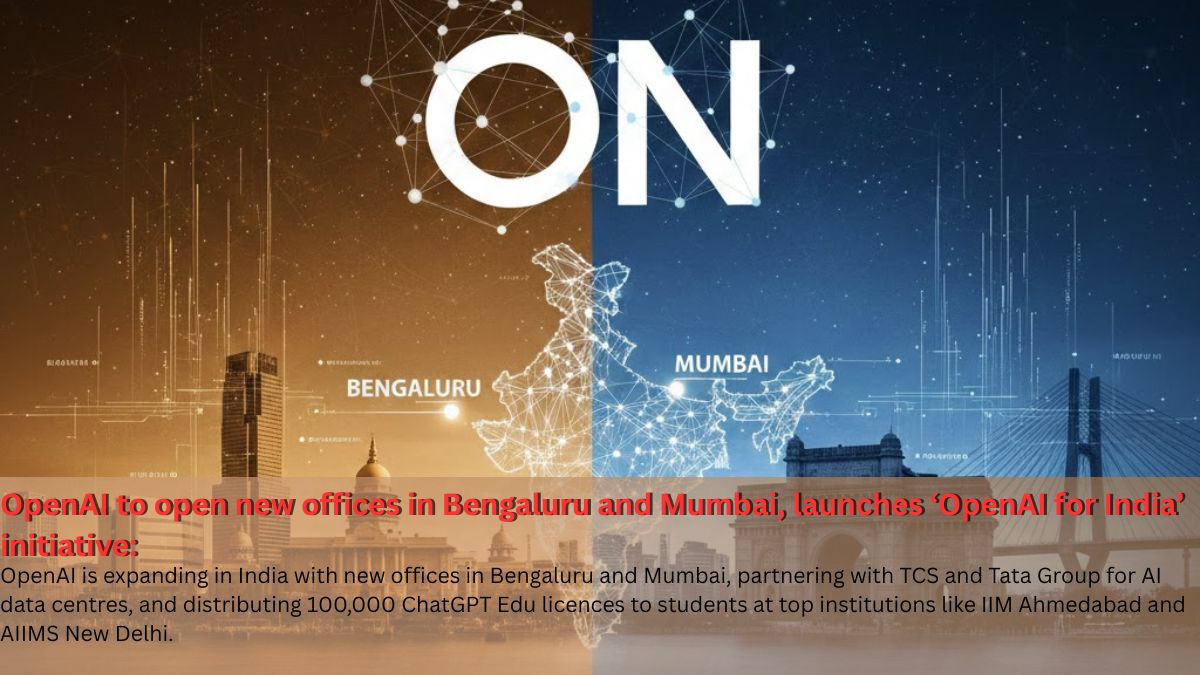
OpenAI, the U.S. artificial intelligence powerhouse behind ChatGPT, has announced that it plans OpenAI to open new offices in Bengaluru and Mumbai later in 2026. This announcement comes as part of a broader campaign called “OpenAI for India,” aimed at deepening engagement with Indian developers, enterprises, academic partners, and users. India has emerged as one of OpenAI’s fastest-growing markets globally, with more than 100 million weekly ChatGPT users, placing the country among the largest user bases outside the United States. The new offices will complement OpenAI’s existing base in New Delhi and are expected to support enterprise collaborations, developer outreach, and partnerships with local technology companies and academic institutions. The announcement was officially revealed at the India AI Impact Summit 2026 in New Delhi, where OpenAI CEO Sam Altman emphasized India’s role in shaping the future of artificial intelligence.
Simultaneously, OpenAI has unveiled strategic partnerships with the Tata Group and Tata Consultancy Services (TCS). Under the global Stargate initiative, OpenAI will become the first customer of TCS’s HyperVault AI-ready data centre business, beginning with 100 megawatts of capacity and with plans to scale up to 1 gigawatt. This infrastructure build-out is intended to support advanced AI computation, improve data residency and security, and enable onsite deployment of large-scale AI models.
OpenAI is also expanding its certification programs in India, offering practical AI training with TCS as the first participating partner outside the United States. The company is distributing over 100,000 ChatGPT Edu licences to students through collaborations with leading Indian institutions such as IIM Ahmedabad and AIIMS New Delhi. These developments reflect OpenAI’s commitment to fostering AI skills, innovation, and enterprise growth in India’s booming tech ecosystem.
1. Introduction to OpenAI and Its India Expansion
1.1 The Global Rise of OpenAI
OpenAI started as an ambitious research effort built around a simple belief. Artificial intelligence should push the world forward, not just impress researchers in labs. Over the years, it grew into one of the most influential forces in modern technology. What began as experiments in language modeling eventually reshaped how people work, learn, and communicate. Tools like ChatGPT didn’t just enter mainstream use; they changed expectations for what everyday software can do.
Instead of being another tech product, generative AI became something people rely on for writing, studying, coding, and brainstorming. Developers stitched it into their apps. Companies built internal workflows around it. And slowly, the idea of talking to a machine stopped feeling futuristic and started feeling normal.
1.2 Why India Matters
India has become one of OpenAI’s most important markets, not because of its size alone but because of its energy. There’s a unique mix of English fluency. Fast-growing technical talent, and a culture that embraces new digital tools almost as quickly as they appear. When you look at the numbers, it’s obvious why OpenAI pays attention. Over 100 million weekly ChatGPT interactions come from India. That level of engagement isn’t just impressive, it shows genuine curiosity and hunger for transformation.
Anyone who has spent time with India’s developer communities knows how rapidly ideas spread there. A new model release becomes a late-night experiment for thousands of engineers almost instantly. Startups adjust their plans. Students try new workflows. Established companies rethink how they operate. India doesn’t just adopt technology. It absorbs it and then pushes it further.
1.3 The “OpenAI for India” Initiative
The OpenAI for India initiative, announced at the India AI Impact Summit 2026, represents a shift from treating India as a major user base to treating it as a partner in shaping AI’s future. It’s a commitment to build something that fits the country’s realities: vast linguistic diversity, enormous variations in digital maturity, unique compliance requirements, and a booming developer ecosystem that thrives on open experimentation. This initiative isn’t only about introducing technology. It’s about supporting AI infrastructure, guiding skill development, building local partnerships, and making sure the tools respect the language, culture, and regulatory environment of India. In many ways, it signals that India isn’t just consuming the future of AI; it’s helping define it.
2. OpenAI’s Business Model and Value Proposition
2.1 Core Products and Services
At the center of OpenAI’s portfolio is ChatGPT, a conversational engine designed to feel natural and helpful. It writes, rewrites, brainstorms, analyzes, explains, and solves. For businesses, it becomes a collaborator. For developers, a capability they can build on. And for individuals, it often feels like a dependable companion during work that requires clarity or creativity. Enterprise-level products, especially ChatGPT Enterprise, add the guardrails companies need: privacy, security, admin control, and performance guarantees. Many organizations treat it as a productivity layer that sits on top of their existing systems.
On the other side, OpenAI’s developer APIs quietly power a huge range of services. Finance firms use models to summarize documents. Healthcare companies use them to structure data. Ed-tech startups deploy them to personalize learning. Retail and e-commerce teams rely on them to automate customer interactions or build internal tools. The models have grown far beyond text they interpret images. Analyze data, and support coding workflows that save engineers hours every week.
2.2 Revenue Streams
Most of OpenAI’s revenue comes from two channels: subscriptions and API usage. Consumer plans like ChatGPT Plus support individual users who want faster responses and access to advanced models. Enterprise plans provide a long list of additional features that large companies depend on. One of the most significant commercial steps lately has been the partnership with the Tata Group, which plans to bring ChatGPT Enterprise into its many companies. It’s a massive, multi-year deployment, and it signals how deeply generative AI is being embedded into established industries. For OpenAI, partnerships like these are less about selling software and more about shaping how entire organizations work.
2.3 Funding and Financial Backing
OpenAI’s evolution wasn’t cheap. The shift from a nonprofit lab into a capped-profit structure allowed it to attract the kind of long-term investment needed to train cutting-edge models, scale global infrastructure, and support international expansion. This funding approach gave the company room to push boundaries without losing sight of its mission. The financial backing over the years from venture capital firms to strategic partners helped OpenAI move quickly when the technology demanded it. And that speed is part of what enabled ChatGPT and the broader platform to grow as fast as it did.
3. The Indian Market and Ecosystem Trends
3.1 Growth of AI Adoption in India
India is not just adopting AI; it is embracing it with a kind of hunger and intensity that few other countries match. From fintech companies using predictive analytics to healthcare startups analyzing patient data, from educational platforms personalizing learning journeys to logistics firms optimizing supply chains, AI is rapidly becoming woven into the fabric of business operations. The rise of generative AI tools like ChatGPT has been especially transformative. Developers are no longer just consumers they are creators, experimenting with AI to build new products, automate processes, and solve longstanding inefficiencies.
Walking through Bengaluru’s tech corridors or Mumbai’s financial districts, one can feel this energy firsthand. Small startups are running internal hackathons around AI, universities are integrating advanced machine learning into their syllabi, and large enterprises are piloting AI-driven automation at a scale that would have seemed impossible just a few years ago. The launch of localized infrastructure and partnerships signals a long-term commitment: India is not a testing ground; it is a strategic collaborator in shaping global AI adoption. The sheer scale of interest and adoption shows that India is ready not only to use AI but to actively shape its future.
3.2 Regulatory and Infrastructure Developments
India’s approach to AI adoption has been remarkably proactive. Hosting the India AI Impact Summit 2026 in New Delhi was more than a showcase it was a statement of intent. Policymakers, industry leaders, and global AI innovators convened to discuss governance, ethical frameworks, and standards, highlighting India’s desire to balance innovation with responsibility.
Simultaneously, investments in infrastructure are accelerating. Building AI-ready data centers, establishing compliance frameworks, and implementing data residency measures are now top priorities. Companies like OpenAI recognize that operating in India requires more than simply shipping technology; it demands respect for regulatory realities, cultural nuances, and local operational conditions. This ensures that AI solutions are both legally compliant and practically impactful for businesses and users alike. For organizations planning AI deployment, India’s infrastructure readiness is now on par with major global hubs, offering both reliability and strategic advantage.
3.3 Enterprise Partnerships and Skills Development
Partnerships with Indian corporations, particularly the Tata Group and TCS, illustrate how collaboration is central to the AI story. These are not merely commercial agreements they are ecosystems in which knowledge, expertise, and infrastructure are exchanged. By co-developing AI-ready data centers and rolling out certification programs, OpenAI is not only deploying technology but also cultivating a skilled workforce capable of using it effectively.
Institutions like IIM Ahmedabad and AIIMS New Delhi amplify this impact, serving as talent incubators where students and professionals gain exposure to cutting-edge AI applications. From observing AI labs in these institutions, one can see the excitement on young professionals’ faces as they tackle real-world challenges with generative AI. These initiatives go beyond product adoption they create communities of practice, nurture local expertise, and prepare India’s workforce to be leaders in a global AI economy.
4. Competitive Landscape: AI Startups and Giants
4.1 Direct and Indirect Competitors
OpenAI is entering India at a moment when the market is vibrant but fiercely competitive. Direct rivals like Anthropic, which recently opened its Bengaluru office, bring strong generative AI capabilities and ambitious expansion strategies. Global giants such as Google (with Bard and Gemini models) and Microsoft (integrating OpenAI technologies into Microsoft 365 and Azure) compete for both enterprise and consumer mindshare. Even Meta and Amazon are intensifying efforts to localize AI solutions, blending cloud infrastructure with domain-specific tools.
Beyond these global players, India’s own AI startups and specialized NLP firms are innovating rapidly. They offer unique insights into local language processing, regional content, and culturally attuned AI applications. The result is a competitive landscape that challenges every entrant to not only provide world-class technology but also understand the nuanced needs of Indian users. In such an environment, OpenAI’s approach deep partnerships, investment in infrastructure, and focus on enterprise deployment demonstrates strategic insight and long-term vision.
5. Strategic Rationale: Why Offices in Mumbai and Bengaluru
5.1 Bengaluru: The Tech Hub
Bengaluru is more than India’s Silicon Valley; it’s the beating heart of its innovation ecosystem. Startups, multinational R&D centers, and AI research labs thrive here, creating a dense talent pool with expertise in cloud computing, machine learning, and enterprise software. By situating an office in Bengaluru, OpenAI gains direct access to this talent, the energy of local developer communities, and opportunities to collaborate with cutting-edge research projects. It’s a place where ideas turn into prototypes overnight and experimentation is celebrated.
5.2 Mumbai: The Business Capital
Mumbai, in contrast, is the epicenter of India’s corporate world. The city hosts financial services, multinational headquarters, and enterprise customers across sectors. An office in Mumbai allows OpenAI to work closely with decision-makers, forge enterprise partnerships, and integrate AI into complex, regulated industries. It is here that AI meets strategy, and that global solutions are tailored to local business realities.
5.3 Beyond Physical Presence
These offices are not just addresses on a map they are the foundation of a regional ecosystem. They will serve as hubs for enterprise support, community engagement, policy dialogue, and local collaborations. They reflect OpenAI’s understanding that presence isn’t just about operations; it’s about relationships, trust, and sustained investment in a market with both enormous potential and complex challenges. By committing to India in this way, OpenAI is signaling that it wants to be part of the country’s AI journey for the long term.
6. Broader Impact on Indian Innovation and Talent
6.1 Driving AI Skill Development
OpenAI’s move to expand certification and training programs in India is about more than simply teaching tools it’s about shaping the future workforce. Across classrooms, co-working spaces, and corporate offices, there’s a palpable excitement among professionals who are finally getting hands-on experience with generative AI models like ChatGPT.
By collaborating with TCS and leading educational institutions, OpenAI is creating structured pathways for learning. For instance, students at IIM Ahmedabad and medical professionals at AIIMS New Delhi are now experimenting with real-world AI applications whether it’s automating research summarization, building predictive models, or designing intelligent workflows. Early feedback shows that participants are not just absorbing knowledge; they’re innovating with it. Developers are integrating AI into startups, mid-sized enterprises are redesigning processes, and professionals are discovering efficiencies they didn’t imagine before.
The impact is tangible: India now has a rapidly growing cohort of trained AI practitioners who are comfortable with advanced tools, capable of ethical deployment, and ready to take leadership roles in AI-driven initiatives. For many young engineers, this program isn’t just training it’s a career-defining opportunity that inspires confidence and sparks creativity.
6.2 Strengthening Enterprise AI Adoption
The rollout of ChatGPT Enterprise across the Tata Group is a landmark example of how AI can move from concept to everyday operational impact. In practice, this means that business teams, analysts, and decision-makers are now interacting with AI daily drafting reports, analyzing data patterns, automating repetitive tasks, and accelerating problem-solving.
This adoption is not just technical; it transforms culture. Employees who initially approached AI with caution are beginning to see it as a partner rather than a threat. Companies report increased productivity, faster decision-making, and higher engagement among staff experimenting with AI tools. Smaller enterprises observing this deployment are inspired to implement AI themselves, creating a ripple effect across India’s corporate landscape.
The result is a visible shift in how organizations operate: AI is no longer an experimental sidebar it is becoming an integral part of enterprise workflows, driving efficiency, innovation, and digital transformation in measurable ways.
6.3 Contribution to AI Infrastructure
Perhaps the most understated but crucial element of OpenAI’s expansion is the HyperVault AI-ready data centre collaboration with the Tata Group. For AI applications to work seamlessly at scale, especially for enterprises handling sensitive or regulated data, robust infrastructure is critical. These centers provide local computing power, which reduces latency, ensures compliance with India’s data localisation laws, and supports large-scale AI deployments.
From a practical standpoint, this means companies can run AI models without sending sensitive data overseas, alleviating regulatory concerns and building trust with customers. It also enables experimentation at scale: startups, research labs, and corporates can run complex models efficiently, fostering innovation that was previously constrained by infrastructure limitations.
The broader implication is profound. India’s AI ecosystem now has both the talent and the infrastructure to compete globally. It’s not just about having the latest tools it’s about creating an environment where AI can thrive sustainably, responsibly, and with local relevance. Every student trained, every workflow optimized, and every enterprise deployment contributes to a tangible ecosystem effect, positioning India as a global AI leader in the making.
7. Learning for Startups and Entrepreneurs
OpenAI’s expansion into India is more than a business move it is a case study in strategy, resilience, and vision for startups and entrepreneurs. There are several lessons here, drawn from real-world impact, tangible results, and the human side of scaling technology globally.
7.1. Build with scale in mind.
Growth isn’t just about increasing users it’s about creating systems that can handle that growth without breaking. OpenAI didn’t just launch ChatGPT in India; it invested in partnerships, local infrastructure, and enterprise-ready solutions. The result is a market-ready ecosystem where millions of users can interact with AI reliably every week. Startups should internalize that scaling is not only about product but also about architecture, talent, and support structures that grow with your ambition.
7.2. Partner with local leaders.
When entering a new market, understanding local culture, regulations, and business practices is critical. OpenAI’s collaboration with the Tata Group and TCS shows how aligning with respected local partners can smooth operational challenges, accelerate adoption, and lend credibility. Entrepreneurs can learn that partnerships are not just transactional they are bridges that connect global vision with local realities.
7.3. Invest in skills development.
Technology alone cannot drive transformation; people do. OpenAI’s certification programs, training initiatives, and university collaborations illustrate how building human capacity amplifies technology’s impact. For startups, investing in the skill development of employees, clients, or users doesn’t just strengthen adoption it cultivates loyalty, innovation, and a sustainable growth engine.
7.4. Adapt to regulatory environments.
Expanding into large, regulated markets like India requires early and proactive engagement with policies and compliance frameworks. OpenAI’s localized infrastructure, adherence to data residency laws, and dialogue with regulators exemplify how respecting the ecosystem prevents friction and builds trust. Entrepreneurs should view regulations not as obstacles but as guideposts for responsible growth.
7.5. Balance global and local needs.
One of the most challenging but crucial lessons is harmonizing a global vision with local execution. OpenAI maintains its global standards while tailoring solutions, partnerships, and training programs to India’s unique needs. Startups can learn that flexibility and localization, without compromising core principles, are key to building relevance and lasting impact.
At its core, OpenAI’s journey in India is a reminder that scaling technology requires foresight, empathy, and execution excellence. Startups that internalize these lessons don’t just grow—they shape markets, influence industries, and build ecosystems that endure long after the first product is launched. The human takeaway is clear: successful entrepreneurship combines vision with empathy, strategy with local insight, and technology with human capital.
About foundlanes.com
foundlanes.com is India’s leading startup idea discovery platform. It helps entrepreneurs find actionable startup opportunities, market insights, and industry-specific guidance to turn ideas into real businesses. With deep research and practical resources, foundlanes supports founders at every stage, from idea validation to launch and growth.