


News Summary
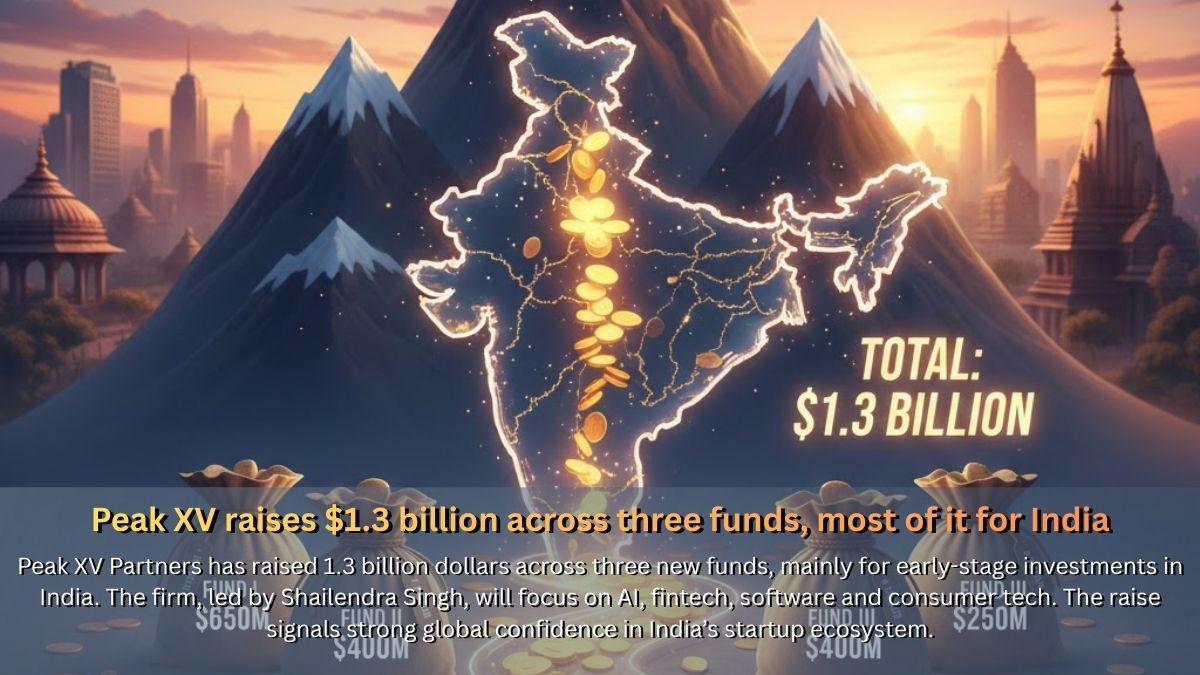
Peak XV Partners, one of the most influential venture capital firms focused on India and the Asia-Pacific region, has successfully closed a major capital raise, marking a milestone in global venture capital activity. In its first independent fundraise since separating from the Silicon Valley giant Sequoia Capital in 2023, Peak XV raises $1.3 billion across three new investment vehicles. The funds will be deployed through its India Seed, India Venture and APAC funds, with a significant portion earmarked for Indian startups. This fundraising effort reinforces investor confidence in India’s vibrant startup ecosystem and global interest in backing early-stage innovation and growth companies in this region.
The firm, which manages more than $10 billion in assets under management, plans to allocate most of the fresh capital to seed and venture opportunities in India, while also supporting broader Asia-Pacific ventures. Shailendra Singh, Managing Director at Peak XV, has emphasised the strategic role of this new corpus over the next two to three years, particularly in sectors like artificial intelligence, fintech, software and consumer technologies.
This development follows a period of structural change and leadership transitions at the firm, yet investors and founders see the move as a strong endorsement of India’s startup markets. Peak XV’s new raise comes amid heightened competition from global venture firms that are increasing bets on Indian founders and innovation-driven businesses. Beyond immediate deployments, the fund underscores a broader trend of global capital flowing into emerging markets and the rising importance of India as a key destination for deep-tech and high-growth ventures.
1. Introduction
1.1 What Happened: Peak XV Raises $1.3 Billion
In February 2026, Peak XV Partners secured $1.3 billion in fresh investor commitments across three new funds. The scale of this raise is striking, but what makes it especially meaningful is that it marks the firm’s first large-scale fundraising effort since parting ways with Sequoia Capital in 2023.
For anyone who has watched the venture landscape over the past decade, this moment carries a sense of arrival. It’s the firm proving that its reputation, decision-making, relationships, and track record stand strong on their own. Raising $1.3 billion isn’t simply about amassing capital. It’s about convincing the world that your vision for the next generation of founders is worth backing at scale.
1.2 Why It Matters
This isn’t just another headline about a big venture fund. The impact is real and immediate, especially for India’s startup ecosystem. Most of this capital is earmarked for founders in India and the broader Asia-Pacific region, where early-stage companies are hungry for partners who can think long-term and move quickly.
Seed and venture stages in India continue to face a supply-demand imbalance. Founders often have the ambition, talent, and market insight, but not the early capital or mentorship they need to break out. A fund of this size can change that dynamic. It signals that the world still believes deeply in India as a source of bold innovation, whether in AI, fintech, consumer products, or frontier technology. For many founders, this announcement feels like a breath of fresh air. It reminds them that serious investors still want to take risks on new ideas, not just double down on proven winners.
2. About Peak XV Partners
2.1 Origins and Evolution
Peak XV Partners didn’t come out of nowhere. The firm originally began in 2006 as Sequoia Capital India & Southeast Asia, the regional branch of one of the most storied venture firms in the world. Over nearly twenty years, the team backed a range of startups across India and Southeast Asia that grew into category leaders. Their fingerprints can still be seen across some of the region’s most ambitious companies.
The rebrand in 2023 was more than a name change. Separating from their Silicon Valley parent forced the firm to stand on its own convictions. It meant re-evaluating what the region needed, how local markets behaved differently from the US, and how to build a culture rooted in Asia rather than borrowing one from California. Since becoming fully independent, the firm has shown more clarity and confidence in how it deploys capital. The focus remains on India and APAC, but the mindset has shifted toward building a distinctive identity. Independence gave them the freedom to structure funds their own way, invest with more flexibility, and take bets shaped purely by regional insight.
2.2 Leadership and Team
The heart of the firm is its leadership team, a group of investors who’ve lived through multiple cycles of venture euphoria and downturns. Their experience spans technology, consumer internet, fintech, SaaS, and the rapidly advancing world of AI. These aren’t just people who read market reports. They’re people who’ve sat across countless founder tables, navigated messy pivots, supported teams through existential challenges, and helped scale breakout companies in markets where the rules often change overnight.
It’s true that the firm has seen a few senior departures recently. That happens in every maturing venture organization. What matters is the collective strength of the team that remains. The core investing leaders still bring a steady hand, sharp judgment, and a deep emotional commitment to founders. Their approach is relationship-driven rather than transactional. They stay close to the ground, listen carefully, and make decisions from lived experience, not spreadsheets alone.
For founders, this level of stability and emotional intelligence matters. Venture capital isn’t just about money. It’s about having partners who stay calm when the market turns rough, who share honest feedback even when it stings, and who celebrate wins like they’re part of the team. Peak XV’s leadership has built that reputation over nearly two decades, and this new fundraise suggests that investors believe the team’s best years are still ahead.
3. How Peak XV Operates
3.1 Investment Approach
Peak XV works like a true multi-stage venture partner rather than a fund that drops in for one round and disappears. They like to meet founders early, often when a company is little more than a sharp idea, a scrappy prototype, and a team that refuses to quit. That early connection matters. It lets the firm see how founders think under pressure, how they process feedback, and whether they can make the hard calls that turn young companies into enduring ones.
Their style is hands-on without being overbearing. Founders often describe the team as present during the messy parts of company building, the parts no pitch deck ever shows. Whether it’s hiring a first engineer, navigating a tough product pivot, or fighting for margin in a crowded market, Peak XV tries to act as a long-term partner rather than a distant board observer. They’re not afraid to follow on for years, supporting companies as they grow from seed to Series C and beyond.
3.2 Fund Structure
The newly raised $1.3 billion sits across three separate pools of capital, each designed to meet founders exactly where they are:
- India Seed Fund
This fund exists for the earliest moments, when an entrepreneur needs conviction more than anything else. These checks often go to founders who are just getting started and need backing for experimentation, hiring, and early product validation. It’s the stage where belief counts as much as capital. - India Venture Fund
This is where Peak XV supports companies that have found some traction but are still fighting for market share. At this stage, founders are usually growing fast, solving operational challenges on the fly, and figuring out how to scale sustainably. The Venture Fund helps them build real companies with real staying power. - APAC Fund
While India remains the heart of their strategy, Peak XV also writes checks across the broader Asia-Pacific region. These markets are diverse and complex, but they also offer some of the fastest-growing opportunities in the world. The APAC Fund gives Peak XV the ability to partner with ambitious teams from Singapore to Indonesia to Vietnam, and places India at the center of a larger regional thesis.
This structure isn’t just administrative housekeeping. It reflects an investment philosophy: founders need different kinds of support at different stages, and no single fund can serve all of them well.
4. Revenue Model and Returns
4.1 How Peak XV Makes Money
Peak XV earns revenue the way most established venture firms do, but the mechanics are often misunderstood. The firm collects a small management fee on the capital it oversees. This keeps the lights on, pays for teams on the ground, and supports years of slow, patient work before any results become visible. The real economics come from carried interest, or “carry.” This is the share of profits the firm earns when a company succeeds. It’s performance-based, and it only kicks in after investors get their capital back. In practice, it means the firm wins only when founders win first. It’s one of the few financial models where incentives are aligned so cleanly. When a startup breaks out, the founders, employees, and investors all share in the upside.
4.2 Track Record of Returns
Peak XV’s long-term results speak loudly. Over its history, the firm has returned more than $7 billion to its limited partners. These aren’t theoretical returns on paper. They’re real distributions, backed by public listings, acquisitions, and secondary transactions from companies that managed to scale despite fierce competition and challenging markets. Several portfolio companies have gone public on exchanges across India, Southeast Asia, and the United States. Others have become category leaders in fintech, consumer platforms, enterprise software, and AI-driven technology. These exits are what allow a firm to raise billion dollar funds. Investors back results, not promises.
5. Strategic Focus and Sectors
5.1 Priority Sectors
Peak XV isn’t trying to chase every shiny object. They focus on sectors where they’ve spent years building intuition, relationships, and pattern recognition.
- Artificial intelligence (AI)
AI continues to reshape entire industries, and Peak XV has been increasing its exposure here. They’re particularly interested in founders who understand how to turn AI from a capability into a business model, whether that’s in enterprise automation, developer tools, or vertical-specific applications. - Fintech
Fintech remains one of the strongest opportunity areas in India and Southeast Asia. The region has hundreds of millions of people moving into digital financial services, and new regulations, new consumer behavior, and new infrastructure are creating openings for bold founders. This is an area where Peak XV has deep operational history. - Consumer technologies
Digital adoption across the region keeps rising, and with it, new behaviors around commerce, content, education, and entertainment. These markets move fast and can be unforgiving, but when a product hits, it can scale to millions of users with breathtaking speed. - Deep tech and software
These companies often require patient capital and technical mentorship. They’re not always glamorous in the early years, but they have the potential to build the sort of defensible, infrastructure-level businesses that last decades.
Much of the $1.3 billion recently raised is earmarked for founders working in these areas. The firm is doubling down on themes it understands well, rather than spreading itself thin.
6. Problems Peak XV Aims to Solve
6.1 Funding Gaps for Startups
India’s startup ecosystem is energetic and full of ambition, but the reality on the ground isn’t always easy. Early-stage founders often find themselves in a tough spot. They’re building in markets that move fast, with limited capital and even less guidance. Many promising teams struggle to raise their first institutional round, not because their ideas lack merit, but because they don’t have access to the kind of structured support that turns potential into performance.
Peak XV Partners is trying to close that gap. Their new fund structure is built to back founders at the messy beginning and stay with them through the harder growth phases. The combination of capital, mentorship, and long-term partnership is what early India-based founders need most. For many of them, having a committed investor who understands the local challenges can be the difference between scaling and stalling.
6.2 Supporting Innovation at Scale
India has entered a new era of technical ambition. The country isn’t just producing consumer apps or fintech platforms anymore. It’s producing companies building world-class AI models, advanced software infrastructure, workflow automation tools, and hardware-software hybrids that can compete globally.
Many of these founders are first-time entrepreneurs, yet they’re trying to solve problems that are global in scope. They need capital that understands what it takes to scale internationally. Peak XV’s investment focus is designed to give these teams a real shot at going beyond local success. It’s not just the money. It’s the operational guidance, the pattern recognition, and the steady support during the unpredictable scaling phase.
7. Competition and Market Context
7.1 Direct Competitors
Peak XV operates in an environment filled with heavyweight investors, and competition isn’t theoretical it’s daily. Some of the strongest rivals include General Catalyst, Accel, and Lightspeed Venture Partners, along with several global funds that have been steadily increasing their presence in India and the Asia-Pacific region.
Each of these firms brings deep pockets, strong global networks, and their own philosophies about backing founders. This creates a dynamic, sometimes intense environment where the best startups often have their pick of investors. Peak XV’s advantage is its long history in India and APAC, its independent identity, and its ability to move with both speed and conviction.
7.2 Indirect Competition
Peak XV also faces softer, but still meaningful, competition from alternative sources of funding. Corporate venture arms are becoming more aggressive, using their balance sheets to enter young markets early. Angel networks are expanding quickly, especially in Indian metros, and they often swoop in before traditional funds even hear about an opportunity. Seed accelerators are popping up as well, giving founders structured early pathways that didn’t exist a decade ago.
These players don’t always compete head-on with Peak XV, but they influence founder expectations and funding availability. If anything, they raise the bar for what a firm must offer beyond capital things like mentorship, trust, and real hands-on experience.
8. Industry Trends and Growth Drivers
8.1 India’s Venture Market Momentum
India’s venture landscape has shifted from being “emerging” to becoming one of the core global markets for innovation. Deal volume has grown, valuations have stabilized, and investors are finally seeing the kind of long-term maturity that signals durability, not hype.
A few macro forces are driving this momentum:
- A young, ambitious population hungry for digital-first solutions
- Rapid infrastructure upgrades in payments, logistics, and connectivity
- A regulatory environment that, while imperfect, has become significantly more supportive
- A surge of talent in AI, deep tech, and software engineering
Founders today are building with more confidence and more ambition because the ecosystem has evolved enough to support bold ideas. The rise of AI and deep tech has only amplified this shift.
8.2 Global VC Interest in India
India isn’t just attracting domestic capital. The world is watching closely. Many global venture firms see India as one of the most strategically important markets outside Silicon Valley and China. Interest has surged because the country now produces startups that can compete internationally in sectors like worker productivity, AI-driven automation, fintech infrastructure, and consumer internet.
Global investors aren’t just making small exploratory bets anymore. They’re deploying serious capital and placing long-term bets on India’s founders. This is reshaping the competitive landscape, but it’s also validating the strength of the ecosystem. When the world’s largest funds start treating India as a priority market, it signals that something real and lasting is happening.
9. Learnings for Startups and Entrepreneurs
The $1.3 billion raise by Peak XV Partners isn’t just a milestone for the venture industry. It’s a moment founders can learn from. When a firm of this size doubles down on India and APAC, it reinforces what actually matters in building a durable company. These lessons aren’t abstract—they’re shaped by thousands of founder conversations, product failures, pivots, and the emotional rollercoaster that defines early-stage life.
9.1 Focus on Market Demand
Founders sometimes fall in love with their idea so deeply that they forget to ask whether the world wants it. The market is the final judge. The most successful startups Peak XV has backed share a common thread: they identified a real problem before writing a single line of code. If you’re building something new, spend time talking to the people you want to serve. Ask them what frustrates them, what they pay for, and what they wish existed. Market demand is not a theoretical checkbox. It’s about solving a pain point so clearly that customers feel relief the moment they try your product. When founders anchor themselves in real demand, everything else becomes easier fundraising, talent recruitment, product decisions, and long-term growth.
9.2 Early-Stage Capital Is Vital
Seed capital isn’t just money. It’s breathing room. It’s the difference between a founder making decisions from a place of strength rather than panic. Early checks help teams build prototypes, test ideas without fear, hire that first critical engineer, and run those early experiments that reveal whether the idea has legs. Peak XV’s commitment to a dedicated seed fund is a recognition that this stage is fragile and often lonely. Many of the great companies in India started with small, scrappy teams that just needed someone to believe in them before the metrics were ready. The right early capital allows founders to push past the uncertainty and build momentum.
9.3 Long-Term Support Matters
Building a startup is not a straight path. You’ll celebrate one day and feel lost the next. Markets shift. Customer behavior changes. Competitors appear out of nowhere. In moments like this, the quality of your investors matters more than the quantity of capital they provide. Long-term partners know when to push, when to listen, and when to simply show up. They’ve seen dozens of companies walk the same emotional path, so their advice comes from experience, not theory. The best investors stay through pivots, support difficult decisions, and help founders stay grounded when growth feels overwhelming or painfully slow.ctor and offer ongoing mentorship can shape future growth.
Working with people who understand your business, your industry, and your personality can change the trajectory of your company. Stability, trust, and shared conviction aren’t soft qualities they’re competitive advantages.
About foundlanes.com
foundlanes.com is India’s leading startup idea discovery platform. It helps entrepreneurs find actionable startup opportunities, market insights, and industry-specific guidance to turn ideas into real businesses. With deep research and practical resources, foundlanes supports founders at every stage, from idea validation to launch and growth.