


Summary
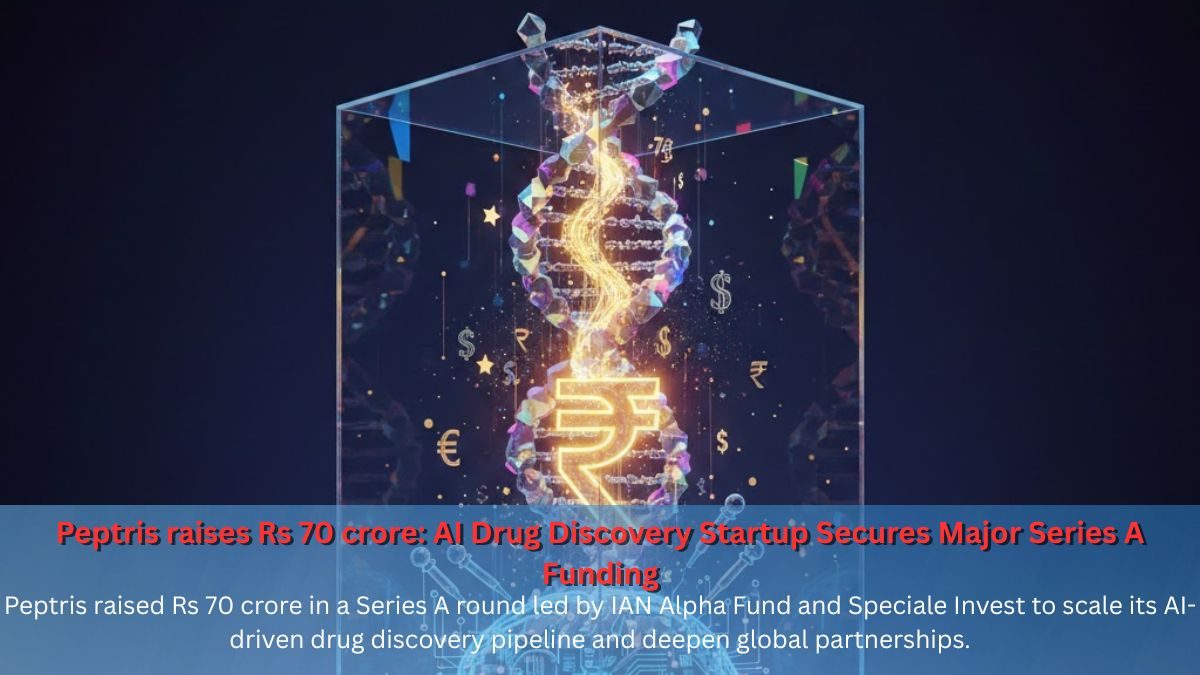
In a landmark development for India’s biotech and deep-tech ecosystem, Bengaluru-based AI-driven drug discovery startup Peptris raises Rs 70 crore in a Series A funding round. The round was co-led by IAN Alpha Fund and Speciale Invest, with participation from Tenacity Ventures, BYT Ventures and other investors. This capital infusion will accelerate Peptris’s efforts to bring its drug discovery programmes closer to clinical development, expand its pipeline over the next 24 months, and support recruitment across scientific and technology teams, especially in biology, chemistry, data science, and artificial intelligence.
The company’s proprietary AI platform is designed to generate novel molecules and predict crucial drug development parameters early, helping reduce costs and failure rates in preclinical research, a longstanding bottleneck in pharmaceutical R&D. Founded in 2019 by Narayanan Venkatasubramanian, Shridhar Narayanan, Anand Budni and Amit Mahajan, Peptris has emerged as a leader in integrating computational intelligence with early-stage drug research. Besides advancing novel chemical entities, the startup also pursues drug repurposing and rescue programmes that can unlock new therapeutic uses for existing or shelved compounds.
The funding reflects growing investor confidence in AI-powered biotech solutions in India and signals an expansion of deep-tech venture capital beyond traditional sectors such as fintech and e-commerce into life sciences and healthcare innovation. Stakeholders say this Series A capital will help strengthen global collaborations, particularly in the United States and Europe, while reinforcing India’s status as a hub for advanced biotech innovation and AI-based drug discovery platforms.
1. Background of the Startup
1.1 Origins and Founders
Peptris was born in 2019 in Bengaluru, but the idea had been brewing long before its formal launch. Its four founders Narayanan Venkatasubramanian, Shridhar Narayanan, Anand Budni and Amit Mahajan came together with a shared frustration every drug-discovery professional knows too well. They had spent years watching promising molecules fail late in the process, despite massive investment, brilliant science and long nights spent in the lab.
They understood the real emotional cost of these failures. Drugs don’t just disappear from a spreadsheet. They take with them months of hope, millions in sunk costs and the possibility of helping patients who are running out of time. Peptris emerged from that lived experience. The founders weren’t chasing hype. They wanted to fix a system they had personally struggled with one where timelines drag, decisions move slowly and life-changing therapies often never see the light of day. Together, they pooled their expertise in AI, biology, chemistry and machine learning to build tools they wished they had earlier in their careers.
1.2 Mission and Vision
Peptris began with a simple but ambitious mission: to make drug discovery smarter, faster and far less painful. At its core was the belief that advanced AI systems could finally break the bottlenecks that make early-stage research so expensive and unpredictable.
The team’s vision wasn’t just technological. It was deeply human. They wanted to help scientists make decisions with clarity instead of guesswork. They wanted to replace endless trial-and-error with intelligent prediction. And most importantly, they wanted more patients to have access to the therapies they desperately need. Their goal was to shorten the journey from idea to impact, so that medical breakthroughs don’t stay stuck in research pipelines but reach real people sooner.
2. How Peptris Works
2.1 AI-Powered Drug Discovery Platform
Peptris built an AI engine designed to work the way experienced scientists think only at a scale no human team could match. Its platform uses unsupervised learning, generative models and predictive simulations to design and prioritise molecules long before they reach the lab. Instead of screening millions of compounds manually, the system rapidly evaluates virtual libraries, predicts pharmacokinetics, flags toxicity concerns and highlights the most promising candidates. The result is a level of precision researchers often describe as “having a thousand senior scientists working beside you, all day, every day.”
This isn’t automation for the sake of automation. It’s deeply collaborative tech that gives researchers the clarity and confidence they’ve been craving for years.
2.2 Core Services and Capabilities
Peptris’s discovery engine supports three major scientific approaches:
- Generating new chemical entities (NCEs) – designing original molecules with the right profile from day one.
- Repurposing approved drugs – finding new uses for molecules already known to be safe.
- Rescuing clinically tested assets – giving a second life to molecules shelved too early.
Each capability reduces the need for wasteful, repetitive lab work. Pharma partners often describe the experience as “cutting months of uncertainty out of the process.”
2.3 Engagement Model with Industry
The company works entirely B2B, partnering with pharma and biotech teams that need fast, high-confidence discovery support. Its revenue comes from licensing its technology, milestone-linked payments and royalties tied to successful discoveries.
This model lets Peptris stay deeply involved throughout the scientific journey instead of just handing off a tool and stepping away. For many partners, this ongoing collaboration has become just as valuable as the platform itself.
3. The Funding: Series A Round
3.1 Investors and Capital Raised
In February 2026, Peptris raised Rs 70 crore (about 7.7 million dollars) in its Series A round. The raise was co-led by IAN Alpha Fund and Speciale Invest, joined by meaningful participation from Tenacity Ventures and BYT Ventures. This wasn’t a round driven by hype. Investors leaned in because they could see the substance behind the company. Many had spent months watching Peptris deliver measurable impact for partners who were desperate to accelerate early discovery. They saw consistent results, scientifically sound data and a team that approached the problem with both precision and empathy. To investors, this round was a signal that the industry is ready for a shift. Teams are tired of slow, costly discovery cycles, and Peptris is proving that AI can bridge that gap without compromising scientific rigor.
3.2 Use of Funds
Peptris is approaching the next two years with a practical, outcome-focused plan. Nothing here is theoretical. Every use of capital ties back to real scientific or operational needs:
- Pushing key programmes toward clinical readiness
These are molecules the team believes can actually make it to patients. The funding lets them move from promising data to real-world validation. - Expanding the discovery pipeline
Peptris wants to explore more therapeutic areas, especially those where unmet medical needs keep families waiting for treatments that never arrive. - Strengthening scientific, data science and AI talent
Their technology only works because great people stand behind it. Hiring more expertise means they can take on harder problems with confidence. - Building business development in the US and Europe
Many global pharma teams have already expressed interest. This expansion lets Peptris support them more actively and bring its platform to markets that move fast and demand high-quality science.
This phase is not simply about growing bigger. It’s about growing responsibly. Every decision is tied to the belief that drug discovery should be more predictable, more thoughtful and more humane.
3.3 Quotes from Leadership
Peptris’s leadership often speaks about their work with a level of emotion that’s rare in deep-tech. For them, drug discovery isn’t just a scientific puzzle. It’s a responsibility. They remind their team that every dataset and every model ultimately connects to a person who is waiting for relief, healing or a second chance. Their message is consistent: advanced science means nothing if it doesn’t move lives forward.
4. The Problem Peptris Aims to Solve
4.1 Drug Discovery Challenges
Anyone who has worked in drug discovery knows the emotional weight of the process. It is slow, unforgiving and often heartbreaking. Teams pour years into molecules that fall apart in preclinical testing. Costs climb, timelines stretch and hope fades. Attrition in early stages is brutal. A single failed candidate can wipe out months of progress and millions in investment. It’s not just a financial loss. It takes a toll on scientists who believe deeply in their work and patients waiting for solutions. This is the painful reality Peptris set out to change.
4.2 The Role of AI
Peptris uses AI not as a shortcut but as a way to bring clarity into a process full of uncertainty. Their models simulate what traditional labs can’t do quickly: testing thousands of molecules, predicting safety concerns, highlighting viable candidates and flagging failures early. This approach cuts down the exhausting cycles of trial and error. Instead of spending months in the lab, teams get insights in days. It shortens timelines, reduces cost and gives scientists the confidence to move forward with stronger evidence. The emotional impact is real. Researchers feel more in control. Decisions feel more grounded. And the path from idea to impact becomes far less draining.
5. Industry Context and Trends
5.1 India’s Growing Biotech Ecosystem
India’s biotech sector is entering a moment of transformation. For years, the country has produced exceptional scientific talent, but the infrastructure and funding weren’t always strong enough to match that potential. That’s changing quickly. More investors are supporting deep-tech life science startups. Research institutes are collaborating more actively with industry. And global pharma is taking India seriously not just as a manufacturing hub but as a center for original innovation. Peptris is arriving at a time when the ecosystem is finally ready to support bold, high-impact science.
5.2 Surge in AI in Drug Research
Around the world, AI-first discovery is shifting from experiment to expectation. Pharma companies that once relied only on traditional wet-lab workflows are now integrating computational tools into early discovery. They want to move faster, fail smarter and allocate resources more wisely.
Peptris is part of this global movement, but with a uniquely grounded approach. Their platform wasn’t built in a vacuum. It was built by people who have lived the frustrations of traditional discovery and know exactly where AI can make the most meaningful difference. pharmaceutical R&D is rising, making startups like Peptris attractive targets for venture capital.
6. Competitive Landscape
6.1 Direct Competitors in AI-Driven Drug Discovery
Peptris works in one of the most competitive and fast-moving spaces in life sciences. Across the world, several companies are racing to blend AI with chemistry and biology, each trying to prove they can predict drug behavior better and faster than traditional methods. Some build generative chemistry platforms. Others specialize in virtual screening or predictive toxicology.
Peptris stands out because its technology was shaped by people who have lived the day-to-day reality of failed experiments, unclear data and the emotional toll of slow progress. The founders know exactly where AI adds real scientific value and where it becomes noise. While many competitors chase scale, Peptris focuses on accuracy, interpretability and meaningful outcomes. Pharma partners often describe their experience with Peptris as “finally feeling like we can see the science clearly again.” In a sector where everyone talks about speed, Peptris brings a rare combination of speed, humility and deep scientific understanding.
6.2 Indirect Competitors
Indirect competition comes from traditional pharma R&D groups and contract research organizations. These teams rely heavily on conventional wet-lab workflows, established assays and manual screening techniques. Their processes are trusted and time-tested, but they move slowly and burn through resources quickly.
Peptris doesn’t dismiss their value. Instead, it complements what they do. AI isn’t here to replace the lab. It’s here to help researchers focus on the right experiments instead of drowning in endless cycles of trial and error. Indirect competitors often struggle to match the pace and precision Peptris offers. And once teams experience a discovery process that feels more informed, more predictable and less emotionally draining, they rarely want to go back.
7. Growth and Future Prospects
7.1 Pipeline Expansion
With fresh Series A funding, Peptris is stepping into a new chapter marked by sharper execution and bolder ambition. Several ongoing programmes are now moving faster toward clinical readiness. At the same time, new projects are being launched, especially in drug repurposing and molecule rescue—areas where patients often wait the longest for breakthroughs.
What makes this phase exciting is the sense of momentum inside the company. Teams describe feeling “lighter” and more confident because they finally have the resources to explore ideas that were previously out of reach. Each new molecule entering the Peptris pipeline represents not just scientific curiosity but the possibility of easing someone’s pain, restoring someone’s hope or extending someone’s life.
7.2 Global Partnerships
Peptris is also gearing up for deeper partnerships across North America and Europe. These regions house some of the most advanced pharma companies in the world groups that understand the value of AI and are eager for tools that help them make better decisions faster. The company’s goal isn’t to simply “expand internationally.” It’s to build relationships built on trust, shared scientific values and a common desire to bring therapies to patients sooner. Peptris wants to collaborate with teams who care as deeply about meaningful impact as they do. Every partnership is an opportunity to demonstrate that AI, when built with empathy and scientific rigor, can elevate the entire discovery journey.
8. Learning for Startups and Entrepreneurs
Peptris’s story offers lessons that go far beyond biotech:
- Solve a problem you have personally felt.
The founders built Peptris because they were tired of watching promising molecules fail late after years of work. That emotional weight became their motivation. - Lead with integrity, not noise.
In a space filled with exaggerated claims about AI, Peptris grew by showing real results, not big promises. - Build technology that respects human effort.
Their AI doesn’t replace scientists. It gives them clarity, saves them from unnecessary late-stage failures and protects their emotional energy. - Grow only when the foundation is strong.
Peptris waited until it had real traction and proven value before raising a large round. This preserved trust and kept the company grounded. - Remember the human outcome.
Whether a startup works in biotech, software or consumer products, the end goal should always be improving someone’s life in a meaningful way.
Peptris’s journey shows how powerful a company can become when it combines technical expertise with lived experience, empathy and relentless purpose. If more startups approached innovation this way, we would see not just better technology but better outcomes for the people who depend on it.
About foundlanes.com
foundlanes.com is India’s leading startup idea discovery platform. It helps entrepreneurs find actionable startup opportunities, market insights, and industry-specific guidance to turn ideas into real businesses. With deep research and practical resources, foundlanes supports founders at every stage, from idea validation to launch and growth.