


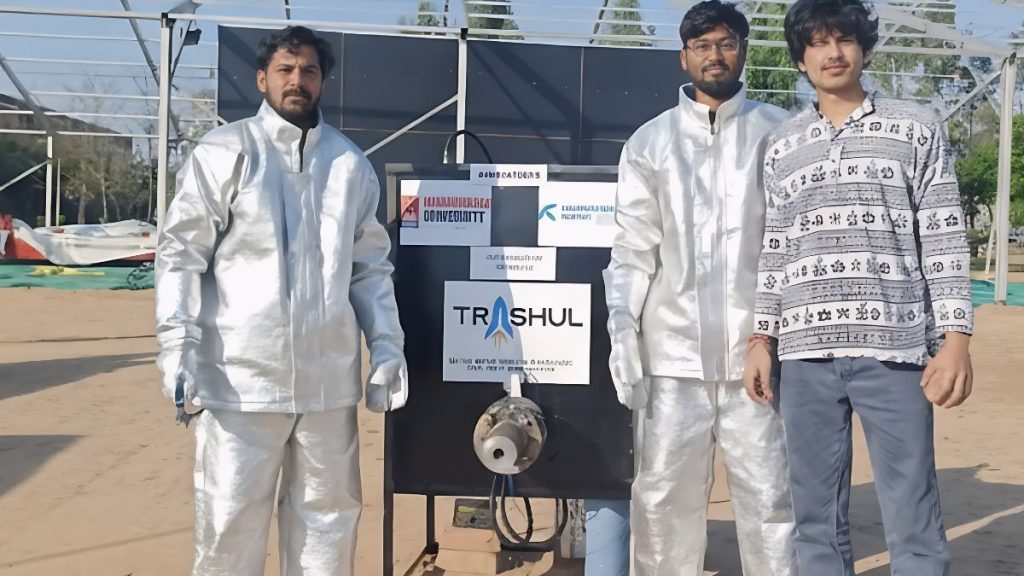
Trishul Space, a Prayagraj-based rocket propulsion startup, has made headlines as Prayagraj Rocket Startup Trishul Space Raises Rs 4 Crore in a pre-seed funding round led by IAN Angel Fund, with contributions from 8X Ventures and ITEL. This isn’t just a funding milestone, it’s a vote of confidence in a young team tackling one of the most complex challenges in aerospace: building reliable, high-performance rocket engines. Founded in 2022 by Aditya Singh, Divyam, and Rajat Choudhary, Trishul Space is focused on developing next-generation liquid rocket engines. Its flagship Harpy-1 engine integrates staged combustion cycles with AI-driven failure detection, aiming to make space launches faster, cheaper, and more accessible.
The new capital will push research and testing in turbopump technology, strengthening Trishul Space’s goal of offering modular, ready-to-use propulsion systems for both government and private launch vehicle manufacturers. Operating out of IIT Delhi’s Research & Innovation Park, the startup is challenging a long-standing bottleneck in the Indian space ecosystem making rocket propulsion scalable, affordable, and globally competitive.
This round reflects the broader trend of India’s private space sector maturing, with deep-tech startups stepping in where traditional programs struggle to innovate quickly. As the global market for small and medium-lift launch vehicles is projected to cross $15 billion by 2030, Trishul Space is positioning itself not just as a participant, but as a key driver of India’s private aerospace ambitions.
1. Introduction
1.1 Overview of Funding Announcement
Prayagraj Rocket Startup Trishul Space Raises Rs 4 Crore, a milestone that signals serious momentum in India’s private space sector. The pre-seed funding led by IAN Angel Fund, with support from 8X Ventures and ITEL, injects much-needed capital into the development of Harpy-1, Trishul’s liquid rocket engine tailored for small satellite launches.
What stands out is not just the money, but the belief in a technical vision: combining AI, staged combustion cycles, and modular design to reduce development time, simplify integration, and cut costs for rocket builders. The funds are earmarked for turbopump optimization, testing, and scaling R&D operations tasks that have historically slowed down India’s private launch ambitions.
1.2 Significance for India’s Space Startups
India’s space sector is no longer the exclusive domain of government programs. Startups like Trishul Space are bridging the gap between ambition and execution. By streamlining rocket propulsion, they allow new entrants to build launch vehicles without the decades-long trial-and-error cycle. This is a crucial shift: private innovation is becoming central to India’s global space competitiveness.
2. Background of Trishul Space
2.1 Founding and Vision
Trishul Space was founded in 2022 by Aditya Singh, Divyam, and Rajat Choudhary, rooted in Prayagraj but operating out of IIT Delhi’s Research & Innovation Park. The founders’ vision is clear: build India’s most advanced, reliable, and affordable rocket propulsion systems. They aim to make rocket engines modular, plug-and-play, and accessible to private and government players alike.
2.2 Core Offerings
The startup’s flagship, Harpy-1, is a liquid rocket engine that combines staged combustion cycles with AI-based failure detection. What makes it compelling is the modular design: manufacturers can integrate it without reinventing the wheel, cutting development time and reducing risks. Trishul Space is effectively offering “propulsion as a platform,” something rare in the Indian space ecosystem.
2.3 Growth and Market Potential
Small and medium-lift launch vehicles represent a global market projected to exceed $15 billion by 2030, with propulsion systems comprising roughly 30–40% of total costs. Trishul Space’s approach high performance yet affordable positions it to capture a meaningful slice of this market while bolstering India’s private space ambitions.
3. Business Model and Revenue Streams
3.1 Revenue Model
Revenue comes from selling ready-to-use propulsion systems to launch vehicle developers. The startup focuses on high-value engines that save clients engineering time and cost. The modular nature also allows Trishul Space to scale without a corresponding increase in production complexity a smart model in deep-tech startups.
3.2 Value Proposition
AI-assisted reliability, staged combustion technology, and plug-and-play modularity together create a compelling offer. Launch vehicle manufacturers benefit from faster deployment, predictable performance, and lower upfront investment. This is a rare mix in a field where experimentation is usually expensive and slow.
4. Funding and Strategic Support
4.1 Details of the Funding Round
Prayagraj Rocket Startup Trishul Space Raises Rs 4 Crore, a lifeline for turbocharging research and development. The funds will directly impact Harpy-1’s testing and commercialization, allowing the startup to move beyond prototypes and into scalable production.
4.2 Role of IAN Angel Fund
IAN Angel Fund does more than write a check. It offers mentorship, strategic guidance, and access to networks that are vital for deep-tech startups like Trishul Space. In an ecosystem where technical brilliance alone rarely guarantees success, this support can be transformative.
4.3 Investor Perspective
Investors see the long game: a startup capable of redefining India’s private launch capabilities. Supporting Trishul Space is not just a financial bet but a strategic endorsement of India’s potential to compete globally in space propulsion.
5. Operational and Technical Infrastructure
5.1 Engine Development Facilities
The IIT Delhi R&I Park base gives Trishul Space access to advanced labs, testing rigs, and academic collaborations. It’s a place where theory meets practice, enabling rapid prototyping and AI integration to detect potential failures before engines leave the lab.
5.2 Technology Integration
AI isn’t an afterthought; it’s embedded in every stage of engine development. Predictive failure analysis, performance optimization, and monitoring are built into the design, reducing testing time and mitigating risks a necessity in an industry where errors are costly.
6. Industry Opportunity and Trends
6.1 India’s Private Space Growth
The private space sector is expanding rapidly, with small satellite launch vehicles leading the charge. Startups like Trishul Space are attacking the most difficult parts of the puzzle: propulsion and engine reliability, traditionally expensive and time-intensive hurdles.
6.2 Competitive Landscape
Direct competitors include emerging Indian propulsion startups and global small-lift engine manufacturers. Government programs remain indirect competitors, slower but well-resourced. Trishul Space’s advantage is modularity, AI integration, and speed a combination that sets it apart.
6.3 Global Market Trends
Globally, the small and medium-lift market is projected to top $15 billion by 2030. Trends include modular propulsion, AI-enhanced monitoring, cost efficiency, and private-led innovation. Trishul Space’s plug-and-play engines fit perfectly within this trajectory.
7. Founders’ Vision and Strategy
7.1 Insights from Co-founders
Rajat Choudhary stresses that building reliable propulsion systems is tough and expensive. By combining AI, staged combustion, and modular design, Trishul Space is challenging the status quo, enabling faster, more affordable access to space.
7.2 Strategic Goals
The immediate focus is Harpy-1 commercialization, scaling R&D, and securing partnerships. Long-term, the vision is global competitiveness for India’s private space sector, making advanced propulsion accessible to all serious players.
8. Problems Solved by Trishul Space
8.1 For Launch Vehicle Manufacturers
The startup slashes development time and reduces technical complexity by providing modular liquid rocket engines. Smaller teams can now build launch vehicles without starting from scratch.
8.2 For the Aerospace Ecosystem
By offering reliable, cost-effective propulsion, Trishul Space accelerates India’s private space ecosystem, lowers barriers to entry, and enables faster satellite deployment.
9. Learning for Startups and Entrepreneurs
Investing in R&D, focusing on modular solutions, and leveraging deep-tech can be game-changers for startups. Trishul Space proves that combining human expertise with AI and strong mentorship accelerates growth, validates business models, and positions startups for meaningful market impact.
About FoundLanes
At foundlanes.com covers emerging startups and trends, both in India and globally. Coverage of Prayagraj Rocket Startup Trishul Space Raises Rs 4 Crore underscores the rising importance of deep-tech aerospace startups. It tracks funding rounds, technical innovation, and strategic moves, giving entrepreneurs and investors actionable insights into a rapidly evolving ecosystem.