


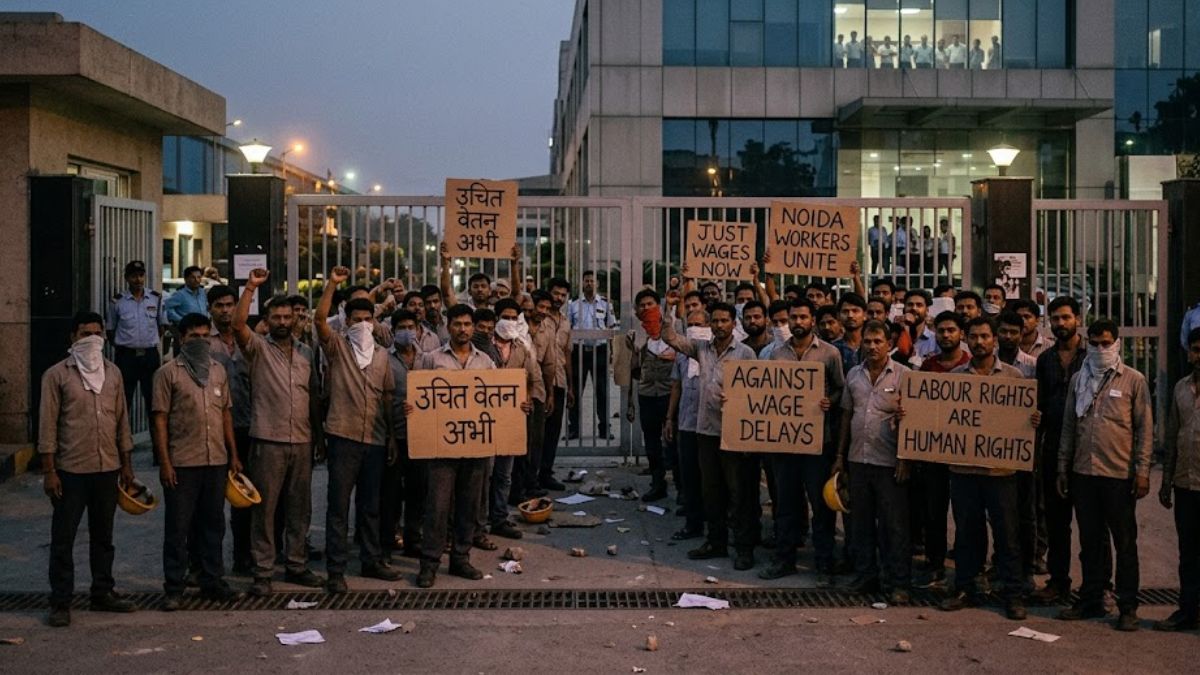
News Summary – Protest or Hooliganism in Noida Labour Unrest
The ongoing “Protest or Hooliganism” situation in Noida has triggered serious debate across India’s industrial and startup ecosystem. What began as a wage-related labour protest outside office premises quickly escalated into chaos, forcing employees inside corporate buildings into panic and lockdown-like conditions. According to multiple reports, labour groups entered office zones in Noida demanding better pay, citing rising living costs and financial distress.
The incident has raised a critical question across media and industry observers: is this a legitimate labour protest or an act of disruption crossing into hooliganism? The “Protest or Hooliganism” debate intensified after visuals showed police using tear gas and trying to control aggressive protest movements. Traffic disruption, office shutdowns, and employee evacuation further worsened the situation.
Workers involved in the protest claim they are unable to meet daily expenses with current wages. Meanwhile, authorities argue that law and order was disturbed, leading to forced intervention. The situation reflects deeper issues in India’s labour market, especially in industrial hubs like Noida and nearby regions.
Interestingly, this unrest is not isolated. It connects with wider labour tensions reported in Faridabad and Manesar, where similar wage-related disputes have surfaced. Analysts suggest that rising inflation, stagnant wages, and poor communication between employers and workers have created a pressure point. The “Protest or Hooliganism” narrative is now dominating discussions across startup news, business funding, startup ecosystem, and Indian startups communities, as companies fear operational disruptions. The event highlights growing concerns in startup trends, business models, startup regulations, and startup markets, especially in high-density office zones. As investigations continue, the core question remains unresolved: was it a structured labour protest or uncontrolled hooliganism disrupting business continuity in Noida’s corporate hub?
1. Understanding the “Protest or Hooliganism” Incident in Noida
1.1 What Happened in the Noida Labour Protest?
The incident in Noida did not start as chaos. It started as frustration that slowly reached a breaking point. Labour groups gathered outside office complexes with a very clear demand: better wages and fair compensation for daily work. At first, it looked like a routine protest that is often seen in industrial areas. But the situation changed quickly when the crowd grew larger and emotions became stronger.
As per reports, the movement escalated when some groups moved closer to office premises, and that is when panic spread inside corporate buildings. Employees who were working inside suddenly found themselves in an uncertain and tense situation. Many rushed out, while others stayed locked inside waiting for clarity. The presence of police added another layer of intensity. Tear gas was reportedly used to control the crowd, which turned the atmosphere from protest to complete disorder within minutes. Offices shut down abruptly, traffic collapsed in nearby routes, and an ordinary workday turned into confusion and fear.
What stands out here is not just the event itself, but how fast it escalated. It shows how fragile industrial peace can become when communication between workers, employers, and authorities breaks down. In a matter of hours, a wage-related protest turned into a full-scale disruption affecting businesses, employees, and daily life in the entire area.
2.2 Why Workers Are Protesting
To understand the protest, it is important to step away from headlines and look at the human side. The workers involved are not asking for something extraordinary. Most of them are asking for stability. Many have shared that their current income is no longer enough to handle basic living costs. Rent has increased, food prices have gone up, and transport expenses keep rising. But wages have not moved at the same pace.
This gap creates a daily struggle that builds slowly over time. It is not a sudden reaction. It is a long accumulation of financial pressure, fatigue, and feeling unheard. In industrial regions like Noida, where large office parks and factories operate side by side, this tension becomes even more visible. Workers see rapid corporate growth around them, new offices being built, and startups raising funding, while their own income remains stagnant. That contrast creates emotional distance between growth and ground reality.
Similar unrest in nearby regions like Manesar and Faridabad shows that this is not an isolated situation. It reflects a broader regional imbalance in wage structures. The phrase “Protest or Hooliganism” becomes a debate because one side sees disruption, while the other side sees survival. In reality, both perspectives are shaped by different lived experiences.
3. Economic Background Behind the Protest Movement
3.1 Wage Pressure and Cost of Living Crisis
The core issue behind this entire situation is not protest itself, but pressure that has been building silently for years. Workers in industrial belts are facing a cost of living that is rising faster than their wages. Basic needs like food, housing, healthcare, and transport have become significantly more expensive, especially in urban and semi-urban corridors connected to major economic hubs.
For many workers, this means every month feels like a balancing act. Even small increases in expenses can disrupt household stability. When income remains fixed while costs keep rising, frustration becomes unavoidable. This is where emotional pressure starts to build. People are not reacting to one incident; they are reacting to years of economic mismatch. In regions like NCR, this gap becomes even more visible because industrial growth and personal income growth are not moving at the same pace.
What makes this situation more sensitive is the proximity to high-growth corporate environments. Workers see wealth creation happening around them, but do not feel part of that growth. This emotional disconnect becomes a major trigger for unrest.
3.2 Industrial Growth vs Worker Earnings Gap
Noida has become a symbol of rapid industrial and corporate expansion. It is home to global startups, fintech companies, AI-driven firms, outsourcing centers, and large-scale service industries. On the surface, it looks like a success story of modern urban development. But underneath that growth, there is a widening gap between business expansion and worker earnings.
Companies are scaling quickly, hiring aggressively, and attracting venture capital. Yet, the benefits of this growth do not always reach the lowest layers of the workforce. Many operational roles still rely on cost-sensitive hiring models, where wage growth remains limited. This creates a structural imbalance. While companies grow in valuation and infrastructure, workers feel stuck at the same financial level.
This imbalance slowly builds frustration. It is not about opposition to industry. It is about feeling left behind in a system that is visibly moving forward. That emotional contradiction is what fuels movements like this and eventually leads to situations being labeled as “Protest or Hooliganism.”
3.3 Impact of Startup Ecosystem Expansion
The expansion of the startup ecosystem in India has created massive opportunities, but it has also introduced hidden pressures. Venture capital funding, unicorn growth, and rapid scaling strategies have pushed companies to optimize costs aggressively. In many cases, operational efficiency becomes the priority, and labour cost becomes a sensitive area of adjustment.
This does not mean startups are the direct cause of unrest. Instead, it shows how ecosystem design indirectly affects ground-level employment structures. As startups focus on growth metrics, user acquisition, and global expansion, support roles often depend on outsourced or contract-based labour systems. This creates a layer of instability for workers who are essential to daily operations but do not always receive long-term security.
Over time, this structural imbalance starts to surface in the form of protests and industrial tension. It influences startup markets, hiring confidence, and even regulatory discussions. What we are seeing is not just a labour issue. It is a reflection of how fast-growing ecosystems sometimes struggle to balance human stability with business speed.
4. Startup Ecosystem Context and Industrial Structure
4.1 Are Any Startups Involved?
It is important to clarify that no single startup has been identified as the direct cause of the incident. However, the environment where the protest happened includes multiple modern workplaces, including emerging startups, outsourcing companies, and service-based firms. These organizations operate in shared industrial and office spaces where operational dependency on workforce support is high.
Workers involved in maintenance, logistics, security, cleaning, and facility operations form the backbone of these environments. Without them, offices cannot function smoothly. Yet, these roles often remain outside the core growth narrative of startups. This disconnect between visibility and importance creates long-term tension that is rarely acknowledged until it becomes a disruption.
4.2 Working Model of Affected Business Ecosystem
The business ecosystem in areas like Noida is built on a layered operational structure. Most companies rely heavily on outsourced labour, contract-based staffing, and service vendors to manage day-to-day functions. This model allows startups and corporates to scale quickly without building large internal operational teams.
High-density office parks amplify this structure further. Multiple companies operate within the same infrastructure, relying on shared services for efficiency. While this model is highly cost-effective and supports rapid growth, it also creates pressure at the lowest level of employment. Workers in these systems often face limited job security, inconsistent wage growth, and minimal upward mobility.
From a business perspective, this structure is efficient. But from a human perspective, it often feels unstable. This contrast between efficiency and emotional security is one of the most important hidden tensions in modern industrial zones.
4.3 Revenue Model and Cost Structure Pressure
Most startups and tech companies operating in such ecosystems follow subscription-based, service-driven, or platform-based revenue models. These models are designed for scalability and predictable income. Investors often push companies to optimize margins, reduce operational costs, and improve unit economics.
In this process, labour cost becomes one of the most sensitive variables. While companies invest heavily in technology, marketing, and expansion, operational cost optimization often happens quietly at the workforce level. This does not necessarily indicate negligence, but it does show how financial pressure travels downward in a growth-driven ecosystem.
Over time, this creates a structural imbalance where revenue grows faster than wage growth. This gap becomes visible on the ground, especially in labour-heavy environments. That imbalance is one of the contributing factors behind tensions that get labeled as “Protest or Hooliganism,” even though the root cause is economic pressure rather than isolated conflict.
4.4 Competitors and Industry Landscape
The industrial landscape in which this incident occurred is highly competitive and interconnected. Direct competitors include IT outsourcing companies, logistics firms, manufacturing clusters, and co-working ecosystems. These sectors compete not just for business, but also for operational efficiency and cost advantage.
Indirectly, the pressure comes from global startups, fintech platforms, and AI-driven automation systems that are reducing dependency on manual labour. As automation increases, certain roles become less stable, creating anxiety among workers whose jobs depend on traditional operational structures. This does not eliminate jobs immediately, but it changes the nature of work over time.
This combination of competition, automation, and cost optimization creates a complex environment where economic growth and employment stability do not always move together. That tension is at the heart of modern industrial transformation in India, and it is clearly reflected in incidents like this.
5. Police Response and Law and Order Situation
5.1 Escalation of the Protest
What began as a controlled gathering quickly turned into a situation that authorities struggled to contain. As protest groups moved closer and eventually inside office premises, the entire environment shifted within minutes. For employees working inside these buildings, the sense of normalcy disappeared almost instantly. Many people were mid-task when they suddenly saw movement outside their floors, raised voices, and unexpected crowd pressure building around the premises.
The panic that followed was immediate and very human. Employees reportedly left their desks without even gathering personal belongings. Some rushed out of exits, while others stayed inside waiting for instructions, unsure whether it was safer to move or remain where they were. This confusion is often what makes such incidents feel more intense than they actually are in scale. It is not just the protest outside; it is the fear inside working spaces that amplifies everything.
From a ground reality perspective, this is where a labour protest stops being just a demonstration and becomes a disruption of daily life. Office routines collapse, communication breaks down, and uncertainty spreads faster than verified information. That emotional shock inside workplaces is one of the most overlooked parts of such events, yet it defines how people remember them long after they are over.
5.2 Security Measures and Intervention
As the situation intensified, authorities responded with deployment of police forces to regain control and stabilize the area. The goal at that stage was not just crowd management, but restoring a sense of safety for both workers outside and employees inside office spaces. When tensions rise in such environments, law enforcement has to act quickly, often making decisions in very short time frames under pressure.
Reports indicated that tear gas was used in certain zones to disperse gatherings. While such measures are typically used to prevent further escalation, on the ground they often create mixed reactions. For those present, it becomes a moment of confusion, fear, and urgency. Some move away immediately, while others try to understand what is happening before reacting. In densely packed office and industrial zones, even controlled intervention can feel overwhelming due to limited space and high population density.
What is important to understand here is the dual pressure authorities face. On one side, they must ensure that protest rights are not completely suppressed. On the other side, they must protect working professionals and maintain order in high-density business environments. This balance is extremely difficult in real-time situations like this. Every decision has visible consequences, and every minute without control increases uncertainty for everyone involved.
5.3 Traffic and Business Disruption
The impact of the protest extended far beyond the immediate location of the gathering. One of the first visible effects was traffic breakdown in surrounding routes. Roads that normally handle steady industrial movement suddenly became congested, with vehicles stuck for long periods and movement slowing to almost a halt in certain stretches. For daily commuters, it turned an ordinary workday into a stressful and uncertain journey.
Inside office environments, the disruption was equally severe. Several buildings reportedly shut operations temporarily, either as a precaution or due to staff evacuation. Meetings were cancelled, production timelines were affected, and digital operations slowed down as teams struggled to coordinate remotely. Even short-term disruptions in such zones can have ripple effects on business schedules, especially for service-based companies that depend on real-time delivery.
The broader business impact is often underestimated in such situations. Delayed operations affect client commitments, productivity cycles, and internal planning. For startups and growing companies, even a few hours of disruption can affect investor confidence and operational metrics. This is where the phrase “Protest or Hooliganism” gained traction in media and public discussions. It reflects not just the nature of the event, but the scale of its impact on both human life and business continuity.
6. Industry Impact on Indian Startups and Business Environment
6.1 Impact on Startup News and Funding Sentiment
Events like these do not remain limited to ground-level disruption. They travel quickly into boardrooms, investor discussions, and funding conversations. Venture capital firms and angel investors constantly evaluate not just business models, but also the stability of the environments where those businesses operate. When incidents like this occur in major industrial hubs, they immediately become part of risk assessment discussions.
For investors, stability is as important as growth. Even high-potential startups can lose momentum if operating environments appear uncertain or volatile. That is why startup trends, regulatory conditions, and regional risk factors are closely monitored. Situations like this influence sentiment around startup markets, especially when they occur in areas that host a large number of venture-backed companies.
In simple terms, it is not just about one protest. It is about how safe and predictable the ecosystem feels for long-term capital. When disruptions happen, even temporarily, they create questions in the minds of investors about scalability and operational risk. This is why such events often reflect quickly in startup news coverage and funding discussions, even if no startup is directly involved.
6.2 Hiring and Workforce Concerns
One of the most immediate impacts of such incidents is on hiring sentiment. Companies operating in affected regions often become more cautious in recruitment planning, especially for roles that require physical presence in industrial zones. Hiring confidence can slow down temporarily as businesses reassess operational stability.
Contract labour availability is also affected in subtle ways. Workers become more uncertain about job security, while employers become more cautious about large-scale onboarding. This creates a temporary hesitation on both sides. Even startup jobs, which are usually seen as attractive and fast-growing opportunities, can feel uncertain during such disruptions.
Workforce stability is not just a human resources issue in such cases. It becomes a business continuity concern. Companies begin evaluating backup plans, remote work structures, and alternative operational locations. Over time, repeated incidents can influence where startups choose to set up offices, which directly affects regional employment ecosystems.
6.3 Broader Startup Ecosystem Concerns
Beyond immediate hiring and funding effects, such incidents also raise broader questions for the entire startup ecosystem. Startup incubators, accelerators, and venture-backed platforms often evaluate long-term infrastructure stability before supporting expansion into specific regions. When industrial unrest occurs, it adds a layer of caution to location-based decisions.
For global funding networks, even temporary instability can influence perception. Investors prefer ecosystems where operational risk is predictable and manageable. Industrial unrest, even if short-lived, becomes part of that evaluation matrix. This does not reduce India’s growth potential, but it does highlight the importance of balancing rapid expansion with social and operational stability.
Over time, such events can influence how startups design their business models. Companies may shift toward hybrid work structures, distributed operations, or automation-heavy systems to reduce dependency on high-density industrial zones. This is how ground-level events slowly shape strategic decisions across the entire ecosystem.
7. Social and Economic Analysis of “Protest or Hooliganism” Debate
7.1 Worker Perspective
From the perspective of workers, this situation is not about disruption or confrontation. It is about survival. Many workers see the protest as a necessary response to long-standing financial pressure. When daily wages do not align with rising living costs, frustration builds gradually until it reaches a breaking point. In that moment, protest becomes not a choice, but an expression of accumulated struggle.
There is also a deeper emotional layer here. Workers often feel invisible in the broader economic narrative. While cities expand, companies grow, and startups raise funding, their own financial reality remains unchanged. This disconnect creates a sense of being left behind in a system that is visibly moving forward. From their point of view, raising their voice is not disruption. It is an attempt to be heard in a system that often overlooks them.
7.2 Corporate Perspective
From the corporate side, the situation is viewed through a completely different lens. For companies, stability, productivity, and safety are non-negotiable. Any disruption that affects operations, employees, or client commitments is seen as a serious threat. This is why such incidents are often described in stronger terms like “hooliganism” in public discussions.
It is not necessarily about dismissing worker concerns. It is about managing risk in environments where time-sensitive operations are critical. For startups and businesses, even a few hours of disruption can affect deliverables, revenue cycles, and investor expectations. This creates a natural conflict between operational continuity and protest activity.
7.3 Policy and Governance Gap
At the center of this entire situation lies a deeper structural issue: the gap between labour regulation and wage reality. While policies exist to protect worker rights, implementation and wage alignment often lag behind economic changes. This creates a space where frustration builds faster than resolution mechanisms can respond.
The “Protest or Hooliganism” debate is therefore not just about one incident. It reflects a larger policy challenge where economic growth, labour welfare, and industrial expansion are not always moving in sync. When this imbalance continues, it eventually surfaces in visible disruptions like the one seen in Noida.
8. Learning for Startups and Entrepreneurs
8.1 Importance of Wage Balance
One of the clearest lessons from such incidents is that wage balance is not just a financial decision, it is a stability decision. When companies design compensation structures, especially in high-growth environments, they often focus on cost efficiency and scaling speed. But in reality, wages are deeply connected to emotional stability on the ground. When people feel fairly paid, they do not just work harder, they work with trust, and that trust becomes the invisible foundation of operational stability.
In many startup and industrial ecosystems, wage decisions are made in isolation from ground realities like inflation, living costs, and regional economic pressure. Over time, this creates a gap between what companies consider “market rate” and what workers feel is “livable income.” That gap does not stay silent forever. It slowly builds into frustration, disengagement, and eventually visible unrest. For startups aiming to scale sustainably, understanding this balance is not optional. It directly affects retention, productivity, and even brand reputation in the long run.
8.2 Workforce Stability Matters
Workforce stability is often underestimated in fast-moving startup environments, but it is one of the strongest predictors of long-term success. A company can have a great product, strong funding, and aggressive growth plans, but without stable teams, execution always becomes fragile. When employees feel uncertain, undervalued, or disconnected from the company’s growth story, that instability quietly reflects in performance, coordination, and delivery timelines.
What many founders realize too late is that employee satisfaction is not just about perks or culture statements. It is about consistency, respect, and a sense of belonging. When workers feel secure in their roles, they naturally contribute more creatively and efficiently. On the other hand, when uncertainty grows, even small disruptions can escalate into larger operational challenges. In environments like industrial hubs, this becomes even more critical because workforce dependency is high. Stability is not just a human resources goal here; it is a business survival factor that directly influences scalability.
8.3 Risk Management in Industrial Zones
Operating in dense industrial zones comes with hidden risks that many companies only recognize after disruption occurs. These risks are not always financial or technological. Often, they are social and operational in nature. Labour relations, local sentiment, and workforce expectations can all influence how smoothly a business functions on a daily basis.
Companies that scale successfully in such environments are usually the ones that build structured systems for dispute resolution and communication. This includes clear grievance channels, transparent wage discussions, and proactive engagement with workforce concerns. When these systems are missing, small issues can escalate quickly, especially in high-density office and industrial clusters where multiple stakeholders are involved. Risk management in this context is not about preventing protests alone. It is about creating an ecosystem where tensions are identified early and resolved before they grow into disruptions.
8.4 Long-Term Business Sustainability
Long-term sustainability in business is not just about revenue growth or market expansion. It is about building systems that can survive pressure, uncertainty, and social complexity. Ignoring labour-related issues may not show immediate impact, but over time it can quietly weaken the foundation of even the most successful startups. Growth strategies that focus only on scaling without considering workforce stability often face hidden resistance in execution.
For venture-backed startups, this becomes even more important because investor expectations are tied to predictable performance. Any disruption in operations, whether due to labour unrest or workforce dissatisfaction, can impact trust, valuation confidence, and future funding rounds. Sustainable businesses are the ones that treat employees as core stakeholders, not just operational resources. When startups understand this early, they not only reduce risk but also build stronger, more resilient organizations capable of handling rapid expansion without internal breakdowns.
About foundlanes.com
foundlanes.com is India’s leading startup idea discovery platform. It helps entrepreneurs find actionable startup opportunities, market insights, and industry-specific guidance to turn ideas into real businesses. With deep research and practical resources, foundlanes supports founders at every stage, from idea validation to launch and growth.