


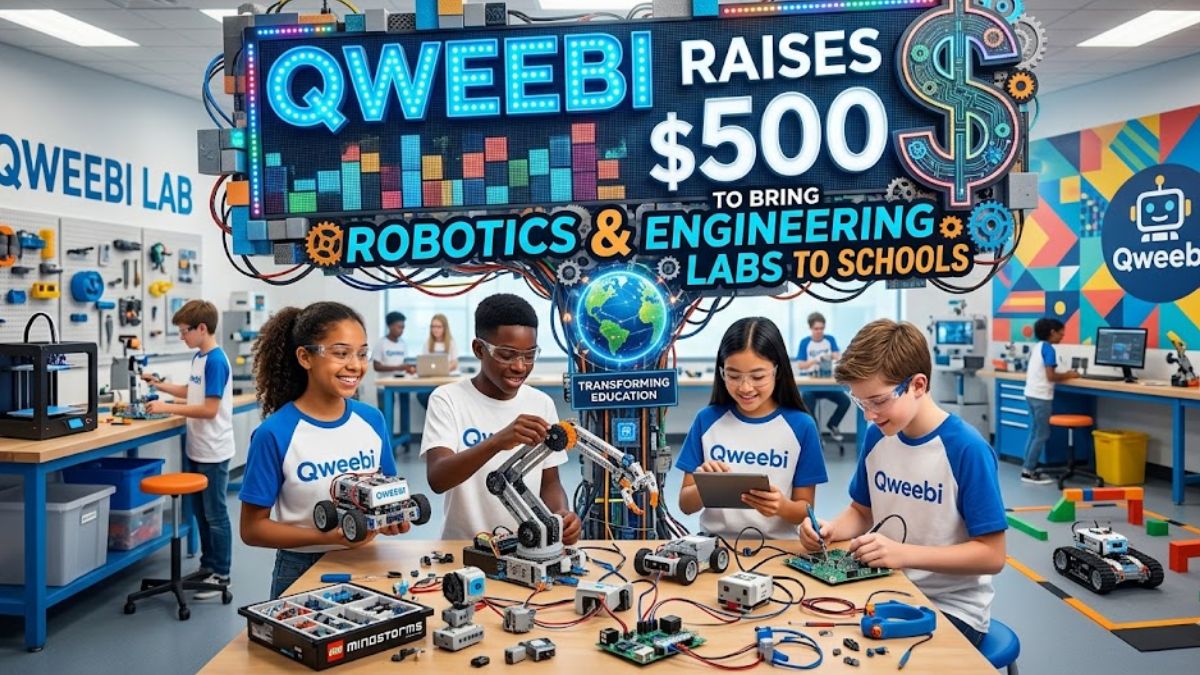
News Summary
The headline “Qweebi Raises $500K” marks a significant moment in India’s fast-evolving edtech and STEM learning space. Qweebi, a K-12 edtech startup focused on hands-on robotics and engineering education, has raised $500,000 in a seed funding round led by Inflection Point Ventures. The funding aims to scale its browser-first robotics platform and expand access to experiential STEM learning across schools in India and beyond. Founded with a mission to make engineering education accessible and engaging, Qweebi is addressing a deep gap in the traditional education system. While students learn theory, they rarely get practical exposure to concepts like robotics, electronics, and coding. Qweebi’s model flips this approach by enabling students to build, experiment, and learn through virtual labs and hands-on kits. Its low-friction, browser-based platform allows schools to adopt robotics education without heavy infrastructure investment.
The startup operates at the intersection of education and technology, tapping into rising demand for future-ready skills. As India pushes toward innovation-driven growth, STEM education has become a national priority. Qweebi’s approach aligns with this shift, offering scalable solutions for schools that want to integrate robotics and engineering into their curriculum. The funding comes at a time when the global edtech sector is witnessing transformation. Investors are now focusing on sustainable business models, real learning outcomes, and product depth. Qweebi’s traction and vision have positioned it as an emerging player in this space. This development not only highlights the growth of Indian startups in deep learning domains but also reflects broader industry trends. With this capital, Qweebi plans to expand its reach, enhance product capabilities, and strengthen partnerships with schools.
1. Introduction to the News: Qweebi Raises $500K
1.1 Understanding the Funding Announcement
When a startup like Qweebi raises $500K, it may not grab headlines the way large funding rounds do, but if you look closely, it tells a much deeper story. This is not just about capital coming in. It is about belief in a very specific kind of education. One that moves beyond textbooks and into real understanding.
The round, led by Inflection Point Ventures, signals that investors are beginning to pay attention to niche edtech models. Platforms that are not trying to be everything for everyone, but instead are focusing on doing one thing exceptionally well. Qweebi’s focus on practical STEM and robotics education is what makes this interesting. It is not chasing scale through generic content. It is building depth in a space that actually prepares students for the real world. And that is where the real value lies.
1.2 Why This News Matters in the Startup Ecosystem
If you step back and look at India’s edtech wave, the first phase was dominated by test preparation and content-heavy platforms. They scaled fast. They reached millions. But somewhere along the way, a gap remained. Students were learning, but not always understanding. They were consuming information, but not always applying it. This is where the next phase of edtech is emerging.
Startups like Qweebi are shifting the focus toward skill-based learning. Toward building, experimenting, and actually doing things. It is a quieter shift, but a far more meaningful one. This funding reflects that change. It shows that the ecosystem is beginning to value outcomes over just reach. Learning that stays with the student, not just content that gets completed.
2. About Qweebi: Startup Overview and Vision
2.1 Founders and Background
Behind Qweebi is a team that seems to understand a simple but powerful truth. Education is not broken because of lack of information. It is broken because of lack of experience. While detailed public profiles of the founders may be limited, their direction speaks clearly. They come from a mix of technology and education, and more importantly, they seem to have spent time understanding how students actually learn.
There is usually a moment that drives founders in this space. Maybe it was seeing students struggle with concepts that felt abstract. Maybe it was realizing that classrooms often stop at theory, leaving curiosity unanswered. Whatever that moment was, it has shaped Qweebi’s approach. Instead of adding more content, they are trying to change how learning happens.
2.2 Vision and Mission
Qweebi’s vision feels both ambitious and necessary. To make STEM education accessible, affordable, and engaging is not a small goal. It is a response to a very real gap that exists across schools, especially when it comes to subjects like robotics and engineering. Their mission aligns closely with where the world is heading.
We are moving toward a future where automation, AI, and technology will define most industries. Preparing students for that future cannot rely on outdated methods. It requires a shift. From memorizing to understanding. From listening to building. Qweebi is trying to be part of that shift.
3. Product and Working Model
3.1 How Qweebi’s Platform Works
One of the biggest barriers in robotics education has always been access. Hardware is expensive. Software is complicated. And for many schools, especially outside major cities, setting up a full lab is simply not practical. Qweebi’s browser-first platform quietly removes these barriers. Students can access virtual labs directly, without downloading heavy software or relying on physical infrastructure. It sounds simple, but the impact is significant. It means a student sitting in a regular classroom, or even at home, can experiment with robotics concepts that would otherwise be out of reach. This kind of accessibility changes who gets to learn.
3.2 Hands-On STEM and Robotics Learning
What truly sets Qweebi apart is its emphasis on doing, not just learning. Students are not just watching videos or reading explanations. They are building projects, running simulations, testing ideas, and sometimes failing before they get it right. And that failure is important. Because real learning often happens in those moments when something does not work as expected. When a student has to pause, think, and try again. This hands-on approach builds something deeper than knowledge. It builds confidence. Over time, students begin to see themselves not just as learners, but as creators.
3.3 Integration with Schools
Adoption is often the hardest part for any edtech platform. Schools are cautious. Teachers are already managing heavy workloads. Introducing new tools can feel overwhelming. Qweebi’s approach of integrating directly with school curricula makes this transition smoother. Instead of being an add-on, the platform becomes part of the learning process. Teachers can use it as a tool, not as an extra responsibility. This increases consistency. Students engage with the platform regularly, not occasionally. And over time, it helps schools evolve their teaching methods without disrupting their existing structure.
4. Problem Qweebi Solves
4.1 Gap in Traditional Education
If you think back to how most of us were taught, the pattern is familiar. Concepts were explained. Notes were written. Exams were taken. But somewhere in that process, the connection between theory and real-world application was often missing. Students could solve problems on paper, but struggled to apply those concepts outside the classroom. This gap is what Qweebi is trying to address. By focusing on hands-on learning, it brings concepts to life. It allows students to see how things work, not just how they are described.
4.2 Lack of Infrastructure for Robotics
Robotics education has always carried a certain exclusivity. It requires equipment, space, and technical expertise. For many schools, especially those with limited resources, this makes it inaccessible. Qweebi changes this equation. By offering a digital, scalable solution, it removes the dependency on physical infrastructure. Schools no longer need to invest heavily upfront to introduce robotics into their curriculum. This democratizes access in a very real way. It ensures that learning is not limited by geography or budget.
4.3 Need for Future-Ready Skills
The world students are preparing to enter is very different from the one we grew up in. Jobs are evolving. New roles are emerging. Skills that were once optional are now essential. Coding, robotics, problem-solving, critical thinking, these are no longer niche abilities. They are becoming foundational. Qweebi is positioning itself at this intersection. It is not just teaching students how to use technology. It is helping them understand it, question it, and build with it. And that shift, from user to creator, is what will define the next generation.
5. Revenue Model and Business Strategy
5.1 Subscription-Based Model
When you look at how Qweebi is building its business, the model feels practical and grounded in reality. A subscription-based approach, especially with schools, is not just about predictable revenue. It is about continuity in learning. Schools don’t want one-time solutions. They want systems that can integrate into their academic cycle, something they can rely on throughout the year. By offering access through subscriptions, Qweebi becomes part of that ongoing process rather than a temporary tool.
From experience, this model works best when the value is consistently visible. If students are actively using the platform, building projects, and engaging with the content, schools see the return. Renewal becomes a natural decision, not a forced one. It also creates accountability on Qweebi’s side. They cannot afford to become static. The platform has to keep evolving, improving, and staying relevant because schools are constantly evaluating whether it is worth continuing. That dynamic pushes the company to stay sharp.
5.2 B2B2C Approach
Qweebi’s B2B2C model is one of its smartest strategic choices. On one side, it partners with schools. These institutions act as gateways, providing access to a large number of students in a structured environment. On the other side, the real impact is felt by the students themselves. This dual-layer approach creates a strong balance. For the business, it ensures scale. Instead of acquiring individual users one by one, Qweebi can onboard entire classrooms or schools at once. That significantly reduces customer acquisition challenges.
For the product, it ensures relevance. Because the platform is used in real classroom settings, feedback is immediate and practical. Teachers see what works, students engage with what excites them, and the product evolves accordingly. There is also something deeper here. When a student uses a platform like this regularly, not just once in a while, it starts shaping how they think. It becomes part of their learning journey, not just an extra activity. That kind of integration is hard to replicate with purely consumer-driven models.
5.3 Expansion Strategy
With fresh funding, expansion becomes the obvious next step. But in edtech, expansion is not just about reaching more users. It is about maintaining quality while scaling. Qweebi’s focus will likely be on onboarding more schools, strengthening relationships with educators, and refining its product experience. Each new school brings a different environment. Different teaching styles, different student capabilities, different expectations. Scaling successfully means adapting without losing the core value of the platform.
There is also room for product evolution. As more students use the platform, data begins to tell a story. What concepts are difficult? Where do students spend more time? What excites them the most? These insights can shape new features, better simulations, and more intuitive learning experiences. Expansion, when done right, is not just about growth. It is about becoming better at what you already do.
6. Funding Details and Investor Confidence
6.1 Qweebi Raises $500K: Funding Breakdown
At first glance, a $500K funding round may seem modest compared to larger deals in the startup ecosystem. But in early-stage edtech, this kind of capital can be incredibly meaningful. It gives the team breathing space. It allows them to focus on improving the product, investing in technology, and building the right team without being under immediate pressure to generate large revenues. More importantly, it marks the transition from idea to validation. When investors come in at this stage, they are not just funding what exists. They are backing what could exist.
6.2 Why Investors Backed Qweebi
Investors today are becoming more selective, especially in edtech. The market has seen both rapid growth and sharp corrections. This has forced investors to look beyond surface-level metrics and focus on real differentiation. Qweebi stands out because it is not trying to compete in overcrowded segments like test prep or generic learning content. Its focus on robotics and engineering gives it a clear identity. But differentiation alone is not enough.
What likely convinced investors is the combination of accessibility and practicality. A platform that removes infrastructure barriers and enables hands-on learning has a strong value proposition, especially for schools that want to modernize without heavy investments. There is also a sense of timing. The world is moving toward skills that require understanding, not just memorization. Platforms that align with this shift naturally attract attention.
6.3 Role of Angel Investors
In early-stage startups, angel investors often play a role that goes far beyond funding. They bring experience. They bring perspective. And sometimes, they bring the kind of honest feedback that founders may not hear elsewhere. For a startup like Qweebi, this support can be crucial.
Building in education is not straightforward. It involves multiple stakeholders, students, teachers, parents, and institutions. Navigating this complexity requires more than just a good product. Angel investors, especially those who understand the space, can help founders avoid common pitfalls, refine their strategy, and connect with the right people. In many ways, they become silent partners in the journey.
7. Industry Trends and Market Opportunity
7.1 Growth of Edtech and STEM Learning
The edtech industry has gone through a dramatic evolution. There was a phase of rapid expansion, followed by a period of correction where many models were questioned. But through all of this, one segment has remained consistently relevant, STEM learning.
Science, technology, engineering, and mathematics are not just subjects anymore. They are foundational skills for the future. As industries evolve, the demand for these skills continues to grow. And with that, the need for better ways to teach them becomes more urgent. Qweebi is operating right at the center of this demand.
7.2 Rise of Experiential Learning
There is a growing realization in education that passive learning has limits. Students may remember information for exams, but without application, that knowledge often fades quickly. Experiential learning changes this dynamic. When students build something, test an idea, or solve a problem on their own, the learning becomes personal. It stays with them longer. It shapes how they approach challenges. Platforms like Qweebi are built around this idea. They do not just deliver content. They create experiences. And in today’s world, that distinction matters more than ever.
7.3 India’s Startup Ecosystem and Edtech
India’s startup ecosystem is one of the most dynamic in the world. Edtech, despite facing recent challenges, continues to be a significant part of it. But the focus is shifting. The market is moving away from pure scale-driven models toward those that deliver real value. Startups are being evaluated on outcomes, not just user numbers. This creates an opportunity for companies like Qweebi. By focusing on meaningful learning and practical skills, they align with what the ecosystem is gradually demanding. And if they continue to execute well, they have the chance to be part of the next wave of edtech, one that is more thoughtful, more grounded, and ultimately, more impactful.
8. Competitor Landscape
8.1 Direct Competitors
Qweebi is not building in an empty space. There are already several players trying to bring robotics and STEM learning into classrooms. Some focus on physical kits, where students assemble hardware and learn through hands-on building. Others offer coding platforms that introduce logic and programming through structured lessons. At first glance, these solutions seem similar. But when you look closely, each comes with its own limitations.
Hardware-based models, while effective, often struggle with scale. They require investment, maintenance, and physical access. Coding platforms, on the other hand, are easier to distribute but sometimes miss the depth of real-world application. Qweebi sits somewhere in between. It is competing with both, but also redefining what accessibility in robotics education can look like.
8.2 Indirect Competitors
Then there is the broader edtech landscape. Traditional platforms offering coding and science courses have already built large user bases. They are familiar, widely marketed, and often easier for schools and parents to adopt. But there is a subtle gap.
Most of these platforms focus heavily on content delivery. Videos, quizzes, structured lessons. They do a good job of explaining concepts, but often stop short of letting students truly experience them. This is where Qweebi creates its own space. It is not trying to outcompete on content volume. It is focusing on depth. On giving students the ability to actually build, test, and understand. That difference may seem small, but in learning, it changes everything.
8.3 Competitive Advantage
Qweebi’s browser-first approach is more powerful than it initially appears. By removing the need for installations, expensive setups, or specialized hardware, it lowers the entry barrier significantly. A student only needs access to a device and the internet to begin exploring robotics. In real-world terms, this means more schools can adopt it. More students can use it. And learning is no longer restricted by infrastructure.
There is also a certain ease that comes with this model. Teachers don’t have to worry about technical complexities. Schools don’t need to allocate large budgets. Students can start learning almost instantly. This simplicity becomes a strong advantage, especially in a market like India where accessibility often determines adoption.
9. Startup Journey and Growth Story
9.1 Early Days of Qweebi
Every meaningful startup begins with a moment of realization. For Qweebi, that moment came from observing a gap that many had accepted as normal. Robotics education existed, but only for a limited group of students. Those with access to the right schools, the right resources, the right infrastructure. For everyone else, it remained out of reach. The early days were not about scaling or funding. They were about understanding this gap deeply. Why was access limited? What made robotics education so difficult to implement at scale? And more importantly, how could it be simplified? These questions shaped the foundation of Qweebi.
9.2 Building the Product
Turning that understanding into a product is where things get real. The team had to make choices. Not just about features, but about philosophy. They chose accessibility over complexity. Usability over unnecessary sophistication. Scalability over niche perfection. Building a browser-first platform was not just a technical decision. It was a strategic one. It meant designing something that could work across different environments, different devices, and different levels of familiarity with technology. meant thinking about the student sitting in a small classroom just as much as the one in a well-equipped lab. This kind of thinking does not happen by accident. It comes from clarity of purpose.
9.3 Growth Milestones
The $500K funding is a visible milestone. But like most startup journeys, the real milestones are often quieter. A school adopting the platform and seeing students engage differently. A student completing their first project and understanding something that once felt abstract. A teacher finding a new way to explain a concept. These moments don’t make headlines, but they define growth.
The funding, however, adds a new layer. It validates the direction. It tells the team that what they are building is not just meaningful, but also scalable and investable. At the same time, it brings responsibility. To deliver better, to reach further, and to stay true to the original purpose.
10. Broader Impact on Education
10.1 Transforming Classroom Learning
Walk into a traditional classroom, and the pattern is familiar. Teacher explains, students listen, notes are taken. Qweebi begins to change that dynamic. Instead of just listening, students start interacting. They experiment. They test ideas. see immediate results of what they are learning. This shift may seem subtle, but it changes how students engage with education. Learning becomes active, not passive.
10.2 Supporting Innovation and Creativity
There is something powerful about giving students the freedom to build. When they are not limited to predefined answers, they begin to explore. They try different approaches. They make mistakes and learn from them. This process naturally fosters creativity. It also builds confidence. Students start believing that they can solve problems, not just understand them. Over time, this mindset extends beyond the classroom. It shapes how they approach challenges in general.
10.3 Long-Term Impact
The real impact of platforms like Qweebi is not immediate. It shows up years later. In the way students think. In the careers they choose. the problems they decide to solve. By introducing concepts like robotics and engineering early, it prepares students for a future that is increasingly driven by technology. But more than that, it prepares them to adapt. Because the future will not just reward knowledge. It will reward the ability to learn, unlearn, and build.
11. Learning for Startups and Entrepreneurs
There is a quiet clarity in Qweebi’s journey that offers meaningful lessons. The first is about solving real problems. Not imagined ones, not trendy ones, but gaps that people actually experience. Qweebi identified a clear issue in education and stayed focused on addressing it.
The second is differentiation. In a crowded edtech market, it chose not to compete broadly. It went deep into robotics and STEM, building a strong identity instead of spreading itself thin. The third lesson is scalability. A browser-first platform may sound like a technical choice, but it reflects a deeper understanding of how to grow without being limited by infrastructure. Then there is timing.
The demand for STEM and skill-based learning is rising globally. Building in alignment with this trend gives the startup a natural advantage. And finally, trust. Investor confidence does not come from just an idea. It comes from clarity. From execution. From showing, step by step, that the vision can become reality. Qweebi’s story is still unfolding. But even at this stage, it reminds you that meaningful startups are not built on noise. They are built on understanding, patience, and a genuine desire to create impact.
About foundlanes.com
foundlanes.com is India’s leading startup idea discovery platform. It helps entrepreneurs find actionable startup opportunities, market insights, and industry-specific guidance to turn ideas into real businesses. With deep research and practical resources, foundlanes supports founders at every stage, from idea validation to launch and growth.