


Summary
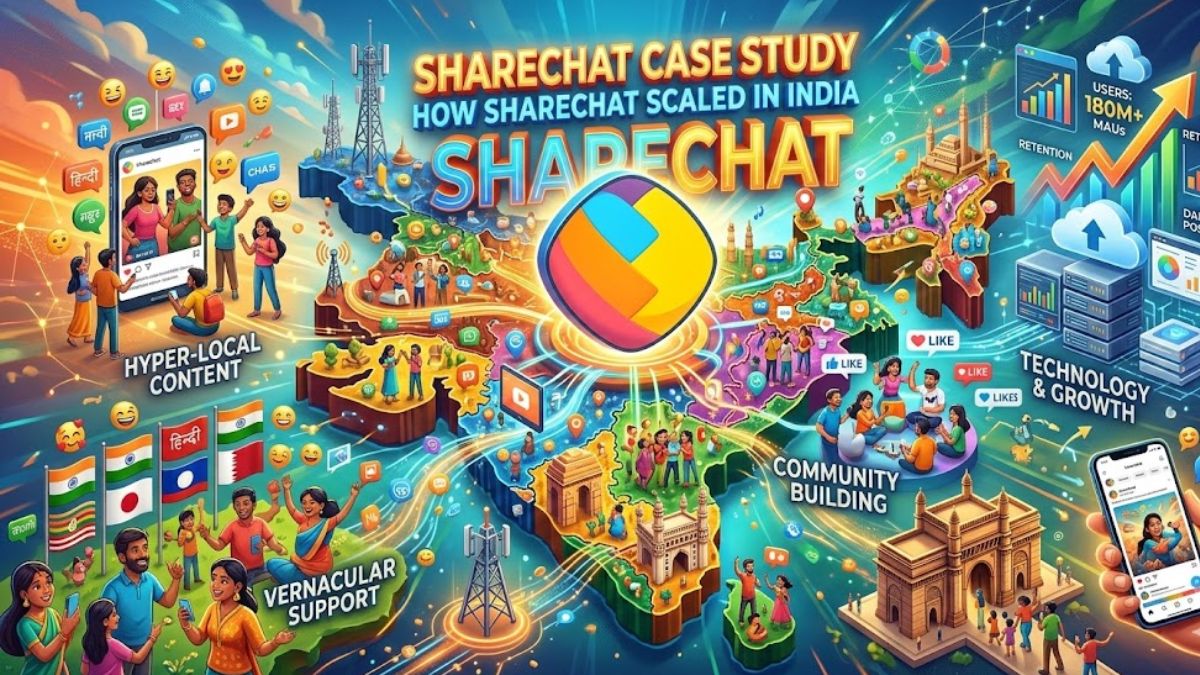
This ShareChat case study examines how the Indian social media platform identified a gap in regional language content, built a product tailored for Bharat-first users, and scaled into one of India’s largest homegrown consumer internet companies. ShareChat is a social networking platform that allows users to create, share, and consume content in their preferred regional language. It was started to solve a simple but overlooked problem: most Indians online did not speak English, and mainstream platforms offered very little support for Indian languages. As a result, millions of new internet users were online but had nowhere relevant to go.
ShareChat was founded in Bengaluru in 2015 by Ankush Sachdeva, Bhanu Pratap Singh, and Farid Ahsan. The trio met at IIT Kanpur and began experimenting with consumer products while still in college. They noticed a rising wave of Indian internet adoption driven by cheap smartphones and cheaper data packs. At the same time, they saw that large global platforms were designed for English-speaking or Hindi-speaking users, ignoring the content needs of audiences who preferred Tamil, Telugu, Bengali, Marathi, Gujarati, Odia, and other regional languages.
ShareChat launched publicly in 2015 and quickly evolved from a WhatsApp content discovery tool to a full-fledged social media platform. It works by allowing users to browse, post, and interact with content entirely in their preferred language. The platform uses machine learning models trained on regional language datasets to deliver personalized feeds. As the user base grew, ShareChat expanded into creator tools, chat features, video formats, and eventually a separate short video app, Moj.
ShareChat has raised over a billion dollars in funding from leading global and Indian investors. While revenue numbers aren’t publicly detailed, the company has experimented with advertising, virtual gifting, and creator monetization tools. This ShareChat business case study traces how the company built for underserved audiences, scaled despite intense competition, and became one of India’s most influential vernacular content platforms.
1. The Origin Story of ShareChat
ShareChat’s origin story begins inside an IIT Kanpur hostel room, not as a grand idea but as a series of experiments. The founders initially tried multiple products, including a debating platform and a small social network, none of which found traction. But these attempts gave them early insight into how Indian users interacted with content.
The turning point came when they observed that many WhatsApp groups were buzzing with regional jokes, memes, quotes, and videos that weren’t available anywhere else online. When they traced the origins of this content, they realized that users relied on informal networks because there was no mainstream platform where regional content thrived. This insight convinced the founders that the next wave of Indian internet growth would not come from English-speaking users in metros but from regional language speakers in smaller cities and towns.
They decided to build a platform that solved this content discovery gap. Instead of focusing on English-speaking audiences, they chose to build for the 90 percent of Indians who preferred their own language. This was the idea that eventually became ShareChat. During the early days, the founders traveled across small towns and interacted with potential users. They observed how people searched for content, what formats they consumed, and which cultural references resonated. This user research shaped the product philosophy long before ShareChat had traction. The founders wanted to create a platform that felt familiar, intuitive, and culturally aligned with the content people already enjoyed sharing in local communities.
The origin of ShareChat is not just the story of a startup but the story of a shifting internet landscape. It was built in response to a structural change: millions of Indians were coming online for the first time, and the internet was not ready for them. ShareChat positioned itself as the home for this new digital audience.
2. The Founder Journey and Early Struggles
The founders of ShareChat had entrepreneurial instincts even before college. They enjoyed experimenting with consumer-facing products and often built tools designed for mass user engagement. In the early years, they created apps that gained small bursts of growth but couldn’t sustain users. These experiences gave them a practical understanding of user behavior, retention problems, and product-market fit. One of the first serious experiments was a debating app that attracted only a niche audience. The founders realized Indian users were more interested in entertainment than structured discussions. Other attempts, including micro-networks, also struggled. Instead of being discouraged, the team treated each failure as user research.
When they started working on ShareChat, early struggles centered around two challenges: understanding what regional language users wanted and building a product that simplified content consumption. They had limited funding, no prior experience in scaling large systems, and a product idea that many investors dismissed as too niche. For months, they manually curated content to understand what resonated. They managed user communities themselves and personally responded to feedback. They spent long hours analyzing patterns in how users shared content between WhatsApp groups and what triggered virality.
The biggest struggle was building language support. Tools for Indian languages were limited, and machine learning models for translation or classification barely existed. The team wrote many tools from scratch, investing time in custom keyboards, language parsing, and spam detection. Despite these challenges, the founders stayed committed to the idea that the next generation of Indian internet users needed their own platform. The founder journey of ShareChat is a story of persistence and user obsession. They built slowly but deliberately, prioritizing user needs over fast growth until the product found its natural audience.
3. The Market Problem ShareChat Identified
Before ShareChat, the Indian social media landscape was dominated by global platforms optimized for English-speaking users. Regional language users found themselves constrained. They preferred content that reflected their own culture, humor, festivals, and local news, but platforms offered little support. The major problem ShareChat identified was that a large majority of Indians entering the internet ecosystem after 2014 came from non-English-speaking backgrounds. They consumed content differently, engaged differently, and often felt intimidated by English-first user interfaces. Their content was informal, community-driven, and deeply cultural, but there was no structured platform to host it.
Two structural shifts amplified this gap. First, inexpensive Android smartphones became available across Tier II and Tier III cities. Second, mobile data costs crashed after the entry of 4G networks. These changes brought millions of new users online, creating a content vacuum. ShareChat noticed that these users were not looking for text-heavy newsfeeds. They preferred short videos, static images, jokes, devotional content, quotes, and memes that reflected local sensibilities. They wanted a place where their language flowed naturally and their identity felt represented.
The lack of Indian language content platforms created an opportunity. Existing platforms were broad, global, and not optimized for regional nuances. ShareChat positioned itself as a specialized solution for this problem: a platform built around Indian language content, cultural familiarity, and intuitive design tailored for first-time internet users. By solving this need, ShareChat tapped into one of the fastest-growing internet user demographics in the world. This case study on ShareChat shows how the company aligned itself with a structural shift in user behavior rather than a trend.
4. How the Product Was Built and Evolved
ShareChat’s product evolution is one of constant iteration. The first version of the app wasn’t even a social network. It was a platform that allowed users to discover trending WhatsApp content. Users would browse through categories and share memes or quotes directly to their groups. This simple workflow drove early traction.
As the team studied user behavior, they realized that people wanted a platform where they could not only forward content but also interact, comment, and build communities. This insight led to the creation of the core ShareChat feed. Building the feed took time. The team built language-specific models to classify content into categories like jokes, entertainment, festivals, motivation, and local updates. Because off-the-shelf tools didn’t support most Indian languages, the engineering team trained custom models using datasets curated from scratch.
Another major evolution was the introduction of creator tools. ShareChat realized early that user-generated content would fuel long-term engagement. They added features that made it easy for creators to upload custom posters, voice clips, and short videos. Over time, ShareChat became not just a consumption app but a creator ecosystem. A significant moment in product evolution came after global short-video platforms were banned in India. ShareChat quickly launched Moj, a separate app focused entirely on short videos. Moj scaled rapidly, leveraging ShareChat’s existing user base and infrastructure.
Over time, ShareChat introduced personalization engines, regional trends, content moderation systems, and improved language support. The product evolved from a simple content-sharing tool into a multi-language social network powered by machine learning. The ShareChat scaling case study demonstrates how the platform continuously adapted to user needs and industry shifts rather than sticking to a fixed product roadmap.
5. Early Traction and the Validation Phase
ShareChat’s earliest traction came from its integration with WhatsApp sharing behavior. Users discovered the app because their friends shared links. This created organic virality, especially in smaller cities where content sharing was a daily habit. A major milestone in early validation came when ShareChat noticed a surge in users from Hindi-speaking regions, quickly followed by growth in Tamil, Telugu, Malayalam, Bengali, and Marathi. The founders saw that once a language community reached a certain critical mass, it became self-sustaining. The content creation and consumption loop remained entirely within the language group.
The validation phase also revealed that engagement was significantly higher among first-time internet users. These users spent long sessions browsing content and were quick to create their own posts. This was a strong signal that ShareChat had tapped into a market gap with real user demand. During this stage, retention became a key challenge. Many users installed the app out of curiosity but didn’t return after a few days. The team focused on improving onboarding, feed relevance, and language settings to ensure users felt comfortable right from the start.
ShareChat also ran small offline campaigns to understand user expectations better. They observed how users interacted with their phones, what confused them, and which content formats triggered emotional engagement. By the end of the validation phase, ShareChat had established itself as a serious player in vernacular social media. Its growth was not explosive in the beginning, but it was consistent and organic. The foundation built during these early years later enabled the platform to scale rapidly when the market expanded.
6. ShareChat’s Business Model and Revenue Approach
ShareChat’s business model evolved alongside the product. Early on, the company prioritized user growth over revenue. The founders believed that building a large, engaged community in regional languages would open new monetization opportunities. Advertising became the natural revenue stream as user numbers grew. Brands interested in reaching regional audiences saw ShareChat as a high-impact channel. The platform offered targeted campaigns based on language, interest, and location. Its ad business grew across categories such as FMCG, entertainment, political outreach, and consumer tech products.
Another revenue stream came from partnerships during seasonal events and regional festivals. Campaigns tailored for local audiences performed well because they matched cultural contexts.
ShareChat also experimented with virtual gifting and creator monetization tools. These features allowed users to support creators directly. Although still evolving, this ecosystem laid the groundwork for future revenue models. Moj, the short-video app, added additional advertising opportunities. With short video emerging as one of India’s most consumed formats, Moj became an important part of ShareChat’s long-term revenue strategy. The ShareChat monetization model continues to evolve, but it remains grounded in a simple principle: enable brands to reach India’s regional internet users in a culturally relevant environment.
7. Funding History and Investor Involvement
ShareChat has raised significant funding from global and domestic investors. In its early stages, the startup received seed funding from well-known Indian venture firms. As the platform demonstrated growth across multiple regional languages, larger investors began to take interest.
Major funding rounds followed, with participation from international investors who recognized the rise of vernacular internet platforms. These investments were used to strengthen engineering teams, expand language support, build machine learning capabilities, and scale infrastructure. Later rounds saw even larger commitments from strategic and financial investors. Some invested because they saw ShareChat as a strong local competitor to global social networks. Others saw value in the company’s deep regional insights and growing creator ecosystem.
A critical phase of fundraising happened when the short-video market in India went through major disruption. ShareChat used some of this funding to accelerate the development of Moj, which quickly became one of the leading short-video platforms in India. The company has raised over a billion dollars in total funding. This capital allowed ShareChat to hire top engineering talent, invest heavily in AI-driven content moderation, and expand its footprint in regional content formats.
8. Go-to-Market Strategy and Distribution Channels
ShareChat’s go-to-market strategy relied heavily on understanding the behavior of India’s first-time internet users. Instead of spending aggressively on advertising in its early phase, the company leaned into natural patterns of content sharing. For millions of new smartphone users, forwarding jokes, memes, and festival greetings through messaging apps was a daily ritual. ShareChat designed its product to fit neatly into this routine, making it easy to share content outwards. This helped the platform spread organically through personal networks.
As the platform grew, ShareChat expanded its strategy into regional influencer collaborations. These creators already had strong followings in their local communities, and their content felt familiar to new users. The platform also experimented with online campaigns during regional festivals when people were actively searching for culturally relevant content. The company’s distribution channels evolved as digital consumption patterns changed. App store optimization played an important role in the beginning, but community-driven word-of-mouth remained a powerful engine of growth. Later, as the brand matured, ShareChat invested in digital marketing, video promotions, and collaborative campaigns with entertainment companies. The launch of Moj gave the company another avenue to acquire users who preferred short videos over static content.
Offline research tours also shaped the go-to-market strategy. The founders and product teams visited smaller cities to understand how people perceived the internet. These interactions guided decisions around UI, onboarding, and content categorization. The platform stayed close to the user base and positioned itself as a friendly, familiar companion for regional internet users. ShareChat’s success in user acquisition was not driven by flashy campaigns but by a thoughtful approach to how India communicates. Its growth strategy shows how deep cultural understanding can outperform traditional marketing playbooks.
9. Brand Positioning and Messaging Evolution
ShareChat’s brand positioning has evolved with the growth of the Indian digital ecosystem. In the beginning, the platform positioned itself simply as a place to find entertaining content in regional languages. The early messaging centered on community participation, familiarity, and cultural comfort. The brand wanted users to feel that the app belonged to them and reflected their everyday lives.
As the platform matured, ShareChat shifted toward positioning itself as the social media home for Bharat. This identity resonated with users from non-metro communities who often felt overlooked by mainstream platforms. By embracing the diversity of local languages and cultural expressions, ShareChat differentiated itself from global giants who primarily targeted English-speaking audiences.
The brand’s voice stayed simple and conversational. ShareChat avoided jargon-heavy messaging and kept its language relatable. Its campaigns highlighted regional festivals, popular local creators, and everyday humor. The platform didn’t try to imitate global social networks. Instead, it leaned into its strengths: linguistic diversity, cultural nuance, and local relevance.
Over time, the brand also focused on empowering creators. The launch of Moj accelerated this shift. ShareChat began emphasizing tools, reach, and opportunities for regional creators to build communities. The platform started hosting creator education programs, workshops, and campaigns that celebrated regional talent. This positioned ShareChat as a growth platform for creators, not just a content destination. ShareChat’s brand positioning today reflects its ambition to be a culturally rooted social network that serves the needs of millions of users outside major metros. The messaging has grown up with the company, becoming more confident as ShareChat solidified its role in the regional content landscape.
10. Key Challenges, Failures, and Turning Points
ShareChat’s journey has not been free of challenges. The platform had to navigate intense competition, evolving user preferences, and the complexities of building technology for multiple languages. One of the earliest challenges was retention. Many users downloaded the app but didn’t return after the first few days. This forced the team to refine onboarding flows, feed algorithms, and content categorization. The founders learned that first-time internet users needed a gentle introduction to features, not complex menus or unfamiliar icons.
Another challenge was moderation. With content flowing in more than a dozen languages, the platform had to invest heavily in machine learning systems and human reviewers to maintain quality. Ensuring user safety across languages with limited training data was a difficult problem.
Competition created another turning point. ShareChat faced pressure from global social networks that began paying more attention to regional audiences. At the same time, local startups also entered the vernacular content market. To stay ahead, ShareChat invested deeply in AI, creator tools, and regional insights. This sharpened the product’s competitive edge. A major turning point arrived when India banned several international short-video apps in 2020. This reshaped the entire content ecosystem. ShareChat responded quickly by launching Moj and redirecting engineering resources to accelerate its growth. Moj’s rapid user adoption helped ShareChat hold onto the short-video audience at a time of industry upheaval.
ShareChat also faced scaling challenges. As millions of users joined every month, infrastructure had to be optimized to handle load across content formats, languages, and geographies. The engineering team had to rebuild multiple systems to support the volume of uploads, downloads, and personalization queries. Each challenge became a learning moment. Failures pushed the platform to rethink assumptions, refine product design, and re-evaluate priorities. These turning points shaped ShareChat into a resilient, insight-driven company.
11. The Competitive Landscape and Differentiation
ShareChat operates in a market dominated by global social networks, domestic content platforms, and entertainment apps. The competitive landscape includes products that serve diverse content categories such as short videos, chat communities, microblogging, and memes. Despite the crowded space, ShareChat carved a distinct position by focusing on regional languages from the start. Competing platforms often treated regional content as an add-on. Their interfaces were built for English-first users, and language support came later. ShareChat flipped this model by placing language identity at its core. This early commitment helped the platform attract audiences who felt underserved elsewhere.
The launch of Moj pushed ShareChat into direct competition with other short-video platforms. While rivals emphasized glamour and high-production content, Moj focused on relatable creators from small towns. This helped Moj succeed among users who sought familiarity rather than polish.
Another differentiator is community culture. ShareChat’s content ecosystem reflects everyday life across India’s small cities and towns. The content is raw, emotional, celebratory, and deeply local. The platform grew by encouraging communities around festivals, religious themes, humor, and motivational quotes all of which resonated strongly with regional audiences.
ShareChat’s focus on building language-specific algorithms also sets it apart. Its recommendation systems are trained to understand the nuances of local scripts, slang, and cultural references. This makes the feed experience more relevant for users and improves engagement. Despite the competition, ShareChat maintained a loyal user base by leaning into its strengths: local relevance, community-driven discovery, and deep language expertise.
12. Growth Metrics, Milestones, and Achievements
ShareChat’s growth has mirrored the rise of the Indian internet. The platform achieved several important milestones as regional language adoption accelerated across the country. One of the earliest milestones was gaining traction in multiple languages simultaneously. This showed that the platform’s model wasn’t limited to one region but had nationwide appeal. Another milestone was crossing tens of millions of users across different language communities. This growth validated the company’s belief that India’s next wave of internet users would prefer regional content.
The launch of Moj was another major achievement. When short-video consumption surged in India, Moj capitalized on the opportunity and became one of the top short-video apps in the country. Its early user growth was among the fastest the company had experienced. ShareChat also achieved recognition for its technology and AI work. The company invested heavily in moderation tools, personalized recommendations, and content curation systems designed specifically for Indian languages. These innovations helped manage the complexity of serving diverse content across user groups.
Another important milestone was securing multiple large funding rounds from global investors. These investments indicated long-term belief in ShareChat’s potential to build a sustainable regional content ecosystem. Although exact revenue numbers are not public, the platform has built meaningful partnerships with brands looking to reach regional audiences. ShareChat’s achievements lie not only in scale but in its ability to stay relevant in a rapidly evolving digital landscape.
13. Team Building and Leadership Approach
ShareChat’s team culture has been shaped by its founders’ belief in experimentation, data-driven decisions, and deep user empathy. In the early years, the company operated like a tight-knit group focused on solving user problems. As the team grew, ShareChat invested in building leadership across engineering, product, content, and creator ecosystem functions.
Hiring for regional expertise became a priority. The company needed people who understood different languages, cultural nuances, and content trends. This shaped a leadership culture that valued diverse perspectives and on-the-ground insights. The founders focused on building strong engineering teams because much of ShareChat’s differentiation came from solving hard technical problems. Supporting more than a dozen languages required custom machine learning solutions, and the company prioritized hiring talent capable of taking on these challenges.
Leadership also emphasized user-first thinking. Teams were encouraged to spend time studying user behavior in smaller cities, understanding their motivations, and building features that felt natural to them. This approach helped ShareChat avoid the common trap of designing products for metro users while expecting them to work for regional audiences. The company’s culture values humility, curiosity, and long-term thinking. Teams are encouraged to learn from failures rather than hide them. This mindset helped ShareChat navigate multiple turning points and stay resilient through market changes.
14. Technology, Operations, and Product Infrastructure
ShareChat’s technology stack is built to support high-volume content uploads, complex feed algorithms, and real-time interactions across multiple languages. Operating at this scale required significant investment in infrastructure. One of the platform’s biggest technological challenges was language processing. Unlike global platforms that focus primarily on English, ShareChat had to build systems capable of understanding scripts such as Tamil, Telugu, Bengali, and Marathi. This meant training machine learning models using datasets that the company often created manually.
Content moderation became another major operational challenge. With millions of daily uploads, the company implemented a combination of automated detection systems and human reviewers. The technology team developed tools for spam detection, hate speech identification, and contextual understanding across languages. Operationally, ShareChat had to ensure its infrastructure could handle spikes during festivals, elections, and major cultural events. These moments often resulted in high user activity, and the platform needed to stay reliable across network conditions.
The recommendation engine was another core component. Personalized feeds are central to ShareChat’s user experience, and the algorithm had to be sensitive to local trends and language-specific content preferences. The engineering team continuously improved ranking models to increase session time and reduce content fatigue. Overall, ShareChat’s technology and operations represent the backbone of its growth. The company built systems tailored for India’s unique digital landscape rather than relying on global templates.
15. Regulatory, Legal, and Industry-Specific Hurdles
Navigating India’s regulatory environment has been a recurring part of ShareChat’s journey. As a social media platform hosting user-generated content, the company had to comply with evolving guidelines related to data privacy, content moderation, and platform accountability.
Changes in IT rules required platforms to set up grievance mechanisms, appoint compliance officers, and respond promptly to user complaints. ShareChat invested in building internal processes to meet these requirements. The company also expanded its content moderation capabilities to align with new legal expectations. Another challenge was managing misinformation. Since ShareChat serves a large regional audience, misinformation could spread quickly without proper checks. The company collaborated with fact-checking partners and enhanced its detection tools to limit the spread of misleading content.
Industry-specific hurdles also emerged during the growth of the short-video ecosystem. The rapid shift in user preferences following the ban of several international apps created both opportunities and responsibilities. ShareChat had to adapt quickly while maintaining compliance with content safety standards. Overall, the regulatory environment forced ShareChat to invest heavily in governance, transparency, and user protection. These measures strengthened the platform’s credibility but also required significant operational resources.
16. Current Status of ShareChat
Today, ShareChat stands as one of India’s leading regional social media platforms. It continues to attract users from across major Indian languages and has built a strong presence in the short-video market through Moj. The company has expanded its creator ecosystem, offering tools, support, and community-building programs for influencers and regional creators. Its advertising partnerships have grown steadily, with brands recognizing the value of reaching audiences in their own languages. Technologically, ShareChat continues to improve its AI systems, moderation processes, and content discovery engines. The platform is also experimenting with new formats and engagement features to stay relevant in a dynamic market.
While competition remains intense, ShareChat retains an advantage because of its deep cultural insights and language-first approach. It is one of the few Indian platforms that has consistently built for Bharat-first users over nearly a decade. ShareChat’s current status reflects a mature company with strong user roots, a wide content ecosystem, and a long-term vision shaped by India’s evolving digital economy.
17. Future Outlook and Long-Term Vision
The future of ShareChat will be shaped by the continued expansion of the Indian digital ecosystem. Millions of new users are expected to come online over the next few years, and most will prefer regional languages. This gives ShareChat a long runway for growth if it continues to deliver relevant content and intuitive product experiences. The platform is likely to invest more in creator monetization, as creators increasingly expect ways to earn through their content. Advertising will remain a major revenue stream, but virtual gifting, brand collaborations, and creator-focused products could become important parts of ShareChat’s revenue strategy.
AI-driven personalization will also play a critical role in ShareChat’s future. With rising competition in short-video and social discovery platforms, relevance will become a key differentiator. ShareChat may continue enhancing its algorithms to improve engagement and reduce content fatigue.
The company’s long-term vision is expected to focus on building a robust digital ecosystem for Bharat, where creators, users, and brands can interact in culturally relevant ways. As India’s internet penetration grows deeper, platforms that understand regional nuances will have an advantage. ShareChat is well-positioned to remain a major player in this space. This ShareChat success story shows how building for India’s linguistic and cultural diversity can create long-lasting value. The ShareChat case study also highlights the importance of cultural insight, timing, and user empathy in scaling a consumer internet product in India.
About foundlanes.com
foundlanes.com documents and analyzes startup journeys, business models, and entrepreneurial insights from across India’s fast-growing startup ecosystem. The platform focuses on long-form case studies, founder interviews, and strategic breakdowns that help readers understand how startups scale, adapt, and build enduring businesses.