


Introduction:
Introduction: How Snabbit Turned Everyday Household Chaos Into India’s Next Hyperlocal Startup Opportunity India’s instant commerce boom changed consumer behavior faster than almost anyone expected. Groceries started arriving in minutes. Medicines showed up before people could leave home. Daily essentials became available with a few taps on a smartphone. Urban consumers slowly became addicted to speed, convenience, and reliability. But inside millions of homes, one major problem still felt painfully old-fashioned.
Finding dependable household help remained frustrating, unpredictable, and completely unorganized. Maids took sudden leaves. Cleaning help arrived late. Local referrals failed often. Trust issues remained common. For working professionals living in fast-moving cities, managing household chores still depended heavily on informal arrangements and endless phone calls. Snabbit saw an opportunity hidden inside that everyday frustration. Founded in 2024 by Aayush Agarwal, Snabbit entered India’s fast-changing home services market with a bold idea: what if booking household help became as easy and predictable as ordering groceries online?
The startup built an on-demand home assistance platform that connects users with trained workers for cleaning, dishwashing, laundry support, and routine household chores through a hyperlocal, app-driven operating model. Instead of depending on fragmented neighborhood networks, Snabbit introduced a managed service layer focused on speed, standardization, and operational reliability. The timing worked in its favor. India’s urban workforce was already adapting to app-based convenience across food delivery, fintech, ecommerce, and quick commerce startups. Consumers had started expecting instant solutions everywhere. Snabbit positioned itself directly inside that behavioral shift, applying quick-commerce style execution to one of India’s largest yet most unorganized service categories.
Initially launched in Mumbai before expanding operations into Bengaluru, the company quickly emerged as one of the fastest growing Indian startup stories in the hyperlocal services segment. Investors responded aggressively. By April 2026, Snabbit had reportedly raised nearly $112 million across multiple funding rounds and reached an estimated valuation close to $350 million. The startup attracted backing from major venture capital firms including Lightspeed, Nexus Venture Partners, Bertelsmann India Investments, Susquehanna Venture Capital, Mirae Asset Venture Investments, and FJ Labs.
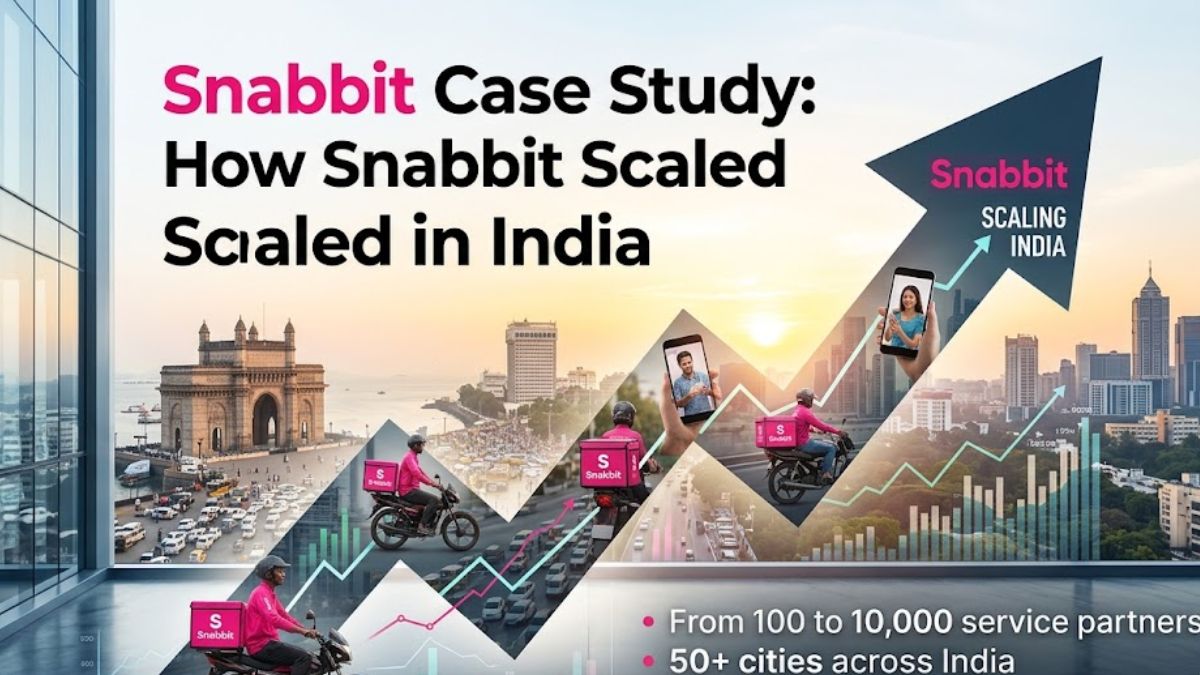
Its rapid rise reflected something much larger happening inside India’s startup ecosystem. Consumers who once waited days for household services were now beginning to expect the same speed and convenience they experienced from instant delivery apps. Snabbit attempted to transform one of India’s most fragmented labor-driven industries into a structured, technology-led, hyperlocal commerce platform powered by operational density and standardized service delivery. This Snabbit Case Study explores how the startup identified a deeply broken market, built a scalable on-demand operations model, attracted major venture capital funding, navigated the highly competitive home services industry, and positioned itself at the center of India’s growing hyperlocal commerce revolution.
1. How Snabbit Was Born From India’s Everyday Household Frustration
The Snabbit startup journey began at a time when India’s consumer internet economy was changing rapidly. Quick commerce apps had already transformed how urban India behaved. Groceries arrived in minutes. Food delivery became effortless. Consumers got used to speed, convenience, and app-first lifestyles almost overnight. But inside homes, daily household management still felt stuck in another decade. Finding reliable domestic help remained frustratingly complicated.
Most families still depended on apartment WhatsApp groups, local referrals, building guards, brokers, or random word-of-mouth recommendations to hire cleaners and household workers. Some workers were dependable. Others disappeared without notice. Schedules changed suddenly. Replacements became stressful. There was very little structure, accountability, or transparency anywhere in the process. The gap became even more visible after the pandemic.
Cities like Mumbai, Bengaluru, Delhi NCR, and Pune saw a sharp rise in dual-income households where both partners worked long hours. Time slowly became one of the most valuable urban resources. People were willing to pay for convenience, but the home services market still lacked reliable, organized, and technology-led solutions for everyday household chores. That is where Snabbit spotted an opportunity. The startup did not look at household work like a traditional classifieds business. Instead, it viewed the category through the lens of hyperlocal logistics and operational execution. And that difference changed everything.
1.1 Aayush Agarwal’s Startup Exposure Shaped Snabbit’s Thinking
Before launching Snabbit, founder Aayush Agarwal had already spent time inside India’s fast-moving startup ecosystem. According to multiple reports and startup discussions, he previously worked at quick commerce company Zepto. That exposure appears to have deeply influenced Snabbit’s operating philosophy. Instead of building another marketplace where users manually searched for domestic workers, the company approached home services with the mindset of a last-mile delivery business.
The insight itself sounded simple on paper. If groceries could be delivered instantly through dense hyperlocal networks, why could household help not operate similarly? But execution was far more difficult. Household services involve human coordination, scheduling unpredictability, worker availability, customer expectations, and operational reliability all at once. Managing those variables at scale required far more than building an app.
Snabbit focused heavily on local density instead of aggressive city-wide expansion. Rather than spreading across entire metropolitan areas too quickly, the company concentrated on tightly packed neighborhood clusters where worker availability, booking demand, and travel time could be optimized together. This hyperlocal density-first strategy later became one of Snabbit’s strongest operational advantages. Because in businesses built around speed and convenience, proximity often becomes the real moat.
2. The Broken Market Snabbit Decided to Organize
India’s domestic work industry is enormous, yet deeply fragmented. Millions of household workers operate independently without formal contracts, standardized pricing, structured training systems, insurance coverage, or predictable work conditions. For decades, the sector functioned largely through informal trust networks rather than organized infrastructure.
For consumers, that created constant uncertainty. Workers sometimes stopped showing up without warning. Finding replacements became difficult. Verification systems remained weak. Communication gaps caused friction frequently. At the same time, rapid urban migration increased workforce turnover across major cities, making consistency even harder for households.
Snabbit realized these were not isolated user frustrations. They were structural inefficiencies hidden inside one of India’s largest informal labor markets. The company identified several major gaps simultaneously. The first problem was fragmented trust. Most consumers had no standardized method to verify domestic workers properly before hiring them. The second issue was operational inefficiency. Many workers spent large parts of their day traveling between homes instead of maximizing productive work hours. The third challenge involved unstable earnings. Worker income fluctuated constantly because of cancellations, inconsistent referrals, locality dependence, and unpredictable scheduling. And finally, there was no standardization.
Different households expected different cleaning styles, routines, and quality levels without any formal training framework guiding the process. Snabbit attempted to organize this chaos using a platform-led operating model inspired partly by India’s quick commerce and hyperlocal delivery ecosystem. Instead of acting like a passive listings platform, the startup positioned itself as a managed operational layer between households and workers. Customer requests became digitally assigned. Workers operated inside localized clusters. Processes became standardized through structured workflows. That made Snabbit feel less like a marketplace and more like a technology-powered operations company.
3. How Snabbit Built Its Product Around Operations, Not Just Technology
One of the most interesting aspects of the Snabbit business case study is that the company focused heavily on operational infrastructure rather than only app design or user interface innovation. From a customer perspective, the product looked relatively simple. Users could book home assistance for cleaning, dishwashing, laundry support, and small household chores directly through the mobile application. But the real complexity existed behind the screen.
The difficult part was coordinating worker availability, minimizing travel time, managing localized demand spikes, optimizing scheduling, maintaining service quality, and ensuring operational consistency at scale. That operational layer became the real engine powering Snabbit’s growth. Because in hyperlocal service businesses, execution usually matters far more than flashy technology alone.
3.1 Snabbit’s Hyperlocal Clustering Strategy Became a Major Advantage
Unlike older home service platforms that operated loosely across entire cities, Snabbit reportedly built tightly concentrated neighborhood-level service clusters. This strategy reduced worker travel time significantly. And that mattered enormously. Long travel distances reduce efficiency, increase worker fatigue, and weaken unit economics inside hyperlocal businesses. Snabbit borrowed heavily from quick commerce operating models where dense local networks improve both speed and profitability. The operational thinking resembled dark-store density strategies used by instant delivery startups.
By concentrating workers inside compact urban micro-markets, the company could:
- Reduce idle time
- Increase booking frequency
- Improve assignment speed
- Enhance customer response time
- Strengthen operational predictability
Instead of expanding aggressively across massive city zones immediately, Snabbit reportedly prioritized deep neighborhood penetration first. That decision likely improved both customer experience and operational sustainability during its early growth phase. In hyperlocal businesses, density often scales better than uncontrolled expansion.
3.2 Standardization Became Critical for Building Consumer Trust
India’s on-demand delivery ecosystem had already proven something important. Technology alone cannot build trust. Operational consistency matters just as much. Snabbit reportedly focused heavily on worker onboarding, process training, and service standardization to reduce unpredictable customer experiences. That challenge was not easy. Because household work is deeply personal. Every home operates differently. Every family has unique expectations. Cleaning preferences vary widely between households.
The company needed to create reliable service frameworks without making interactions feel mechanical or impersonal. Balancing flexibility with operational discipline became one of Snabbit’s biggest execution challenges. At the same time, workforce retention remained another critical issue. India’s domestic labor market is highly competitive and fragmented. Workers often move between opportunities depending on income stability, convenience, and working conditions. Maintaining supply consistency inside a rapidly growing hyperlocal operations model required continuous workforce management and optimization.
That is why Snabbit’s growth story is not only about app-based convenience. It is really about whether operational discipline, technology infrastructure, and hyperlocal density can successfully organize one of India’s most unstructured service industries at scale.ive labor environment where multiple gig platforms were competing for workers.
4. How Snabbit Turned Early Demand Into One of India’s Fastest Growing Startup Stories
Snabbit’s early growth phase arrived at the perfect moment inside India’s rapidly evolving hyperlocal startup ecosystem. Quick commerce had already changed consumer psychology. Urban users no longer viewed app-based convenience as a luxury. It had quietly become part of daily life. Ordering groceries in minutes, booking rides instantly, and getting food delivered anytime slowly trained consumers to expect speed everywhere.
Snabbit entered exactly when that behavioral shift was accelerating. The startup quickly found traction in densely populated urban pockets filled with working professionals who already depended heavily on convenience-led digital services. For many users, booking household help through an app suddenly felt less unusual than waiting endlessly for unreliable local arrangements. And demand moved faster than many expected.
According to public reports, founder Aayush Agarwal stated that Snabbit completed more than one million household jobs in March 2026 alone. Earlier reports also suggested the company was handling over 40,000 daily tasks across five cities while operating with a workforce network of more than 15,000 workers. Those numbers revealed something important. Consumers were not just experimenting with instant household services. They were building habits around them. What once sounded like an unusual startup idea was slowly becoming routine urban behavior.
4.1 India’s Urban Consumers Were Already Ready for This Shift
Snabbit benefited from a much larger transformation happening across Indian cities. Convenience apps were no longer occasional problem-solving tools. They were becoming digital infrastructure woven directly into urban lifestyles. Once consumers became comfortable using apps for groceries, food delivery, cabs, fintech services, and ecommerce purchases, the psychological resistance toward booking household help digitally started disappearing naturally.
Snabbit simply entered at the right behavioral moment. At the same time, time scarcity became a growing pressure inside modern Indian households. Young professionals working long hours increasingly preferred paying extra for predictable and immediate service instead of dealing with uncertainty, cancellations, and inconsistent schedules through traditional domestic arrangements. For many users, convenience itself became worth paying for. And that shift created fertile ground for Snabbit’s rapid expansion.
5. Why Investors Moved Aggressively Behind the Snabbit Success Story
One of the biggest reasons the Snabbit Case Study gained attention across India’s startup ecosystem was the extraordinary speed at which the company attracted venture capital funding. Between 2025 and 2026, investor enthusiasm around hyperlocal commerce startups and quick-commerce-inspired operational models intensified dramatically. Venture capital firms began searching aggressively for the next category capable of producing large-scale consumer internet outcomes.
Snabbit quickly became one of the most talked-about venture-backed startups inside the instant home services market. Because investors believed the company was attempting to organize a massive but deeply fragmented sector that had remained largely untouched by technology for decades.
5.1 Snabbit’s Fundraising Momentum Happened Extremely Fast
Reports suggest Snabbit raised multiple investment rounds within a relatively short time frame. In May 2025, the startup reportedly secured $19 million in funding led by Lightspeed. At that stage, investors were betting heavily on the idea that hyperlocal household services could evolve similarly to India’s quick commerce revolution. But the momentum did not slow down.
By October 2025, reports indicated that the startup had already raised additional capital at a valuation close to $180 million. That speed reflected unusually strong investor conviction. The belief was clear. If groceries could become instant, household services might eventually follow the same path. And whoever solved operational execution first could potentially dominate a massive consumer category.
5.2 The Series D Round Pushed Snabbit Into India’s Elite Startup Conversation
In April 2026, Snabbit raised another major funding round worth approximately $56 million. The Series D round was reportedly co-led by Susquehanna Venture Capital, Mirae Asset Venture Investments, and Bertelsmann India Investments. Existing investors including Lightspeed and Nexus Venture Partners also participated again.
The funding reportedly pushed Snabbit’s valuation close to $350 million. By then, total capital raised had crossed nearly $112 million. That made Snabbit one of the highest-funded startups in India’s emerging instant home services sector. More importantly, it signaled that investors were no longer viewing home services as a small lifestyle category. They were beginning to treat it like large-scale urban infrastructure.
5.3 Why Venture Capital Firms Saw Massive Potential in Snabbit
Several factors likely drove investor excitement around the startup. The first was timing. Investors saw similarities between Snabbit’s operational model and the earlier rise of quick commerce startups across India. The second factor was market size. India’s domestic services economy is enormous, yet still operates largely outside organized digital systems.
The third advantage involved repeat demand. Unlike occasional services, household chores create recurring usage patterns. That increases long-term retention potential and customer lifetime value. And finally, operational defensibility mattered heavily. Building dense hyperlocal worker networks requires significant execution capability, capital investment, workforce coordination, and local market understanding. Those barriers can become difficult for competitors to replicate quickly. For investors, that operational complexity looked less like a weakness and more like a moat.
6. Snabbit’s Business Model Looks Simple, But the Real Challenge Lives Underneath
On the surface, Snabbit’s revenue model appears straightforward. Consumers book household assistance through the platform. The company earns money through service fees, platform commissions, and operational coordination while managing workforce allocation and customer requests. But underneath that simplicity sits a highly demanding operational business. Because instant service companies survive or fail based on execution efficiency.
6.1 The Biggest Battle Was Always Unit Economics
India’s quick commerce ecosystem already showed how difficult convenience-driven businesses can become financially. Fast delivery sounds attractive to consumers, but maintaining speed while controlling costs is extremely challenging. Snabbit faced a similar reality. The company needed enough localized booking density to ensure workers stayed efficiently utilized throughout the day. Low worker utilization could quickly increase operational losses because travel time, idle hours, and scheduling inefficiencies directly impact margins.
According to TechCrunch reporting, Snabbit reportedly reduced losses per order by nearly 50%, while customer acquisition costs declined by around 65%. Those numbers suggested the startup was slowly improving operational maturity while scaling. And in hyperlocal businesses, operational efficiency often matters far more than growth headlines alone.
6.2 Expansion Into Premium Service Categories Could Improve Margins
Reports also indicated that Snabbit planned expansion into additional categories such as home cooks, childcare support, and elderly care services. That move reflects an important strategic evolution. Basic cleaning and dishwashing services may generate frequent demand, but higher-trust household categories often create stronger customer retention and potentially better unit economics. Consumers become more dependent on platforms once they begin trusting them with sensitive household responsibilities.
That dependence can gradually increase loyalty, recurring revenue, and long-term platform stickiness. For Snabbit, expanding beyond basic chores could eventually transform the startup from a convenience platform into a deeply integrated household services ecosystem.
7. Snabbit’s Go-To-Market Strategy Focused More on Density Than Noise
The Snabbit startup growth story becomes even more interesting when examining how the company approached market expansion and consumer acquisition. Unlike early internet startups that spent heavily educating users about digital adoption, Snabbit entered a market where consumers already understood app-based convenience extremely well. The challenge was not teaching people how to use apps. The real challenge was changing household behavior itself.
7.1 Hyperlocal Penetration Became the Core Growth Strategy
Instead of chasing nationwide visibility immediately, Snabbit focused aggressively on dense urban clusters. This approach created important operational advantages. Localized demand improved assignment efficiency. Shorter travel distances increased productivity. Worker availability became more predictable. Customer experience improved through faster service delivery.
Reports suggest the startup prioritized expanding deeply within existing cities before aggressively entering entirely new geographies. That strategy likely strengthened operational control during rapid scaling. Because in hyperlocal businesses, concentrated density often matters more than superficial geographic expansion.
7.2 Trust Became the Most Important Consumer Acquisition Tool
Household services involve a unique emotional layer. Consumers are not simply ordering products. They are allowing strangers into private personal spaces. That makes trust one of the biggest growth barriers inside the category. Snabbit appears to have addressed this challenge through structured onboarding systems, worker verification processes, platform accountability, and standardized service frameworks.
Even the app experience itself likely influenced perception. Urban consumers increasingly associate technology-led systems with transparency, reliability, tracking, accountability, and operational discipline. In many ways, Snabbit was not just selling cleaning services. It was selling predictability in a category historically dominated by uncertainty. compared to informal arrangements.
8. Inside Snabbit’s Competitive Battle in India’s Exploding Home Services Market
As India’s quick commerce boom intensified, competition inside the hyperlocal services ecosystem became brutally aggressive. What started as a niche convenience category quickly turned into one of the most closely watched battlegrounds in the Indian startup ecosystem. Snabbit was not building in an empty market.
The company entered a space crowded with traditional home-service marketplaces, local service aggregators, emerging instant-service startups, and large established players already operating at scale. And yet, the opportunity was too massive for investors to ignore. Because household services in India remain one of the country’s largest unorganized consumer categories. That naturally attracted a flood of startup experimentation.
8.1 The “Quick Commerce for Home Services” Race Began Fast
Between 2024 and 2026, several startups attempted to build what many investors casually described as the “Zepto for home services” model. The pitch sounded attractive. If groceries could arrive in minutes, why not household help? Suddenly, multiple startups began chasing the same hyperlocal convenience narrative. Companies like Pronto and Pync entered the market with similar app-driven household assistance models focused on speed, reliability, and neighborhood-level operations.
However, reality quickly became more difficult than the pitch decks suggested. Unlike groceries or food delivery, home services involve unpredictable human coordination, personalized customer expectations, labor retention challenges, and operational complexity that cannot be solved through technology alone. Building a scalable instant household services company turned out to be execution-heavy, capital-intensive, and operationally exhausting. And that reality separated serious operators from short-lived experiments very quickly.
8.2 Market Consolidation Started Earlier Than Expected
As competition intensified, the sector began showing early signs of consolidation. In January 2026, reports surfaced that house-help startup Pync was shutting down operations amid rising competitive pressure. Multiple reports later suggested that its founders eventually joined Snabbit. That moment revealed something important about the category. Hyperlocal home services are extremely difficult to scale without deep funding, operational discipline, workforce density, and strong local execution.
Smaller startups struggled to survive because operational inefficiencies can destroy margins rapidly inside labor-driven businesses. Snabbit’s aggressive fundraising likely became one of its biggest strategic advantages during this phase. Capital allowed the company to build density faster, expand workforce networks, improve retention systems, and survive the brutal economics that weaker competitors could not sustain. In hyperlocal markets, survival itself often becomes a competitive moat.
9. Why Scaling Snabbit Across Indian Cities Was Far More Difficult Than Scaling Software
Scaling a software product is one thing. Scaling thousands of real-world household workers across crowded Indian cities is something completely different. Every new locality introduces fresh operational challenges. Every neighborhood behaves differently. Consumer demand changes. Worker availability fluctuates. Traffic patterns shift. Travel optimization becomes more complex. Local labor dynamics vary city by city. That is why hyperlocal operations businesses often scale slower and harder than pure technology startups. And yet, Snabbit expanded aggressively anyway.
9.1 Snabbit Focused on Deep Density Instead of Superficial Expansion
Reports suggest the company expanded operations across Bengaluru, Mumbai, Delhi NCR, and Pune while continuing to strengthen micro-market penetration inside existing zones. This strategy mirrors the playbook used by several successful quick commerce startups. Instead of chasing visibility across massive geographic areas too early, Snabbit reportedly prioritized deep operational concentration inside tightly packed local clusters. That decision matters enormously in hyperlocal businesses.
Dense neighborhoods improve:
- Worker utilization
- Response times
- Booking efficiency
- Customer retention
- Operational predictability
In contrast, thinly spread expansion often creates logistical inefficiencies and weak customer experiences. Snabbit appeared to understand that neighborhood-level dominance can sometimes matter more than city-wide presence. And in instant-service categories, operational density often becomes the real growth engine.
9.2 Workforce Scaling Became One of Snabbit’s Hardest Challenges
By 2026, reports indicated that Snabbit was operating with a workforce network of more than 15,000 workers. Managing operations at that scale is incredibly demanding.
The company needed systems for:
- Worker onboarding
- Skill training
- Scheduling coordination
- Customer feedback handling
- Service quality monitoring
- Retention management
And unlike software infrastructure, human workforce systems are unpredictable. Labor marketplaces naturally experience high churn. Workers frequently shift platforms depending on incentives, convenience, locality demand, and earning stability. Maintaining consistency while scaling rapidly becomes one of the toughest operational balancing acts inside hyperlocal startups. That is why Snabbit’s growth story is as much about workforce management as it is about technology.
10. Snabbit Operates More Like a Logistics Company Than a Traditional Home Services App
At first glance, Snabbit may appear to be a household services platform. But underneath, the company functions much closer to a hyperlocal logistics operation. Its success depends heavily on operational coordination, worker allocation systems, and real-time demand management rather than simple app functionality alone. Technology became the invisible layer powering that coordination.
10.1 The Entire Model Relies on Logistics-Style Execution
Snabbit’s operational architecture reportedly depends on systems that resemble delivery and logistics infrastructure more than conventional service marketplaces.
The company’s model revolves around:
- Demand forecasting
- Localized workforce density
- Real-time task assignment
- Travel optimization
- Response-time efficiency
- Service tracking systems
That operational sophistication is one reason investors repeatedly compared instant household services to India’s quick commerce ecosystem. Because ultimately, both businesses rely on solving the same core problem: How do you deliver reliable services rapidly inside dense urban environments while controlling costs? The answer usually depends on operational precision.
10.2 Data Likely Became Central to Snabbit’s Expansion Decisions
In hyperlocal commerce, not every neighborhood performs equally. Some micro-markets generate significantly stronger repeat usage and higher service frequency than others. Reports and industry discussions suggest Snabbit likely relied heavily on booking-density analytics to guide expansion decisions.
That approach makes strategic sense. Neighborhoods with frequent repeat usage improve unit economics because worker idle time reduces while operational efficiency improves. Over time, those localized clusters can become highly valuable. Because in hyperlocal businesses, data does not just improve operations. It decides where growth becomes sustainable.
11. Snabbit’s Rapid Growth Also Comes With Serious Structural Risks
Despite its impressive momentum, Snabbit operates inside a category filled with operational, financial, and trust-related challenges. The instant home services model looks attractive externally. But internally, it can become extremely difficult to sustain without disciplined execution.
11.1 Hyperlocal Growth Burns Capital Very Quickly
Convenience businesses are expensive to build. Maintaining worker availability, reducing response times, acquiring users, and building neighborhood density all require heavy upfront spending. This explains why investors aggressively funded the category early. Without sufficient scale efficiency, the economics can deteriorate rapidly. Hyperlocal businesses often survive on operational optimization long before they achieve meaningful profitability. And that pressure never fully disappears during expansion.
11.2 Retaining Consumers Is Harder Than It Looks
Unlike grocery delivery, household service usage can fluctuate heavily. Some users may rely on the platform frequently during busy work periods, then eventually return to long-term domestic arrangements later. That creates retention volatility. Snabbit therefore needs strong customer engagement systems, recurring service behavior, and trust-based relationships to maintain sustainable growth efficiency over time. Convenience may drive initial adoption. But consistency usually drives long-term retention.
11.3 Labor Marketplace Instability Can Become a Major Operational Problem
Gig-work platforms across industries often struggle with workforce volatility. Workers regularly shift between apps depending on incentives, earnings, convenience, and local demand conditions. Household services add another layer of complexity because customer relationships become deeply personal over time. Scaling worker supply while maintaining service consistency becomes operationally exhausting at large scale. And any decline in workforce quality can directly impact customer trust.
11.4 Trust and Safety Will Always Define the Category
Unlike ecommerce or food delivery, household services involve direct access to private homes and personal spaces. That raises the stakes significantly. Even isolated safety incidents can damage brand credibility heavily. This makes verification systems, onboarding standards, customer support infrastructure, and worker accountability absolutely essential for long-term sustainability. In many ways, Snabbit is not only managing household chores. It is managing trust itself.
12. How Snabbit’s Brand Messaging Evolved Beyond Convenience
During its early growth phase, Snabbit’s branding leaned heavily into speed and convenience. The messaging aligned naturally with India’s quick commerce culture where consumers increasingly expected instant solutions for everyday problems. But over time, the positioning slowly matured.
The company began shifting its narrative from simply being fast toward becoming dependable household infrastructure. And that evolution matters strategically.
12.1 Snabbit Wants to Become a Habit, Not Just an Emergency Option
The strongest consumer internet companies eventually move beyond occasional usage and become part of everyday life. Snabbit appears to be attempting that transition carefully. Instead of positioning itself only as a backup solution during emergencies, the startup increasingly seems focused on becoming a recurring layer inside urban household management itself. That shift could make the business significantly more defensible long term. Because habitual consumer dependence creates stronger retention than convenience alone.
The company’s expansion into broader categories like childcare, home cooking, and elderly support also suggests a larger ambition. Snabbit may ultimately want to evolve from a home-cleaning platform into a full-stack household services ecosystem deeply integrated into urban Indian lifestyles.
13. Why the Snabbit Case Study Reflects a Bigger Shift Inside India’s Startup Ecosystem
The rise of Snabbit is not just another startup growth story. It reflects a much larger transformation happening across India’s consumer internet economy and venture capital landscape. For years, Indian startups largely focused on asset-light business models. Most companies preferred operating as marketplaces, aggregators, or software-led platforms because those models scaled faster and required less operational complexity.
Snabbit belongs to a very different generation of startups. Instead of avoiding operational challenges, the company built its entire business around them. That distinction matters. Because a new wave of Indian startups is now emerging with the belief that real-world operational infrastructure itself can become a competitive advantage. And investors appear increasingly willing to back that thesis aggressively.
13.1 How Quick Commerce Quietly Shaped Snabbit’s Entire Playbook
India’s quick commerce boom changed more than grocery delivery. It completely altered investor psychology. Companies like Zepto proved that operationally demanding businesses could still create massive venture-scale opportunities if consumer behavior shifted strongly enough. That realization opened the door for startups like Snabbit.
The company borrowed several strategic principles directly from the quick commerce ecosystem:
- Hyperlocal density
- Speed-led convenience
- Supply-side clustering
- Operational control
- Technology-driven coordination
- Neighborhood-level penetration
These similarities explain why venture capital firms took the category seriously despite its obvious complexity. Investors had already witnessed Indian consumers becoming addicted to convenience once the experience became reliable enough. Snabbit attempted to apply that same behavioral logic to household services. And suddenly, what once looked like a small utility category started appearing much larger. Because if consumers begin treating household assistance like recurring infrastructure instead of occasional support, the market potential expands dramatically.
14. Building Snabbit Required an Execution-Heavy Company Culture
Very little public information exists about Snabbit’s internal leadership structure or organizational systems. However, the company’s operational model itself reveals important clues about the type of culture likely driving its growth. Hyperlocal operations businesses cannot scale through software alone.
They require relentless execution discipline. Unlike purely digital startups where growth often happens through product loops and online distribution, companies like Snabbit operate inside the messy realities of physical coordination, workforce management, customer expectations, and city-level execution. That demands a completely different organizational mindset.
14.1 Snabbit’s Growth Story Was Built More on Metrics Than Marketing Narratives
One noticeable aspect of the Snabbit startup journey is how heavily investor conversations focused on operational performance rather than storytelling alone.
Discussions around the company consistently centered on measurable execution indicators such as:
- Daily completed jobs
- Booking growth velocity
- Worker network expansion
- Micro-market penetration
- Unit economics improvements
- Operational efficiency metrics
That pattern suggests a company culture where execution likely mattered more than branding theatrics. And in operational startups, that usually becomes essential. Because consumers may initially download an app because of marketing. But they continue using it only when the service actually works reliably. Snabbit’s rapid rise indicates that operational consistency probably became one of its strongest internal priorities very early.
15. The Regulatory Challenges Facing India’s Hyperlocal Gig Economy
As India’s gig economy expands rapidly, startups operating large workforce networks increasingly face growing regulatory attention. Snabbit operates directly inside that evolving policy environment. And that creates long-term structural questions for the entire instant services category. Because while hyperlocal platforms create convenience for consumers and earning opportunities for workers, they also raise deeper debates around labor rights, social protections, and platform accountability.
15.1 Gig Worker Classification Could Become a Major Industry Debate
Across India and globally, governments continue debating how gig workers should be classified legally. Should they remain independent contractors? Should platforms provide benefits? What level of responsibility should startups carry toward workforce welfare? These questions are becoming increasingly important for labor-intensive startups.
For companies like Snabbit, future discussions may involve:
- Insurance coverage
- Worker safety frameworks
- Earnings stability
- Platform accountability
- Social security structures
- Incentive transparency
As the category matures, regulatory compliance could eventually become a major competitive factor rather than just a legal requirement. Because in labor-driven businesses, workforce trust matters just as much as customer trust. And the startups that balance both successfully may ultimately build stronger long-term sustainability.
16. The Numbers Behind Snabbit’s Rapid Rise
The most striking part of the Snabbit Case Study is how quickly the company scaled inside such a difficult operational category. Publicly available figures suggest unusually fast growth for a startup launched only recently. By early 2026, reports indicated that Snabbit had already crossed several major milestones. The company reportedly completed more than one million household service jobs in a single month. Daily task volume reportedly exceeded 40,000 jobs across operational cities.
Its workforce network expanded to more than 15,000 workers operating across multiple urban markets. Meanwhile, total funding reportedly crossed approximately $112 million. Following its latest investment round, the company’s valuation reportedly approached nearly $350 million. Those are significant numbers for a startup operating in a category that many investors once viewed as fragmented, difficult, and operationally risky.
Today, however, Snabbit is increasingly being discussed among the fastest growing Indian startup stories emerging from the hyperlocal commerce revolution. And perhaps the biggest reason behind that attention is this:
- The company is not simply building another convenience app.
- It is attempting to reorganize one of India’s oldest informal service economies using technology, operational density, and consumer behavior shifts that barely existed a few years ago.
17. Public Reactions to Snabbit Show Both Curiosity and Caution
As Snabbit expanded rapidly across India’s hyperlocal services market, conversations around the startup started appearing everywhere from LinkedIn threads to Reddit discussions and startup forums. And the reactions were mixed in the most predictable startup way possible. Some consumers and startup observers viewed Snabbit as one of the most exciting attempts to organize India’s deeply fragmented domestic work industry. For many urban users, the platform represented relief from years of unreliable household arrangements, last-minute cancellations, and endless dependency on informal referrals. Others, however, remained skeptical.
Questions around profitability, workforce retention, operational sustainability, and long-term economics surfaced repeatedly across online discussions. Many users compared Snabbit’s expansion strategy to the aggressive growth playbook followed by quick commerce companies like Zepto. Some discussions focused on whether instant household services could realistically become profitable at scale. Others debated the challenges of onboarding thousands of workers while maintaining consistent service quality inside such a human-driven category.
The fundraising pace also became a major talking point. Several startup observers questioned whether investor enthusiasm around hyperlocal commerce was moving faster than the underlying business fundamentals. But in many ways, that mix of excitement and skepticism is common around nearly every fast-scaling consumer startup in India. Because the bigger the opportunity appears, the louder the debate usually becomes.
18. How Snabbit Scaled So Fast in India’s Hyperlocal Services Market
The biggest question behind the Snabbit Case Study is surprisingly simple: How did a startup operating in such a difficult category scale this quickly? The answer likely lies in the intersection of timing, consumer psychology, operational execution, and investor momentum. Snabbit did not invent household chores. It simply reorganized how urban consumers accessed them. And sometimes, timing matters more than invention itself.
18.1 India’s Consumers Were Already Conditioned for Convenience
One major advantage worked strongly in Snabbit’s favor. Indian consumers had already spent years adapting to app-based convenience. Food delivery normalized instant ordering. Quick commerce normalized speed. Ride-sharing normalized on-demand access. Fintech normalized digital payments.
By the time Snabbit entered the market, urban users were already comfortable trusting apps with everyday life decisions. That behavioral foundation reduced friction dramatically. The company did not need to convince consumers to adopt digital convenience. It only needed to extend that convenience into household management.
18.2 Snabbit Chose a Massive Yet Broken Market
Another major reason behind Snabbit’s rapid growth was the sheer size of the opportunity itself. India’s domestic work economy is enormous but still operates largely through fragmented informal systems. That created visible inefficiencies everywhere. Consumers struggled with trust and reliability. Workers faced unstable earnings. Service discovery remained chaotic. Scheduling systems lacked structure.
Snabbit identified these inefficiencies early and positioned itself as an organized operational layer built around technology, workforce coordination, and hyperlocal density. That combination created strong market pull.
18.3 Operational Density Became Snabbit’s Real Growth Engine
One of the smartest strategic decisions in the Snabbit startup growth story appears to be its focus on density over reckless expansion. Instead of spreading thin across massive geographies immediately, the company concentrated deeply inside urban micro-markets where demand already existed.
That improved:
- Worker utilization
- Customer response times
- Repeat booking behavior
- Operational efficiency
- Service consistency
In hyperlocal businesses, dense neighborhoods often matter far more than flashy expansion headlines. And Snabbit appears to have understood that earlier than many competitors.
18.4 Venture Capital Momentum Accelerated Growth Aggressively
The timing of Snabbit’s rise also aligned perfectly with investor enthusiasm around India’s hyperlocal commerce revolution. After witnessing the explosive rise of quick commerce startups, venture capital firms started searching aggressively for the next operationally intensive consumer category capable of producing large-scale outcomes. Household services suddenly looked attractive.
Investors saw:
- High-frequency use cases
- Massive market size
- Consumer convenience behavior
- Long-term retention potential
- Operational defensibility
That funding momentum allowed Snabbit to scale faster, build workforce density aggressively, and survive the expensive realities of hyperlocal operations better than smaller competitors.
18.5 Execution Inside Urban Clusters Made the Difference
Ultimately, however, capital alone cannot scale operational businesses. Execution does. Snabbit appears to have expanded aggressively inside urban clusters where working professionals already faced severe time scarcity and convenience dependence. Cities like Mumbai, Bengaluru, Pune, and Delhi NCR provided exactly the kind of concentrated demand environment hyperlocal platforms need to grow efficiently.
The startup reportedly focused intensely on local execution, workforce availability, and neighborhood-level operational optimization. And that operational discipline likely became one of the biggest reasons behind its rapid scaling trajectory.
19. Future Outlook: Can Snabbit Become India’s Household Infrastructure Layer?
The next phase of Snabbit’s journey may prove far more difficult than its early growth story. Scaling quickly is one challenge. Building a sustainable long-term operational business is another entirely. The company now appears to be entering a stage where profitability, retention, workforce stability, and operational discipline may matter more than pure expansion speed.
Reports suggest Snabbit is already exploring adjacent household categories including home cooks, childcare support, and other recurring domestic services. That strategy could become extremely important. Because broader household integration may improve retention while increasing customer lifetime value over time. But competition will also intensify aggressively. India’s quick commerce market already demonstrated what happens once large consumer categories begin scaling rapidly. New competitors emerge quickly. Copycat operational models appear. Bigger platforms enter aggressively with capital and distribution advantages.
Snabbit will likely face pressure from:
- Established home services companies
- Hyperlocal startups
- Operational imitators
- Consumer internet giants
- Large convenience platforms
And in the long run, speed alone may not be enough.
The company’s future success will probably depend more on:
- Service consistency
- Workforce reliability
- Customer trust
- Operational efficiency
- Retention strength
- Unit economics discipline
Still, the Snabbit Case Study reveals something much bigger about India’s evolving startup ecosystem. Even sectors that remained deeply informal and unorganized for decades can suddenly become venture-scale opportunities when technology, consumer behavior, logistics infrastructure, and investor timing align together. That shift is important.
Because it signals a new generation of Indian startups willing to tackle operationally difficult industries instead of only building lightweight digital marketplaces. Whether Snabbit eventually becomes a category-defining household infrastructure platform or struggles under the same operational pressures that challenge many hyperlocal businesses, its rise has already become one of the most closely watched startup scaling stories inside India’s emerging home services economy. And perhaps that is the real significance of the Snabbit startup journey.
It represents a future where convenience is no longer limited to groceries or food delivery. Instead, entire layers of urban living may gradually become organized through technology-led operational networks designed around speed, reliability, and everyday human behavior.
20. About foundlanes.com
foundlanes.com is India’s leading startup idea discovery platform. It helps entrepreneurs find actionable startup opportunities, market insights, and industry-specific guidance to turn ideas into real businesses. With deep research and practical resources, foundlanes supports founders at every stage, from idea validation to launch and growth.