


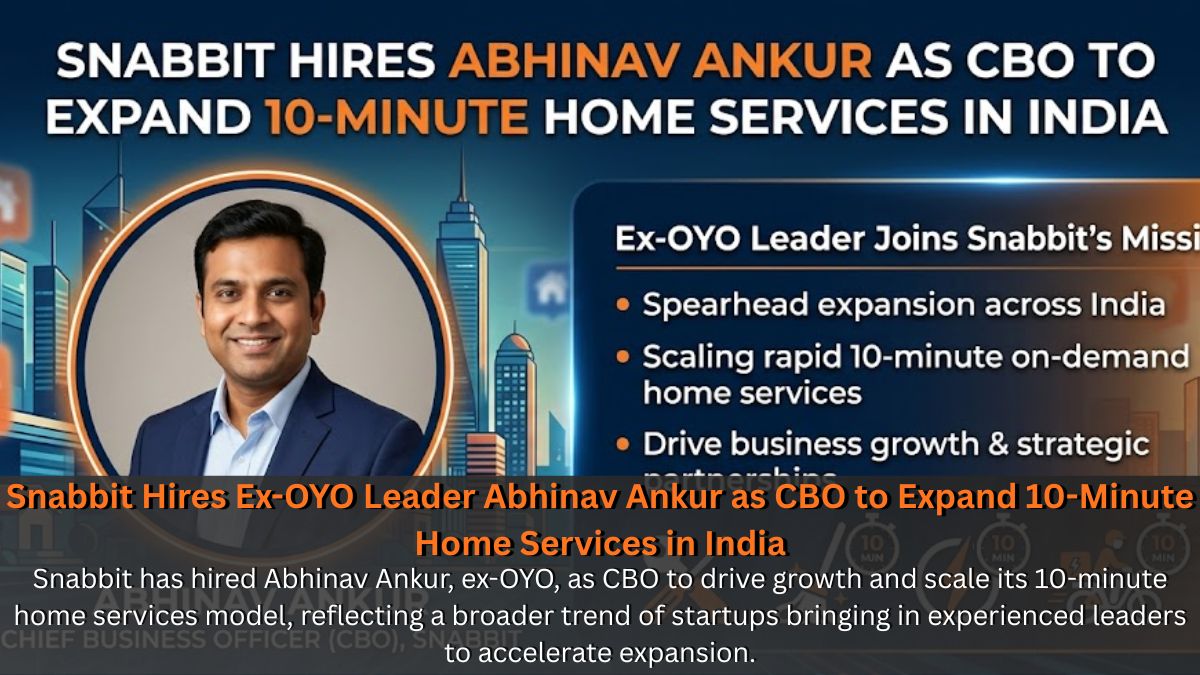
News Summary
Snabbit Hires Ex-OYO Leader Abhinav Ankur as CBO in a strategic move aimed at accelerating its rapid growth in India’s quick-service home solutions market. The startup, which focuses on delivering home services within 10 minutes, is now strengthening its leadership team to scale operations across major Indian cities. This development highlights a growing trend in the startup ecosystem where experienced leaders from established unicorn startups join emerging startups to drive expansion and business transformation.
Abhinav Ankur, a former senior executive at OYO, brings deep expertise in scaling operations, building partnerships, and managing large teams. His appointment comes at a time when Snabbit is looking to capture a larger share of India’s fast-growing home services market. The company operates in a highly competitive space where speed, reliability, and customer experience define success.
India’s startup ecosystem has seen increasing activity in hyperlocal services, especially after the rise of quick commerce and on-demand platforms. Snabbit’s 10-minute service model reflects this shift in consumer expectations. Customers now demand faster service delivery for everyday needs such as cleaning, repairs, and maintenance.
Moreover, the hiring move signals strong confidence from investors and stakeholders. Leadership hires often indicate upcoming expansion plans, funding rounds, or new market entries. As venture capital and angel investors continue to back such disruptive tech startups, Snabbit’s growth trajectory becomes even more relevant. Overall, Snabbit Hires Ex-OYO Leader Abhinav Ankur as CBO marks a significant step in the evolution of India’s home services sector. It shows how startups are leveraging experienced talent to scale quickly and compete in a dynamic and fast-changing market.
1. Introduction to Snabbit Hiring an Ex-OYO Leader
1.1 Understanding the Strategic Move
When a young startup makes a senior leadership hire, it’s rarely just about filling a position. It’s usually a signal. In this case, Snabbit bringing in Abhinav Ankur as Chief Business Officer says one thing very clearly: the company is no longer thinking small. Startups at an early stage focus on survival. Then comes traction. But hiring someone with deep operational experience from OYO shows Snabbit is entering a different phase entirely, the phase where execution matters more than ideas.
This isn’t a random hire. It’s a calculated decision rooted in a very real challenge: scaling a business that promises something as ambitious as 10-minute home services. That kind of speed sounds attractive on paper, but behind the scenes it’s brutally complex. Logistics, workforce availability, demand prediction, customer satisfaction, everything has to work almost perfectly.
Someone like Abhinav Ankur brings scars from having done this before. At OYO, he would have seen what rapid expansion actually looks like, not the glamorous version, but the messy, unpredictable, operationally intense reality. That kind of experience is exactly what Snabbit needs right now. More importantly, this move shows intent. Snabbit is not just trying to grow. It’s trying to grow fast, and without breaking.
1.2 Why This Hiring Matters in Startup News
If you’ve been following the startup space closely, you’ll notice a pattern. Emerging startups increasingly look toward leaders from companies that have already gone through hypergrowth. It’s almost like borrowing muscle memory. This is why this hiring stands out. It fits into a broader shift in how startups are being built today. Founders are realizing that passion and vision are not enough once scale enters the picture. Systems, processes, and experienced leadership become critical.
Investors also read these signals carefully. A strong leadership team reduces execution risk. When a startup hires someone with a proven track record, it builds confidence. Not just internally, but across the ecosystem. There’s also a psychological layer to it. For customers and partners, leadership credibility matters. Knowing that someone who has worked at a company like OYO is now shaping Snabbit’s business strategy adds a level of trust that early-stage startups often struggle to build. So this isn’t just a hiring update. It’s a milestone that quietly shifts how Snabbit is perceived in the market.
2. About Snabbit: Background and Journey
2.1 Founding Vision and Startup Story
Every startup begins with a moment of frustration. For Snabbit, that moment likely looked very familiar: a leaking tap that takes two days to fix, a cleaning service that shows up late, or an electrician who never arrives. These are small problems individually, but together they define a broken experience that millions of people deal with daily.
Snabbit’s founders didn’t try to reinvent the service itself. They focused on something far more powerful: time. The idea was simple but bold, what if home services could be delivered in 10 minutes? That question changes everything. It shifts the problem from “finding a service provider” to “building an entire ecosystem that can respond instantly.” And that’s where the real challenge begins.
Building such a system requires more than just an app. It demands dense supply networks, intelligent matching algorithms, real-time tracking, and a workforce that is both available and reliable at any given moment. What makes Snabbit interesting is not just the idea, but the commitment to solving this problem at scale. Many startups test convenience. Few try to compress time this aggressively.
2.2 Growth in the Startup Ecosystem
Snabbit’s growth reflects a much larger trend in India’s startup ecosystem. Consumers are no longer satisfied with just availability. They expect immediacy. We’ve seen this shift in food delivery, grocery delivery, and mobility. Now it’s entering home services. Snabbit is part of this new wave of hyperlocal platforms that are redefining convenience. But growth in this space isn’t linear. It’s operationally heavy and capital-intensive.
Expanding to a new area isn’t just about marketing. It involves onboarding service providers, ensuring quality, setting up local operations, and managing demand fluctuations. From what we can observe, Snabbit has managed to navigate these early challenges well enough to attract attention. Not just from users, but from investors and industry insiders. And that’s important. Because in a crowded market, attention is often the first validation.
3. Who is Abhinav Ankur? Leadership Background
3.1 Experience at OYO and Industry Expertise
To understand what Abhinav Ankur brings to Snabbit, you have to understand what companies like OYO demand from their leaders. OYO wasn’t just growing. It was expanding across cities, countries, and cultures at an aggressive pace. That kind of growth exposes every weakness in a system. Leaders in such environments learn quickly that scaling is not about doing more of the same. It’s about constantly adapting.
Abhinav Ankur’s experience likely includes managing large teams, building partnerships, optimizing operations, and handling the kind of pressure that only high-growth startups can create. He would have seen what happens when supply doesn’t match demand. When customer expectations outpace service quality. When expansion moves faster than infrastructure. These lessons are not theoretical. They are earned through real-world challenges. And that’s what makes his entry into Snabbit significant. He’s not coming in to experiment. He’s coming in with a playbook shaped by experience.
3.2 Role as Chief Business Officer
As Chief Business Officer, his role goes far beyond strategy presentations and boardroom discussions. He will be responsible for translating vision into execution. That means building partnerships, driving revenue, optimizing pricing, and ensuring that operations can support growth. In a company like Snabbit, this role becomes even more critical. Because the promise of 10-minute service leaves very little room for error.
Every delay, every mismatch, every failed service directly impacts customer trust. Abhinav’s focus will likely be on tightening these systems. Making them more predictable, more scalable, and more resilient. And if done right, this is where real growth happens. Not just in user numbers, but in sustainable business performance.
4. Snabbit’s Business Model Explained
4.1 Working Model of 10-Minute Home Services
At first glance, a 10-minute service model sounds almost unrealistic. But when you break it down, it’s actually a combination of several well-coordinated systems. Snabbit operates as a hyperlocal marketplace. It connects users with nearby service professionals who are ready to respond immediately. But the real magic lies in how quickly this matching happens. The platform likely uses location intelligence to identify the closest available service provider. It then assigns the task in real time, minimizing delays. However, speed alone isn’t enough. Reliability matters just as much.
To maintain this balance, Snabbit must ensure that its service providers are trained, verified, and consistently available. This requires ongoing engagement, incentives, and performance tracking. From a user’s perspective, the experience feels simple. You request a service, and someone shows up quickly. But behind that simplicity is a highly complex system that has to work flawlessly.
4.2 Revenue Model and Monetization
Snabbit’s revenue model is fairly aligned with other marketplace platforms, but with its own nuances. The primary source of income comes from commissions on each service. Every transaction generates a percentage for the platform. In addition, there’s potential for premium pricing. Customers who want faster or priority service may be willing to pay extra.
Subscriptions could also play a significant role. Regular users might prefer a membership model that offers benefits like discounted services or guaranteed availability. But here’s where it gets interesting. In a 10-minute service model, operational costs are higher. Faster service requires higher supply density and better infrastructure. So profitability depends heavily on efficiency. This is where leadership, again, becomes crucial. Optimizing pricing, managing costs, and improving unit economics are all areas where experienced leadership can make a massive difference.
5. Services and Product Offerings
5.1 Range of Home Services
On the surface, Snabbit offers what looks like a familiar list: cleaning, minor repairs, electrical fixes, plumbing, and routine maintenance. The kind of things every household eventually needs. But the difference isn’t in what they offer. It’s in how they deliver it.
Think about the last time something broke at home. Maybe a fan stopped working in peak summer or a sink started leaking just before guests arrived. The problem itself wasn’t the hardest part. The waiting was. Calling multiple people, negotiating availability, adjusting your entire day around someone else’s schedule. It’s frustrating in a very human way. Snabbit is trying to remove that friction entirely.
Instead of treating home services as planned tasks, it treats them like urgent needs. That shift changes everything. Cleaning is no longer something you book a day in advance. Repairs are not something you “manage somehow.” They become on-demand, almost like ordering food. But delivering this consistently requires discipline. Service providers must show up on time, do the job properly, and leave customers satisfied. That’s where quality control becomes critical.
Snabbit appears to be focusing heavily on standardization. Verified professionals, consistent service protocols, and performance tracking. These aren’t just operational choices. They are trust-building mechanisms. Because in this business, one bad experience doesn’t just lose a customer. It creates hesitation the next time someone even thinks about using the platform.
5.2 Technology and Innovation
If you strip away the app interface, what Snabbit is really building is a logistics engine. The promise of a 10-minute service is not powered by speed alone. It’s powered by precision. Every request triggers a chain of decisions: Who is closest? Who is available? Who is best suited for this specific job? And how quickly can they realistically reach the customer? This is where technology quietly does the heavy lifting.
Location intelligence helps map supply in real time. Smart scheduling ensures that service providers are not overloaded or underutilized. Routing systems reduce travel time. And behind all this, there’s likely a layer of data constantly learning from patterns, peak hours, common requests, high-demand areas. But technology alone isn’t enough.
Real efficiency comes when technology and human behavior align. Service partners need to trust the system. Customers need to feel the reliability. And the platform needs to balance both without friction. When that balance works, the experience feels effortless. You tap a button, and help arrives. Almost like it was already waiting for you.
6. Problem Snabbit Solves
6.1 Delayed Home Services
The biggest problem in the traditional home services market isn’t lack of supply. It’s unpredictability. You can find a plumber. You can find an electrician. But you can’t always count on when they’ll show up. Or whether they’ll show up at all. That uncertainty has been normalized for years. People build their schedules around it. They wait. They follow up. Adjust.
Snabbit challenges that normalization. By committing to a 10-minute response time, it’s not just offering speed. It’s offering control. It’s telling customers that their time matters. But here’s the reality. Delivering on that promise consistently is incredibly hard. There will be traffic. There will be demand spikes. Will be situations where supply falls short. The real test is not whether delays happen, but how often they happen and how quickly the system recovers.
If Snabbit manages to maintain even a reasonably high success rate, it changes customer expectations permanently. Once people experience that level of convenience, going back to waiting hours feels unacceptable. That’s how behavior shifts. Not through marketing, but through experience.
6.2 Lack of Reliable Service Providers
Trust is the silent barrier in this industry. Inviting someone into your home, especially a stranger, requires a level of comfort that many platforms underestimate. People worry about safety, professionalism, and quality of work. Snabbit seems to be addressing this head-on by focusing on verified professionals. But verification is just the starting point.
Real trust is built over time. Through consistent experiences. Through accountability. Systems that ensure that if something goes wrong, it gets fixed. This could include ratings, reviews, repeat assignments for high-performing providers, and possibly penalties for poor service. From a customer’s perspective, what matters is simple: Will the person who shows up do the job properly and respectfully? If the answer is consistently yes, trust builds naturally. And once trust is established, retention follows.
7. Industry Trends and Market Growth
7.1 Rise of Hyperlocal and Quick Commerce
India is going through a very visible shift in consumer behavior. Convenience is no longer a luxury. It’s becoming an expectation. Food arrives in minutes. Groceries show up almost instantly. Mobility is on-demand. Home services were one of the last categories to catch up, and now they’re being pulled into the same expectation cycle.
Snabbit sits right at the intersection of this shift. The rise of hyperlocal platforms is not accidental. It’s driven by urban lifestyles where time is limited and expectations are high. People are willing to pay a premium to avoid delays and uncertainty. But this trend also comes with pressure. Speed increases customer expectations. Once you promise 10 minutes, even 20 minutes can feel like a delay. That’s the paradox of convenience. The better you get, the less room you have for error. Still, the direction is clear. Hyperlocal, on-demand services are not a passing trend. They are becoming part of everyday life.
7.2 Investment and Funding Trends
Investors are paying close attention to this space, and for good reason. On-demand services have large market potential, repeat usage, and strong monetization opportunities. But they also come with operational complexity, which creates a natural barrier to entry. That combination is attractive.
When venture capital firms look at startups like Snabbit, they’re not just evaluating the idea. They’re evaluating execution capability. Can this team build dense supply networks? Can they maintain service quality at scale? They manage costs while growing rapidly? Leadership plays a huge role here. Hiring experienced operators often signals that the company is preparing for the next phase, whether that’s aggressive expansion or a funding round. And in many cases, that signal alone is enough to start conversations with investors.
8. Competitive Landscape
8.1 Direct Competitors
Snabbit is not entering an empty market. There are already established platforms offering home services, each with its own strengths and weaknesses. Some focus on quality. Others focus on pricing. A few try to balance both. The real differentiator for Snabbit is speed.
While competitors may offer same-day or scheduled services, the 10-minute promise creates a completely different category. It positions Snabbit not just as an option, but as a faster alternative. However, this advantage only holds if it is consistently delivered. If speed becomes unreliable, the differentiation weakens quickly. Customers will always choose a slightly slower but more dependable option over a fast but unpredictable one. So the competition is not just about features. It’s about execution.
8.2 Indirect Competitors
Interestingly, some of Snabbit’s biggest competition doesn’t come from apps at all. It comes from local, informal networks. The neighborhood electrician. The trusted plumber. The cleaning staff who has been working with a family for years. These relationships are deeply rooted and built on familiarity. They may not offer speed, but they offer trust. Snabbit’s challenge is to replicate that trust at scale while adding the layer of convenience that traditional providers lack. If it succeeds, it doesn’t just compete with platforms. It replaces habits.
9. Funding and Expansion Plans
9.1 Business Funding and Investor Interest
In the startup world, timing matters as much as strategy. Leadership hires, especially at senior levels, often come just before a major growth phase. Sometimes it’s expansion. Sometimes it’s a funding round. Often, it’s both. Bringing in someone like Abhinav Ankur signals readiness. It suggests that Snabbit is preparing to handle more complexity. More users, more cities, more transactions. And that usually requires capital.
Investors tend to look for these signals. Strong leadership reduces risk. It shows that the company is thinking beyond short-term growth. There’s also increasing global interest in Indian startups, especially in sectors driven by consumption and convenience. Home services fit perfectly into that narrative. If Snabbit continues to execute well, attracting funding may not be the hardest part. Using it efficiently will be.
9.2 Expansion Strategy
Expanding a hyperlocal service is not like launching a digital product. Every new city is almost like starting from scratch. You need supply. You need demand. Need operational infrastructure. And all of this has to come together quickly enough to maintain service quality. Snabbit’s expansion strategy will likely focus on dense urban areas where demand for quick services is naturally higher. But expansion brings its own challenges.
What works in one city may not work in another. Consumer behavior differs. Service expectations vary. Even logistical constraints change. This is where experience becomes critical again. Scaling without losing control is one of the hardest things to do in a startup. If Snabbit gets this right, it doesn’t just grow. It builds a defensible position in a market that is only going to get more competitive.
10. Impact on the Startup Ecosystem
10.1 Job Creation and the Reality of Startup Jobs
It’s easy to talk about startups in terms of funding rounds, valuations, and growth metrics. But on the ground, their real impact is far more human. It shows up in livelihoods. Snabbit, like many hyperlocal platforms, doesn’t just build a product. It builds an ecosystem of workers. Electricians, cleaners, plumbers, technicians, people who were earlier dependent on irregular, word-of-mouth work now get access to a steady flow of income opportunities. And that changes things in a very real way.
For a service professional, unpredictability is one of the hardest parts of the job. Some days are packed, others are completely dry. Income fluctuates. Planning becomes difficult. There’s no clear structure. Platforms like Snabbit attempt to bring some order into that chaos. With a steady demand pipeline, service providers can expect more consistent work. With ratings and repeat customers, they can build a reputation that goes beyond their immediate neighborhood. Digital payments, there’s more transparency in earnings. But it’s not a perfect system.
There are trade-offs. Platform commissions, performance pressure, and dependency on the app’s algorithm are real concerns. The freedom of independent work gets replaced with structured expectations. Yet, for many, the benefits outweigh the downsides. What’s important here is scale. If Snabbit grows the way it intends to, it could create thousands of micro-entrepreneur opportunities across cities. Not traditional jobs, but income streams that are flexible and scalable. And in a country like India, where informal work dominates, that shift matters. It doesn’t just create jobs. It formalizes them, even if partially.
10.2 Boost to Emerging Startups
Every visible startup story does something subtle but powerful. It lowers the psychological barrier for the next founder. When people see a company like Snabbit trying to solve everyday problems in a bold way, it sparks ideas. Not necessarily to copy, but to rethink what’s possible. Someone observing this might ask:
“If home services can be delivered in 10 minutes, what else can be reimagined?” That’s how ecosystems evolve. One startup pushes boundaries. Others build around it, improve on it, or take inspiration from it in entirely different sectors. There’s also a confidence effect.
For early-stage founders, especially those without strong networks or funding backgrounds, seeing companies rise from similar conditions creates belief. It makes the journey feel less distant. And investors notice this too. As more startups experiment with hyperlocal and on-demand models, capital begins to flow into the category. Not blindly, but with curiosity and intent. So Snabbit’s journey, whether it succeeds massively or struggles along the way, contributes to something bigger than itself. It becomes part of a larger narrative. One where Indian startups are not just copying global models, but building solutions deeply rooted in local problems.
11. Learning for Startups and Entrepreneurs
11.1 The Real Importance of Leadership Hiring
There comes a point in every startup’s journey where hustle alone stops being enough. In the early days, founders do everything. They sell, they build, they fix problems as they arise. Speed matters more than structure. But as the company grows, cracks begin to show. Operations become messy. Teams expand. Decisions become more complex. And suddenly, the same scrappy approach that worked before starts to slow things down.
This is where leadership hiring becomes critical. Bringing in someone like Abhinav Ankur is not just about adding experience. It’s about adding perspective. Experienced leaders have seen scale before. They understand patterns. They know where things are likely to break. And more importantly, they know how to fix them before they become disasters. But here’s the nuance many founders miss.
Hiring a senior leader is not a shortcut to growth. It only works if the organization is ready to absorb that experience. If the culture resists change, if systems are too chaotic, or if expectations are unclear, even the best leaders struggle to make an impact. So the real lesson isn’t just “hire experienced people.”
It’s “build an environment where experience can actually create value.” When that alignment happens, growth doesn’t just speed up. It becomes more stable.
11.2 Relentless Focus on Customer Needs
At the heart of every successful startup is a very simple truth: it solves a real problem. Not a theoretical one. Not a “nice to have” improvement. A real, felt, everyday problem. Snabbit’s entire model revolves around one insight, people don’t just want home services, they want them quickly and reliably. That insight may sound obvious, but executing on it is anything but simple. Many startups get distracted by features, expansion, or competition. They start optimizing for growth metrics instead of customer experience. But in service-based businesses, customers remember how you made them feel.
Did the service arrive when promised? Was the work done properly? Was the experience smooth or frustrating? These moments define loyalty. Speed, in Snabbit’s case, is not just a feature. It’s the core value proposition. And maintaining that consistently requires discipline. For entrepreneurs, the takeaway is clear. Find a real problem. Solve it better than anyone else. And don’t lose focus, no matter how fast you grow.
11.3 Leveraging Technology the Right Way
Technology often gets romanticized in startup conversations. AI, automation, algorithms, all powerful tools, but only when used correctly. Snabbit’s model depends heavily on technology, but not in a flashy way.
It uses tech to solve very practical problems:
- Matching supply with demand, reducing delays, optimizing routes, improving communication. That’s where technology creates real value.
- The mistake many startups make is building technology for the sake of it and adding features that look impressive but don’t actually improve the user experience. The better approach is quieter. Identify bottlenecks.
- Use technology to remove them. Repeat. Over time, these small improvements compound into a system that feels seamless. And when that happens, users don’t notice the technology. They just notice that things work. That’s the goal.
About foundlanes.com
foundlanes.com is India’s leading startup idea discovery platform. It helps entrepreneurs find actionable startup opportunities, market insights, and industry-specific guidance to turn ideas into real businesses. With deep research and practical resources, foundlanes supports founders at every stage, from idea validation to launch and growth.