


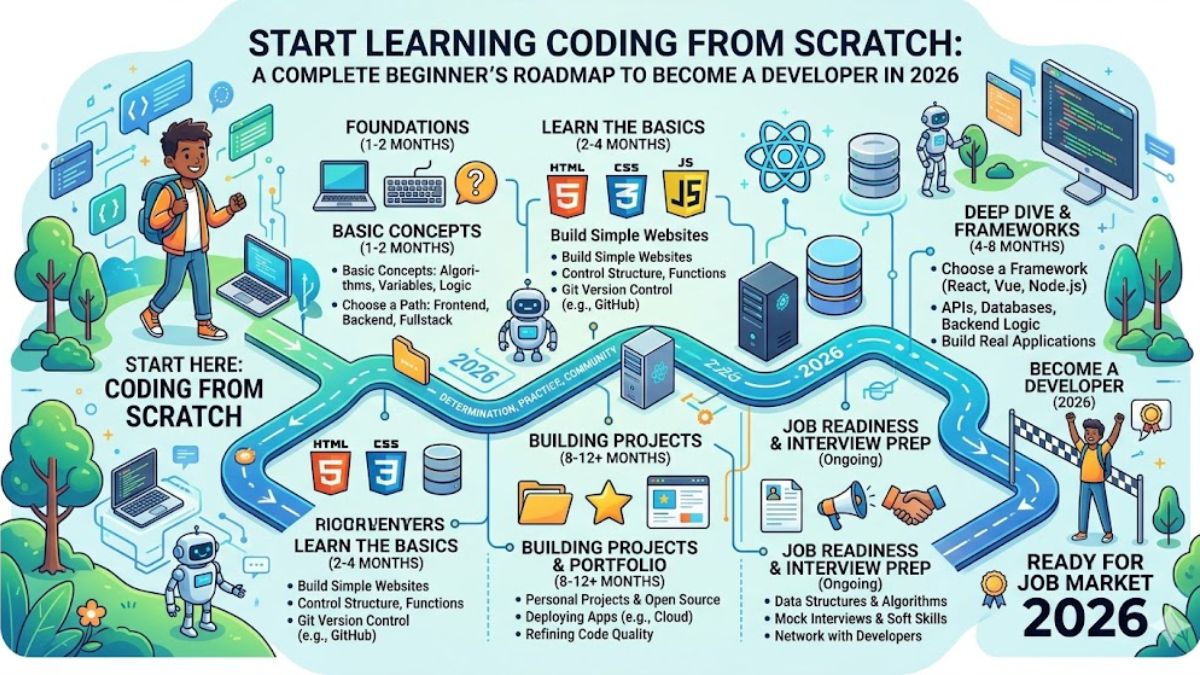
Why Learning Coding from Scratch Has Become a Modern Career Starting Point
Learning to code today feels very different from what it used to be. It’s no longer this intimidating, locked world meant only for engineers or people with formal degrees. For many, it has quietly become a second chance. A way to restart, to grow, or to finally move toward something that feels more in their control. When someone types “how to start learning coding,” it usually comes from a very real place. It’s not just curiosity. There’s often a story behind it. Maybe a job that isn’t going anywhere. Maybe financial pressure. Just that constant feeling that you could be doing more, if only you knew how to begin. Coding starts to feel like a door, but at first, it’s not clear how to open it.
And that beginning… it can be uncomfortable. You look at all the options and feel stuck. Python, JavaScript, apps, websites, AI… it all sounds exciting and confusing at the same time. Questions start piling up. Do I need a degree? Am I too late? What if I try and fail? That hesitation is real, and almost everyone who starts goes through it. The honest truth is, you don’t need everything figured out on day one. You don’t need to be brilliant or “technical.” What matters more is deciding to start anyway, even if it’s messy, even if it feels slow. Progress in coding doesn’t come from big, perfect steps. It comes from small, consistent ones. Sitting down, trying, getting stuck, figuring things out, and coming back again the next day.
This guide is written for that version of you
This guide is written for that version of you, the one who is ready, but unsure. Whether you’re a student trying to build a future, someone thinking about switching careers, or just someone who wants more stability and freedom in life, this is meant to give you a clear, simple path forward without making you feel overwhelmed. The timing, honestly, couldn’t be more important. In India especially, things are changing fast. Startups are growing, tech is becoming part of almost every industry, and people who can build are in demand. Not just to get jobs, but to create things, solve real problems, and sometimes even build something of their own from scratch.
As you move forward, you’ll slowly figure out what works for you. Which language feels right. How to practice. How to go from watching tutorials to actually building something, even if it’s small. And somewhere along the way, things start to click. You stop feeling like an outsider and start feeling like you belong in this space. At the end of the day, coding isn’t just about writing lines of code. It’s about giving yourself options. It’s about building something, maybe a project, maybe a career, maybe even a new version of your life. And it all starts in a very simple way, by deciding that you’re going to try.
1. Startup Idea Overview: Learn Coding Platforms for Beginners
If you’ve ever seen someone try to learn coding for the first time, you’ll notice something very simple. The excitement is there in the beginning. They open YouTube, sign up for a course, maybe even tell a few people, “I’m going to learn coding.” And for a few days, it feels real. Then confusion starts creeping in. Not because coding is too hard, but because nothing feels connected. One video talks about variables, another jumps into projects, a blog assumes you already know things you’ve never even heard of. And slowly, that excitement turns into doubt.
That’s where this idea comes from. A platform that doesn’t try to teach everything at once. It just holds your hand at the start and says, “Don’t worry about all that. Just do this first.” Then the next step. Then the next. No noise. No pressure to know everything. Just steady movement. And the biggest difference? You don’t just learn and forget. You build. Even if it’s something small and imperfect, it’s yours. That feeling, of creating something from nothing, is what keeps people going. Without that, most people quietly give up.
2. Problem Statement & Solution
The problem is not that people don’t want to learn. It’s that they don’t know how to stay on the path. There’s too much content out there. Too many voices saying different things. One person says “learn Python,” another says “start with JavaScript,” someone else says “focus on DSA first.” For a beginner, it feels like standing at a crossroads with no signboards. So they try everything a little. Nothing deeply. And after a point, it starts to feel like maybe they’re not made for this. That’s the dangerous part. Not the confusion, but what it does to confidence.
The solution is actually very simple, but rarely done well. Give people a path they don’t have to question. Not ten options. One clear direction. Start here. Finish this. Then move forward. And while they’re learning, make them do things. Not just watch or read. Let them struggle a little while building something. Let them see mistakes. Them fix them. Because that’s when learning becomes real. When you stop asking “What should I learn next?” and start thinking “How do I make this work?”
3. Target Audience & Customer Persona
The people who need this the most are usually the ones who feel the most lost. A student who keeps hearing that coding is important but has no idea where to begin. A graduate who feels like they’re already behind everyone else. Someone stuck in a job that pays the bills but doesn’t feel like a future. They’re not looking for something fancy. They’re looking for a way in. Most of them carry a quiet hesitation. “What if I don’t understand this?” “What if I’m too late?” “What if I try and still fail?” These thoughts don’t always come out loud, but they’re there. That’s why they don’t connect with platforms that feel too complex or too fast. They connect with something that feels patient. Something that doesn’t make them feel stupid for not knowing.
Because once that fear goes away, learning becomes much easier. And behind all of this, there’s a simple reason they’re trying in the first place. They want a better option. A different life. More control over their time, their income, their future. They’re not just learning coding. They’re trying to change direction.
4. Market Opportunity & Timing
Right now, the world is quietly shifting in a way most people can feel but not fully explain. Everything is becoming digital. Businesses, services, even small local operations are moving online in some form. And behind all of that, there’s always someone who understands how to build or manage it. That demand isn’t slowing down.
In India, you can see it clearly. Startups are everywhere. Companies are hiring faster than before. Even people with basic skills are finding opportunities if they can actually build something. At the same time, starting has become easier. You don’t need expensive setups or special access. You can learn from anywhere, build from anywhere. But here’s the honest truth. Access is not the problem anymore. Direction is. People don’t fail because they don’t have resources. They fail because they don’t know how to use them in the right order. And that’s why this moment matters. Because the opportunity is not just in teaching coding. It’s in guiding people through it in a way that actually works.
5. USP & Value Proposition
Most platforms try to prove how much they know. A good platform focuses on how much the user understands. That’s the difference. Instead of throwing everything at the learner, it slows things down. It removes the unnecessary parts. It focuses on what actually matters right now. And most importantly, it makes sure learning leads somewhere. Not just “you completed a lesson,” but “you built something.” Even if it’s basic, even if it’s not perfect, it’s real. And that changes everything. Because now the learner is not just consuming content. They’re creating.
Another thing that matters is context. People don’t just want random exercises. They want to feel like what they’re doing connects to the real world. Building something that looks like a real product, even in a simple form, makes learning feel meaningful. At the end of it, the value is not in the platform itself. It’s in what the user becomes. Someone who started confused, unsure, maybe even doubting themselves. And slowly reached a point where they can say, “I know how to build this.” That shift is everything.
6. Business Model & Pricing Strategy
If you sit with this long enough, you realize people don’t come to a coding platform ready to spend money. They come with hesitation. Curiosity, yes. But also doubt. “Will I even understand this?” “What if I quit in a week?” That’s the mindset. So the smartest thing you can do is remove that pressure at the door. Let them start for free. Let them explore without feeling like they’ve already committed to something big. That first small win, writing a few lines of code and seeing it work, that’s where the shift happens. That’s when it starts feeling real.
Only after that does paid content make sense. Not as a push, but as a next step. When someone reaches a point where random videos aren’t enough anymore, they start looking for structure. A path. Something that tells them, “Do this, then this, and you’ll get somewhere.” That’s what people actually pay for. Not content, but clarity. And the beauty of this kind of business is that once you’ve built something meaningful, it doesn’t stay limited. One lesson can reach thousands of people. But that only works if the content feels human, if it actually helps. Because people can tell the difference between something made to sell and something made to teach.
7. Execution Plan & Launch Strategy
In the early stage, there’s always this urge to build everything at once. Every language, every feature, every idea you’ve seen somewhere else. It feels productive, but it usually leads to a scattered product. A better way, even if it feels slower, is to start with just one clear purpose. Help a complete beginner take their first step without feeling lost. Pick one language. Keep it simple. Python works because it doesn’t overwhelm people on day one. Then design the experience like you’re sitting next to someone who’s never coded before. Small lessons. Tiny exercises. Little moments where they can say, “Okay, I get this.”
That feeling matters more than anything. At this stage, you’re not trying to impress people. You’re trying to understand them. Where do they get stuck? When do they drop off? What keeps them coming back? That’s the real work. And when it comes to launching, forget the idea of a “big launch.” Most real traction comes quietly. Someone finds your content on YouTube. Someone mentions it in a Reddit thread. A college group shares it. That’s how it starts, slowly, but honestly.
8. Budget, Resources & Infrastructure
It’s easy to assume something like this needs a big budget. But if you look closely, many of the platforms people admire today didn’t start that way. They started small, almost unnoticed. In the beginning, you’re just trying to make something that works. A platform where lessons load properly, videos play without issues, and coding actually feels interactive. That’s enough.
You don’t need a large team either. A few people who understand what they’re building and care about doing it well can go a long way. There are tools today that make things easier, cheaper, faster. The challenge isn’t access anymore. It’s focus. Spend where it matters. Good content. Smooth experience. Everything else can evolve later. Because at the end of the day, learners won’t remember how advanced your infrastructure was. They’ll remember whether they felt progress or not.
9. Brand Strategy
Branding here isn’t about standing out loudly. It’s about feeling approachable. Most beginners already feel like they’re stepping into something unfamiliar. A complicated name, a heavy tone, too much technical language, all of that pushes them away before they even begin. A simple name works because it feels safe. It tells people, “You don’t need to be an expert to be here.”
The way you speak matters just as much. It should feel like someone explaining things patiently, not trying to prove how much they know. The moment it starts feeling intimidating, you lose people. And if your platform connects to startups or real-world building, that should come through naturally. Not as a promise, but as a direction. Learning coding shouldn’t feel like studying for an exam. It should feel like preparing to build something that actually matters to you.
10. Vendor & Partner Strategy
At some point, you realize you can’t build something meaningful alone. Not because you lack ideas, but because good learning comes from different perspectives. Partnerships help, but only when they make sense. A college that genuinely wants its students to grow. A company that values practical skills. A bootcamp that focuses on real outcomes. These connections bring in people who are already serious.
Then there are instructors. This is where things either click or fall apart. Someone can be brilliant at coding and still struggle to teach. What you need are people who remember what it felt like to not understand. People who can slow down, explain, and stay patient.
Mentors matter too. Because learning isn’t always smooth. People get stuck, lose confidence, question themselves. Having someone guide them through those moments can make all the difference. In the end, this isn’t just about building a platform. It’s about building trust. And that only happens when the people behind it genuinely care about helping others move forward.e.
11. Go-to-Market & Customer Acquisition Channels
If you really think about it, nobody wakes up randomly and says, “Let me download a coding app today.” It usually starts with a moment. Someone feeling stuck in their career. Someone seeing others succeed in tech. Wondering, “Can I do this too?” And then they search. That search is everything. They go to YouTube, type a question, click on a video, maybe watch two, maybe ten. They read blogs, scroll through comments, try to figure out who actually makes sense. They’re not just consuming content, they’re looking for clarity. For someone who explains things in a way that finally clicks.
That’s where you meet them. Not with ads, not with big promises, but with something simple that helps them understand one thing better than before. And once they start, what keeps them there isn’t content, it’s connection. A small community where they can ask a question without feeling judged. Where they see others struggling with the same things. Where someone replies, even if it’s a simple answer. That kind of space changes everything. It makes the journey feel less lonely. And when someone feels helped, they talk about it. Not because you asked them to, but because they want others to feel the same relief they felt when something finally made sense.
12. Growth & Retention Strategy
The hardest part is not getting people to start. It’s getting them to not quit. Because quitting doesn’t happen in one moment. It happens slowly. A day missed, then another. A concept not understood, then avoided. That quiet feeling of “maybe this isn’t for me” starts creeping in. And that’s where most platforms lose people. What actually keeps someone going is not motivation speeches or badges. It’s progress they can feel.
The moment when something that didn’t make sense yesterday suddenly becomes clear today. The moment when they build something small and realize, “Wait, I actually did this.” That feeling is powerful. It’s personal. If a platform can create more of those moments, people stay. They don’t need to be pushed. They just need to feel like they’re moving forward. Even slowly. And once they reach that point, they naturally want more. They want to go deeper, build bigger things, understand more. Growth doesn’t need to be forced at that stage. It happens on its own.
13. Team Structure & Responsibilities
In the early days, a team doesn’t feel like a “team” in the formal sense. It feels like a small group of people trying to figure things out together. No one has perfect clarity. Roles overlap. One day you’re creating content, the next day you’re fixing something on the platform, the next day you’re talking to users trying to understand why they stopped showing up. It’s messy, but it’s real. What holds it together is not structure, it’s belief.
Everyone involved needs to care about the same problem. Not just their task, but the reason behind it. Because when things don’t go as planned, and they won’t, that shared understanding is what keeps people from giving up. As things grow, roles become clearer. People specialize. Systems improve. But that early phase, where everyone is close to the user and the problem, that’s where the strongest foundations are built.
14. Risks, Challenges & Mitigation
The biggest threat is not another platform doing better marketing. It’s the moment your user stops showing up. That silence is dangerous because it doesn’t announce itself. You don’t always know when someone is about to quit. They just slowly disappear. And most of the time, it’s not because they didn’t care. It’s because something felt too confusing, too slow, or too disconnected. That’s why simplicity matters so much.
If someone feels lost, even for a short time, it creates friction. And if that friction builds, they leave. Not dramatically, just quietly. So the focus shouldn’t be on doing more. It should be on removing confusion. Making sure every step feels clear. Making sure users don’t have to guess what to do next. Because the moment they start guessing, they start drifting away.
15. Legal, Compliance & Fundamentals
This part doesn’t feel exciting, but it’s like the foundation of a house. You don’t see it, but everything stands on it. When someone signs up, shares their data, maybe even pays, they’re trusting you without thinking too much about it. That trust is fragile. If something feels off, unclear policies, lack of transparency, anything that feels unstructured, it creates doubt. And once doubt comes in, it’s hard to rebuild trust. So even though it feels like a background task, getting these basics right matters. Clear policies, proper structure, respecting user data, all of it quietly tells users, “This is safe. This is real.” And that feeling stays with them.
16. Long-Term Vision & Goals
If you zoom out, this is not really about coding. It’s about giving someone a way to change their story. Someone who starts with confusion, maybe even insecurity, slowly learning, building, understanding. And then one day, they look at something they created and realize they’re not the same person they were when they started. That shift is powerful.
Over time, the platform can grow into something much bigger. Not just a place to learn, but a place to move forward. Jobs, freelance work, maybe even building something of their own. But none of that happens without the first step. And that’s what matters most. Making that first step feel less intimidating. Less confusing. More human. Because once someone takes that step and realizes they can actually do this, everything else starts to open up.
foundlanes.com Note
foundlanes.com focuses on startup ideas, execution frameworks, and real-world business thinking. This article aligns with that vision by showing how a simple idea like learning coding can evolve into a scalable startup opportunity in the education and tech ecosystem