


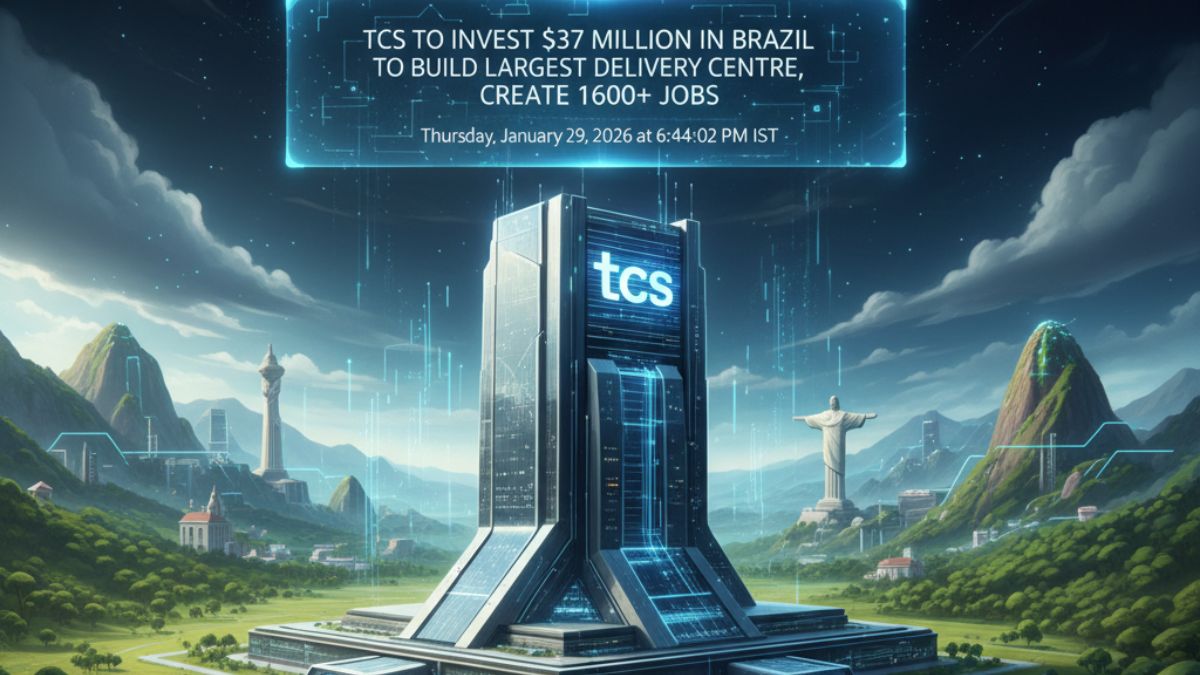
TCS to Invest $37 Million in Brazil
TCS to Invest $37 Million in Brazil marks a major expansion move by India’s largest IT services company in Latin America. Tata Consultancy Services has announced plans to build its largest delivery centre in Brazil with an investment of around $37 million, or nearly Rs 330 crore. The new campus will come up in Londrina, a city in the southern Brazilian state of Paraná, and is expected to be operational by 2027. Once completed, the facility will create more than 1,600 new technology jobs, strengthening TCS’s footprint in the region.
This investment underlines TCS’s long-term confidence in Brazil as a strategic technology and delivery hub. The centre will support global clients across sectors such as banking, financial services, insurance, retail, manufacturing, and digital transformation. It will also focus on emerging areas like cloud computing, data analytics, cybersecurity, artificial intelligence, and enterprise platforms. By expanding in Brazil, TCS aims to serve clients in the Americas more efficiently while also tapping into local talent pools.
The announcement comes at a time when global IT firms are rebalancing delivery models. Instead of concentrating operations in a few countries, companies are spreading talent and infrastructure across regions. Brazil offers a strong combination of skilled professionals, improving digital infrastructure, and government support for technology investments. TCS already employs thousands of professionals in Latin America, and this new centre will significantly scale its operations. As TCS to Invest $37 Million in Brazil. The move also highlights a broader trend of Indian tech giants increasing overseas investments. The decision reinforces TCS’s global delivery strategy. Showcases how Indian companies continue to play a central role in shaping international technology services markets.
1. Introduction: TCS to Invest $37 Million in a Strategic Global Move
Tata Consultancy Services is taking a decisive step in Latin America with a $37 million investment in Brazil, reflecting more than just expansion. It represents a carefully orchestrated global strategy. Over the past decade. TCS has steadily built its footprint across the Americas, but Brazil has emerged as a pivotal market. The company sees not only immediate business opportunities but also long-term potential in tapping into the country’s growing tech ecosystem.
The new delivery centre in Londrina, Paraná, will become TCS’s largest in Brazil, serving both regional and global clients. Beyond operational capacity, it strengthens TCS’s nearshore delivery capabilities. Enabling faster response times and deeper engagement with clients across North and South America. In a world where demand for tech talent is surging. TCS’s investment demonstrates confidence in Brazil’s skilled workforce and its ability to support sophisticated technology projects.
2. Details of the Brazil Delivery Centre Investment
2.1 Scale and Location of the Project
The delivery centre will be strategically located in Londrina, a city known for its universities and emerging technology talent. Spread across a modern campus, the facility is designed to foster collaboration, innovation, and productivity. With an investment of $37 million (approximately Rs 330 crore), TCS plans to complete construction over the next two years, with the centre operational by 2027.
Once completed, the facility will host over 1,600 professionals, spanning software development, cloud engineering, cybersecurity, data analytics, and enterprise solutions. This will make it the largest TCS delivery hub in Brazil, cementing the company’s presence in a high-potential market and reinforcing its commitment to long-term growth.
2.2 Job Creation and Economic Impact
The project is expected to generate more than 1,600 direct jobs, while indirect employment opportunities will grow through vendors, service providers, and infrastructure partners. This will not only strengthen the local economy but also nurture a technology ecosystem that benefits the wider region. Local authorities have welcomed the initiative, recognizing it as a signal that Brazil can become a strategic hub for global technology services. Beyond numbers, the project promises a cultural and professional exchange: young graduates will gain exposure to cutting-edge enterprise solutions, while TCS will cultivate a talent pool aligned with global technology trends. In essence, this centre is a bridge between local capabilities and global client demands.
3. Why Brazil Matters in TCS’s Global Strategy
3.1 Strategic Position in the Americas
Brazil offers a unique combination of geographic proximity and favorable time zones, making it ideal for nearshore delivery. For TCS, this reduces client turnaround times and fosters closer collaboration with North and Latin American teams. It also ensures faster deployment of solutions and greater responsiveness—critical differentiators in enterprise IT services.
By establishing a significant presence in Brazil, TCS is not just expanding capacity—it is creating a platform for deeper client engagement. The delivery centre will serve as a hub for innovation, allowing teams to collaborate seamlessly with clients across continents while maintaining service quality.
3.2 Access to Skilled Talent
Brazil’s universities produce a steady stream of technology and engineering graduates, particularly in regions like Paraná. TCS plans to collaborate closely with these academic institutions to develop curricula that align with emerging global tech demands in cloud computing, AI, and digital engineering.
This focus on talent development ensures long-term sustainability. By investing in skills and workforce readiness, TCS is preparing not just for current project needs but for future innovations. The strategy blends immediate operational efficiency with the cultivation of a future-ready workforce—demonstrating a nuanced understanding of how global technology firms succeed over decades, not just years.
4. Understanding TCS’s Working Model
4.1 Global Delivery Model
Tata Consultancy Services has built its reputation on a meticulously crafted global delivery model, one that distributes work across countries based on skill availability, cost efficiency, and client requirements. This is not a simple operational choice—it is a strategic framework that balances expertise, risk, and responsiveness.
Delivery centres like the one in Brazil are crucial cogs in this machinery. By positioning talent near clients while maintaining global connectivity, TCS can optimize time zones, reduce project turnaround, and provide seamless service continuity. Nearshore, onshore, and offshore operations are orchestrated with precision, ensuring that disruptions in one region do not derail global commitments. The Brazil centre will become a linchpin for this model, supporting everything from software development to enterprise solutions, all while embedding local expertise into global projects.
4.2 Client-Centric Execution
At its core, TCS thrives on long-term client partnerships. Teams are not just deployed—they are aligned with the industries, processes, and strategic goals of the clients they serve. This ensures deep understanding, faster problem-solving, and solutions tailored to real business needs rather than generic templates. The new centre in Londrina will extend this philosophy to clients across banking, retail, manufacturing, and telecommunications. It will also play a central role in digital transformation projects, helping organizations modernize technology, integrate AI, and adopt cloud-first strategies. By combining local insight with global standards, TCS can deliver impact that is both immediate and sustainable, a model that has consistently reinforced its position as one of the world’s most successful IT services firms.
5. Revenue Model and Business Strength
5.1 How TCS Makes Money
TCS generates revenue by providing a wide spectrum of IT services, consulting expertise, and digital solutions. Clients engage through long-term contracts or project-specific arrangements, depending on their requirements.
Its revenue streams are diverse: application development, infrastructure management, cloud and cybersecurity solutions, enterprise software support, and advisory services. Recurring contracts form a backbone of financial stability, allowing TCS to plan multi-year strategies and invest in innovation without jeopardizing operational continuity. This predictable cash flow distinguishes TCS from many competitors who rely on one-off projects.
5.2 Financial Strength and Investment Capacity
As one of India’s most profitable companies, TCS’s strong balance sheet provides the freedom to pursue ambitious global investments without relying on external funding. The $37 million allocation for the Brazil delivery centre exemplifies this financial confidence. It is not just expenditure—it is a deliberate long-term play, intended to secure strategic advantages in talent, client proximity, and operational scale. This capacity to invest thoughtfully, rather than reactively, underscores TCS’s disciplined approach to growth and risk management. It allows the company to focus on sustainable value creation, rather than short-term gains, in an increasingly competitive global IT landscape.
6. Founders, Legacy, and Company Background
Founded in 1968 under the Tata Group, TCS began as a modest IT division and gradually evolved into a global technology powerhouse. The company pioneered offshore delivery from India, demonstrating early on that high-quality software solutions could be delivered at scale from emerging markets.
Over the decades, TCS expanded to Europe, the Americas, and Asia-Pacific, blending local expertise with global standards. Today, it serves clients in over 50 countries and has become synonymous with trust, execution, and strategic foresight. The company’s legacy is not only in its size or revenue but in the disciplined, client-first philosophy that continues to guide every investment and every delivery decision—including the establishment of the Londrina centre in Brazil.
7. Services and Products Offered by TCS
7.1 Core IT Services
At the heart of TCS’s business lies its suite of core IT services, which have consistently formed the company’s revenue backbone. This includes application development, ongoing maintenance, and enterprise infrastructure management. While these offerings may seem foundational, their execution at scale is anything but ordinary. TCS manages millions of lines of code and complex, mission-critical systems for some of the world’s largest organizations. Every project requires meticulous planning, cross-border coordination, and adherence to rigorous quality standards. The Brazil delivery centre will augment these capabilities, providing localized teams that can respond faster to client needs while maintaining TCS’s globally recognized service standards.
7.2 Digital and Emerging Technologies
Beyond traditional IT, TCS has invested heavily in digital and emerging technologies, carving out a competitive advantage in cloud computing, artificial intelligence, advanced analytics, cybersecurity, and enterprise platforms. The Brazil hub is not just a support centre; it will actively contribute to next-generation digital solutions. By integrating local talent into these high-tech initiatives, TCS can innovate more quickly, tailor solutions to regional nuances, and accelerate the deployment of cutting-edge services. As digital adoption continues to accelerate globally, these offerings are set to become the primary drivers of growth and differentiation.
8. Problems TCS Solves for Global Clients
Modern enterprises face an intricate web of technology challenges. Legacy systems hinder efficiency, cybersecurity threats escalate, and digital disruption demands continuous innovation. TCS positions itself as more than a service provider—it becomes a strategic partner in transformation.
For clients, TCS modernizes complex systems, ensures seamless migration to cloud environments, strengthens cybersecurity posture, and drives end-to-end digital transformation. The company doesn’t just solve immediate technical problems; it anticipates future operational risks and builds scalable solutions. In doing so, it reduces uncertainty, enhances business resilience, and enables clients to focus on growth rather than firefighting technology challenges.
9. Industry Growth Trends Supporting Expansion
9.1 Rising Demand for IT Services
The global market for IT services is on an unrelenting upward trajectory. Organizations across sectors—from banking to healthcare—are investing in automation, AI-driven analytics, and cloud transformation to stay competitive. This surging demand underlines the strategic timing of TCS’s Brazil investment, as enterprises seek reliable partners capable of delivering at scale while navigating technological complexity.
9.2 Shift Toward Nearshore Delivery
A notable shift in client preferences is emerging: the move toward nearshore delivery. Companies increasingly value partners located closer to their operational markets, as it improves regulatory compliance, accelerates communication, and reduces project turnaround times. By establishing its largest Brazilian hub in Londrina, TCS aligns perfectly with this trend, offering the agility of a local presence while maintaining its global standards.
10. Competitive Landscape
10.1 Direct Competitors
TCS operates in a fiercely competitive space, contending with other global IT services firms with established Latin American footprints. These competitors also compete on pricing, talent acquisition, and execution quality. Yet TCS’s differentiator lies in its ability to combine scale, reliability, and long-term client partnerships—a combination few rivals can match consistently.
10.2 Indirect Competition
Indirect competition comes from technology product vendors, cloud providers, and consulting firms offering niche solutions. While these players may serve specific client needs, TCS stands out by providing end-to-end services across consulting, IT operations, and digital transformation. Its decades-long experience, coupled with a global delivery network, allows TCS to execute complex initiatives that many competitors cannot handle seamlessly. The Brazil investment strengthens this advantage, embedding the company deeper into a key regional market while expanding its capabilities to meet the evolving demands of multinational clients.
11. Impact on the Startup Ecosystem
TCS’s $37 million investment in Brazil extends far beyond its corporate ambitions—it has the potential to ripple across the local startup ecosystem. Large-scale tech projects like this create a pool of highly skilled professionals who gain exposure to global delivery standards, modern technology stacks, and complex problem-solving. Many of these professionals eventually move into startups, founding new ventures or bringing best practices to early-stage companies, sparking innovation. The Londrina centre could also become a natural collaborator with local tech startups. Partnerships in AI, cloud services, or analytics projects could emerge, creating opportunities for knowledge exchange and entrepreneurial experimentation. Such collaborations don’t just strengthen TCS—they help nurture a broader innovation culture, attracting global investors who see Brazil as a growing hub for technology talent.
12. The Startups News Perspective
From a global startup lens, this investment signals the maturity and international ambitions of Indian tech companies. TheStartupsNews.com tracks such expansions because they illustrate how established firms are not only serving global clients but actively shaping local ecosystems abroad.
TCS’s move underscores the growing strategic importance of Latin America in global IT services. It also highlights the influence Indian technology firms wield, demonstrating that with vision and disciplined execution, they can compete, collaborate, and innovate on a truly global scale. Coverage like this provides entrepreneurs and investors with a window into emerging trends, global talent flows, and the opportunities that arise when companies combine long-term strategy with local engagement.
13. Learning for Startups and Entrepreneurs
The TCS Brazil story offers several lessons for founders and early-stage entrepreneurs. First, a long-term vision matters more than short-term gains. TCS is not merely building a facility—it is embedding itself in a region to create lasting value for clients, employees, and the ecosystem. Second, investing in talent and infrastructure builds resilience and scalability. Startups often focus on rapid product launch, but sustained growth comes from systematically developing human capital and operational excellence. Finally, geographic diversification reduces business risk and opens new market opportunities. For entrepreneurs, the overarching takeaway is clear: global thinking combined with disciplined execution allows companies to grow sustainably while creating impact beyond their immediate markets.
Conclusion: TCS to Invest $37 Million Signals Long-Term Global Confidence
The $37 million investment in Brazil is more than a capital allocation—it is a statement of intent. By establishing its largest delivery centre in Londrina, TCS will create over 1,600 direct jobs, strengthen regional technology capabilities, and deepen its service offerings across the Americas.
This move reflects confidence in Brazil’s talent pool and technology ecosystem while reinforcing TCS’s commitment to long-term global growth. Beyond numbers and contracts, it signals India’s expanding influence in the global technology landscape, demonstrating how strategic vision, operational discipline, and a focus on talent can create sustainable impact on multiple levels—corporate, regional, and entrepreneurial alike.
About foundlanes.com
foundlanes.com is India’s leading startup idea and deep-dive platform built for founders, operators, and serious entrepreneurs. We go beyond surface-level advice to deliver grounded, research-backed, and experience-driven startup content.
Every guide on foundlanes.com is designed to help readers think clearly, act strategically, and build sustainably. This cloud kitchen startup guide is part of our mission to document real business pathways in India’s evolving startup ecosystem.