


News summary
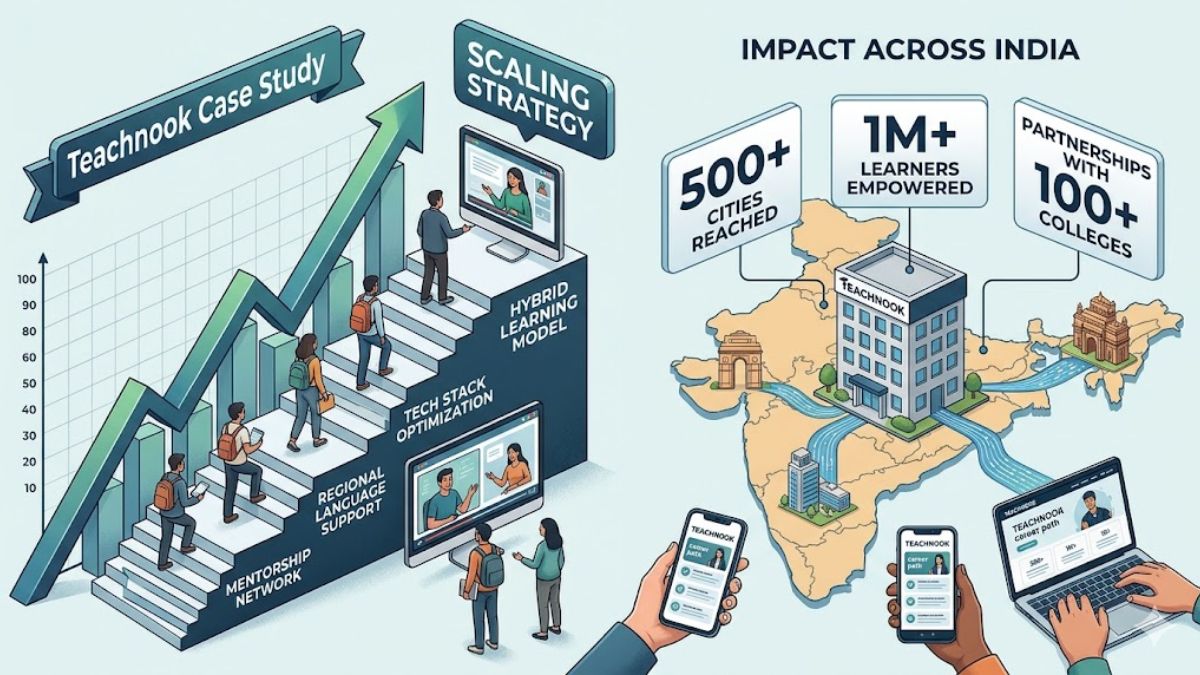
The Teachnook Case Study reflects the journey of a fast-growing Indian edtech startup that positioned itself at the intersection of skill development and real-world learning. Teachnook operates as an online platform that offers industry-relevant courses, internships, and mentorship programs aimed at college students and young professionals. The startup was founded to address a persistent gap in India’s education system, where academic learning often fails to translate into practical skills required by employers. Founded by Aditya Rao along with his team, Teachnook is headquartered in Bengaluru, one of India’s leading startup ecosystems. The company was launched around 2020, at a time when the COVID-19 pandemic accelerated digital learning adoption across the country. This timing played a critical role in shaping its early growth trajectory.
Teachnook works by offering curated training programs in collaboration with industry experts and academic institutions. Its core model blends online courses with internship-based learning, allowing students to gain hands-on experience while studying. The platform focuses on high-demand domains such as data science, digital marketing, and software development. While publicly available financial data remains limited, Teachnook has reportedly gained significant traction through partnerships with colleges and a large base of student users. Its growth has been driven by aggressive campus outreach, digital marketing, and a strong focus on employability outcomes. This Teachnook business case study examines how the startup identified a critical gap in India’s education ecosystem, built a scalable model around skill-based learning, and leveraged timing, distribution, and partnerships to expand rapidly in a competitive edtech market.
1. Origin Story and Early Background
Teachnook didn’t start with a grand vision or a flashy pitch deck. It started with a quiet but uncomfortable realization. Every year, lakhs of students were graduating with degrees in hand but uncertainty in their minds. They had done everything “right” on paper, yet when it came to actual jobs, they felt unprepared. The founders kept seeing the same pattern. Students could explain theories, clear exams, and even score well, but when faced with real-world tasks, they struggled. Interviews exposed gaps. Internships felt overwhelming. The transition from classroom to workplace was not smooth, it was jarring.
This wasn’t just a small inefficiency. It was a structural problem. India’s higher education system had scaled rapidly, but skill development hadn’t kept up. Colleges were producing graduates, not professionals. And the gap between the two was growing wider each year. That’s where the core idea of Teachnook took shape. The founders didn’t want to build just another course platform. The internet was already full of content. What was missing was application.
1.1 They asked a simple question:
What if learning didn’t stop at theory? What if every student could practice what they learn in a structured way? That question became the foundation of Teachnook. Instead of positioning themselves as a content provider, they built around outcomes. Learning would be tied to doing. Courses would not end with videos, they would lead into projects, mentorship, and internships. But ideas are easy. Reality is where things get tested.
In the early days, nothing was certain. There was no guarantee students would pay for such programs. There was no proof colleges would collaborate. The team started small, running pilot batches with limited resources. Those early experiments mattered more than any funding round could. They showed one crucial thing: students were not just interested, they were hungry for something more practical. That validation gave Teachnook its first real push forward.
2. Founder Journey, Motivation, and Early Struggles
2.1 Identifying the Problem Firsthand
What made Teachnook different from many other startups was how close the founders were to the problem. They weren’t observing from a distance. They had lived through the same system. had seen peers struggle after graduation. Some couldn’t crack interviews. Others landed jobs but felt lost in their roles. There was a sense of frustration that kept coming up in conversations:
“We studied so much, but why don’t we feel ready?”
That frustration turned into motivation. The founders didn’t want to build something abstract. They wanted to fix something real. Their goal wasn’t just education, it was transformation. If a student joined Teachnook, the expectation was simple: they should walk away more confident, more capable, and more employable. That clarity of purpose shaped every decision early on.
2.2 Early Execution Challenges
Of course, clarity doesn’t make execution easy. The biggest challenge was trust. Education is a sensitive space. Students are cautious. Parents are even more cautious. Convincing them to invest time and money in a new platform with no long track record was tough. Then came the colleges. Getting institutions to partner wasn’t straightforward. Many were hesitant to work with a young startup. Some didn’t see the need. Others were bound by rigid systems that made collaboration slow.
So the team did what most early-stage founders end up doing, they knocked on doors. Again and again. There were rejections. There were meetings that led nowhere. were moments when progress felt painfully slow. At the same time, they were dealing with product challenges.
How do you design a program that is:
- Affordable for students
- High quality in content
- Practical enough to make a difference
- Scalable across multiple domains
Balancing all of this was not easy. Every iteration required trade-offs. Sometimes they got it wrong. But each mistake brought clarity.
Another real struggle was perception. In the edtech space, many platforms promised outcomes but delivered only content. This made students skeptical. Teachnook had to prove that it was different, not through marketing, but through actual results. That took time. But slowly, things started to shift.
3. Problem Identification in India’s Edtech Ecosystem
To understand Teachnook’s positioning, you have to look at the larger system it operates in. India produces millions of graduates every year. On paper, this should be a massive advantage. But in reality, employability remains a concern. The issue isn’t intelligence or effort. It’s exposure. Students spend years studying concepts, but very little time applying them. There is limited interaction with industry. Mentorship is often missing. And internships, when available, are not always structured or meaningful.
Teachnook broke this down into three core problems:
1. Lack of hands-on experience
Most students had never worked on real-world problems. They knew the “what” but not the “how.”
2. Limited access to mentorship
Guidance from industry professionals was either unavailable or inaccessible to most students.
3. Curriculum mismatch
What students learned often didn’t align with what companies expected.
These weren’t new problems. But what Teachnook did differently was focus on solving them together, not individually.
Instead of offering just courses, they created an ecosystem where:
- Learning was followed by doing
- Doing was guided by mentors
- And the entire process was aligned with industry expectations
This positioning helped them carve out a clear niche. They weren’t competing directly with traditional edtech platforms. They were building something more outcome-driven, more practical, and closer to real-world work environments.
4. Product Development and Evolution
4.1 Building the Initial Offering
Teachnook’s first version was simple. Online courses combined with guided projects. The idea was straightforward: don’t let students just watch, make them build. Each program was designed to push students beyond passive learning. They had to complete tasks, solve problems, and apply concepts in a structured way.
But the team quickly realized something. Projects alone were not enough. Students needed context. They needed to understand how their work fit into real business scenarios. They needed feedback that went beyond correctness. That insight led to the next phase.
4.2 From Courses to Internship-Based Learning
Teachnook began integrating structured internship experiences into its programs. This was a big shift. Instead of isolated learning modules, students now went through a journey that resembled real work environments. They had timelines, deliverables, expectations, and guidance. It wasn’t just about completing a course anymore. It was about experiencing what it feels like to work in a domain.
This change had a noticeable impact. Students reported higher confidence levels. They could talk about their work in interviews with more clarity. They felt better prepared. And importantly, they started seeing tangible outcomes. That’s when the product truly began to stand out.
4.3 Expansion Across Domains
Once the model started working, the next challenge was scale. Demand wasn’t limited to one field. Students from different backgrounds were looking for similar opportunities.
Teachnook expanded into multiple domains:
- Technology
- Business and management
- Creative fields
But even as they expanded, they stayed disciplined.
Every program had to meet one core requirement:
It should deliver practical value. If a course couldn’t improve a student’s real-world capability, it didn’t belong on the platform. That consistency helped maintain quality even as they grew.
5. Early Traction and Validation Phase
The real turning point for Teachnook came through campus partnerships. Instead of relying only on digital marketing, they went directly to where their audience was, colleges.
This approach did two things:
- It gave them access to large groups of students
- It helped build credibility faster
When a college partnered with Teachnook, it acted as a form of validation. Students began enrolling, initially out of curiosity, but many stayed because they saw value. The promise of internships and practical exposure resonated deeply. And then something important happened. Students started talking. Word-of-mouth became a powerful growth driver. Those who completed programs shared their experiences with friends and peers. Some recommended it during campus discussions. Others spoke about it in online communities. This organic growth was not driven by marketing budgets. It was driven by experience. And that’s always stronger.
Early results showed clear signals:
- High student engagement in programs
- Positive feedback on practical learning approach
- Increasing demand across campuses
These weren’t vanity metrics. They were indicators of product-market fit. Teachnook wasn’t just attracting users. It was creating impact.
6. Teachnook Business Model Analysis
If you look at Teachnook from a distance, it might seem like just another edtech platform selling courses. But when you go deeper, the model is far more layered and intentional. At its core, Teachnook doesn’t sell content. It sells outcomes. That difference changes everything. The primary revenue stream comes from paid programs. Students enroll not just to learn, but to gain something tangible at the end of it, skills they can demonstrate, projects they can showcase, and internship experience they can talk about with confidence. This subtle shift in value proposition is what makes students willing to pay. Because let’s be honest, content today is everywhere. A motivated student can find free tutorials online for almost any topic. So why would they pay?
They pay for structure. They pay for guidance. And most importantly, they pay for a sense of direction. Teachnook builds its programs around this idea. A student doesn’t just log in and watch videos. They move through a journey, from learning to applying, from applying to experiencing something close to real work. That’s where the internship layer becomes critical.By integrating internships into the product, Teachnook adds perceived and actual value. Students feel like they are stepping into the professional world, even if it’s in a guided environment. For many, this becomes their first real exposure to how work actually happens.
6.1 From a business standpoint
From a business standpoint, this creates stronger retention and better completion rates. When students feel invested in an outcome, they are far more likely to stay engaged. Now comes the pricing challenge. India is a price-sensitive market, especially when it comes to students. Teachnook had to strike a delicate balance, keeping programs affordable enough to drive volume, while ensuring margins remained sustainable.
They leaned heavily on scale. Instead of charging premium prices for a small group, they focused on reaching a large number of students across colleges. As enrollments grew, the unit economics started making more sense. This is where operational efficiency became important. Standardizing parts of the program, optimizing mentor bandwidth, and using technology to manage delivery allowed them to maintain quality without costs spiraling out of control. In many ways, Teachnook sits in the same broad category as online learning platforms in India. But the intent is different. While most platforms optimize for content consumption, Teachnook optimizes for transformation. And that difference reflects in how the entire business model is structured.
7. Go-to-Market Strategy and Distribution
Teachnook’s growth didn’t come from one big breakthrough. It came from a series of smart, grounded decisions about where their audience lives and how they behave. And the answer was simple, colleges. Instead of trying to chase students only through ads, Teachnook went directly to campuses. This is where one of their most effective strategies came into play, the campus ambassador program. Now, on paper, this sounds like a common tactic. But in execution, it made a real difference. Students trust other students more than they trust brands.
When someone from their own college talks about a program, shares their experience, or even casually recommends it, it carries a different kind of weight. It feels real, not like marketing. Campus ambassadors became the bridge between Teachnook and thousands of students across institutions. They weren’t just promoters. In many cases, they were early adopters who had experienced the product themselves. Their conversations were grounded in actual experience, which made the messaging more believable. Alongside this, digital marketing played a strong supporting role.
7.1 Teachnook invested in:
- Social media campaigns that spoke directly to student pain points
- Targeted ads focusing on career anxiety and skill gaps
- Influencer collaborations, especially with creators who resonated with students
The tone of communication was important. It wasn’t overly polished or corporate. It was relatable. spoke the language students understood, the pressure of placements, the fear of being left behind, the desire to stand out. Then came the pandemic. This was a defining moment.
With colleges shutting down and students stuck at home, online learning saw a massive surge. But more importantly, uncertainty around jobs increased. Students started actively looking for ways to improve their profiles. Teachnook was already positioned around employability. So when demand spiked, they were ready. Their multi-channel distribution, campus presence, and digital reach allowed them to scale quickly during this period. What might have taken years under normal circumstances accelerated dramatically. But it wasn’t just luck. It was preparation meeting opportunity.
8. Brand Positioning and Messaging Evolution
In the beginning, Teachnook communicated itself like most early edtech startups, as a place to learn. But over time, that positioning started to feel insufficient. The market was getting crowded. New platforms were launching almost every month. Everyone was offering courses. Everyone was talking about learning. And when everyone says the same thing, no one stands out. Teachnook had to rethink how it wanted to be perceived. The shift didn’t happen overnight. It came from observing how students interacted with the product and what they valued most. Interestingly, students didn’t talk much about the content.
They talked about:
- The projects they worked on
- The experience of internships
- The confidence they gained
That insight was powerful. It showed that the real value wasn’t in “learning,” it was in what learning led to. So the messaging evolved. Teachnook moved from being a “learning platform” to an “employability-focused platform.” The difference may sound small, but it changes the entire narrative. Instead of saying: “Learn this skill, They started saying: “Become job-ready”
Instead of highlighting course modules, they highlighted outcomes. This shift helped them cut through the noise. In a crowded market, clarity wins. And Teachnook found its clarity by focusing on what students truly cared about, their future.
9. Competitive Landscape and Differentiation
The Indian edtech space is one of the most competitive markets out there. On one side, you have giants like BYJU’S, which built massive scale through content and aggressive distribution. Then there’s Unacademy, which focused heavily on test prep and educator-led learning. On the global front, platforms like Coursera brought structured courses from top universities to Indian learners. Each of these players dominates a specific segment.
Trying to compete with them directly would have been a losing battle. Teachnook took a different path. Instead of fighting for the same space, it carved out its own. The focus was clear, practical learning with structured internships. While many platforms stop at content delivery, Teachnook extends into application and experience. This creates a more complete journey for students. It also taps into a deeper need. Students don’t just want knowledge. They want confidence. They want something they can show during interviews. want stories they can tell about what they’ve actually done. That’s where Teachnook stands out. It doesn’t try to be everything for everyone. It focuses on a specific problem and solves it deeply. And in a crowded market, that kind of focus becomes a real advantage.
10. Key Challenges, Failures, and Turning Points
No startup story is complete without its struggles, and Teachnook had its fair share. One of the biggest challenges was scaling without losing quality. In the early days, when batches were small, it was easier to manage student experience. Mentors could give more attention. Programs felt more personal. But as the number of students grew, things became more complex. Maintaining consistency across hundreds or thousands of learners is not easy. Small gaps in delivery can quickly turn into large issues. There were moments when the team had to pause and rethink processes. How do you ensure every student gets value, not just a certificate?
This required constant iteration, better systems, and sometimes tough decisions. Another major challenge was rising competition. As edtech boomed, customer acquisition costs started increasing. More players entered the market. Advertising became more expensive. Attention became harder to capture. Teachnook had to become sharper, in messaging, in targeting, and in execution. Not every campaign worked. Not every experiment delivered results. But each failure added to their understanding of what their audience actually responds to. Then came the pandemic, a moment that changed everything. For many businesses, it was a crisis. For edtech, it was an inflection point.
10.1 Demand for online learning exploded
Demand for online learning exploded. But here’s the thing, not every edtech company benefited equally. Only those with the right positioning did. Teachnook, with its focus on employability, found itself in a strong position. Students were not just looking to pass time. They were worried about their future. Placements were uncertain. Opportunities felt limited. Teachnook’s offering suddenly became more relevant than ever. This period became a major turning point. The company scaled rapidly, expanded its reach, and strengthened its presence across campuses. What had been a steady climb turned into accelerated growth. But growth brought its own pressures. More students meant higher expectations. More visibility meant more scrutiny. And that’s where the real test begins for any startup, not just in getting attention, but in sustaining trust.
11. Operational Execution and Scaling Decisions
If there’s one thing that quietly defines whether an edtech startup survives or collapses, it’s operations. In Teachnook’s case, growth didn’t just come from a good idea or strong demand. It came from the hard, often invisible work of building systems that could actually handle that demand. In the early days, everything was manual. Students were onboarded through basic processes. Mentors managed interactions in small groups. Tracking progress often meant spreadsheets, follow-ups, and constant coordination. It worked when the scale was small, but it was never going to hold if thousands of students started coming in. And that moment came faster than expected.
As enrollments increased, cracks started to appear. Delays in communication. Inconsistent student experiences. Overloaded mentors. These weren’t failures of intent, they were signals that the system needed to evolve. That’s when Teachnook made a crucial shift, from hustle-driven execution to system-driven execution.
They began standardizing everything they could:
- Structured onboarding flows for students
- Defined timelines for course delivery
- Clear frameworks for project evaluation
- Organized communication channels between mentors and learners
Automation started playing a bigger role. Instead of relying on people to manage every step, the platform began handling repetitive tasks, reminders, progress tracking, and basic support. This didn’t just reduce workload, it improved consistency. Because in education, inconsistency is dangerous. One bad experience can break trust. Another smart operational decision was leveraging partnerships instead of trying to build everything in-house. By collaborating with colleges, Teachnook gained access to large student bases without massive marketing spends. By working with industry experts and mentors, they enriched their programs without needing a full-time team for every domain.
This approach kept costs under control while allowing expansion. But scaling operations is never a one-time fix. It’s a continuous process. Every new batch, every new domain, every spike in demand brings new challenges. And the ability to adapt systems quickly becomes a competitive advantage. Teachnook’s journey here reflects something very real, scaling is not about growing fast, it’s about growing without breaking.
12. Team Building and Leadership Approach
Behind every system, every decision, and every pivot, there’s a team trying to make sense of chaos. In Teachnook’s early days, the founding team did almost everything themselves. They were speaking to students, closing partnerships, designing programs, solving issues, and sometimes even handling things that had nothing to do with their roles. That phase is messy, exhausting, and honestly, unavoidable. But it’s also where clarity comes from. Because when you do everything, you understand what actually matters. As Teachnook started growing, the limitations of this approach became clear. There’s only so much a small team can handle before things start slipping. That’s when hiring became not just important, but necessary.
The focus wasn’t just on filling positions. It was about bringing in people who understood the space.
- People from education who knew how students think
- People from technology who could build scalable systems
- People from marketing who understood how to communicate value
Each new hire added a layer of strength to execution. But building a team is not just about skills. It’s about alignment. In a startup, especially in edtech, things change fast. What works today might not work tomorrow. Plans evolve. Strategies shift. Teachnook’s leadership had to create an environment where adaptability wasn’t just encouraged, it was expected. There’s also a human side to this. When you’re building something from scratch, there are moments of doubt. Targets are missed. Experiments fail. Pressure builds. Leadership during these moments matters more than during success. Keeping the team focused, grounded, and motivated is not easy. It requires clarity, communication, and sometimes just the ability to say, “We’ll figure this out.” That mindset often becomes the difference between teams that survive and teams that burn out.
13. Technology and Platform Insights
At its heart, Teachnook is a technology-driven platform. But what’s interesting is how technology is used, not as a showcase, but as a backbone. The platform isn’t trying to impress with complexity. It’s trying to solve real problems for students. Think about a typical student journey. They enroll in a program. They need to understand what to do next. need reminders. feedback. clarity on their progress. If any of these things break, the experience starts falling apart. Teachnook’s platform is built to hold this journey together.
Students get structured dashboards where they can:
- Track their progress
- Access learning material
- Submit projects
- Interact with mentors
These might sound like basic features, but their impact is significant. A student who can clearly see their progress is more likely to stay engaged. student who receives timely feedback feels supported. A student who knows what comes next doesn’t feel lost. And in online learning, feeling lost is one of the biggest reasons people drop off. The platform also plays a role in scaling mentorship.
Instead of unstructured interactions, communication is guided. Mentors can manage multiple students more effectively. Feedback loops become more efficient. Over time, these small improvements compound. What you get is not just a platform, but an experience that feels structured and reliable. This is where Teachnook aligns with a new category of internship-based learning programs, where technology doesn’t replace human interaction but enhances it.
14. Regulatory and Industry Considerations
For a long time, edtech in India operated in a relatively open environment. This allowed startups like Teachnook to experiment, iterate, and grow without heavy regulatory pressure. It was a space driven more by market demand than by strict compliance frameworks. But that’s changing. As the sector grows, so does scrutiny.
Questions around quality, certifications, outcomes, and transparency are becoming more important. Students and parents are becoming more aware. They’re asking tougher questions.
- Does this program actually improve employability?
- Are the certifications meaningful?
- Is the experience consistent?
For Teachnook, this shift is both a challenge and an opportunity.
The challenge lies in staying ahead of evolving expectations. Ensuring that programs are not just marketed well but delivered well. Making sure that outcomes are real, not exaggerated. The opportunity lies in building trust. Because in a crowded market, trust becomes a differentiator. Being transparent about what students can expect, maintaining quality across batches, and continuously improving programs are no longer optional, they’re essential. As regulations become clearer in the future, companies that already prioritize these aspects will be in a stronger position.
15. Current Status of Teachnook
Today, Teachnook stands in an interesting place. It’s no longer an early experiment, but it’s not yet a legacy player either. It sits somewhere in between, growing, evolving, and still figuring out its full potential. The platform has built a presence across multiple colleges and student communities. Its programs continue to attract learners who are looking for something more practical than traditional courses. Partnerships have expanded. Offerings have diversified. And the core idea, improving employability, remains intact.
While exact financial numbers are not publicly available, some indicators speak for themselves:
- Continued expansion into new domains
- Increasing student enrollments
- Strong word-of-mouth in certain student circles
These signals point toward a product that has found resonance. But growth also brings responsibility. As more students join, expectations increase. Delivering consistent value at scale becomes the real test. And that’s where Teachnook’s current phase feels critical, it’s not just about growing bigger, but about growing better.
16. Future Outlook
The Teachnook Case Study highlights a startup that has successfully tapped into a critical gap in India’s education system. As the demand for practical skills continues to rise, platforms like Teachnook are likely to play an increasingly important role. The future of Teachnook growth story India will depend on its ability to scale while maintaining quality. Expanding into new domains, strengthening industry partnerships, and enhancing technology will be key focus areas.
In the long term, Teachnook has the potential to evolve into a comprehensive employability platform. The emphasis on internships and real-world learning gives it a strong foundation for sustainable growth. As the edtech sector continues to evolve, the Teachnook startup case study offers valuable insights into how timing, positioning, and execution can drive success in a competitive market.
About foundlanes.com
foundlanes.com is India’s emerging platform dedicated to startup ideas, founder journeys, and deep-dive business insights. The platform aims to simplify entrepreneurship by publishing practical startup ideas, case studies, and execution frameworks that help aspiring founders transform concepts into real businesses. foundlanes focuses on actionable content designed for students, professionals, and early-stage entrepreneurs who want to explore new opportunities in India’s rapidly evolving startup ecosystem. Through detailed analysis of emerging industries and innovative business models, foundlanes seeks to empower the next generation of founders with knowledge, strategy, and inspiration.