


News Summary
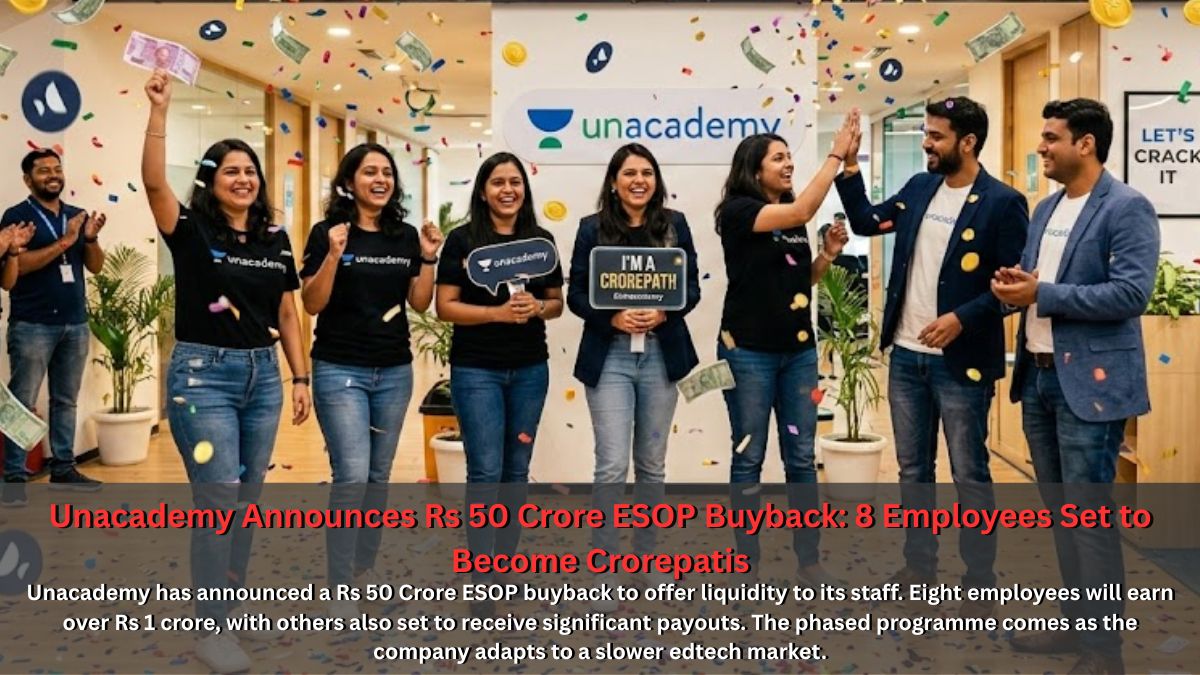
Unacademy has announced a Rs 50 Crore ESOP Buyback programme designed to provide liquidity to its workforce amid continued headwinds in the edtech sector. The buyback, approved by the company’s board, will allow selected current and former employees to sell their employee stock ownership plan (ESOP) shares back to the company. According to co-founder and CEO Gaurav Munjal, eight employees are set to receive more than Rs 1 crore each, with additional staff receiving significant payouts 17 will get over Rs 50 lakh and 38 are expected to make more than Rs 10 lakh from the exercise.
The initiative comes in the wake of a broader strategic reset at Unacademy as growth in online learning moderates after the pandemic boom and valuations have declined compared with previous funding rounds. Earlier, the company drew criticism for shortening the ESOP exercise window for former employees, a decision it later reversed following backlash. This move marks another structured liquidity event in the Indian startup ecosystem, where ESOP buybacks are increasingly used to reward employees and retain talent when secondary market exits or IPOs are not immediately available. The programme is expected to roll out in phases, with eligible participants contacted over the coming weeks.
1. Introduction to the News Event
1.1 What Is the Rs 50 Crore ESOP Buyback?
Unacademy has launched a Rs 50 Crore ESOP Buyback plan as part of a focused effort to give employees financial liquidity in a tightening startup funding environment. The initiative enables select staff and former employees to sell company-issued stock options back to Unacademy for cash.
The buyback is significant for early employees whose ESOPs may have accumulated value over their tenure, especially during times when broader liquidity channels like public listings or secondary sales are limited. Eight individuals are set to cross the Rs 1 crore mark from this exercise alone, highlighting its size and importance.
1.2 Why This Matters Now
Unacademy’s decision follows months of sectoral pressure in India’s edtech ecosystem. Funding growth has slowed since the pandemic surge, and valuation corrections are becoming common. The company’s buyback comes at a time when many startups are reassessing strategies to retain core talent and keep morale high. Employee stock options have become a critical part of compensation in tech-led startups, offering a share of future success to those who help build the business. But without near-term exit events, ESOP holders often lack liquidity a problem this buyback directly addresses.
2. Background: Understanding Unacademy
2.1 History of the Startup
Unacademy was founded in 2015 by Gaurav Munjal and Roman Saini with the goal of democratizing access to quality education in India. Initially a YouTube channel, it quickly grew into one of the country’s most well-known edtech companies, offering online coaching and test preparation for competitive exams such as UPSC, IIT-JEE, NEET, and more. Over the years, it expanded services to cover K-12 education, professional upskilling, and additional categories through partnerships and acquisitions, becoming a leader in the Indian online learning space. Unacademy’s growth trajectory saw it become a unicorn startup, valued at over $3 billion at its peak.
2.2 What Unacademy Does
Unacademy operates an edtech platform that connects learners with educators through live and recorded lessons, personalised learning tools, quizzes, interactive sessions, and practice tests. It serves students preparing for competitive exams as well as professionals seeking skills for career advancement. The company’s revenue model includes subscription fees for premium courses, advertising in certain free content, and strategic partnerships. It has also experimented with offline learning centres and franchise models to extend its reach.
3. How the Esop Buyback Works
3.1 What Are ESOPs?
Employee Stock Ownership Plans give employees the right to buy shares of their company at a fixed price after a certain period of employment. When the company performs well, these options can be worth much more than the original exercise price. However, without public trading or secondary markets, employees often can’t realise that value until a buyback event, acquisition, or IPO.
3.2 The Structure of the Buyback
Unacademy’s Rs 50 Crore ESOP Buyback creates a dedicated cash pool for repurchasing these stock options. The company will contact eligible employees and former staff over the coming weeks to facilitate participation.
Payouts range widely:
- Eight employees will receive more than Rs 1 crore each.
- Seventeen employees will receive over Rs 50 lakh.
- Thirty-eight employees are expected to make more than Rs 10 lakh.
This cascading payout structure reflects the varied size of stock option holdings across the company’s team.
4. Strategic Context Around the Buyback
4.1 Sector Slowdown and Valuation Trends
Edtech firms boomed during the pandemic, fueled by a surge in online learning adoption and robust venture capital funding. But as growth normalised, many companies faced slowing revenues and tightening investor interest. Unacademy is no exception, with its valuation reportedly much lower than peak levels. Earlier acquisition discussions with upGrad were called off due to valuation disagreements, underscoring the company’s current market challenges.
4.2 Policy Reversals and Employee Reactions
Late last year, Unacademy revised ESOP terms for former employees, shortening the window to exercise vested options. The company faced criticism and reversed this decision, reinstating a longer exercise period after feedback from employees. These moves reflect broader tensions around startup compensation, valuations, and employee expectations in a matured ecosystem. The latest buyback is part of this ongoing evolution.
5. Industry and Market Trends
5.1 ESOP Buybacks in Indian Startups
Liquidity events like this are gaining traction across the Indian startup landscape. With IPO exits rare outside top-tier unicorns and secondaries limited, structured buybacks provide a meaningful outlet for employees to realise value from stock options. These transactions also allow companies to signal confidence to their teams and align incentives during uncertain market cycles.
5.2 Edtech Sector Outlook
Despite cooling valuations, India’s edtech market remains significant. Growth is expected as digital adoption spreads and demand for flexible learning solutions continues. But profitability pressures and investor discipline are reshaping strategy and funding decisions.
6. Unacademy’s Business Model Explained
6.1 How the Platform Works
Unacademy built its core offering around digital learning. The platform connects educators and learners through scheduled live classes and structured courses. Students join interactive sessions, watch recordings, ask questions, and take mock tests. This structure helps them prepare for exams with guidance from teachers who specialize in specific subjects. The company uses a mix of proprietary tools, community features, and analytics to help students track performance. This approach became popular because it offered flexibility and affordability compared with traditional coaching centers. It also reached students in smaller towns who lacked access to expert faculty. As internet access grew, the platform became a preferred option for competitive exam preparation.
6.2 Subscription-Based Monetization
The company makes most of its revenue from subscription plans. Students pay a monthly or yearly fee to access courses for exams such as UPSC, IIT-JEE, NEET, banking, and state exams. These subscriptions include unlimited live classes, doubt-solving sessions, structured study plans, and mock test series. Beyond exam prep, the company introduced professional development courses. These include skill-based learning, coding programs, and business-oriented modules. While exam prep brings in the largest share of revenue, professional learning has added new opportunities for growth.
The company previously relied on aggressive marketing spend to expand. As the funding environment shifted, it moved toward more sustainable revenue and reduced discounts. This transition shaped the company’s financial decisions over the last two years.
6.3 Offline Centers and Hybrid Experiments
The startup expanded into offline learning centers in major cities. These centers aimed to combine digital tools with traditional classroom experiences. Students attended classes taught by senior faculty, while the platform provided digital notes, assessments, and analytics. The hybrid model helped the company serve students who still prefer face-to-face coaching. It also opened a path to compete with well-established offline players. While the offline expansion faced challenges during the edtech correction, it remained a strategic part of the company’s long-term plans.
7. Funding and Growth Journey
7.1 Major Funding Rounds
The startup raised capital from top global investors. These included venture capital firms and technology-focused funds that believed in India’s edtech potential. Over several rounds, the company’s valuation crossed $3 billion at its peak. This growth was driven by strong demand during the pandemic and heavy investor interest in online learning. As market conditions changed, valuations across the sector corrected. The company adjusted operations, optimized spending, and focused on profitability. These decisions influenced the timing of the Rs 50 Crore ESOP Buyback as it aimed to balance financial discipline with employee rewards.
7.2 Scaling Through Acquisitions
The company also used acquisitions to expand into new verticals. Smaller startups in test prep, upskilling, and specialized training became part of the group over time. These acquisitions helped expand content diversity, strengthen capabilities, and bring in experienced educators. While consolidation slowed in the recent funding winter, earlier deals remain part of the company’s broader ecosystem. They also contributed to the company’s rapid rise during the high-growth years.
7.3 Founders’ Vision and Values
The startup was founded by Gaurav Munjal, Roman Saini, and Hemesh Singh. Their collective vision was to make quality education accessible to every learner. Munjal focused on strategy and product direction. Saini brought deep knowledge of competitive exams, and Singh led the technology roadmap. Their combined experience shaped the platform’s design and rapid user adoption. The founders often emphasized long-term value creation, which explains the company’s continued investment in educators, content quality, and technology upgrades.
8. What Problem the Startup Solves
8.1 Unequal Access to Quality Educators
For decades, India’s exam-centric education system created a silent divide. Students in metro cities had easy access to experienced teachers, structured coaching, and competitive peer groups. Those in Tier 2 and Tier 3 towns often had to make do with limited faculty or travel long distances for decent coaching. Many families uprooted their lives just so their children could attend premium institutes in places like Kota or Delhi.
The platform stepped into this gap at the right moment. It brought top educators directly to a student’s phone or laptop. It didn’t matter whether a student lived in Guwahati or a remote town in Madhya Pradesh. They could finally learn from teachers whose classes were once restricted to only a few privileged students. This access changed outcomes. Thousands of learners who had never imagined studying under elite faculty suddenly had that chance. Hearing real stories from students who cracked tough exams because they finally had the right teacher shows how deeply this shift mattered.
8.2 High Cost of Traditional Coaching
Anyone familiar with India’s competitive exam ecosystem knows how expensive coaching can be. A single year of preparation for exams like NEET or IIT-JEE can cost families anywhere between Rs 1 lakh to Rs 3 lakh. For many middle-class homes, this fee is overwhelming. Parents take loans. They dip into savings. Some even send one child to coaching while the other has to compromise.
When the platform introduced a subscription model, it changed the financial math for thousands of families. Instead of committing to a massive annual fee, students could pay monthly, quarterly, or follow shorter plans. They didn’t have to relocate or worry about hostel charges. Many parents say the platform gave them “mental peace” because they could finally afford structured coaching without sacrificing essential household needs. The reduced cost didn’t mean reduced quality. Students gained access to structured courses, live doubt-solving, mock tests, and top educators at a fraction of traditional coaching prices. This affordability widened the learning circle and made competitive exams more inclusive.
8.3 Need for Personalized Learning Tools
Traditional coaching has its strengths, but personalization is rarely one of them. In classrooms with 50, 80, or even 120 students, it’s almost impossible for teachers to track each learner’s progress. Many students feel left behind. Some hesitate to ask questions because they fear judgment. Others begin losing confidence long before the exam.
Digital learning tools finally gave students a voice. Real-time analytics showed them their weak areas. Mock tests highlighted gaps. Doubt-clearing sessions became safe spaces where students could ask anything without feeling embarrassed. Personalized study plans and performance dashboards helped even average students understand what they needed to improve. The emotional shift here is real. Students who once felt invisible in crowded coaching centers now felt seen. They felt supported. For many young learners, that psychological reassurance often made the biggest difference in their performance.
9. Competitive Landscape
9.1 Direct Competitors
The edtech market is crowded and competitive, and the platform fights for attention every day. Its direct rivals include other large digital learning companies that offer live classes, structured exam-prep programs, and course subscriptions. These companies compete aggressively on educator quality, pricing, content style, and student engagement.
The stakes are high because students switch quickly. If an educator connects better or a course structure feels more logical on another platform, students will not think twice about moving. This constant shuffle keeps the pressure high and forces every edtech brand to keep improving. Educators also have massive influence. A star teacher changing platforms can shift thousands of students overnight. This fluid movement keeps the competition sharp, emotional, and deeply personal.
9.2 Indirect Competitors
Traditional coaching centers remain a powerful force. Their offline presence, legacy reputation, and consistent results give them strong credibility. Families who prefer face-to-face learning or structured environments still trust these institutes. For many students, the “classroom experience” holds emotional value that digital platforms must work hard to match.
Then come the smaller digital platforms. These apps offer budget-friendly test series, recorded classes, or no-frills preparation modules. They may not have the massive features of big platforms, but they attract students who want simple, low-cost tools. Even colleges offering integrated coaching have become indirect competitors because they blend degree programs with exam preparation.
9.3 Market Positioning
Despite the crowded battlefield, the platform carved a powerful identity. Its early focus on high-quality educators created an emotional bond with learners who believed in those teachers more than the brand itself. Over time, the platform expanded its internal tools, improved learning design, and built a community-driven approach that kept students engaged.
Its brand became synonymous with accessible quality. The platform didn’t just position itself as a coaching substitute. It became a learning companion a space where students felt guided, supported, and understood. This emotional connection helped the company remain relevant through market fluctuations.
The platform continues to evolve. It experiments with pricing, content depth, and hybrid models. It listens to student feedback. It shifts strategies based on exam cycles and competitive pressure. Most importantly, it keeps working to preserve the trust it built through years of consistent teaching quality and student-focused design.
10. Broader Industry Trends
10.1 Multi-Format Learning
Education in India is no longer limited to screens or classrooms. Students want the best of both worlds. They want the warmth of a teacher standing in front of them, explaining a hard concept with simple words. At the same time, they want the freedom to revisit a recorded lesson at midnight when a doubt suddenly strikes. This desire for blended learning did not emerge overnight. It grew from the lived experiences of millions of students who tasted digital convenience during the pandemic and then missed the emotional comfort of physical classes.
Startups across the country noticed this shift. They began opening hybrid centers where digital tools meet real classrooms. Parents who once doubted online education now appreciate how a child can attend an offline class, come home, and revise everything on an app. This hybrid approach also solves a deeper emotional need. Many students feel lonely preparing for competitive exams. Learning centers help them reconnect with peers and build a sense of community while still retaining the flexibility that digital learning provides.
The hybrid wave is not a trend. It’s a response to how students genuinely want to learn today.
10.2 Profitability Focus
The golden years of “grow at any cost” are gone. Investors who once showered edtech companies with capital now ask harder questions. They want sustainable business models, solid unit economics, and stable revenue streams. This shift is not easy for companies that expanded at breakneck speed. Many had to rethink marketing budgets, streamline team structures, and cut down on features that looked good on paper but never converted to real usage.
Behind these financial decisions are very human stories. Startups learned that survival depends not just on ambition but on discipline. Founders spoke openly about tough choices they had to make—reducing burn, changing product priorities, and restructuring operations. This pressure is one of the reasons the Rs 50 Crore ESOP Buyback stands out. It signals that despite the push for profitability, companies can still create financial outcomes for their teams.
It shows that responsible management and employee rewards can coexist. And that matters more in today’s cautious market than any hyper-growth headline.
10.3 Demand for Skill-Based Learning
India is entering a decade where degrees alone cannot guarantee jobs. Young professionals want practical skills that help them stand out in interviews and adapt to new roles. Coding, data analytics, UI/UX, product management, cloud computing, and business communication are no longer “extra courses.” They are necessities.
This shift is visible in lived experiences. Fresh graduates often share how a single certification opened doors that their college marks never could. Working professionals talk about how learning a new tool changed their career trajectory. Startups responded by expanding into skill-based learning, offering courses designed around real industry needs.
Tech innovations from AI-driven adaptive learning to interactive virtual labs made these skill courses more engaging. These tools allow learners to practice, experiment, and build real project experience. The edtech companies that combine strong content with practical training are now shaping the future of India’s employability.
11. The Rs 50 Crore ESOP Buyback in Context
11.1 Why It Matters for the Startup Ecosystem
The Rs 50 Crore ESOP Buyback is more than a financial transaction. It’s a morale booster for an ecosystem that has been through one of its toughest winters. Startups across India faced funding pressure, slower growth, and tough restructuring decisions. In such a climate, a buyback of this scale sends a powerful message: liquidity events are still possible even when the market is tight.
Founders, employees, and investors take notice. When a company creates wealth for its people during a downturn, it restores belief in the startup journey. It tells early-stage founders that discipline does not mean the end of rewards. It tells employees that loyalty and hard work can still pay off. And it tells the ecosystem that ESOPs are not just theoretical promises they can become real cash in the bank. This emotional reassurance is just as valuable as the money itself.
11.2 Impact on Employees
For the employees participating in the buyback, the experience is life-changing. These are people who spent years working late nights, managing uncertainty, and helping build a company from scratch. Many joined when the startup was still finding its footing. They took risks because they believed in the vision. Now, with the buyback, eight of them will become crorepatis. That moment is more than a financial milestone. It’s the validation of years of faith, sacrifice, and resilience. Some may finally be able to buy homes. Others may support their parents or invest in their children’s education. Some may invest the money to secure their future.
This transformation is emotional. Employees often describe feeling proud not just for themselves but for being part of a company that values their contribution enough to offer real liquidity. It strengthens loyalty in a way no appraisal cycle ever could.
11.3 Signaling Strength to the Market
A buyback during a tough market signals quiet strength. It shows that the company is confident about its financial stability and long-term direction. It also tells the market that the company is not retreating under pressure but is instead choosing to stand by its people. This kind of message spreads fast. Job seekers notice. Competitors notice. Investors notice. The company’s brand gains credibility in ways that traditional marketing cannot achieve. It becomes known as a place where contributions are acknowledged and rewarded.
In an industry where talent moves quickly, this reputation becomes a competitive advantage. It helps attract committed individuals who want to be part of a company that honors its promises. It also boosts internal morale, leading to better performance, stronger teams, and a healthier culture.
12. Learning for Startups and Entrepreneurs
12.1 Prioritizing Long-Term Talent Value
One of the clearest lessons from this buyback is that teams stay loyal when they feel seen, valued, and included in the company’s long-term vision. ESOPs often get treated like a checkbox during hiring, but in reality they’re a long-term promise. A buyback is the moment where that promise finally turns into something real.
Most founders underestimate how deeply this impacts people. When employees receive actual liquidity, it changes how they look at the company. It signals that their work mattered. It shows that the company isn’t just using them to hit the next valuation milestone but wants them to share the rewards too. This emotional validation often matters as much as the financial payout. Startup leaders who internalize this build teams that will weather tough cycles and stay invested in the vision.
12.2 Adaptation During Market Cycles
The edtech sector reminds us that market cycles can flip without warning. One year the pressure is “scale at any cost,” and the next year everyone is scrambling to cut burn and talk about profitability. Founders who survive aren’t the ones with the loudest growth story. They’re the ones who adapt quickly, make data-backed decisions, and stay honest about what’s working and what isn’t.
During down cycles, it’s tempting to blame the market. But the truth is tougher: companies that stay flexible and learn to operate with less emerge stronger. This buyback happened in a time when most edtech companies were tightening budgets and revising forecasts. The fact that the company still created a liquidity event shows how much discipline and planning went on behind the scenes. It’s a reminder that real leadership isn’t loud. It’s consistent.
12.3 Balance Between Growth and Sustainability
A lot of startups rode the wave of aggressive funding between 2018–2021. Many scaled faster than their internal systems could support. When the cycle cooled, the harsh reality showed up. Runways were shorter. Costs were higher. Growth-at-all-costs suddenly looked irresponsible.
Now the industry is in a phase where efficiency matters more than ever. Founders are learning to build tighter teams, double down on profitable verticals, and question every operational leak. The buyback offers an interesting contrast because it shows that sustainability and generosity can co-exist. A company doesn’t have to be wildly profitable to appreciate its people. It just needs to plan well and stay committed to responsible growth. This is the new playbook: grow, but grow with intention.
12.4 Invest in Employee Experience
ESOPs might look like financial tools, but they are really about trust. Employees don’t just want good salaries. They want to feel like partners, not passengers. When companies communicate clearly about ESOP structures, vesting schedules, and liquidity events, they create a culture where people feel respected.
The way a company handles these moments says more about its character than any marketing campaign ever could. Employees talk. Their stories shape the brand far more authentically than any ad. When people experience transparency, fair treatment, and real financial outcomes, they become long-term ambassadors for the company. For founders, the takeaway is simple: don’t treat ESOPs like a formality. Treat them like a relationship. A strong ESOP culture builds a strong company.
About foundlanes.com
foundlanes.com is India’s leading startup idea discovery platform. It helps entrepreneurs find actionable startup opportunities, market insights, and industry-specific guidance to turn ideas into real businesses. With deep research and practical resources, foundlanes supports founders at every stage, from idea validation to launch and growth.