


Summary
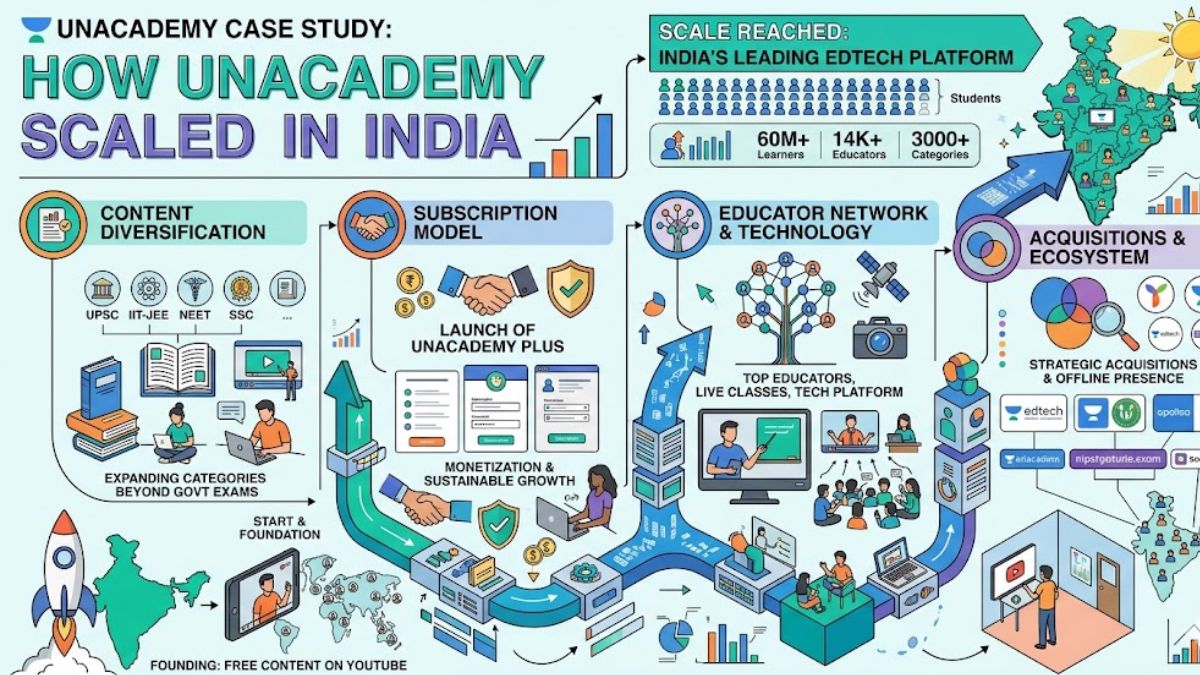
This Unacademy Case Study explores how one of India’s most prominent edtech startups transformed from a simple YouTube channel into a large-scale digital learning platform serving millions of learners across the country. Unacademy operates as an online education platform that provides courses, live classes, and test preparation resources for competitive exams such as UPSC, SSC, banking, and more. The company was founded by Gaurav Munjal, Roman Saini, and Hemesh Singh. It traces its origins back to 2010, when Gaurav Munjal started uploading educational content on YouTube. The formal company was established in 2015 and is headquartered in Bengaluru, India. The founders aimed to democratize access to quality education by making learning affordable, accessible, and scalable through technology.
Unacademy works through a digital platform where educators can create courses and students can access them through subscriptions. The company leverages live classes, recorded sessions, structured test series, and interactive tools to enhance learning outcomes. Over time, it expanded into multiple categories, including professional courses and skill development. Unacademy has raised significant funding from global investors such as SoftBank, Sequoia Capital India, and Tiger Global. It achieved unicorn status and reported strong growth during the surge in demand for online learning platforms India, particularly during the COVID-19 pandemic. This case study examines how Unacademy built a scalable edtech business, navigated intense competition, and established itself as a major player in India’s digital education ecosystem.
1. Origin Story and Early Background
The origin of Unacademy didn’t begin with a startup pitch deck or investor meeting. It started much earlier, in a very simple and almost personal way, with curiosity and a camera. In 2010, Gaurav Munjal began uploading short educational videos on YouTube. At that time, there was no grand vision of building one of India’s largest edtech platforms. It was just an attempt to explain concepts in a way that felt easier, clearer, and more human than traditional classroom teaching.
What makes this phase important is not the scale, but the signal it created. Students started engaging with the content. They asked questions, shared feedback, and returned for more videos. That kind of response quietly revealed something powerful, learning was shifting. People were ready for digital education, even if the industry itself was not ready yet.
By 2015, this early experiment started to feel less like a hobby and more like an opportunity. Along with other co-founders, the idea began to take shape as a structured platform. This was the real turning point, the shift from individual content creation to building a scalable system for learning. That transition eventually led to the creation of Unacademy, one of the most recognized names in India’s edtech ecosystem.
2. Background of the Founders
The strength of Unacademy lies not just in its idea, but in the very different worlds its founders came from. Gaurav Munjal brought a strong product and tech-driven mindset, shaped by his experience in building digital products and understanding user behavior in online environments. His focus was always on simplicity, scale, and accessibility.
Then came Roman Saini, whose journey as a former IAS officer added a completely different dimension. He understood the pressure of competitive exams, the emotional weight students carry, and the system-level gaps in traditional coaching. That perspective wasn’t theoretical. It came from lived experience, from sitting in the same system students were trying to break into.
Alongside them, Hemesh Singh contributed the technical backbone needed to turn ideas into a working product. His role ensured that the platform didn’t just remain a concept, but became a stable, scalable system capable of handling large numbers of learners. When these three perspectives came together, something important happened. It wasn’t just a startup team. It was a combination of product thinking, real student understanding, and technical execution. That balance became the foundation on which Unacademy was built.
3. Early Challenges
The early journey of Unacademy was far from smooth. One of the biggest challenges was monetization. Education content, especially in India, had long been associated with free access or low-cost coaching. Convincing users to pay for online learning required not just a product, but a shift in mindset. People were used to physical classrooms, handwritten notes, and offline coaching institutes. Trust in online education was still developing. So even when content was useful, converting viewers into paying users was not easy. There was a psychological barrier that had to be crossed first.
On top of that, there were technical challenges in building a live, interactive learning system. Early infrastructure had to support real-time classes, stable streaming, and smooth interaction between educators and students. These are not small problems. In live education, even a few seconds of lag can break the learning experience.
Despite these challenges, the introduction of live classes became a defining moment for Unacademy. For the first time, learning felt interactive rather than one-sided. Students could ask questions in real time, and educators could respond instantly. That human connection, even through a screen, changed how people perceived the platform. It wasn’t just content anymore. It started feeling like a classroom.
4. Product Evolution
As Unacademy evolved, so did its understanding of what learners actually needed. It was no longer enough to just provide videos or live classes. Students preparing for competitive exams needed structure, practice, and feedback loops. This led to the introduction of test series, doubt-solving sessions, and full-length structured courses. Each of these additions wasn’t just a feature. It was a response to real student behavior. Learners wanted more than information. They wanted preparation systems that could guide them step by step.
One of the most important shifts in this phase was the move toward subscription-based learning. Instead of paying for individual courses, users could subscribe and access a wider ecosystem of content. This change created stability for both learners and the platform. It allowed students to explore without worrying about per-course costs, while giving the company a recurring revenue structure. This evolution became central to the Unacademy growth strategy. It transformed the platform from a content provider into a full learning ecosystem where education was continuous, not transactional.
5. Early Traction and Validation
The first real traction for Unacademy didn’t come from advertisements or aggressive marketing. It came organically, from an existing audience that already trusted the founders’ content. Gaurav Munjal had already built a small but engaged following through YouTube, and that became the initial entry point for users. These early learners were not just passive viewers. They became active participants in shaping the platform. Their feedback helped refine content formats, teaching styles, and platform features. That kind of real-time validation is powerful because it comes directly from users, not assumptions.
At the same time, educators started joining the platform. This created a two-sided ecosystem, teachers on one side and learners on the other. As more educators came in, content diversity increased. As more learners joined, credibility increased. This cycle of mutual growth created momentum. What made this phase important is that validation was not based on hype. It was based on usage. Students kept coming back. Classes were attended consistently. Learning outcomes improved. And slowly, the idea stopped being an experiment and started becoming a system people relied on.
6. Business Model and Revenue Approach
The business model of Unacademy is built on subscriptions, but its real strength lies in how it aligns incentives across the ecosystem. Learners pay for access to structured courses, live classes, and exam preparation material. Instead of buying one course at a time, they get access to a broader learning environment. Different pricing tiers were introduced to cater to different types of students. Some needed basic access, while others required full preparation packages for highly competitive exams. This flexibility allowed the platform to reach a wider audience without excluding lower-income learners.
On the other side, educators also became an important part of the ecosystem. They were not just content creators, but partners in growth. Through revenue-sharing models, teachers earned based on the subscriptions their content attracted. This created a strong incentive for quality teaching and consistent engagement. The result of this structure was a recurring revenue system. Unlike one-time course sales, subscriptions created predictability in earnings. This became a key driver of Unacademy revenue growth over time. But beyond numbers, what truly defined the model was its balance. Learners got access to structured, affordable education. Educators got a platform and income opportunity. And the company built a scalable system that could grow with demand.
7. Funding History and Investor Involvement
The growth journey of Unacademy attracted serious attention from investors early on, not because it was loud, but because it was visible. The platform was showing real traction in a space that was slowly shifting online, and that shift mattered. As more students began moving toward digital learning, investors started seeing online education in India not as a niche experiment, but as a large-scale opportunity. Over time, Gaurav Munjal and his team raised multiple funding rounds from well-known global and domestic investors. These weren’t just financial injections. They were signals of confidence in the direction the company was taking. Each round reflected a new stage of maturity, from early product validation to aggressive scaling and ecosystem expansion.
The capital wasn’t sitting idle. It was actively deployed into expanding course offerings, onboarding more educators, and strengthening the platform’s technology backbone. A significant portion also went into acquisitions, which helped Unacademy enter new categories faster than building everything from scratch. In a competitive space like edtech, speed matters, and funding gave the company the ability to move quickly when opportunities appeared. But what often gets overlooked is the pressure that comes with funding. With every round, expectations rise. Growth targets become sharper. Execution becomes more intense. For Unacademy, capital was not just fuel. It was responsibility. Every dollar raised had to translate into real learning outcomes and measurable user growth.
8. Go-to-Market Strategy and Distribution
The go-to-market strategy of Unacademy was built with one simple truth in mind: students are already online. Instead of pushing learners away from where they were, the platform met them directly on digital channels they already used daily. Social media became one of the strongest growth engines. Educational content was not just promoted, it was naturally distributed through short videos, live sessions, and educator-led engagement. This created a loop where content itself became marketing. When students found value, they shared it. That sharing behavior replaced a large part of traditional advertising.
One of the most powerful distribution tools turned out to be the educators themselves. Teachers on Unacademy were not just instructors, they became public personalities. Many built strong followings, and students often joined the platform because they trusted a specific educator. This created a unique dynamic where growth was not driven only by the company, but also by the individual influence of teachers. That shift changed everything. Instead of a top-down marketing model, growth became decentralized. Educators brought in learners. Learners brought in more learners. Trust was transferred through people, not just branding. And in education, that human connection is often more powerful than any advertisement.
9. Brand Positioning and Messaging Evolution
From the beginning, Unacademy positioned itself around a simple but powerful idea: education should not be limited by access, location, or affordability. The early messaging focused heavily on democratization, the idea that anyone, anywhere, should be able to learn from top educators. This message resonated deeply, especially in a country where access to quality coaching has historically been uneven. Students from smaller cities suddenly had access to the same educators as those in metro hubs. That emotional shift mattered just as much as the product itself.
As the platform matured, the positioning evolved. It was no longer just about free or accessible learning. It started focusing on structured preparation, premium learning experiences, and outcome-driven programs. This reflected a natural transition from an early-stage disruptor to a more established education ecosystem. The evolution of messaging is closely tied to the Unacademy success story. It shows how the brand grew with its users. What started as accessibility slowly expanded into ambition, quality, and structured outcomes. The emotional core remained the same, but the expectations became higher.
10. Key Challenges, Failures, and Turning Points
The edtech space in India is extremely competitive, and Unacademy was never operating in isolation. New startups kept entering the market, while established players expanded aggressively. This created constant pressure on growth, pricing, and user retention. One of the biggest internal challenges was maintaining quality at scale. When thousands of educators are part of a platform, ensuring consistency becomes complex. Not every teaching style aligns with student expectations, and not every course delivers the same level of value. Managing this diversity while keeping the learner experience strong was an ongoing challenge.
Despite these hurdles, one of the most defining turning points came during the pandemic. Suddenly, the entire education system shifted online almost overnight. What was once an option became a necessity. Demand for platforms like Unacademy surged dramatically. This period accelerated everything, user growth, course adoption, and platform usage. But it also brought its own pressure. Systems had to scale rapidly, educators had to adapt to massive audiences, and infrastructure had to support unprecedented traffic. It was a moment of both opportunity and stress, where execution mattered more than ever.
For Gaurav Munjal and his team, this phase tested not just product strength, but operational resilience.
11. Operational Execution and Scaling Decisions
Scaling Unacademy required far more than adding users. It required building a system that could handle millions of learners simultaneously without breaking the learning experience. That meant heavy investment in backend infrastructure, streaming capabilities, and platform stability.
As the user base expanded, the company also diversified into multiple exam categories. From competitive exams to professional learning, each segment required different content structures, teaching styles, and engagement formats. This expansion increased complexity significantly, but it also widened the platform’s reach. Operational efficiency became a central concern. Growth is exciting, but in education, consistency is critical. A student preparing for an exam depends on stability, not disruption. Ensuring that live classes ran smoothly, that content remained accessible, and that educators could operate without friction became a daily priority. These decisions shaped how Unacademy scaled. It wasn’t just about growth metrics. It was about building reliability at scale, which is often harder than growth itself.
12. Competitive Landscape and Differentiation
The competitive landscape for edtech startups India is intense, with multiple platforms trying to capture student attention and educator participation. In such an environment, differentiation becomes critical. Unacademy stood out because of its educator-led ecosystem. Unlike traditional models where content is centrally controlled, Unacademy allowed educators to build their own identity and audience within the platform. This created a sense of ownership among teachers.
Educators were not just employees or contributors. They became independent brands. Students often followed specific teachers rather than just the platform itself. This human-centered model created stronger emotional engagement compared to purely content-driven platforms. For learners, this meant access to diverse teaching styles. For educators, it meant visibility and income opportunities. For the platform, it created a self-sustaining ecosystem where growth was driven by trust between teachers and students. This structure became one of the key reasons behind the Unacademy growth story. It wasn’t just technology. It was people-driven scale.
13. Growth Metrics and Milestones
Over time, Unacademy reached several major milestones that marked its position in the Indian startup ecosystem. One of the most significant was achieving unicorn status, a reflection of both market potential and investor confidence. The platform now hosts thousands of educators and serves millions of learners across different exam categories and professional domains. This scale didn’t come overnight. It was built through years of iteration, feedback, and continuous improvement.
Beyond numbers, the expansion into multiple verticals shows how the company evolved from a focused exam preparation platform into a broader learning ecosystem. Each new vertical added complexity, but also strengthened its presence in the education space. These milestones highlight more than just growth. They reflect consistency in execution, adaptability in strategy, and the ability to stay relevant in a fast-changing market. For Gaurav Munjal and his team, this journey represents what it means to build in a space where impact is measured not just in revenue, but in learning outcomes and real student success.
14. Team Building and Leadership Approach
As Unacademy moved from an early-stage idea into a large-scale learning platform, building the right team became one of the most important pillars of its growth. For Gaurav Munjal and the founding team, hiring was never just about filling roles. It was about finding people who could operate in uncertainty, move fast, and still stay aligned with the core mission of improving education access.
In the early phase, there was a clear emphasis on two things. First, strong technical capability, because the platform had to support live classes, large-scale user traffic, and constant product updates. Second, a genuine understanding of education, because building an edtech product is not the same as building a typical consumer app. Every feature directly impacts how someone learns, prepares, and performs in real life.
What made the leadership approach stand out was its openness to experimentation. The founders encouraged teams to test ideas quickly, learn from feedback, and adapt without waiting for perfect conditions. In a fast-moving environment like edtech, rigidity can slow progress. Instead, adaptability became part of the culture. Over time, this approach helped Unacademy handle rapid expansion. Teams were not just executing instructions; they were actively shaping how the platform evolved. That sense of ownership became a key driver of speed and innovation.
15. Technology and Platform Insights
Technology sits at the core of Unacademy, but not in a flashy or superficial way. It is deeply tied to how learning actually happens on the platform. From live streaming infrastructure to interactive tools, every layer is designed to make education more accessible and engaging in real time. One of the most important elements is the use of data. The platform continuously analyzes how students engage with content, where they drop off, which topics create difficulty, and how performance changes over time. This data is not just stored. It is used to improve course structures, teaching methods, and overall learning experience.
Features like live classes transformed the traditional learning model. Instead of passive video consumption, students could interact directly with educators. Doubt-solving sessions, polls, and real-time discussions made learning feel more personal and responsive. That human interaction, even through a digital screen, became a defining part of the experience. As the user base grew, scalability became a constant focus. The platform had to handle spikes in traffic during exams, live sessions, and course launches without disruption. Continuous upgrades in infrastructure ensured that performance remained stable even under heavy load. For Unacademy, technology is not just support. It is the backbone that holds the entire learning ecosystem together.
16. Regulatory and Industry Challenges
Operating in the education sector in India brings a layer of complexity that goes beyond product and growth. For Unacademy, navigating regulatory expectations became an important part of scaling responsibly. Education is a sensitive space because it directly impacts student outcomes, careers, and long-term aspirations. As digital learning platforms grew, questions around quality control, transparency, and accountability became more important. Ensuring that content delivered by educators met consistent standards required internal systems and checks.
There were also evolving policies around digital education and online coaching models. Like many players in the space, Unacademy had to stay aligned with changing guidelines while continuing to innovate. This required a careful balance between speed and compliance.
Transparency became increasingly important as the platform scaled. Students needed clarity on course structure, educator credibility, and learning outcomes. Building trust in such an environment is not a one-time effort. It is something that must be maintained continuously through consistent experience and clear communication. For Gaurav Munjal and the leadership team, this meant treating compliance not as a barrier, but as part of long-term sustainability.
17. Current Status of the Startup
Today, Unacademy stands as one of the most recognized names in India’s edtech ecosystem. What started as simple educational videos has now evolved into a large-scale learning platform serving millions of students across multiple categories. The company continues to expand its offerings beyond traditional exam preparation. From competitive exams to professional upskilling, the platform is steadily moving toward a broader education ecosystem. This expansion reflects how learner needs are evolving beyond just entrance exams into lifelong learning and career development.
Even with growing competition in the edtech space, Unacademy remains a key player due to its strong educator network and established user base. Its presence across different exam categories and learning segments gives it depth that is difficult to replicate quickly. For Gaurav Munjal and the team, the focus now is not just on expansion, but on refining learning outcomes, improving engagement, and strengthening the overall ecosystem.
18. Future Outlook
The journey of Unacademy reflects a larger shift happening in India’s education landscape. The demand for online learning platforms India continues to grow, driven by increasing internet access, changing career expectations, and a stronger focus on skill-based education. Looking ahead, the platform is likely to focus on deeper innovation in learning formats. This includes more personalized learning paths, better use of data analytics, and improved engagement tools that make education more adaptive to individual needs.
Expansion into new categories and professional learning segments is also expected to continue. As education moves beyond traditional boundaries, platforms like Unacademy will play a larger role in both academic and skill-based development. However, long-term success will depend on more than just scale. It will depend on how effectively the platform can improve real learning outcomes. For Gaurav Munjal and the founding team, the challenge is not just growth, but staying relevant in a rapidly changing education ecosystem. Ultimately, the Unacademy case study shows something deeper. It reflects how consistent execution, user understanding, and adaptability can turn a simple idea into a large educational movement.
About foundlanes.com
foundlanes.com is India’s leading startup idea discovery platform. It helps entrepreneurs find actionable startup opportunities, market insights, and industry-specific guidance to turn ideas into real businesses. With deep research and practical resources, foundlanes supports founders at every stage, from idea validation to launch and growth.