


Summary
This Upstox Case Study explores how one of India’s most recognized digital brokerage platforms emerged in a market traditionally dominated by large financial institutions. Upstox is an online trading platform that allows investors to buy and sell stocks, derivatives, commodities, and other financial instruments through a mobile application and web-based interface. The company focuses on delivering low-cost brokerage services supported by technology-driven tools designed for modern retail investors. The company was founded by Ravi Kumar, Shrini Viswanath, and Kavitha Subramanian. It is headquartered in Mumbai and originally began operations in 2009 under the name RKSV Securities. The founders built the company with the vision of making financial markets more accessible to everyday investors by reducing brokerage costs and simplifying the trading process.
Upstox operates as a digital brokerage platform where users can open trading and demat accounts online, deposit funds, analyze market data, and execute trades directly from their smartphones or computers. The platform integrates real-time market information, charting tools, and order execution features that help investors participate in the stock market with greater ease. Over the years, the company has gained support from prominent investors including Ratan Tata, who backed the company during its early growth phase. Upstox has also raised funding from institutional investors to scale its technology infrastructure and expand its product ecosystem.
The growth of digital investing, improved internet connectivity, and increasing retail participation in the stock market have helped platforms like Upstox expand rapidly. Today the company competes with other discount brokerage India platforms and has become one of the most widely recognized online stock trading app India providers. This case study analyzes how Upstox evolved from a small brokerage firm into a major fintech platform, highlighting its founder journey, product strategy, operational execution, and role in the broader ecosystem of fintech startups in India.
1. The Origin Story: From RKSV Securities to Upstox
The story behind Upstox begins in 2009 when the founders launched a brokerage firm called RKSV Securities. At the time, India’s brokerage industry was dominated by traditional firms that relied on offline infrastructure and relationship-driven distribution models. Opening a trading account often required physical paperwork and interactions with brokers. Brokerage fees were relatively high, which discouraged small investors from participating actively in the stock market.
The founders saw an opportunity to simplify this process. They believed technology could dramatically change how investors interact with financial markets. Instead of relying on traditional broker networks, digital platforms could allow investors to manage trades directly. In its early years, RKSV Securities primarily served professional traders and institutional clients. However, the founders soon realized that the future of trading would likely be driven by retail investors using digital tools.
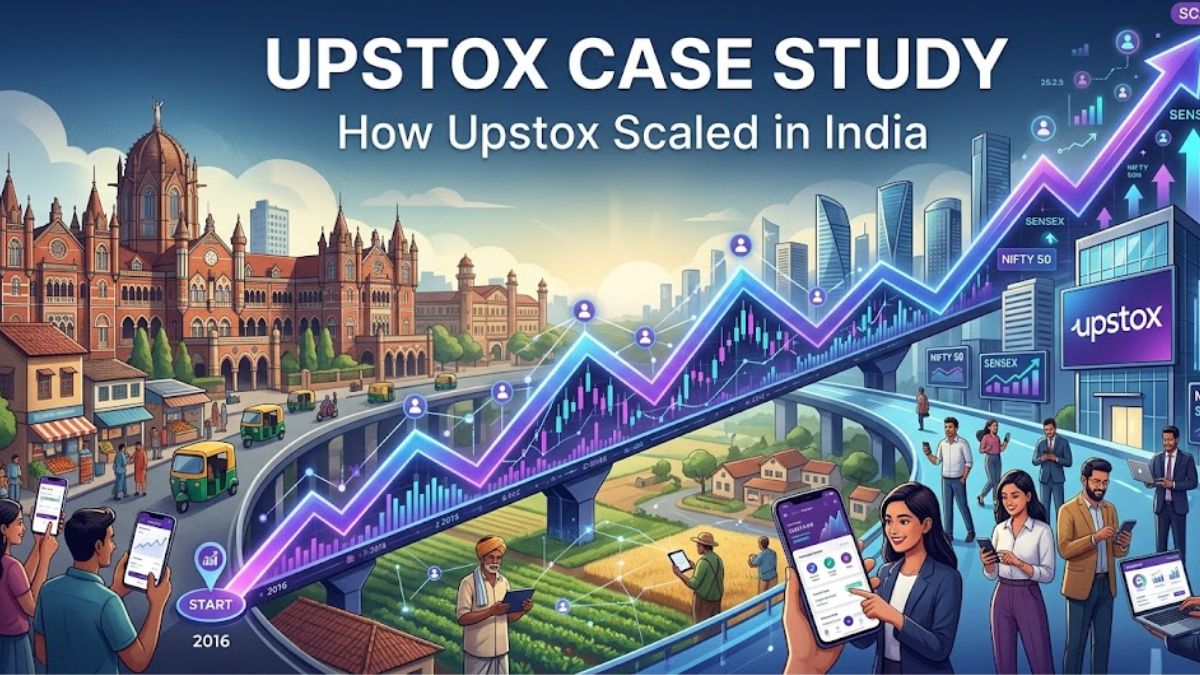
This insight eventually led to a major transformation. In 2016, RKSV Securities rebranded itself as Upstox. The new brand identity signaled a shift from a traditional brokerage firm to a technology-focused fintech platform. The rebranding was not just cosmetic. It represented a deeper strategic change. Upstox began investing heavily in product development, mobile technology, and user experience to attract a broader audience of retail investors. The transformation aligned with the rise of Indian stock market apps, where technology-driven platforms were making trading more accessible to the public.
3. Founder Journey and Early Motivation
The journey of the founders played a critical role in shaping the vision of Upstox. Ravi Kumar had experience working within financial markets and brokerage operations. His exposure to trading infrastructure gave him a clear understanding of the inefficiencies present in traditional brokerage services. Shrini Viswanath contributed deep technical expertise to the company. Building a reliable trading platform required robust engineering capabilities, especially in an industry where speed and reliability are essential.
Kavitha Subramanian brought operational and strategic insight to the team. Her role helped guide the company’s product and business development decisions. The founders shared a common belief that the Indian financial ecosystem was ready for transformation. For decades, investing in the stock market was seen as complicated and expensive for the average individual. Many people depended on brokers or advisors to place trades on their behalf. The founders believed technology could empower investors to make their own decisions. However, building trust was not easy in the beginning.
Financial services rely heavily on credibility, and new platforms often face skepticism from potential users. Upstox had to demonstrate that a digital trading platform could deliver reliability, security, and performance comparable to traditional brokerage firms. The early years were focused on building this trust while simultaneously developing technology infrastructure capable of supporting large trading volumes.
4. Market Problem: Barriers in the Traditional Brokerage Industry
Before the rise of digital brokerage platforms, the Indian trading ecosystem was characterized by several structural limitations. Traditional brokerage firms charged percentage-based commissions on trades. These fees could accumulate quickly for active traders. The account opening process was also time-consuming. Investors often had to submit multiple documents and complete verification steps in person. Another limitation involved technology.
Many legacy trading platforms were built for desktop environments and were not optimized for mobile devices. This created friction for investors who wanted to trade on the go. These barriers limited participation in the stock market. The founders of Upstox believed the solution lay in adopting a discount brokerage India model combined with modern technology. Discount brokers reduce trading costs by automating processes and relying on digital infrastructure instead of physical branches.
This model allows companies to offer lower brokerage fees while maintaining operational efficiency. The emergence of online stock trading app India platforms also reflected broader changes in consumer behavior. As smartphones became more widespread, investors increasingly preferred managing financial activities through mobile applications. By addressing cost, accessibility, and technology limitations, Upstox positioned itself as part of a new wave of fintech startups in India aiming to democratize financial services.
5. Building the Upstox Trading Platform
Developing the Upstox trading platform required significant engineering effort and technological innovation. Trading platforms must process large volumes of market data in real time. Even small delays can impact trading outcomes. The Upstox engineering team focused on building infrastructure capable of delivering fast and reliable execution.
One of the company’s key priorities was mobile-first design. As smartphone adoption increased in India, mobile trading became an essential feature for retail investors. The platform introduced advanced charting tools that allowed traders to analyze price movements and market trends directly from their devices. It also provided features such as order management, portfolio tracking, and customizable watchlists. Over time, the product expanded beyond basic trading capabilities.
Upstox began offering additional financial services such as mutual fund investments and derivatives trading. These features positioned the platform alongside other top brokerage platforms India competing for the growing base of retail investors. Continuous product development remained central to the company’s strategy. User feedback played a major role in shaping updates and improvements to the platform’s interface and functionality.
6. Early Traction and First Customers
In the early stages, Upstox focused on attracting experienced traders who valued low brokerage fees and advanced trading tools. These early adopters were often active participants in financial markets and provided valuable feedback on the platform’s performance. Their usage helped validate the company’s technology infrastructure. As confidence in the platform grew, Upstox gradually expanded its marketing efforts to reach a wider audience.
Retail investors who previously relied on traditional brokerage firms began exploring digital alternatives. The rise of financial education communities and market discussion forums also contributed to awareness about online trading platforms. Upstox leveraged this momentum to build its brand among investors searching for the best trading apps in India. Positive word-of-mouth and referrals played a significant role in the company’s early growth. Satisfied traders often recommended the platform to friends and colleagues interested in investing.
7. Business Model and Revenue Strategy
The core revenue model behind Upstox reflects the broader shift toward the discount brokerage India framework that reshaped the country’s trading ecosystem over the last decade. Unlike traditional brokers that charged percentage-based commissions, Upstox adopted a flat-fee brokerage model designed to reduce trading costs for retail investors. This model appeals particularly to active traders who place multiple trades each day. Instead of paying a commission based on the size of the trade, users typically pay a fixed fee per transaction. The structure significantly lowers the cost of trading compared with older brokerage models.
In addition to brokerage charges, Upstox generates revenue from several related services. These include account-related charges, margin trading services, and other investment-related products offered through the platform. As the user base expanded, additional value-added services began contributing to revenue streams. The growth of digital trading platforms also introduced opportunities for financial partnerships. Brokerage apps often collaborate with other financial service providers to offer complementary products such as mutual funds or investment tools.
This diversified revenue model has become common among Indian stock market apps competing for investor attention. By focusing on affordability and transparency, Upstox positioned itself as a platform that prioritized investor access rather than complex fee structures. This approach resonated strongly with a new generation of investors entering financial markets through digital channels.
8. Funding Journey and Investor Support
Funding played an important role in Upstox’s expansion and technological development. One of the most widely discussed milestones in the company’s journey was the backing it received from Ratan Tata. His investment in the company helped boost its credibility within the startup ecosystem and the broader financial industry. Early-stage investments from respected figures often serve as strong validation signals for emerging fintech platforms.
As the company grew, Upstox attracted additional capital from venture capital firms and institutional investors. These funding rounds helped the company invest heavily in product development, infrastructure upgrades, and customer acquisition strategies. Scaling a financial technology platform requires continuous investment in engineering capabilities. Trading applications must support real-time data streams, secure transactions, and reliable order execution.
The funding also allowed Upstox to compete aggressively in a rapidly expanding market of fintech startups in India. The fintech sector in India experienced strong investor interest during the 2010s, particularly as digital adoption accelerated. Investors saw significant potential in companies building platforms for payments, lending, insurance, and wealth management. Upstox became part of this wave of digital financial innovation.
9. Go-to-Market Strategy and Distribution Channels
Unlike traditional brokerage firms that relied heavily on physical branches and relationship managers, Upstox adopted a digital-first go-to-market strategy. The company focused on acquiring users through online channels, including search engines, social media platforms, and financial education communities. This approach aligned with the behavior of modern investors who prefer researching and managing investments online.
Educational content played a key role in the company’s marketing strategy. Many potential investors hesitate to enter financial markets because they perceive trading as complex or risky. By publishing guides, tutorials, and webinars about trading and investing, Upstox positioned itself as both a platform and an educational resource. The company also leveraged referral programs to encourage organic user growth. Satisfied users often recommended the platform to friends or family members interested in investing. This network-driven growth model proved effective in building trust among new investors. Another element of the company’s distribution strategy involved partnerships with fintech ecosystems and financial communities.
As interest in digital investing grew, Upstox became increasingly visible among users searching for the best trading apps in India. Digital advertising and app-store visibility further contributed to brand recognition. Over time, these strategies helped the company reach millions of users across different segments of the investing population.
10. Brand Positioning and Messaging Evolution
Brand positioning played an important role in Upstox’s growth strategy. In the early days, the company positioned itself primarily as a low-cost brokerage platform for active traders. Pricing transparency and flat-fee brokerage were central to its messaging. However, as the company expanded its user base, the brand began evolving. Instead of focusing only on experienced traders, Upstox started targeting first-time investors as well. This required simplifying communication and highlighting the accessibility of digital investing.
Marketing campaigns emphasized simplicity, affordability, and technology. The brand aimed to communicate that investing in the stock market was no longer limited to professionals or institutional traders. Instead, everyday individuals could participate through user-friendly digital platforms. This positioning aligned with the broader transformation of the financial industry where online stock trading app India platforms were making investing more accessible to the public. The company also emphasized product innovation and continuous improvement. By highlighting its technology infrastructure and user experience, Upstox positioned itself as part of the new generation of top brokerage platforms India competing in the digital age.
11. Competitive Landscape and Industry Dynamics
The Indian brokerage market became increasingly competitive during the 2010s. The rise of discount brokerage firms introduced a new business model that challenged traditional brokerage houses. Several fintech startups entered the market with digital platforms designed for retail investors. This wave of innovation reshaped the industry.
Investors now had access to multiple Indian stock market apps, each offering different pricing models, features, and trading tools. For Upstox, competition meant constant innovation. Platforms competed on several dimensions including pricing, user experience, execution speed, and analytics tools. Some platforms focused heavily on professional traders by offering advanced charting capabilities and algorithmic trading tools. Others focused on simplicity and onboarding new investors.
Upstox attempted to balance both approaches. Its platform provided professional-grade trading features while also maintaining a user interface that could be navigated by beginners. The competitive environment also encouraged platforms to invest heavily in technology infrastructure. Trading platforms must remain stable even during periods of high market volatility when trading volumes surge dramatically. This pressure pushed fintech companies to continuously upgrade their systems. Within the broader landscape of fastest growing fintech startups, digital brokerage platforms emerged as an important segment of India’s financial technology ecosystem.
12. Operational Execution and Scaling Decisions
Scaling a financial technology company involves complex operational challenges. As the user base grows, the platform must handle increasing trading volumes, data traffic, and customer support requirements. Upstox invested significantly in strengthening its technology infrastructure to ensure reliable order execution and platform stability. Handling market data feeds and transaction flows requires high-performance servers and secure systems.
Operational scaling also involves expanding internal teams. Customer support teams must respond quickly to user queries, especially when trading-related issues arise. Trust is critical in financial services. Even small service disruptions can affect investor confidence, so maintaining operational reliability is essential. Another aspect of operational scaling involved compliance and regulatory requirements.
Brokerage platforms operate in a highly regulated environment. Companies must comply with financial regulations governing trading operations, customer data protection, and financial reporting. Upstox had to balance rapid growth with strict adherence to these regulatory frameworks. This combination of operational discipline and technological investment allowed the company to scale its services across millions of users.
13. Product Evolution and Technology Improvements
Technology has remained at the center of Upstox’s growth strategy. The company continuously upgraded its Upstox trading platform to improve performance, usability, and feature availability. User interface design became a major focus as the platform expanded to include new investor segments. Early adopters of digital trading platforms were often experienced traders who preferred advanced charting and analytical tools.
However, as retail investing increased, many new users required simpler interfaces. Upstox worked on balancing these needs by providing advanced tools while maintaining ease of navigation. Mobile optimization also remained critical. Smartphones became the primary device for many investors, particularly younger users entering the market for the first time. Ensuring that the platform functioned smoothly on mobile devices became a strategic priority.
The product roadmap included enhancements such as improved portfolio tracking, analytics tools, and faster order execution capabilities. These improvements helped Upstox remain competitive within the growing ecosystem of fintech startups in India focused on digital investment services.
14. The Role of Technology in Scaling the Platform
Technology has always been central to the growth of Upstox. Unlike traditional brokerage firms that relied on physical branches and manual processes, the company focused on building a digital infrastructure capable of handling millions of users. Modern trading platforms must process enormous volumes of financial data every second. Market prices change rapidly, and traders depend on accurate real time information to make decisions. Even small delays can create serious challenges for investors.
To address this, the engineering teams behind Upstox worked on building systems that could handle high frequency market data feeds, fast order execution, and secure financial transactions. The platform architecture was designed to remain stable even during periods of heavy market activity. This became particularly important during major market events when trading volumes increase dramatically. When markets become volatile, large numbers of investors simultaneously log into trading platforms to buy or sell securities. For digital brokerage companies, these moments are critical tests of infrastructure reliability.
The Upstox engineering team focused on reducing system latency, improving server performance, and ensuring that orders could be processed without disruption. Cloud computing and distributed infrastructure also helped the company scale more efficiently. Instead of relying solely on traditional data centers, modern fintech platforms often use cloud services that allow systems to expand dynamically when traffic spikes. Security was another major priority.
Financial platforms handle sensitive user data and large monetary transactions. Upstox implemented strong encryption systems, authentication layers, and monitoring tools to protect users and ensure regulatory compliance. These technology investments allowed the platform to grow from thousands of users to millions while maintaining stability and reliability.
15. Retail Investing Boom in India
The rapid growth of digital brokerage platforms like Upstox is closely connected to a broader shift in India’s financial landscape. Over the last decade, retail participation in the stock market has increased significantly. Several factors contributed to this transformation. First, smartphone adoption expanded rapidly across India. Millions of individuals gained access to mobile internet, making it easier to download financial applications and manage investments digitally. Second, the rise of online financial education helped people learn about investing.
YouTube channels, blogs, and investment communities started explaining stock market concepts in simple language. This reduced the knowledge barrier that previously prevented many individuals from participating in the market. Third, the COVID-19 pandemic unexpectedly accelerated retail investing. During lockdown periods, many people began exploring financial markets as a way to grow savings or generate income. Digital trading platforms saw a sharp increase in account openings during this period. Companies like Upstox and Zerodha benefited from this shift.
More investors were comfortable managing portfolios through mobile applications rather than traditional broker networks. As retail participation increased, trading apps became an important gateway to financial markets. This structural change in investor behavior created significant growth opportunities for digital brokerage companies across the country.
16. Strategic Partnerships and Ecosystem Growth
Another factor contributing to the growth of Upstox was its ability to build relationships within the broader fintech ecosystem. Financial platforms rarely operate in isolation. Instead, they collaborate with multiple partners across the financial services industry. These partnerships can include payment gateways, banking institutions, market data providers, and financial technology companies. Such collaborations help trading platforms expand their product offerings without building every service internally. For example, brokerage platforms often integrate banking services to simplify fund transfers between trading accounts and bank accounts.
Similarly, partnerships with financial data providers allow platforms to deliver real time market analytics and research tools to investors. Strategic partnerships also extend into investor communities. Many trading platforms collaborate with financial educators, analysts, and influencers who produce educational content about markets. These collaborations help platforms reach new audiences while also promoting financial literacy. By building relationships across the fintech ecosystem, Upstox was able to strengthen its product offering and improve the overall user experience.
17. Challenges Faced During Growth
Like most fintech startups, Upstox encountered several challenges during its expansion journey. One major challenge involved maintaining platform stability during periods of extreme trading activity. Financial markets occasionally experience sudden spikes in volume due to economic events, policy announcements, or global financial developments. During such moments, millions of investors may attempt to place trades simultaneously.
Trading platforms must be able to handle this surge without delays or outages. Even minor disruptions can damage user trust. Another challenge involved navigating regulatory requirements. Financial services companies operate under strict regulatory frameworks designed to protect investors and maintain market integrity. Brokerage firms must comply with regulations related to customer verification, transaction reporting, and risk management.
Staying compliant while scaling rapidly requires strong operational systems. Competition also remained intense. The digital brokerage sector in India became increasingly crowded as multiple companies entered the market. Platforms competed aggressively on pricing, product features, and marketing strategies. To stay relevant, Upstox had to continuously invest in technology, customer support, and product innovation. These challenges are common across fintech startups attempting to scale in highly regulated industries.
18. Leadership and Strategic Direction
Leadership played a critical role in guiding the long term direction of the company. The founding team consisting of Ravi Kumar, Shrini Viswanath, and Kavitha Subramanian focused on building a technology driven organization rather than a traditional brokerage firm. Their approach emphasized product development, engineering strength, and customer focused innovation.
Instead of relying heavily on offline distribution networks, the leadership team believed that digital infrastructure would define the future of financial services. This vision shaped many of the company’s strategic decisions. Investment in engineering talent became a major priority. Building a reliable trading platform requires specialized technical expertise in areas such as high performance computing, financial data systems, and cybersecurity. The leadership team also encouraged a culture of continuous product improvement. User feedback was regularly incorporated into product updates and feature development.
This iterative approach allowed the platform to evolve based on real investor needs rather than theoretical assumptions. Such leadership decisions helped Upstox transition from a small brokerage firm into a technology focused fintech platform.
19. Lessons from the Upstox Growth Story
The journey of Upstox offers several insights for entrepreneurs building fintech startups.
- First, technology can transform traditional industries.
Brokerage services historically relied on human intermediaries and physical offices. Digital platforms replaced many of these processes with automated systems, reducing costs and improving accessibility. - Second, affordability can be a powerful growth driver.
By adopting a flat fee discount brokerage model, Upstox appealed to traders who wanted to minimize transaction costs. Pricing transparency helped attract active traders and retail investors alike. - Third, trust is essential in financial services.
Investors are cautious when choosing platforms to manage their money. Building credibility requires consistent reliability, regulatory compliance, and transparent communication. Support from respected investors like Ratan Tata helped reinforce the company’s credibility during its early growth phase. - Fourth, product design must evolve with the user base.
Early digital trading platforms primarily targeted experienced traders. As retail participation increased, platforms had to simplify interfaces and provide educational resources for beginners. Companies that adapt quickly to user needs are more likely to sustain long term growth.
20. The Future of Digital Brokerage in India
The digital brokerage industry in India continues to evolve rapidly. Millions of new investors are entering financial markets every year, particularly younger individuals who are comfortable using mobile applications for financial activities. Platforms like Upstox and Zerodha have played an important role in this transformation. By reducing trading costs and simplifying access to markets, these platforms have expanded financial participation across the country.
Future growth in the industry may be driven by several trends.One important trend is the integration of artificial intelligence and advanced analytics within trading platforms. AI driven tools could help investors analyze market data, manage portfolios, and identify investment opportunities. Another trend involves expanding financial product ecosystems.
Digital brokerage apps are increasingly offering services such as mutual fund investments, portfolio management tools, and long term wealth planning features. Regulatory developments will also shape the future of the industry. As fintech platforms grow larger, regulators may introduce new guidelines to ensure investor protection and market stability. Companies that successfully balance innovation with regulatory compliance will be better positioned for long term growth.
21. Conclusion
The story of Upstox illustrates how technology driven startups can reshape traditional financial industries. What began in 2009 as a brokerage firm called RKSV Securities gradually evolved into one of India’s most recognized digital trading platforms. Through strategic rebranding, product innovation, and continuous investment in technology, the company successfully adapted to a rapidly changing financial landscape. Its founders recognized early that digital platforms would play a central role in the future of investing.
By simplifying account opening, reducing brokerage fees, and building mobile friendly trading tools, Upstox helped bring stock market participation to a wider audience. The company’s growth also reflects a broader transformation within India’s fintech ecosystem, where startups are redefining how individuals access financial services. As digital adoption continues to increase, platforms like Upstox will likely remain central to the evolution of modern investing in India.
About foundlanes.com
foundlanes.com is India’s leading startup idea discovery platform. It helps entrepreneurs find actionable startup opportunities, market insights, and industry-specific guidance to turn ideas into real businesses. With deep research and practical resources, foundlanes supports founders at every stage, from idea validation to launch and growth.