


1. News Summary
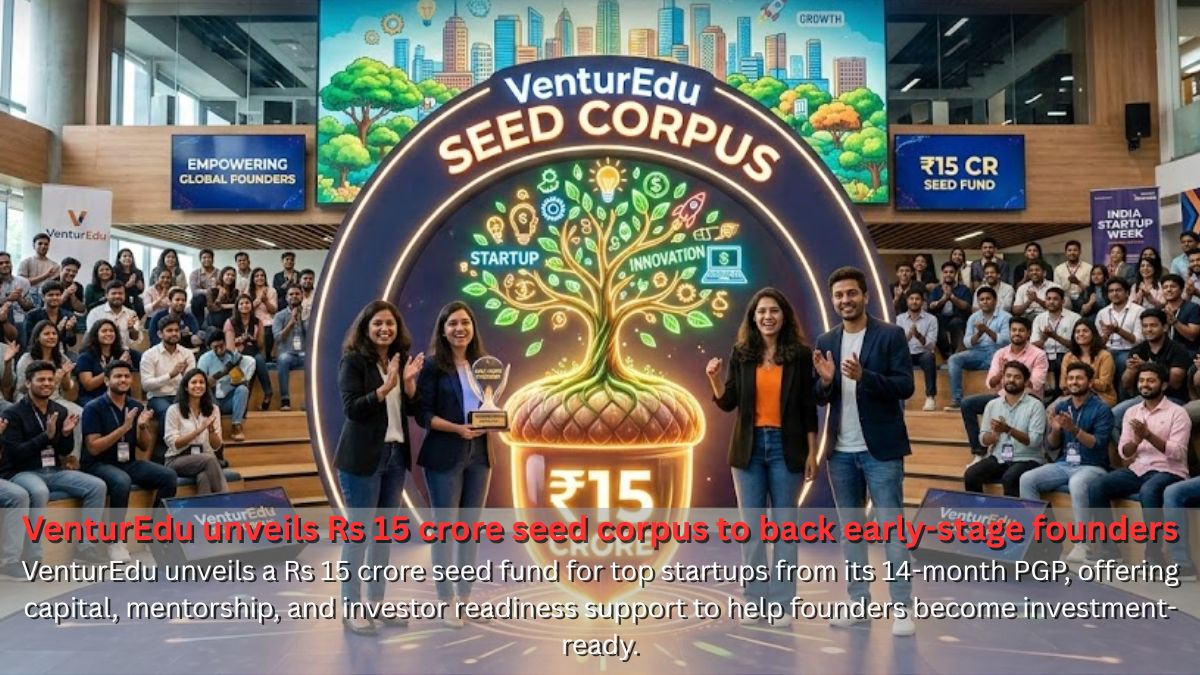
VenturEdu unveils Rs 15 crore seed corpus to back early-stage founders, marking a significant development in India’s startup ecosystem designed to help founders build investible companies with both capital and structured support. The residential venture-building school, launched by Gurgaon-based venture platform Fibonacci X, has announced a selective capital pool of approximately Rs 15 crore to back top performers from its flagship 14-month Post Graduate Programme (PGP). This seed corpus merges in-house capital with contributions from external investor partners and limited partners (LPs), and will be disbursed to founders who demonstrate real traction through an ongoing evaluation process, including biweekly demo days.
Under the programme, the top 30% of startups emerging from each PGP cohort will be eligible for this early-stage funding, with cheque sizes and valuations determined on a case-by-case basis. Founders will also have access to a newly launched Investor Readiness Program that focuses on preparing startups for institutional fundraising. VenturEdu is aiming not just to provide capital but to offer comprehensive venture support, including structured mentorship from a network of 55+ industry leaders and integrated feedback loops from seasoned investors.
The initiative reflects the growing trends in India’s early-stage funding landscape, where capital is increasingly directed toward founders who combine disciplined execution with demonstrable market validation. VenturEdu’s approach blends education, capital deployment, and ongoing mentor engagement to bridge the gap between ideation and investibility.
2. What Is VenturEdu?
VenturEdu is a residential venture-building school designed for early-stage founders who want more than theory and inspiration. It gives them structure, capital, and direct access to people who actually make funding decisions. The goal is simple: help ambitious entrepreneurs build companies that can stand up to real scrutiny and attract real investment.
2.1 Venture-Building Model
What sets VenturEdu apart is the way it blends rigorous learning with hands-on venture creation. There’s nothing passive about the experience. Founders enter a 14-month postgraduate programme where every week pushes them deeper into the work of refining an idea, testing assumptions, building networks and validating their product with actual customers.
The process is intense. Mentorship isn’t a once-a-month check-in. It’s consistent, practical and grounded in real experience. Weekly instruction is paired with frequent demo days, and those demos aren’t just for show. Active investors judge the work, give blunt feedback, and push founders to sharpen what they’re building. This cycle of learning, execution and evaluation forces progress. People don’t walk out of the programme with just a certificate. They walk out with a product that has been tested, questioned and rebuilt multiple times.
2.2 Residential Format
One of the most transformative parts of the programme is its residential setup. Fifty founders live and work together across two cities. This changes the dynamic completely. When you share space, meals and late-night brainstorming sessions with others who are just as driven, you grow faster.
Founders often describe the experience as equal parts energising and humbling. You can’t hide behind slides or broad claims. Your peers see your wins and your weak spots. That kind of environment creates accountability that no remote programme can replicate. Globally, more accelerators are starting to lean into deep-immersion models for this exact reason: when people are pushed into the same room, the quality of their thinking and execution improves. VenturEdu takes that idea seriously.
3. Revenue and Funding Model
VenturEdu’s approach to funding is intentionally different from a typical venture capital setup. Instead of focusing on fixed ticket sizes or rigid evaluation frameworks, it deploys capital based on the real progress founders make throughout the programme.
3.1 Seed Corpus Details
The school operates with a Rs 15 crore seed corpus reserved for the strongest performers in its early cohorts. This pool is powered by both internal capital and external commitments from limited partners and seasoned investors. What makes this model refreshing is the criteria used. The investment committee isn’t swayed by a polished deck or charismatic storytelling. They look for real traction: product iterations that show learning, customer validation that proves demand, and early go-to-market execution that signals discipline. Founders don’t get rewarded for potential alone. They get rewarded for progress.
3.2 Flexible Deployment
The funding structure is flexible by design. There are no predetermined cheque sizes. VenturEdu adjusts investments based on the needs and momentum of each venture. Some founders may need a smaller cheque to validate a key assumption. Others may require a much larger push to accelerate into the market. This flexibility mirrors how real startup building works. Growth isn’t linear, and funding shouldn’t be either.
3.3 Investor Readiness Program
Alongside the seed corpus, VenturEdu runs an Investor Readiness Program that prepares founders for institutional capital. The sessions go beyond surface-level advice. Founders learn how investors think, what metrics actually matter in early stages, how to tell a story that makes sense to the market, and how to navigate due diligence without being overwhelmed. By the time they graduate, founders don’t just understand the fundraising landscape. They’ve lived through mock processes, corrected their blind spots, and built the confidence to face real investor conversations.
4. Founders and Origins
4.1 The Founder
VenturEdu began with a simple but urgent idea from Kulmani Rana. Through his work at Fibonacci X, he saw hundreds of early-stage founders with genuine ambition but nowhere to go for structured execution support paired with smart, timely capital. He carried a frustration many in the ecosystem quietly share: in India, ideas are abundant, talent is everywhere, and founders are hungry. Yet most programmes still focus on polishing pitches instead of actually helping people build.
Rana wanted to close that gap. He believed in a model where founders don’t just learn how to raise money, but learn how to execute well enough that investors are naturally drawn to them. His conviction didn’t come from theory. It came from watching founders struggle. He had seen brilliant teams give up too early because they couldn’t find the guidance or capital to move past early friction. VenturEdu was built as a response to that lived reality.
4.2 Genesis and Vision
VenturEdu was created to solve a very real problem: founders often have the will, but not the environment, to build something fundable. The gap between a founder’s ambition and their ability to execute is wider than most people admit. What VenturEdu does is bring structure, accountability, and capital into one place so founders don’t waste months chasing meetings or figuring out how to start. By placing real capital commitments inside the venture-building process, VenturEdu removes a big burden founders carry – the anxiety of fundraising before they even have a chance to build. Instead of waiting endlessly for investor interest, founders get a clear path: execute well, show progress, and capital follows.
It also reflects a shift happening across India’s venture builders and accelerators. The ecosystem is maturing. The focus is moving from idea incubation to outcome creation. VenturEdu aligns with that shift, but pushes it even further by embedding investor discipline directly into the programme.
5. Why This Seed Corpus Matters
5.1 Supporting Early-Stage Startup Growth
Early-stage capital can decide whether a startup becomes real or fades quietly. Most founders hit a wall right after validating an idea. They have just enough proof to get excited, but not enough traction to convince investors. Pre-Series A is often the hardest stage, and the emotional toll is real. VenturEdu’s seed corpus exists to bridge that painful gap. It rewards founders who are actually executing, not just theorising. This means the money goes to people who have already put in the work, tested their assumptions, spoken to customers, and built something that solves a real problem. For many founders, this is the difference between momentum and stagnation.
5.2 Structured Evaluation and Support
What makes the model powerful is not just the capital, but the way founders earn it. VenturEdu doesn’t hand out cheques based on enthusiasm. Founders are evaluated week after week. They’re measured on what they ship, what they learn, and how quickly they adapt. This mirrors the direction modern early-stage investing is taking. Investors today want clarity, data, customer signals, and proof of execution. VenturEdu gives founders a controlled environment to build those muscles long before they face institutional capital.
Research on early-stage investment repeatedly shows that teams who move fast, test hypotheses, and hit small but consistent milestones are far more likely to raise their next round. VenturEdu designed its model around those truths. It removes guesswork and replaces it with a rhythm of disciplined building that naturally leads to fundability.
6. Problem VenturEdu Aims to Solve
6.1 The Challenge for First-Time Founders
First-time founders in India often begin their journey with energy and ambition, only to run into the same wall over and over: early capital doesn’t come until they already have traction, and traction doesn’t come without early capital. It’s a loop that leaves many promising founders stranded before they even reach their first meaningful milestone.
Traditional angel networks and early-stage VC firms tend to back teams with clear metrics, a strong track record, or previous exits. This creates an unspoken barrier for founders who are building for the first time. Even brilliant ideas struggle to get noticed if the founder hasn’t “been there before.” Many walk into their first investor meeting only to hear some version of: “Come back when you have more proof.” The emotional toll is real. Founders often end up doubting their abilities, even when the problem isn’t their potential. It’s the lack of a support system designed for people just starting out.
6.2 Lack of Structured Execution Support
Funding scarcity is only half the story. The deeper issue VenturEdu identifies is the absence of structured execution frameworks. Most early founders don’t get systematic guidance on how to build a product that investors will take seriously. They experiment blindly, collecting scattered advice from mentors, YouTube videos, and one-off workshops. What they really need is consistent feedback. Someone to tell them when their positioning is off. Challenge their assumptions before they build the wrong product. Someone who understands the difference between a good idea and an investible company.
Without that structure, many founders end up wasting precious months building features nobody wants, misjudging their market, or pitching before they’re ready. It isn’t a lack of effort. It’s a lack of direction. VenturEdu steps in to fill that gap by giving founders a rhythm to work with. Weekly checkpoints. Real product validation. Honest, sometimes uncomfortable feedback. This is the kind of support that turns raw ambition into real execution.
6.3 Bridging Skill Gaps
Every early founder faces a set of skill gaps they rarely admit out loud. How do you build a go-to-market plan when you’ve never launched anything before? Define metrics that show progress when everything feels messy and uncertain? How do you speak to investors without slipping into jargon or over-promising? VenturEdu’s immersive PGP, paired with investor-linked mentorship and regular demo days, is designed to build these skills from the ground up. Founders learn how to interpret customer feedback, build simple but meaningful metrics, and craft a narrative that is honest, grounded, and compelling.
By the time a founder reaches the final stages of the programme, they don’t just have a better product. They have a clearer mind, sharper instincts, and a confidence shaped by repeated cycles of building, testing, failing, and improving.
7. Industry Trends in Early-Stage Funding
7.1 Early-Stage Capital Growth
Over the past few years, the early-stage funding landscape in India has changed dramatically. Seed and pre-seed capital have expanded as more institutional funds and specialised micro-VCs focus on identifying promising founders earlier. New fund launches, sector-specific funds, and first-cheque investors have made the environment far more active than it was even five years ago. But more capital doesn’t automatically mean more access. Most of these funds still want signs of traction before writing a cheque. That gap between interest and actual deployment is exactly where early founders still struggle.
7.2 Rise of Venture Builders and Accelerators
Globally, venture builders and accelerators are shifting toward deeper immersion models. Instead of offering light-touch advisory and occasional mentorship, many now provide residential programmes, tighter community structures, and built-in capital. The logic is simple: when founders are immersed together, pressure-tested regularly, and given resources in real time, they grow faster and build better companies. VenturEdu’s residential approach sits inside this larger trend, but brings its own intensity through sustained execution pressure and performance-linked funding.
7.3 Investor Focus on Execution
Across the early-stage ecosystem, investors have become more focused on execution capability than pure idea potential. It’s no longer enough to present a clever problem statement. Investors want evidence of movement: user behavior signals, early revenue patterns, product iterations, and clear learnings from customer conversations. This shift aligns directly with VenturEdu’s model. By tying capital deployment to measurable progress, the programme prepares founders for the realities of today’s funding environment. The founders who succeed are the ones who can prove, not just pitch, that they can build.
8. Competitors and the Ecosystem
8.1 Regional and Global Players
VenturEdu operates inside a growing and competitive ecosystem of early-stage support platforms, each trying to solve a similar problem in its own way. India has seen a steady rise of incubators, accelerators and alternate venture platforms offering mentorship and capital. One example is PedalStart, a founder-led accelerator that focuses heavily on strategic mentorship and early funding. Their model resonates with founders who prefer a more community-driven approach.
Government-supported incubators also play an important role. I-Hub Gujarat offers incubation space, mentorship, and funding under broader early-stage development initiatives. These programmes help widen access for first-time entrepreneurs across the country. On a global level, the benchmark is often set by accelerator giants like Y Combinator and Techstars, which prioritise intensity, rapid execution, and network strength. Although their models differ from VenturEdu’s residential design, they shape founder expectations worldwide. VenturEdu exists alongside these players but approaches the ecosystem with a different philosophy: founders shouldn’t just be coached; they should be immersed.
8.2 Differentiation Through Immersion
Where most incubators offer periodic sessions, VenturEdu commits to a full residential experience. This changes the rhythm of learning completely. Founders aren’t juggling mentorship calls between day jobs or joining workshops half-focused. They live and build together. The environment becomes a pressure cooker where ideas sharpen because they’re constantly tested.
This kind of immersion accelerates learning cycles. If an idea doesn’t land, founders know quickly. If a product resonates, they see signs early. The programme intentionally removes the distance that usually exists between founders, mentors, and investors. For startups that would otherwise struggle to break into traditional seed funding routes, this immersive model gives them a different path to momentum. It promises structure, accountability, and the emotional support that comes from building alongside 49 other people fighting similar battles.
9. Challenges Ahead for VenturEdu
9.1 Execution Intensity
VenturEdu’s biggest strength is also one of its biggest challenges. A 14-month programme is long. To maintain consistency, the school must continually align mentors, investors, faculty, and founders. The emotional and intellectual intensity required from everyone involved is high. For VenturEdu to scale, it must protect the quality of every cohort. If the mentorship weakens or the investor engagement drops, founders will feel the difference immediately. Long-term credibility depends on delivering the same intensity to the 10th cohort as it does to the first.
9.2 Funding Follow-On Rounds
The seed corpus solves an early problem, but founders will eventually step into the much harder arena of raising Series A and beyond. Success stories in the startup world are rarely defined by the seed round alone. The real test is whether founders can grow fast, meet tougher metrics, and appeal to institutional investors who expect precision. VenturEdu needs to prepare founders for this reality. It must teach them how to handle data, manage teams, communicate growth honestly, and build trust with larger funds. The graduates who cross this stage successfully will ultimately validate the programme far more than any early traction will.
9.3 Market Saturation
India’s early-stage ecosystem is expanding quickly. New accelerators, micro VCs, and venture builders emerge almost every quarter. Standing out is not guaranteed. VenturEdu’s differentiation lies in its residential model and performance-linked funding, but that alone won’t be enough long-term. The programme will need real outcomes: companies that break out, raise significant rounds, and create jobs. In a crowded market, stories speak louder than structure. Results will define relevance.
10. Learning for Startups and Entrepreneurs
VenturEdu’s seed corpus carries lessons for every early-stage founder, even those not part of the programme. First, structure matters. Consistent execution, weekly milestones and a system of accountability often matter more than raw passion or a clever idea. Many founders underestimate this until they’re forced into a disciplined rhythm.
Second, aligning with programmes that offer feedback loops, mentorship, community and capital can dramatically shift a founder’s trajectory. The difference between a team that receives structured guidance and one that operates alone becomes obvious within months. Finally, founders must build companies that show real progress. Not vanity metrics. Not theoretical projections. Real user adoption. Real learning cycles. Signals of traction. These are what attract not only early capital but sustained investor interest over time. The startups that survive are the ones that turn uncertainty into action week after week. VenturEdu’s model is built around that truth, and it’s a lesson every founder can carry, regardless of where they build.
About foundlanes.com
foundlanes.com is India’s leading startup idea discovery platform. It helps entrepreneurs find actionable startup opportunities, market insights, and industry-specific guidance to turn ideas into real businesses. With deep research and practical resources, foundlanes supports founders at every stage, from idea validation to launch and growth.