


News Summary
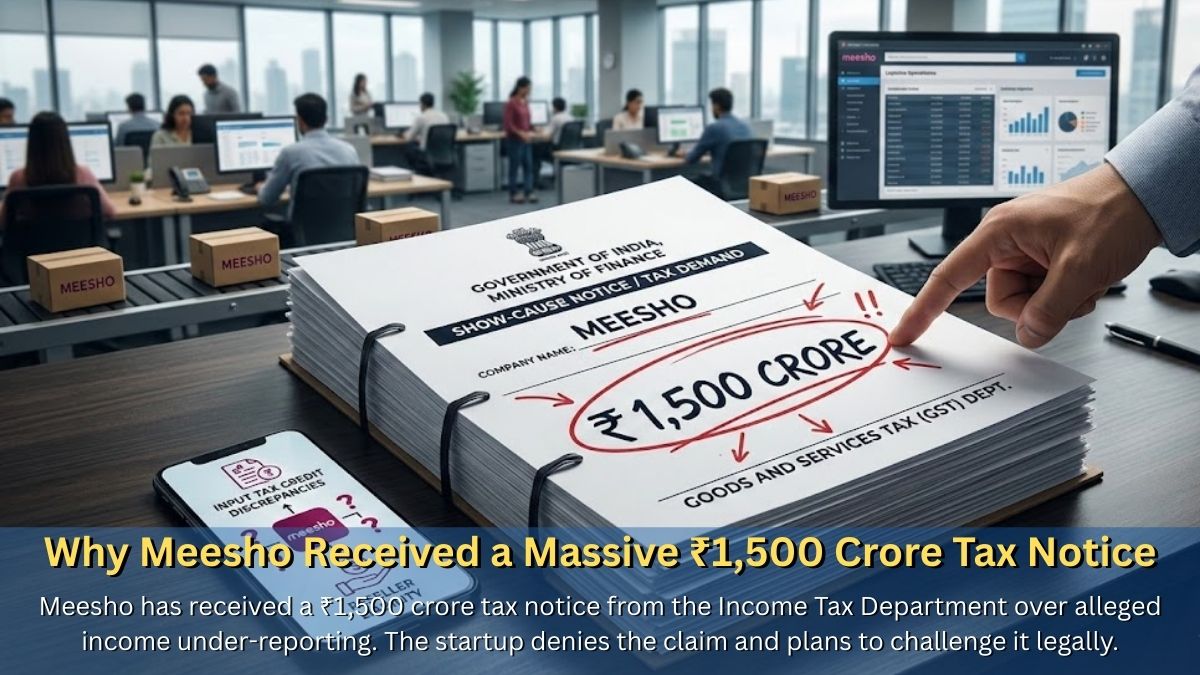
India’s fast-growing social commerce platform Meesho is facing a major regulatory challenge after receiving a ₹1500 Crore Tax Notice from the Income Tax Department. The notice relates to alleged under-reporting of income for the financial year 2023–24. The development has triggered widespread discussion across the Indian startup ecosystem, particularly among venture-backed startups, unicorn companies, and e-commerce platforms that operate large marketplace models.
According to reports, tax authorities believe the company may have misreported certain revenue components linked to its marketplace operations. The demand notice reportedly includes tax liability along with interest and penalties. Meesho, however, has strongly denied any wrongdoing. The company stated that it will challenge the ₹1500 Crore Tax Notice through appropriate legal channels. The firm maintains that its financial reporting follows existing regulations and industry practices.
The issue arrives at a critical time for India’s startup market. The country has seen rapid growth in tech innovations, startup funding, and venture capital investments over the past decade. Platforms like Meesho have become important players in India’s digital commerce expansion by empowering small sellers and entrepreneurs through social commerce tools. As a result, regulatory scrutiny of such fastest-growing startups is increasing.
Market reactions were swift. News of the ₹1500 Crore Tax Notice reportedly impacted investor sentiment and raised questions about compliance practices in large venture-backed startups. Analysts believe the outcome of this dispute could influence startup regulations, taxation practices, and financial reporting standards across the broader startup ecosystem.
Meesho’s journey from a small Bengaluru startup to one of India’s leading e-commerce marketplaces makes this case particularly significant. The company has raised billions from global investors and competes with major players in the online retail industry. Therefore, the tax dispute is not only about one startup. Instead, it reflects the growing complexity of taxation in India’s rapidly expanding digital commerce and tech startup sector. The following report explains the full story behind the ₹1,500 Crore Tax Notice, Meesho’s business model, its growth journey, industry competition, and what entrepreneurs can learn from the situation.
1. Understanding the ₹1500 Crore Tax Notice Against Meesho
1.1 What Triggered the ₹1500 Crore Tax Notice
India’s Income Tax Department issued a ₹1500 Crore Tax Notice to Meesho after reviewing the company’s financial records for FY24. Authorities suspect the company under-reported certain income categories linked to marketplace transactions. Tax officials often review large tech companies, especially those operating digital marketplaces. These businesses handle millions of transactions and complex revenue structures. Therefore, regulators carefully examine how companies classify commissions, incentives, and seller payments. The tax demand notice of ₹1500 crore reportedly includes alleged unpaid tax along with penalties and interest. However, Meesho said it strongly disagrees with the tax authority’s interpretation.
1.2 Meesho’s Official Response
Meesho quickly responded to the ₹1500 Crore Tax Notice and announced that it would challenge the order. The company clarified that its accounting practices follow Indian tax laws. According to the firm, the demand arises due to differences in interpretation rather than deliberate misreporting. Legal experts note that such disputes are common in the startup ecosystem, especially in venture-backed startups operating new business models. Therefore, the final outcome may take months or even years.
1.3 Market Reaction to the Tax Demand
The news triggered concern among investors and startup observers. India’s startup markets have experienced increasing scrutiny from regulators. High-growth unicorn startups often face questions about revenue recognition, tax obligations, and cross-border transactions. As a result, the ₹1500 Crore Tax Notice sparked debate about financial transparency in India’s tech startup ecosystem.
2. Meesho’s Startup Journey
The story of Meesho is not just about building another ecommerce company. It is about unlocking opportunity for millions of ordinary people who never imagined they could run an online business. In a country where entrepreneurship often feels out of reach for many, Meesho quietly changed the rules. What started as a small idea inside a student hostel eventually turned into one of India’s most influential social commerce platforms.
2.1 Founding Story
Meesho was founded in 2015 by Vidit Aatrey and Sanjeev Barnwal, two young engineers who met while studying at Indian Institute of Technology Delhi. Like many engineering graduates in India, they had promising career paths ahead of them. Yet both felt drawn toward solving real-world problems rather than simply following traditional corporate routes. During their early research into ecommerce, they noticed something interesting. India’s online marketplaces were growing quickly, but they were mostly serving established sellers or businesses that already had resources and technical knowledge.
Millions of small entrepreneurs were left out of this digital revolution. Local shop owners, homemakers, students, and small traders had products to sell, but they lacked the tools, logistics networks, and digital infrastructure required to run an online store. For them, platforms like large ecommerce marketplaces often felt complicated and expensive. Vidit and Sanjeev realized that something powerful was already happening in India. People were already selling products through WhatsApp, Facebook, and Instagram. Friends were recommending clothes, cosmetics, and household items in group chats. Small sellers were sharing product photos through social media. It was informal, unorganized, and inefficient. But it was also a massive opportunity. The founders imagined a platform that could turn this informal activity into a structured business model. Their vision was simple yet deeply transformative: anyone should be able to start an online business without investment, inventory, or technical knowledge.
Instead of forcing small sellers to build complicated ecommerce stores, Meesho would allow them to sell directly through social networks they were already comfortable using. A homemaker in a small town could share product images with her WhatsApp contacts. A college student could promote products through Instagram. A neighborhood seller could manage orders without owning any stock. In many ways, Meesho was democratizing entrepreneurship. For the founders, this was not just about technology. It was about creating economic opportunity for people who had never been part of India’s startup ecosystem.
2.2 Early Growth Phase
The early days of Meesho were far from glamorous. Like most startups, the founders faced the difficult challenge of proving that their idea could actually work at scale. Social commerce was still a relatively new concept in India, and convincing investors or sellers required patience and persistence. In the beginning, Vidit and Sanjeev personally spoke to small sellers to understand their problems. They spent time observing how people shared product images in chat groups and how payments were handled informally.
These insights helped them design a platform that was extremely simple. The platform allowed resellers to browse products from suppliers, share them on social media, and earn a margin on every sale. Meesho handled logistics, payments, and delivery, removing the operational burden from sellers. This model solved multiple problems at once. Sellers could start businesses without investment. Suppliers could reach thousands of new customers. Consumers gained access to affordable products through trusted social connections. As the model began to work, investors started noticing.
One of the most important early milestones came when Meesho was accepted into Y Combinator, one of the world’s most respected startup accelerators based in San Francisco. For any startup founder, getting into Y Combinator is a huge validation moment. The program not only provides funding but also mentorship, strategic guidance, and access to a powerful global network of entrepreneurs and investors.
For Meesho, this support helped accelerate product development and platform expansion. With fresh capital and growing confidence, the company began onboarding thousands of suppliers and resellers across India. The platform quickly started attracting a new type of entrepreneur. Many of them were women working from home. were students looking for side income. were first-time business owners from smaller towns. For them, Meesho was more than just an app. It was a gateway to financial independence. The company was quietly building one of the largest grassroots ecommerce networks in the country.
2.3 Becoming a Unicorn Startup
As the platform scaled, Meesho’s growth began to attract global investors. The company’s social commerce model was solving a uniquely Indian challenge. Traditional ecommerce platforms were focused on urban customers and established brands, while Meesho was building a marketplace driven by everyday entrepreneurs. This difference caught the attention of major venture capital firms.
Over the years, Meesho raised significant funding from some of the world’s most influential investors, including:
- SoftBank Vision Fund
- Meta Platforms
- Prosus Ventures
- Sequoia Capital
These investments helped Meesho expand its technology infrastructure, strengthen logistics capabilities, and grow its supplier network across India. Eventually, the company crossed one of the most symbolic milestones in the startup world. Meesho became a unicorn. In startup terminology, a unicorn refers to a privately held company valued at more than $1 billion. But behind that number lies something far more meaningful.
Meesho had built a platform that empowered millions of individuals to participate in the digital economy. By simplifying ecommerce and integrating it with social networks, the company unlocked entrepreneurship for people who had previously been excluded from online marketplaces. In many small towns across India, Meesho sellers are not professional business owners. They are parents supporting their families, students earning extra income, and individuals exploring entrepreneurship for the first time. That is the deeper impact of Meesho’s journey. It turned everyday conversations on social media into a nationwide commerce network.
3. How Meesho Works
3.1 Social Commerce Model
Meesho operates a social commerce marketplace. Unlike traditional e-commerce platforms, it allows individuals to resell products using social networks. For example, a user can select products from the Meesho catalog and promote them on WhatsApp or Instagram. When a customer places an order, Meesho manages logistics and payments. This approach supports thousands of micro-entrepreneurs across India.
3.2 Key Services Offered by Meesho
The platform provides several services to sellers and customers. These include product sourcing, logistics support, payment systems, and customer service. Therefore, sellers can start an online business without large investment. The platform mainly focuses on categories such as fashion, home decor, electronics accessories, and lifestyle products.
3.3 Revenue Model
Meesho generates revenue through several methods. First, it earns commission from sellers who use its marketplace. Second, it generates income through advertising and promotional services. Third, the company benefits from logistics and fulfillment partnerships. Because of this complex structure, tax authorities often examine how such revenues are classified. This complexity may partly explain the ₹1,500 Crore Tax Notice.
4. Funding and Venture Capital Support
4.1 Major Funding Rounds
Meesho has raised more than $1 billion in funding. These investments helped the company scale operations rapidly. Global venture capital firms and tech investors believe the platform can transform India’s online retail industry. Funding rounds have supported technology development, logistics networks, and customer acquisition.
4.2 Role of Venture Capital in Startup Growth
The Meesho story highlights the importance of venture capital funding. Investors often support emerging startups that show strong growth potential. However, large funding also brings greater scrutiny. Governments closely monitor high-value venture-backed startups to ensure compliance with regulations. This environment increases the importance of transparent accounting.
5. Problems Meesho Solves
The success of Meesho cannot be understood without looking at the real problems it set out to solve. India’s digital economy has grown rapidly over the past decade, yet a large part of the population was still excluded from the ecommerce revolution. For many small entrepreneurs, starting an online business was simply too complicated. It required inventory investment, technical knowledge, marketing skills, and access to logistics networks. Most people in small towns did not have these resources. Meesho built its entire platform around removing these barriers.
5.1 Empowering Small Sellers
One of the most powerful impacts of Meesho is how it has empowered small sellers across India. Before platforms like Meesho existed, many individuals had the ambition to start small businesses but lacked the infrastructure to do so. Traditional ecommerce platforms required sellers to manage product listings, inventory storage, packaging, shipping, and customer service. For someone living in a small town or working from home, this process felt overwhelming.
Meesho changed the equation by making entrepreneurship incredibly simple. A seller on Meesho does not need to manufacture products or maintain warehouses. Instead, the platform connects them with suppliers who already have ready inventory. Sellers can browse products, choose items they want to promote, and share them directly with their networks through familiar social platforms. Tools integrated with WhatsApp, Facebook, and Instagram allow sellers to promote products to friends, family, and local communities.
Once a customer places an order, Meesho handles the complex backend operations such as payments, delivery logistics, and customer support. This model removes the biggest risks that prevent people from starting businesses.
- There is no need for upfront investment.
- There is no need for technical knowledge.
- There is no need for storage space.
For many individuals, especially women working from home, this platform has created a meaningful path toward financial independence. Thousands of resellers across small towns now earn additional income by simply using their social networks and local communities. In many cases, Meesho has turned casual social media interactions into genuine entrepreneurial opportunities.
5.2 Expanding Digital Commerce
India’s digital commerce ecosystem is expanding rapidly, yet traditional ecommerce platforms often struggle to reach deeper parts of the country. While major marketplaces have focused heavily on urban customers and branded products, millions of price-sensitive buyers in smaller cities remained underserved.
Meesho stepped into this gap with a very different strategy. Instead of focusing only on large brands, the platform emphasizes affordability and accessibility. Products offered through the platform are often sourced from small manufacturers and suppliers who can produce goods at competitive prices. This approach aligns closely with the needs of customers in smaller towns who are highly price conscious but increasingly comfortable with online shopping. Equally important is Meesho’s simplified onboarding process for sellers. Many traditional ecommerce platforms require extensive documentation, catalog management, and digital marketing knowledge. Meesho’s platform, in contrast, is designed to be intuitive even for first-time entrepreneurs.
The result is a new kind of ecommerce ecosystem where small suppliers, individual resellers, and everyday consumers participate together. By lowering the entry barriers to digital commerce, Meesho has helped bring thousands of new businesses into India’s online retail economy.
6. Industry Growth Trends
The rise of Meesho is closely connected to larger structural changes happening in India’s technology and retail sectors. Over the last decade, several powerful forces have reshaped how Indians buy and sell products online. These shifts have created the ideal environment for social commerce platforms to thrive.
6.1 Rise of Social Commerce in India
Social commerce is emerging as one of the most exciting trends in the digital economy. Unlike traditional ecommerce platforms where customers browse large product catalogs, social commerce relies heavily on personal networks, recommendations, and community-driven selling.
This model fits naturally within India’s social and cultural dynamics. People often trust recommendations from friends, relatives, and local sellers more than anonymous online advertisements. Social media platforms have made these interactions even more powerful by enabling sellers to share product information directly with potential customers. The widespread adoption of smartphones has played a critical role in this transformation.
Affordable internet services and growing smartphone penetration have brought millions of Indians online for the first time. Cities that once had limited access to digital services are now active participants in online marketplaces. As a result, industry analysts expect India’s social commerce sector to grow into a market worth tens of billions of dollars within the next few years. Companies like Meesho are at the center of this transformation. By blending social networking with ecommerce infrastructure, they are building entirely new pathways for digital trade.
6.2 Impact on the Startup Ecosystem
The growth of social commerce has had a ripple effect across India’s startup ecosystem. Investors have started paying closer attention to platforms that enable grassroots entrepreneurship and connect underserved markets with digital commerce. The potential scale of such platforms is enormous because they tap into millions of new users who were previously outside the formal ecommerce system.
This potential has attracted funding from global venture capital firms, technology investors, and international startup accelerators. Investment from firms such as SoftBank Vision Fund, Prosus Ventures, and Sequoia Capital has played a significant role in expanding the capabilities of platforms like Meesho. These funds enable startups to invest heavily in logistics networks, data infrastructure, supplier onboarding, and customer acquisition. As social commerce platforms scale, they are gradually reshaping the competitive landscape of India’s retail industry. Many analysts now consider these companies to be among the most disruptive forces in modern Indian commerce.
7. Meesho Competitors
While Meesho has established a strong presence in the social commerce sector, it operates within a highly competitive digital marketplace. Several other companies are attempting to capture similar opportunities by targeting small sellers and price-sensitive consumers.
7.1 Direct Competitors
A few startups have built platforms specifically designed for reseller-driven commerce. One notable example is GlowRoad, a social commerce platform that allows individuals to sell products through their social networks. Another competitor, Shop101, also focuses on enabling small entrepreneurs to start online businesses without large upfront investments. Both platforms share a similar vision of empowering resellers through technology and simplified ecommerce tools.
However, Meesho’s early entry into the market and its strong investor backing helped it scale faster than many of its rivals. By aggressively expanding its supplier base and logistics infrastructure, the company managed to build one of the largest reseller ecosystems in India.
7.2 Indirect Competitors
Beyond direct social commerce rivals, Meesho also faces indirect competition from large ecommerce companies. Major online marketplaces such as Flipkart and Amazon dominate India’s digital retail industry. These platforms have massive product catalogs, advanced logistics networks, and strong brand recognition among consumers. However, Meesho operates with a slightly different strategy.
Instead of focusing primarily on branded products and urban consumers, the platform targets highly price-sensitive buyers and small sellers from tier-two and tier-three cities. Its product mix often emphasizes affordability and local supplier networks rather than premium branding. This focus has allowed Meesho to carve out a unique niche within India’s crowded ecommerce market.
8. Regulatory Challenges for Tech Startups
As India’s startup ecosystem matures, regulatory scrutiny is also increasing. Technology companies are now operating in sectors that directly affect financial transactions, taxation systems, and digital consumer protection. Governments across the world are gradually introducing stricter compliance frameworks to ensure transparency and accountability. For fast-growing startups, adapting to these regulatory expectations has become a critical part of long-term sustainability.
8.1 Increasing Startup Regulations
Digital platforms are now subject to growing oversight from governments and regulatory bodies. In India, authorities have started tightening rules related to online marketplaces, taxation compliance, fintech transactions, and data governance. These regulations aim to ensure fair competition, protect consumers, and prevent financial irregularities. However, the regulatory landscape can sometimes create complex challenges for startups that are scaling rapidly.
Disputes related to taxation, revenue reporting, and financial classification occasionally arise as authorities attempt to interpret evolving business models. Large tax notices or compliance investigations are not uncommon for companies operating at massive scale. These developments reflect a broader trend where governments are trying to keep pace with fast-moving digital business models.
8.2 Financial Transparency
Another important trend shaping the startup ecosystem is the growing demand for financial transparency. In the early days of startup growth, investors often prioritized user acquisition and rapid expansion over profitability or strict financial discipline. Today, that mindset is changing. Venture capital firms and institutional investors now expect unicorn startups to demonstrate stronger governance practices, accurate financial reporting, and well-structured compliance systems. For companies like Meesho, this shift represents both a challenge and an opportunity.
Stronger financial systems not only reduce regulatory risks but also build long-term trust with investors, partners, and customers. As India’s startup ecosystem matures, the companies that succeed will likely be those that combine innovation with responsible corporate governance. In the long run, transparency and compliance will become just as important as growth and scale.
9. Learning for Startups and Entrepreneurs
The Meesho tax dispute offers several lessons for founders. First, startups must prioritize compliance from the beginning. Rapid growth often creates complex financial systems. Therefore, companies should build strong accounting teams early. Second, transparency is essential for maintaining investor trust. Third, regulatory awareness helps startups avoid costly legal disputes. Finally, entrepreneurs should prepare for scrutiny as their businesses scale. Large venture-backed startups face constant evaluation from regulators and investors.
About foundlanes.com
foundlanes.com is India’s leading startup idea discovery platform. It helps entrepreneurs find actionable startup opportunities, market insights, and industry-specific guidance to turn ideas into real businesses. With deep research and practical resources, foundlanes supports founders at every stage, from idea validation to launch and growth.