


Summary
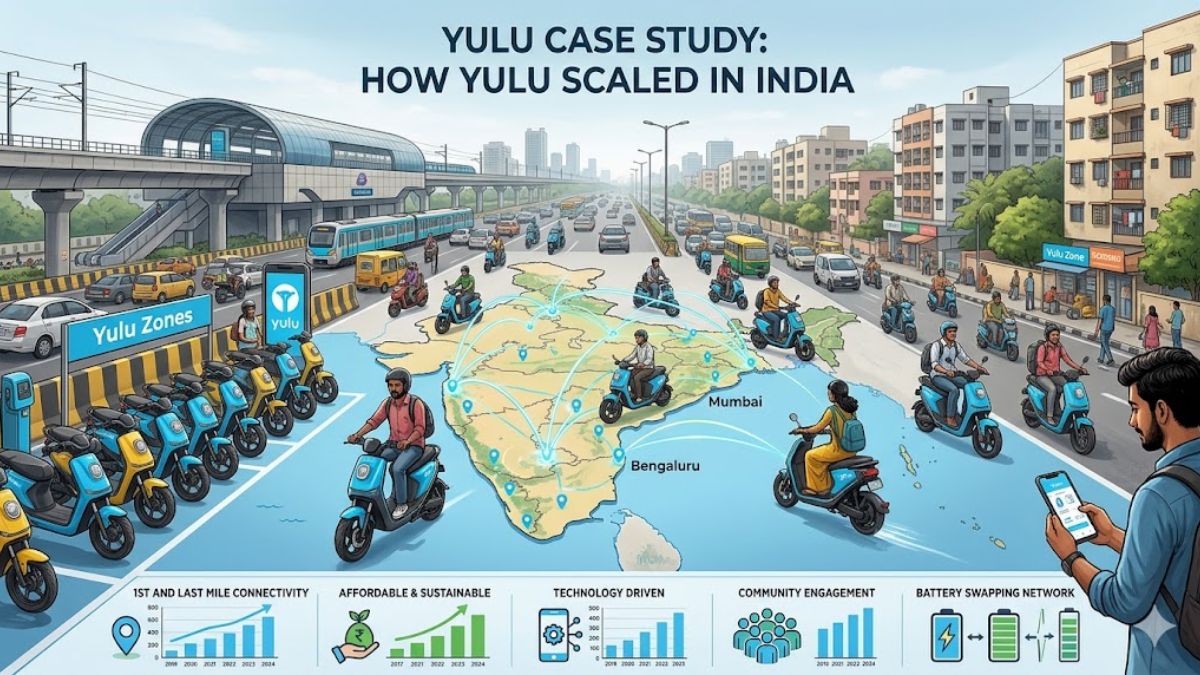
Urban mobility in India has long been shaped by congestion, pollution, and inefficient short-distance travel options. This Yulu Case Study examines how one startup attempted to solve a specific but widespread problem: last-mile transportation in crowded Indian cities. Yulu is an electric mobility platform that provides shared micro-mobility solutions such as dockless electric bikes and scooters designed for short city commutes. The company focuses on solving the “first-mile and last-mile” gap that often exists between public transportation and a commuter’s final destination.
The startup was founded in 2017 by Amit Gupta, RK Misra, and Naveen Dachuri. Headquartered in Bengaluru, the company entered the market with a clear vision: to build a sustainable urban mobility platform that could reduce congestion and carbon emissions in large cities. Yulu’s solution was built around lightweight electric vehicles that could be rented through a mobile application. Users could locate nearby bikes, unlock them digitally, and ride them for short trips across neighborhoods or between transit points such as metro stations and office hubs.
The timing of Yulu’s launch coincided with rising concerns about pollution and traffic congestion in Indian cities. Policymakers, urban planners, and commuters were increasingly looking for alternatives to private vehicles and fuel-powered transport. To support its expansion, Yulu has raised funding from several investors including strategic backing from Magna International. The company has also partnered with technology platforms and mobility players to expand its electric vehicle ecosystem.
Today, Yulu operates as one of India’s most recognized micromobility platforms, contributing to the broader movement of electric mobility startups in India and the growing conversation around sustainable transportation startups. This Yulu Case Study explores how the company evolved from an idea about shared bicycles into one of India’s most visible urban transportation innovation platforms, examining its founding story, operational strategy, business model, challenges, and the broader implications for the future of urban mobility in India.
2. The Origin Story Behind the Yulu Case Study
2.1 The Inspiration Behind Yulu
The origins of Yulu can be traced to the professional experiences of its founding team, particularly Amit Gupta. Gupta had previously co-founded the online food delivery platform InMobi and had spent years working within India’s technology ecosystem. During this time, he frequently observed how inefficient urban mobility had become in large Indian cities. Even short distances could take an unexpectedly long time because of traffic congestion, parking limitations, and poor connectivity between different transportation modes.
Public transportation systems like metro networks were expanding rapidly in cities such as Bengaluru and Delhi. However, commuters still faced a persistent challenge. The final stretch of their journey often required walking long distances or hiring auto-rickshaws for short rides. This gap between transit stations and final destinations is commonly referred to as the last-mile problem. Gupta and his co-founders believed this problem could be addressed through a network of shared micro-vehicles designed specifically for short urban trips. Instead of building a traditional vehicle company, the founders envisioned a technology-driven platform that combined hardware, software, and mobility infrastructure.
3. Founder Journey and Motivation
The Yulu growth story is closely linked to the backgrounds of its founders. Amit Gupta had already experienced the startup journey before launching Yulu. His exposure to high-growth technology companies helped him understand how digital platforms could scale rapidly when paired with strong network effects.
However, mobility presented a different challenge. Unlike purely digital businesses, transportation platforms require physical infrastructure, regulatory approvals, and operational coordination across cities. This complexity made the startup journey significantly more difficult. RK Misra brought decades of leadership experience from the telecommunications and technology sectors. His role helped shape the company’s long-term strategy and partnerships. Meanwhile, Naveen Dachuri focused heavily on technology development and product design. Together, the founding team combined technology expertise, business strategy, and operational experience. Their shared belief was simple but powerful. Cities needed smaller, cleaner, and more efficient transportation options.
4. Identifying the Market Problem
Urban mobility challenges in India are well documented. Cities such as Mumbai, Bengaluru, and Delhi consistently rank among the most congested urban environments in the world. Long travel times reduce productivity and increase stress for commuters. Traditional transportation solutions often focus on long-distance travel. However, many daily trips are actually quite short.
Office workers traveling from metro stations to office buildings, students commuting between neighborhoods, and residents running local errands often need transportation for distances of two to five kilometers. Using cars or taxis for such trips contributes to congestion and pollution. This insight formed the core problem addressed in the Yulu startup case study. The founders believed that lightweight shared vehicles could provide a practical alternative. Such vehicles would be easy to park, energy efficient, and affordable for short trips. This concept aligned with the broader global trend of micromobility platforms emerging in cities worldwide.
5. Building the Product: Shared Electric Mobility
5.1 Early Product Design
In the early stages, Yulu launched shared bicycles designed for short rides across neighborhoods. Users could locate nearby bikes through the mobile application, unlock them using a QR code, and pay for rides digitally. This approach eliminated the need for physical rental stations. The dockless design allowed bikes to be parked at designated public locations across the city. As demand increased, the company expanded its product portfolio to include electric bikes. Electric vehicles made longer trips easier and more comfortable for riders. The introduction of battery-powered vehicles also positioned the company within the rapidly expanding category of electric vehicle startups in India.
5.2 The Yulu Electric Bike Ecosystem
Electric micro-mobility requires reliable battery infrastructure. To support this, Yulu began developing a battery swapping ecosystem that allowed vehicles to be charged efficiently. Instead of waiting for vehicles to recharge, batteries could be swapped quickly, allowing bikes to return to service faster. This operational innovation became an important part of the Yulu business case study. Battery swapping also aligned with broader industry discussions about the scalability of electric mobility in urban environments.
6. Early Traction and Market Validation
The first deployments of Yulu vehicles took place in select neighborhoods of Bengaluru. These areas were chosen because they had high population density, strong technology adoption, and active public transportation networks.
Initial user adoption provided valuable insights. Many early riders were young professionals working in technology parks and office clusters. These users appreciated the convenience of short rides between transit hubs and workplaces. The simplicity of the mobile app also helped reduce friction. Users could locate vehicles quickly and begin rides without complex procedures. As word spread, Yulu expanded to additional zones within the city. Positive early feedback validated the founders’ core hypothesis. There was real demand for affordable micro-mobility services.
7. Business Model and Revenue Strategy
The Yulu success story in India is partly rooted in its straightforward pricing model. Users pay small fees based on ride duration. Short rides typically cost only a fraction of traditional taxi fares. This makes the service attractive for frequent commuters. However, operating a shared mobility platform involves several costs. Vehicles must be maintained regularly, batteries need replacement, and operational teams must monitor fleet distribution across cities. To support these expenses, Yulu focuses on optimizing fleet utilization.
Higher ride frequency increases revenue per vehicle. The company also collaborates with corporate campuses, residential complexes, and transit authorities to deploy vehicles in areas with high demand. These partnerships help ensure consistent usage patterns.
8. Funding Journey and Strategic Investors
Scaling a physical mobility network requires significant capital. To support expansion, Yulu attracted investment from multiple backers. One of the most notable investors in the company is Magna International, a global automotive supplier. Magna’s involvement signaled strong confidence in Yulu’s long-term potential within the green mobility companies ecosystem. Strategic investment from established automotive players can provide more than just funding. Such partnerships often contribute engineering expertise, supply chain capabilities, and global mobility insights. For a startup operating in the electric scooter sharing platforms space, these advantages can be significant.
9. Competitive Landscape in the Micromobility Market
The rise of micro-mobility platforms created a competitive environment. Several companies explored shared mobility models across Indian cities. Some focused on docked bicycle systems while others experimented with electric scooters. The Yulu Case Study highlights how differentiation became crucial in this environment. Instead of pursuing aggressive expansion across many cities simultaneously, Yulu concentrated on building strong operations in specific urban clusters. The company also focused on integrating its service with public transportation networks. This positioning helped the platform align with government initiatives aimed at reducing traffic congestion and encouraging sustainable transportation startups.
10. Operational Challenges and Scaling Realities
Running a shared mobility platform involves numerous operational complexities. Vehicles must be distributed efficiently across cities to ensure availability. Maintenance teams must regularly inspect vehicles to ensure safety. Weather conditions, infrastructure limitations, and urban regulations also influence operations. The COVID-19 pandemic created additional challenges for mobility startups. Lockdowns reduced travel demand dramatically. However, as restrictions eased, many commuters began seeking alternative transport options that minimized close contact with others. Shared micro-mobility services experienced renewed interest during this period.
11. Scaling the Micromobility Network in Indian Cities
As the Yulu growth story progressed, the company faced an important decision about expansion. Many mobility startups attempt to scale quickly across multiple cities. However, the leadership team at Yulu adopted a more controlled approach. Instead of spreading resources across too many locations, the company focused on building dense operational clusters in specific urban zones. This strategy allowed Yulu to maximize vehicle usage and improve operational efficiency. Shared mobility platforms depend heavily on high vehicle utilization rates. If vehicles remain idle for long periods, the economics of the business become difficult.
By concentrating vehicles in areas with high commuting demand, the company increased the number of rides per vehicle each day. Cities like Bengaluru became important early markets where Yulu could test operational models and refine its service before expanding further. Over time, the company expanded to additional urban centers such as Mumbai and Delhi. Each city presented different challenges related to infrastructure, commuting patterns, and regulatory frameworks. Scaling a micromobility network in India required not just technology but also deep operational understanding of each city’s transportation ecosystem.
12. The Role of Technology in the Yulu Platform
Technology plays a central role in the Yulu startup case study. The entire service operates through a mobile application that allows users to locate nearby vehicles, unlock them, begin rides, and complete payments digitally. Behind the user interface lies a complex technology infrastructure that manages fleet tracking, ride analytics, and battery monitoring. Each vehicle in the Yulu network is connected through Internet of Things systems that transmit data about location, battery status, and usage patterns.
This real-time information allows the operations team to monitor fleet distribution and respond quickly when vehicles need maintenance or repositioning. The company also uses analytics to understand user behavior. Data on ride duration, popular routes, and peak demand times helps the platform optimize vehicle placement. Such insights are essential for improving operational efficiency. As the fleet grows larger, these technology systems become increasingly important. Managing thousands of vehicles across urban areas requires precise coordination between software systems and on-ground operations.
13. Building the Battery Swapping Ecosystem
Electric vehicles require reliable charging infrastructure. For micromobility platforms, this challenge becomes even more complex because vehicles must remain available throughout the day. To address this issue, Yulu invested heavily in battery swapping systems. Instead of waiting for vehicles to charge through traditional plug-in methods, batteries can be replaced quickly at designated swap stations. This approach reduces vehicle downtime and increases fleet utilization. Battery swapping also helps solve one of the biggest challenges facing electric mobility startups in India.
Charging infrastructure is still developing in many cities, which can slow the adoption of electric vehicles. By creating a dedicated battery ecosystem, Yulu built a practical solution for operating electric fleets at scale. The company also collaborated with partners to strengthen its battery infrastructure network. These collaborations helped accelerate deployment of swap stations across urban zones where demand for shared mobility was growing.
14. Strategic Partnerships and Ecosystem Development
Partnerships have played a crucial role in the Yulu business case study. Mobility platforms often depend on collaboration with multiple stakeholders, including real estate developers, corporate campuses, and government authorities. Yulu worked with technology parks, residential complexes, and commercial hubs to deploy vehicles in locations where short-distance travel demand was high. These partnerships helped ensure that vehicles were placed in areas where commuters were most likely to need them.
Corporate campuses proved especially valuable. Large office clusters often require employees to travel short distances between buildings, parking areas, and nearby transit stations. Shared electric bikes provided a convenient alternative to walking or using personal vehicles. Another important partnership came from global automotive supplier Magna International. Strategic backing from such organizations not only provides financial resources but also strengthens supply chains and vehicle manufacturing capabilities. These partnerships positioned Yulu within the broader ecosystem of green mobility companies working toward sustainable transportation solutions.
15. Brand Positioning and Messaging Evolution
In its early stages, Yulu positioned itself primarily as a convenient bicycle-sharing service. However, as the company introduced electric vehicles and expanded its platform, the brand narrative began evolving. The platform increasingly emphasized its role in sustainable urban transportation. Marketing campaigns focused on reducing traffic congestion and lowering carbon emissions in cities. This positioning resonated strongly with younger urban commuters who were becoming more environmentally conscious.
The brand also aligned itself with broader conversations about the future of urban mobility in India. Shared electric mobility represents a shift away from private vehicle ownership toward more flexible transportation options. By emphasizing convenience, affordability, and sustainability, Yulu carved out a distinct identity within the growing field of urban transportation innovation.
16. Competition in the Micromobility Industry
The micromobility market has become increasingly competitive. Several startups and established companies have explored shared mobility solutions across India. Some focused on bicycle-sharing models, while others launched electric scooter platforms. Within this landscape, Yulu needed to differentiate itself.
The company focused heavily on solving last-mile transportation rather than competing directly with taxi or ride-hailing services. This focus allowed the platform to serve a specific but important segment of urban transportation. The broader category of electric scooter sharing platforms continues to evolve globally. International examples from Europe and North America have shown that micromobility can play a meaningful role in reducing urban congestion. In India, however, the success of such platforms depends heavily on city infrastructure and regulatory support. By maintaining strong relationships with local authorities and urban planners, Yulu attempted to position itself as a responsible mobility partner rather than just another startup entering the transportation space.
17. Regulatory and Urban Infrastructure Challenges
Operating mobility services in Indian cities involves navigating complex regulatory environments. Transportation systems are often governed by multiple agencies responsible for road infrastructure, traffic management, and public safety. Micromobility platforms introduce new types of vehicles that do not always fit neatly into existing regulatory categories. Companies like Yulu must work closely with local governments to ensure compliance with transportation rules.
Parking regulations are another important factor. Shared vehicles must be parked responsibly to avoid blocking pedestrian pathways or creating urban clutter. Cities around the world have struggled with balancing the convenience of dockless mobility systems with the need to maintain organized public spaces. Yulu addressed these concerns by designating parking zones and encouraging responsible riding practices through its mobile application. The company also collaborated with municipal authorities to integrate its services into broader transportation planning efforts.
18. Growth Milestones and Operational Expansion
The Yulu Case Study includes several notable milestones in the company’s journey. As the fleet expanded, the platform began serving millions of rides across its operating cities. The company also increased its network of battery swap stations and operational hubs. Each new deployment brought additional operational insights. Fleet distribution strategies improved as the company collected more data about commuting patterns. Technology upgrades allowed the platform to handle larger numbers of rides and vehicles simultaneously. Over time, Yulu became widely recognized as one of the fastest growing mobility startups in India’s emerging electric vehicle ecosystem. Its expansion contributed to broader discussions about how micro-mobility platforms could complement public transportation networks.
19. Team Building and Leadership Culture
Behind every mobility platform is a large operational team responsible for maintaining vehicles, managing fleets, and supporting customers. The leadership team at Yulu focused on building a culture that combined technology innovation with strong operational execution. Engineers worked on improving software systems and vehicle design. Operations teams handled fleet maintenance, logistics, and deployment strategies.
Customer support teams ensured that riders could resolve issues quickly. The ability to coordinate these diverse functions became essential as the company scaled across multiple cities. Leadership also emphasized long-term sustainability. Instead of pursuing aggressive expansion at the expense of operational stability, the company focused on improving service reliability. This measured growth strategy helped strengthen trust among riders and partners.
20. Sustainability Goals and Environmental Impact
One of the defining aspects of the Yulu Case Study is its focus on sustainable urban transportation. Modern cities are facing growing environmental challenges. Air pollution levels in large Indian cities such as Delhi and Bengaluru frequently exceed recommended safety limits, largely because of vehicular emissions. Transportation accounts for a significant portion of urban pollution. Private cars and fuel-powered two-wheelers dominate daily commuting patterns in most Indian cities.
The founders of Yulu believed that shared electric mobility could reduce this dependence on fuel-powered transport. Electric micro-vehicles produce no direct emissions and require far less energy compared with traditional vehicles. When deployed at scale, these vehicles can help reduce traffic congestion and lower carbon emissions. Shared mobility models also reduce the number of privately owned vehicles on the road. Instead of each commuter owning a vehicle, multiple riders can use the same fleet throughout the day.
This improves resource efficiency and aligns with the broader vision of sustainable transportation startups that aim to redesign urban mobility systems. For policymakers and city planners, these solutions represent an important step toward cleaner and more efficient cities.
21. The Broader Impact on Urban Mobility
The Yulu startup case study reflects a larger shift happening across global transportation systems. Urban mobility is gradually moving away from traditional ownership models toward shared, on-demand transportation services. Ride-hailing platforms introduced the concept of digital booking and flexible mobility. Micromobility platforms such as Yulu extend this concept further by focusing on short-distance travel. Short urban trips represent a large share of daily transportation demand. Many commuters travel only a few kilometers between home, transit stations, workplaces, and local commercial areas. Traditional vehicles are often inefficient for such trips. Shared electric bikes provide a simpler solution.
This shift is part of a broader trend toward urban transportation innovation. Cities around the world are experimenting with integrated mobility networks where public transit, shared vehicles, and pedestrian infrastructure work together. In India, these changes are still evolving. However, platforms like Yulu have played a role in demonstrating how micro-mobility services can complement existing transportation systems.
22. Lessons from the Yulu Growth Story
The Yulu growth story provides several important lessons for entrepreneurs building mobility startups. One of the most significant insights is the importance of solving a clearly defined problem. Instead of attempting to compete directly with large ride-hailing platforms, Yulu focused on a specific transportation gap: last-mile connectivity. This narrow focus allowed the company to design products specifically optimized for short trips. Another lesson involves operational discipline.
Mobility startups require extensive infrastructure, maintenance teams, and city-level coordination. Unlike purely digital platforms, scaling transportation services requires constant operational management. Yulu’s decision to concentrate on dense urban clusters rather than expanding too quickly across many cities helped improve efficiency. Technology also played a crucial role.
The platform relies on real-time data systems, fleet management software, and IoT-enabled vehicles. Without strong technological infrastructure, managing thousands of vehicles across cities would be nearly impossible. Finally, the story highlights the importance of partnerships. Collaboration with organizations such as Magna International allowed the company to strengthen its electric vehicle ecosystem and scale its battery infrastructure.
23. Challenges That Continue to Shape the Industry
Despite the progress made by companies like Yulu, the micromobility sector still faces several challenges. Urban infrastructure remains a major constraint. Many Indian cities lack dedicated bicycle lanes or safe micro-mobility pathways. This can discourage riders who may feel unsafe sharing roads with larger vehicles. Parking management is another challenge.
Dockless mobility systems rely on responsible parking behavior from users. Without proper management, shared vehicles can create clutter in public spaces. Regulatory clarity also continues to evolve. Transportation policies in India were originally designed for traditional vehicles. Micromobility platforms often require new regulatory frameworks that account for lightweight electric vehicles and shared fleets. Another challenge involves long-term profitability.
Shared mobility businesses require continuous investment in vehicles, batteries, and operations. Balancing affordable pricing with sustainable financial models remains a key focus for many startups in the sector. These challenges are not unique to Yulu. They affect the broader category of electric vehicle startups in India and other fastest growing mobility startups working in urban transportation.
24. Technology and Operational Evolution
As the company matured, Yulu continued refining its technology platform and operational processes. Fleet management systems improved significantly as the company collected more ride data. Predictive analytics began helping the operations team anticipate demand patterns and reposition vehicles accordingly. Battery technology also evolved. Battery swapping infrastructure expanded across operating zones, allowing electric vehicles to remain active throughout the day without long charging interruptions.
The company also worked on improving vehicle durability. Shared vehicles must withstand heavy daily usage, exposure to weather conditions, and varying road environments. Engineering improvements in vehicle design helped extend the lifespan of the fleet. Operational teams played an equally important role. Technicians regularly inspect vehicles to ensure safety and performance. Logistics teams redistribute vehicles between neighborhoods to maintain balanced availability. These operational systems form the backbone of any successful micromobility platform.
25. Yulu’s Role in India’s Electric Mobility Ecosystem
India’s electric mobility ecosystem has expanded rapidly over the last decade. Government initiatives promoting electric vehicles, combined with rising environmental awareness, have created opportunities for mobility startups. Within this ecosystem, Yulu represents a distinct category focused on shared micromobility rather than private vehicle ownership.
This distinction is important. Most electric vehicle companies focus on manufacturing scooters, motorcycles, or cars for individual buyers. Yulu instead operates a shared transportation network where vehicles are used by multiple riders throughout the day. This model improves resource efficiency and aligns with the principles of green mobility companies. The company’s partnerships with technology providers and vehicle manufacturers have also contributed to the development of electric mobility infrastructure. These collaborations support the broader goal of building scalable transportation systems that rely less on fossil fuels.
26. Current Status of the Company
Today, Yulu operates across multiple Indian cities and continues to expand its electric vehicle fleet. The platform serves thousands of daily riders who use shared electric bikes for short urban trips. Battery swapping infrastructure and operational hubs support the growing fleet. The company remains focused on improving fleet utilization and operational efficiency.
While the shared mobility industry continues evolving, Yulu has established itself as a recognizable brand within India’s micromobility sector. Its presence in major urban centers has also helped increase awareness about alternative transportation options. The platform continues to explore partnerships with corporate campuses, residential communities, and urban transportation authorities. Such collaborations remain critical for long-term growth.
27. Future Outlook for Yulu and Urban Mobility
The Yulu Case Study ultimately reflects a larger transformation taking place in urban transportation. Cities are becoming more crowded, environmental concerns are intensifying, and commuters are demanding flexible mobility options. Shared electric mobility platforms represent one potential solution to these challenges. Looking ahead, the future of urban mobility in India is likely to involve integrated transportation networks.
Public transit systems, shared vehicles, and digital mobility platforms may work together to provide seamless commuting experiences. For Yulu, the future will likely involve expanding electric fleets, strengthening battery infrastructure, and deepening partnerships with urban stakeholders. Advances in vehicle technology and battery efficiency may further improve the economics of micromobility platforms. Government support for electric mobility could also accelerate adoption.
If cities continue investing in sustainable transportation infrastructure, shared electric mobility services could become a common part of daily commuting. In that context, the journey of Yulu offers a glimpse into how startups can contribute to reshaping urban transportation systems. The company’s focus on last-mile connectivity, electric vehicles, and shared mobility places it firmly within the evolving landscape of sustainable transportation startups and the broader discussion around the future of urban mobility in India.
About foundlanes.com
foundlanes.com is a digital platform dedicated to documenting and analyzing the journeys of startups, founders, and emerging businesses within India’s startup ecosystem. The platform publishes in-depth startup case studies, founder stories, and business insights designed to help entrepreneurs, students, and professionals understand how modern companies are built and scaled. Through detailed research and long-form storytelling, foundlanes aims to provide readers with practical knowledge about startup strategy, innovation, and the evolving landscape of entrepreneurship in India.