


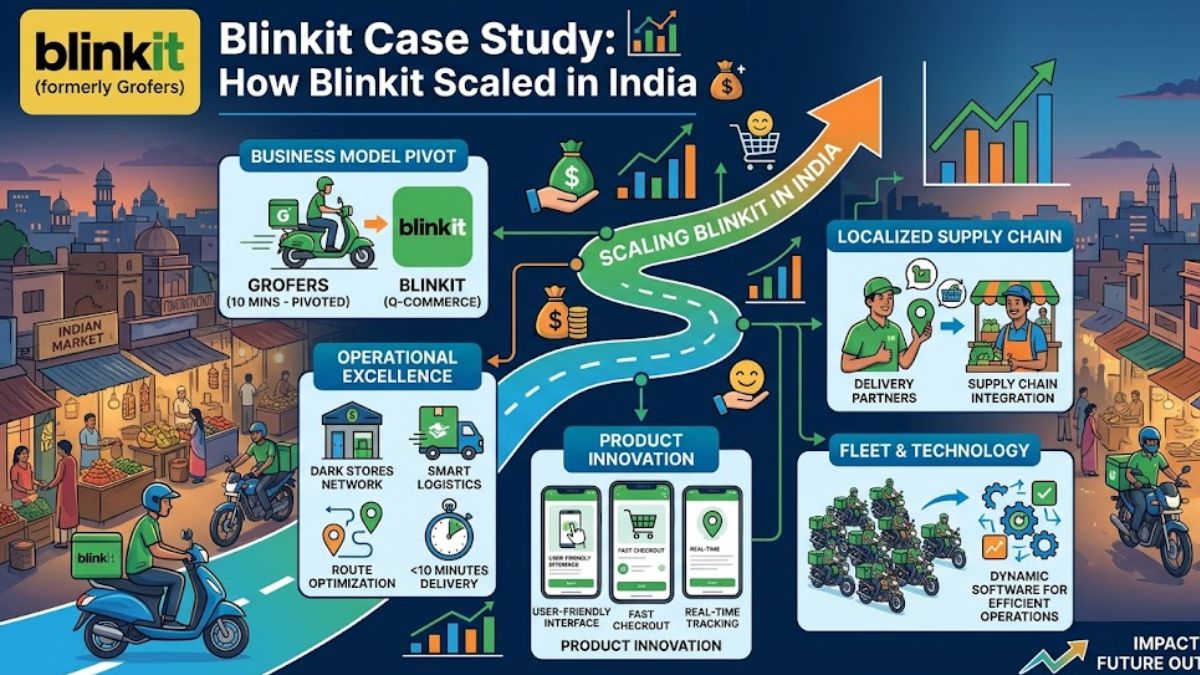
Blinkit Case Study: How Blinkit Scaled in India
Blinkit’s journey doesn’t feel like a straight startup success story. It feels more like something that kept changing shape because the world around it refused to stay still. It began back in 2013 as Grofers. At that time, the idea was simple and honestly very relatable. You order groceries online, and they come from nearby stores at a scheduled time. Nothing flashy. It was about convenience, not urgency. It worked in a way most early internet services worked in India back then, helpful, but still very much tied to patience. But over time, patience started disappearing from the equation.
Cities got faster. People got busier. Expectations quietly shifted. No one wanted to “plan” groceries anymore. They just wanted things to show up when they needed them. That shift sounds small when you say it out loud, but for a company like Grofers, it changed everything. That’s when the reinvention started. And it wasn’t smooth or gentle.
Grofers became Blinkit, and with that, the entire identity of the company changed
Grofers became Blinkit, and with that, the entire identity of the company changed. It stopped thinking in hours and started thinking in minutes. Ten to twenty minutes delivery sounds simple, but behind it is a completely different way of operating. It’s almost like rebuilding the company from scratch while still keeping it running at full speed. The real world version of Blinkit is not what users see on their phone. What they see is a clean interface, a few products, and a promise of speed. What sits behind it is far more intense.
Small dark stores hidden inside neighborhoods. Inventory that has to be guessed before people even place orders. Delivery partners waiting in the right places so movement doesn’t waste even a few minutes. Systems constantly adjusting themselves based on demand that changes hour by hour. It’s controlled chaos, held together by logistics and a lot of trial and error. And all of this exists for something very ordinary: milk, snacks, soap, bread. Everyday things people don’t think twice about.
That’s what makes it interesting. The scale of effort behind the simplicity of the outcome. The turning point came when Zomato acquired Blinkit in 2022. A $568 million deal that, on paper, looked like a strategic move into quick commerce. But in reality, it felt like Blinkit stepping into a much bigger machine. One that already had experience in delivery, pressure, and scale. From there, Blinkit wasn’t just a standalone experiment anymore. It became part of a larger idea, that maybe everything people need daily could eventually come through one system.
The business model reflects that ambition
The business model reflects that ambition, but also its difficulty. Margins on products, platform fees, supply chain efficiency, everything matters, but nothing is easy. Quick commerce is not a relaxed business. It’s expensive, unpredictable, and extremely sensitive to demand changes. Some days it works beautifully. Other days it stretches the system to its limits. And still, it keeps growing. What stands out in Blinkit’s story is not just the transformation, but the pace of it. Most companies evolve slowly. Blinkit had to rewrite itself while running, competing, and scaling all at once. That kind of pressure leaves very little room for comfort.
In the end, Blinkit isn’t just about groceries arriving fast. It’s about how modern cities are changing, how people are redefining time, and how companies are trying to keep up with expectations that never really slow down. It’s not a perfect system. But it’s a very real one.
1. The Origin Story of Blinkit and the Grofers Era
Blinkit’s story doesn’t really start with Blinkit. It starts with Grofers, back in 2013, when India’s internet economy looked very different from today. At that time, most of the excitement was around big categories like fashion, electronics, and high-value online shopping. Grocery, the most everyday and routine part of life, was still very offline, very local, and very fragmented. You would go to your nearby kirana store, probably the same one your family had been visiting for years, and buy what you needed. It wasn’t broken, but it wasn’t seamless either. It was just how things were. That’s the gap Grofers stepped into.
Albinder Dhindsa and Saurabh Kumar weren’t trying to reinvent everything at once. The idea was actually quite grounded. Help people order groceries from their neighborhood stores using an app. No big warehouses, no heavy infrastructure in the beginning, just a digital layer sitting between customers and local shops.
1.1 It sounded simple, and in many ways it was
It sounded simple, and in many ways it was. But simplicity at scale is never really simple. At first, it worked because it solved a very real urban problem. People in cities like Delhi NCR, Mumbai, and Bengaluru were getting busier. Time was getting tighter. And the idea of not having to physically step out for groceries started feeling surprisingly valuable. But as usage increased, the cracks in the model became harder to ignore. Orders depended heavily on third-party stores, and that created unpredictability. Sometimes inventory was wrong. Sometimes items were unavailable after ordering. Delivery timing varied because everything depended on external partners who weren’t fully integrated into the system.
What started as flexibility slowly became friction. Even with those challenges, Grofers grew. Not because the system was perfect, but because the need it was solving was becoming stronger every year. Convenience was turning into expectation. But then something important happened in the background of the entire industry.
Competition started tightening. BigBasket was building a more controlled, supply-chain-heavy system. Amazon and Flipkart entered grocery delivery with massive infrastructure strength. Suddenly, the marketplace model didn’t feel like enough anymore. Grofers wasn’t just competing on features. It was competing on reliability, speed, and control. And in that kind of category, control matters more than almost anything else. That realization quietly pushed the company toward a difficult truth: the model itself had to change.
2. The Shift from Grofers to Blinkit and the Quick Commerce Pivot
When Grofers rebranded itself as Blinkit in 2021, it didn’t feel like just a name change. It felt like a complete identity shift. “Blinkit” wasn’t chosen randomly. It literally carried the idea of speed in its tone. Blink and it arrives. That was the promise. But behind that promise was a much deeper transformation happening inside the company.
The real insight was simple, but powerful. People were no longer satisfied with next-day or even same-day delivery for everyday essentials. Urban life had changed too much. Expectations had compressed. Waiting had started feeling unnecessary. Food delivery apps had already trained users to expect 30 to 40 minute deliveries. Blinkit took that expectation and pushed it even further. This is where quick commerce entered the picture in India in a serious way.
Instead of relying on external stores, Blinkit started building its own network of dark stores, small, tightly packed warehouses placed very close to residential clusters. The idea was not just delivery. It was proximity. The closer the inventory, the faster the fulfillment. But this shift changed everything. Blinkit was no longer just a platform connecting buyers and sellers. It became an operator. It now owned inventory, controlled pricing, managed storage, and handled fulfillment directly.
That kind of control made delivery faster and more predictable. Orders could now be picked, packed, and dispatched in minutes. But it also made the business heavier, more expensive, and far more operationally intense. Every decision now had a cost attached to it. Inventory had to be carefully chosen. Demand had to be predicted. Stock had to move quickly or it would sit and lose value. In many ways, Blinkit had traded simplicity for control. And that tradeoff defines almost everything about quick commerce today.
3. The Role of Zomato Acquisition in Scaling Blinkit
In 2022, Blinkit entered another major turning point when Zomato acquired it in an all-stock deal worth around $568 million. On paper, it looked like a strategic expansion. But on the ground, it felt more like Blinkit stepping into a much larger system that was already built for scale, pressure, and delivery at high frequency. Zomato had already mastered one of the hardest logistics problems in India, food delivery. Millions of orders, tight delivery windows, unpredictable demand. That experience mattered.
For Zomato, the acquisition wasn’t just about adding a new business. It was about extending itself beyond food into the broader world of daily consumption. Groceries, essentials, anything people need regularly. For Blinkit, the acquisition brought something very important: stability and scale. Access to capital meant faster expansion of dark stores across cities. Access to logistics expertise meant better execution. And access to an existing user base meant immediate visibility at scale. But integration was not a simple process.
Food delivery and quick commerce may look similar from the outside, but internally they are very different. Food is prepared, time-sensitive, and relatively predictable in patterns. Grocery is inventory-heavy, margin-sensitive, and deeply dependent on forecasting accuracy. So Blinkit had to continue evolving even after the acquisition. It had to adjust systems, refine operations, and constantly experiment to find the right balance between speed and cost.
Still, the acquisition is widely seen as one of the most important moves in India’s consumer internet space. Not because it changed Blinkit overnight, but because it positioned it inside a larger vision of how daily life in India could eventually be served through one integrated delivery ecosystem. And that vision is still unfolding.
4. Building the Quick Commerce Infrastructure
Blinkit only really makes sense when you start thinking about what it’s trying to do in real life, not on paper. Because promising groceries in 10 to 20 minutes sounds simple until you imagine what has to exist behind that promise. It’s not just an app or a delivery idea. It’s a physical system spread across cities, constantly moving, constantly adjusting, and never really allowed to slow down. The heart of it is the dark store network.
These are not stores in the way we normally think about stores. They don’t exist for browsing or experience. They exist for one thing only: speed. Small spaces tucked into residential areas, quietly stocked with items people in that exact neighborhood are most likely to order. That detail matters more than it sounds.
Because Blinkit isn’t guessing demand at a city level. It’s guessing demand at a street level. What sells in one pocket of a city might be completely different just a few kilometers away. So every store becomes its own little ecosystem, shaped by local habits, routines, and even moods of the people living around it. And this is where things start getting delicate.
4.1 If the prediction is slightly off
If the prediction is slightly off, everything feels it. Something goes out of stock. An order gets delayed. A rider has to adjust. And in a system built around speed, even a small delay feels noticeable. Not because people are impatient for no reason, but because the promise itself is so tight. Behind all of this sits technology that is constantly trying to make sense of chaos. It watches patterns, learns from past behavior, and tries to predict what people will want before they even open the app. Weekdays behave differently from weekends. Rain changes demand. Even time of day shifts what people order.
It’s not perfect. It never really can be. But it reduces uncertainty just enough to keep everything moving. And then there’s the part users actually feel: delivery. Every order is quietly being assigned, reassigned, rerouted in real time. Who is closest. Who is free. Take the fastest path without getting stuck. It all happens in the background, while the user just sees “your order is on the way.” But in reality, there’s a lot of coordination happening in those few minutes. A lot of small decisions stacked on top of each other. And that’s really what Blinkit is at its core. A system trying to make something complicated feel effortless.
5. Early Traction and Market Validation
Blinkit didn’t become important because of a sudden breakthrough moment. It became important because people slowly started changing how they lived. Urban life had already been moving toward convenience long before quick commerce arrived. People were busier. Days felt shorter. Planning small things like groceries started feeling like a task that kept getting pushed. Then the pandemic came in and changed behavior even faster.
For many people, ordering groceries online was not a preference at first. It was just the safer option. But habits formed quickly. Once people experienced not having to step out for basic needs, something shifted in their expectations. That shift is what Blinkit tapped into. In dense cities, especially metro areas, the model started to work almost naturally. Not because it was perfect, but because the conditions were right. Short distances. High demand. People who valued time more than the act of going out.
What really confirmed that this wasn’t just a temporary trend wasn’t installs or marketing. It was repetition. People came back. Again and again. That’s usually the point where something stops being an experiment and starts becoming behavior. But even in that early excitement, nothing about the backend was easy.
Every order still had a cost attached to it. Every delivery still had to be executed within a very small time window. And every small inefficiency showed up immediately in operations. So while users experienced convenience, the system underneath was constantly under pressure, trying to prove it could keep up. That tension is still part of quick commerce today.
6. Business Model and Revenue Structure
Blinkit’s business model looks straightforward from the outside. You order, they deliver, money flows. But inside that simplicity is a system that is constantly balancing on very thin margins. Unlike marketplace models where sellers manage their own stock, Blinkit actually holds inventory itself. That one decision changes the entire responsibility structure. If demand is wrong, Blinkit absorbs the loss. If demand spikes, Blinkit has to be ready instantly.
There’s no easy buffer in between. Revenue comes from product sales, delivery charges, and commissions. But none of that really tells you what the model feels like to run. Because every part of revenue is tied to physical movement, storage, staffing, and timing. And timing is everything here. Most orders are small. Not high-value purchases, but everyday essentials. Things people don’t think twice about. That’s what keeps frequency high, but it also means margins stay tight.
The real challenge is that costs don’t scale down just because order size is small. Dark stores still need rent. Inventory still needs capital. Delivery still needs people and time. So the business is always trying to find ways to squeeze efficiency out of every layer. Over time, the focus naturally shifts toward improving density. More orders per store. Better prediction of what will sell. Smarter routing. Slight improvements that don’t look dramatic individually, but matter a lot when multiplied across millions of orders. But even with all the optimization, the model never really feels settled.
Because quick commerce lives in a constant tradeoff. If you slow down, users notice. If you push speed too hard, costs rise. And in between those two pressures, the system keeps adjusting itself every day. That’s what makes it powerful, and also what makes it fragile at the same time.
7. Competition and Market Dynamics in Quick Commerce
Quick commerce in India doesn’t feel like a normal business category anymore. It feels like a constant race that never really pauses, where everyone is quietly trying to outdo each other every single day. Blinkit, Zepto, Swiggy Instamart, they’re all basically solving the same problem now. Get everyday essentials to people as fast as possible. And when you step back, it’s a bit strange how similar everything has become. Everyone has dark stores. Everyone is promising minutes. Trying to reduce distance, time, and friction.
So the difference between players doesn’t always show up loudly anymore. It shows up in small things. A slightly better delivery time here. A more reliable stock there. A smoother experience when things get busy. But behind that similarity, the pressure is very real.
Because in this space, standing still feels dangerous. Cities are broken into tiny pockets of demand, and every pocket matters. If you don’t serve it, someone else will. So companies keep expanding, not just to grow, but to protect their position. Blinkit’s early lead came from timing. It entered when the idea was still forming in India, so it had space to learn before the market got crowded. And being part of Zomato gave it something important too, the ability to absorb pressure without collapsing under it immediately. But even then, there is no real comfort in this market.
Because competitors learn quickly. What feels like an advantage today doesn’t stay one for long. Everything gets copied, improved, or matched. And slowly, the real competition becomes less about features and more about consistency. Who can keep delivering without breaking the promise again and again. That’s where the real battle sits.
8. Challenges, Failures, and Strategic Turning Points
Blinkit’s journey has not been smooth at all. If anything, it’s been a series of uncomfortable decisions where the company had to choose between what was safe and what was necessary. One of the biggest shifts was moving away from the marketplace model and starting to hold inventory itself. That sounds like a technical change, but internally it changes everything.
Because suddenly, the company isn’t just connecting demand and supply. It becomes responsible for both. And responsibility like that changes the weight of every decision. Now, if something doesn’t sell, it’s a loss sitting in a store. If something runs out, it’s a broken promise to a customer. If demand is misjudged, money is stuck in the wrong place. There’s no buffer anymore. Everything becomes direct and visible.
Add to that the reality of groceries themselves, things that expire, shift in demand, and don’t behave predictably. It creates a system that is always slightly under tension. And then there’s external pressure too. People outside the company want answers. When will it become profitable? How long can it scale like this? When does stability arrive? But quick commerce doesn’t really offer clean answers. It moves in adjustments, not milestones. Some quarters feel good. Some feel stretched. And the company keeps recalibrating in between.
What stands out though is not perfection. It’s how often Blinkit has been willing to change direction instead of holding on to something that clearly wasn’t working anymore. The Zomato acquisition mattered in this phase because it gave Blinkit breathing room. Not just money, but emotional and operational space to stop reacting and start building more carefully. And in this kind of business, that breathing space is rare.
9. Current Position of Blinkit in India’s Startup Ecosystem
Blinkit today doesn’t feel like an experiment anymore. It feels like something people have quietly folded into their everyday lives without really thinking about it. It’s not dramatic. It’s not something people talk about often. But it shows up in small, ordinary moments. When something runs out at home. When there’s no time to step out. Convenience matters more than planning. That’s where Blinkit sits now, inside daily life, not outside it.
The Zomato integration has helped stabilize that position. It gives Blinkit a stronger base to expand from, especially in a category where everything is expensive and constantly shifting. But stability doesn’t mean ease. Every new store adds complexity. Every new city adds pressure. Increase in demand tests whether the system can actually hold itself together. So the company is no longer just trying to grow. It’s trying to stay reliable while growing. And that is a very different challenge.
10. Future Outlook of Blinkit Case Study: How Blinkit Scaled in India
The future of Blinkit is still open-ended. There’s no clear finish line in quick commerce. Only continuous adjustment. What’s obvious is that demand for speed is not going away. If anything, it’s becoming normal. People are getting used to the idea that small things should not take long anymore. That expectation changes everything for the industry.
So growth will likely come from expanding what Blinkit delivers. Not just groceries, but anything that fits into daily urgency. Things people don’t want to wait for. Things that feel small, but necessary. But expansion alone won’t decide success. The harder part is whether the system can stay financially balanced while doing all of this. Because speed costs money. Infrastructure costs money. Inventory mistakes cost money. And all of it adds up quickly if the system is not carefully controlled.
10.1 That’s where technology quietly becomes the backbone
That’s where technology quietly becomes the backbone. Not flashy AI claims or big announcements, but small improvements. Better prediction of what people will order. Better placement of stock. Use of delivery time. Things that don’t look dramatic, but decide whether the system works smoothly or struggles quietly. And competition will always be there in the background, pushing everything forward.
No company stays ahead for long without constant improvement. Advantages shrink. Gaps close. The only thing that really lasts in this space is execution done consistently, even when it gets uncomfortable. Blinkit’s biggest advantage right now is that it is part of a larger ecosystem through Zomato. That gives it room to absorb pressure and keep evolving instead of reacting blindly. But even with that, nothing here is guaranteed.
In the end, Blinkit’s story is really about one simple but difficult idea: building something that moves this fast, serves this many people, and still somehow holds itself together without falling apart. And that question is still being answered, quietly, every single day.
About foundlanes.com
foundlanes.com is a startup-focused media and insights platform that documents detailed startup case studies, founder journeys, and business model analyses from India’s evolving startup ecosystem. It focuses on long-form, research-driven storytelling that helps readers understand how startups are built, scaled, and sustained in real market conditions.