


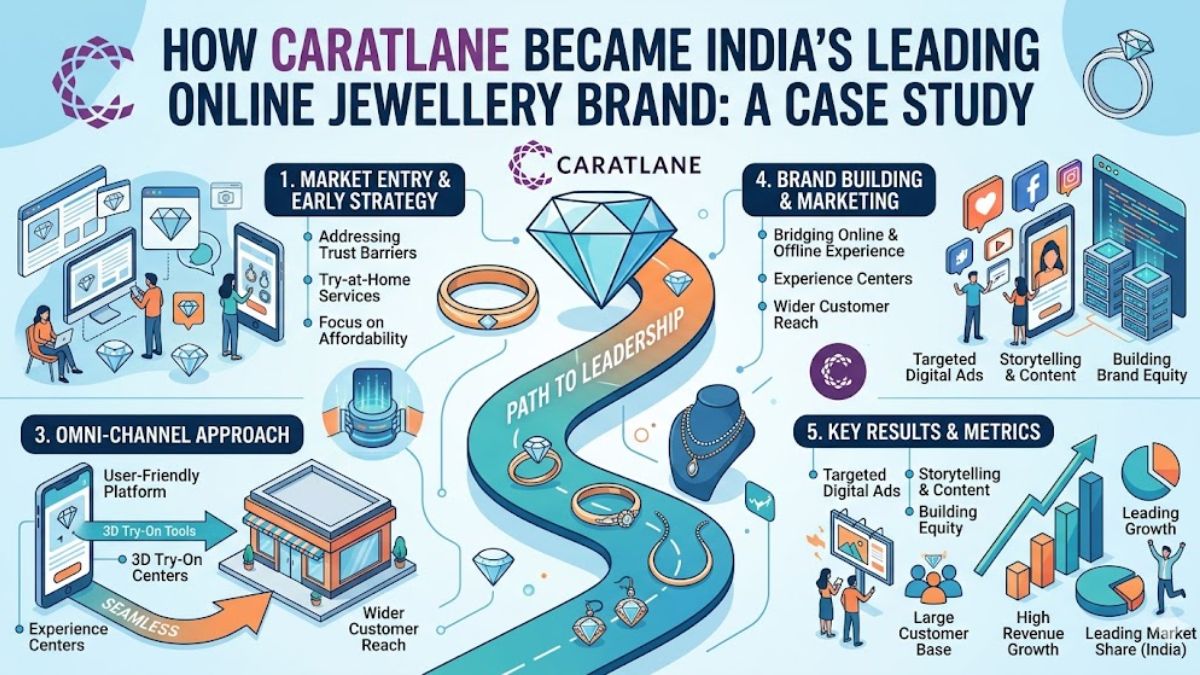
Introduction
CaratLane is widely regarded as a Leading Online Jewellery Brand in India, built on the idea of making fine jewellery accessible, affordable, and convenient for modern consumers. Founded in 2008 by Mithun Sacheti and Srinivasa Gopalan, the company is headquartered in Chennai and operates at the intersection of technology, design, and retail.The startup was created to solve a fundamental problem in India’s jewellery industry. Traditional jewellery buying was largely offline, expensive, and limited in design variety. Customers often faced trust issues, lack of transparency in pricing, and inconvenience in exploring options. CaratLane aimed to change this by bringing jewellery online, offering certified products, transparent pricing, and a wide catalogue.
The company works as a digital-first jewellery platform with an omnichannel retail strategy. Customers can browse designs online, customize products, and either order directly or visit physical stores to experience the product before purchase. Over time, it has blended e-commerce with offline retail, creating a seamless buying journey. CaratLane gained strong momentum after strategic investment from Titan Company, part of the Tata Group, which eventually acquired a majority stake. This partnership helped scale operations, strengthen supply chains, and build trust among Indian consumers.
Today, CaratLane operates as one of India’s top jewellery startups, with hundreds of retail stores and a strong online presence. Its growth reflects a larger shift in consumer behavior toward digital-first commerce, especially in categories once considered strictly offline.
1. The Origins of a Digital Jewellery Disruptor
1.1 Founders’ Background and Industry Roots
The story of CaratLane doesn’t begin with a random idea. It begins with exposure, discomfort, and a quiet realization that an entire industry was operating in a way that hadn’t meaningfully changed for decades. Mithun Sacheti grew up inside the jewellery business. This wasn’t something he observed from the outside. He saw it from within, day after day, transaction after transaction.
And what he saw wasn’t just craftsmanship or legacy. He saw inefficiencies that had become normalized. Jewellery stores carried massive inventories that locked up capital. Designs were limited to what a showroom could physically display. Pricing lacked transparency, often leaving customers unsure if they were truly getting value. It was an industry built on trust, but also one that depended heavily on information asymmetry. Customers trusted the jeweller because they had little choice, not because the system was inherently transparent.
1.2 Coming from a technology background
Now, add Srinivasa Gopalan into the picture. Coming from a technology background, he looked at the same problem through a completely different lens. Where Mithun saw operational inefficiencies, Gopalan saw system gaps that technology could solve. He understood how digital platforms could aggregate demand, reduce dependency on physical inventory, and offer scale that traditional retail simply couldn’t match.
Together, they didn’t just form a founding team. They formed a contrast that worked. Their shared vision was deceptively simple. They wanted to make buying jewellery feel as easy, as intuitive, and as transparent as buying a book or a gadget online. But underneath that simplicity was a deeply complex challenge. Jewellery is not just another product category. It carries emotional weight, financial value, and cultural significance. Reimagining how it is bought required not just technology, but a complete shift in consumer trust. That’s what made the idea bold. Not because it was complicated, but because it questioned something people had accepted for generations.
1.3 Identifying the Core Market Problem
India’s jewellery market has always been enormous, but size doesn’t always translate to efficiency. For decades, it remained fragmented, largely offline, and heavily dependent on local relationships. People bought jewellery from family jewellers, from stores their parents trusted, from places where familiarity replaced transparency. At first glance, this system seemed stable. But beneath it were clear limitations.
Customers had access to only what a store could physically showcase. Design variety was constrained by inventory. If a customer wanted something different, the options were limited. Pricing was another grey area. Without standardized benchmarks, customers often relied on trust rather than clarity. And for a new generation of buyers, this model felt outdated. Urban professionals were beginning to think differently. They were exposed to global trends. They were comfortable shopping online. expected variety, convenience, and clear pricing. But the jewellery market hadn’t evolved to meet these expectations. This gap is where CaratLane found its opportunity.
The founders didn’t just see a market problem. They saw a structural inefficiency. By moving jewellery online, they could aggregate thousands of designs without being limited by physical space. They could optimize inventory instead of overstocking. They could introduce transparency through detailed product specifications and certifications. But more importantly, they could shift control toward the customer. Instead of being restricted by what a store offered, customers could explore, compare, and choose on their own terms. That shift, subtle as it may sound, fundamentally changed the buying experience. And that’s where the foundation of a Leading Online Jewellery Brand in India was quietly laid.
2. Building the Product and Early Challenges
2.1 Launching an Online Jewellery Platform in 2008
Launching CaratLane in 2008 required more than conviction. It required a willingness to operate in an environment where almost nothing was in your favor. E-commerce in India was still in its infancy. People were hesitant to enter card details online. Cash-on-delivery was still gaining traction. And within this fragile ecosystem, CaratLane chose to sell something as high-value and emotionally significant as jewellery.
It wasn’t just ambitious. It was borderline counterintuitive. The initial focus was on diamond jewellery, and this was a strategic decision. Diamonds already came with certification standards, which allowed CaratLane to introduce a level of transparency that traditional stores often lacked. Every product listing included detailed specifications, pricing clarity, and certification details. It was an attempt to replace blind trust with informed confidence. But even with these efforts, adoption was slow.
Customers hesitated. Spending a large amount of money online felt risky. There were concerns about authenticity, delivery safety, and what would happen if the product didn’t meet expectations. Logistics added another layer of complexity. Delivering high-value items required secure systems. Returns were not just operationally challenging but financially sensitive. There were moments when the gap between vision and reality felt overwhelming. Because building a product is one thing. Convincing people to change how they buy something as personal as jewellery is something else entirely.
2.2 Overcoming Trust Deficit in Online Jewellery Shopping India
If there was one battle that defined CaratLane’s early journey, it was the battle for trust. Customers weren’t just evaluating the product. They were questioning the entire idea. Can I trust this platform? Will the jewellery look the same in real life? Is it safe to buy something this expensive online? These were not minor concerns. They were fundamental barriers.
CaratLane understood early on that trust cannot be demanded. It has to be built, layer by layer. So instead of trying to push aggressive sales, the company focused on reducing customer anxiety. Certification became a core pillar. Every piece of jewellery came with clear documentation. Return policies were designed to be customer-friendly, giving buyers the confidence that they wouldn’t be stuck with a wrong decision. One of the most powerful innovations was the try-at-home service.
This was not just a feature. It was a bridge between two worlds. Customers could browse online, shortlist designs, and then physically try them before making a purchase. It combined the convenience of digital discovery with the reassurance of physical experience. And slowly, something began to shift. Customers who took the first step started sharing their experiences. Positive interactions turned into repeat purchases. Word-of-mouth began to replace skepticism. Trust, once fragile, started becoming an asset. And that’s when the idea of online jewellery shopping in India began to feel less like a risk and more like a possibility.
3. Early Traction and Validation
3.1 First Customers and Market Response
The first customers of CaratLane were not the mass market. They were a specific segment that was already comfortable with change. Urban professionals and NRIs formed the early user base. These were individuals who had exposure to global e-commerce platforms, who valued convenience, and who were willing to experiment with new ways of buying. They didn’t represent the entire market, but they represented the future of it.
Their response was cautious at first, but meaningful. When these customers had a good experience, they didn’t just return. They recommended. And in a category like jewellery, where trust is everything, recommendations carry enormous weight. Word-of-mouth became one of CaratLane’s strongest growth drivers.
Each satisfied customer added a layer of credibility. Each repeat purchase strengthened the belief that the model could work. Over time, the platform expanded its catalogue, offering more designs, more price points, and more customization options. This phase was not about rapid growth. It was about validation. It proved that people were willing to buy jewellery online, provided the experience met their expectations. And that validation was critical in establishing CaratLane as a serious contender in building a Leading Online Jewellery Brand in India.
3.2 Product Evolution and Design Strategy
As CaratLane began to understand its customers better, its product strategy evolved in a way that reflected changing consumer behavior. Traditional jewellery in India has long been associated with heavy designs, often purchased for weddings or long-term investment. But a new generation of buyers was emerging, one that viewed jewellery differently. They weren’t just buying for occasions. They were buying for everyday use, for self-expression, for lifestyle. CaratLane leaned into this shift.
The company focused on lightweight jewellery that was affordable, wearable, and modern. These were designs that fit into daily life, not just special events. This approach opened up an entirely new category of demand, especially among younger consumers who wanted style without the burden of high cost. Design diversity became another major strength.
Instead of offering a limited set of options, CaratLane used its digital platform to showcase a wide range of styles. Customers could explore designs that traditional stores simply couldn’t stock due to space constraints. This created a sense of discovery, something that is rare in conventional jewellery shopping. Customization added a deeper layer of engagement. Customers were no longer just buyers. They became participants in the design process. The ability to personalize jewellery created emotional connection, making the purchase feel more meaningful. Over time, this combination of accessibility, variety, and personalization helped CaratLane stand out. It wasn’t just selling jewellery. It was redefining how jewellery fit into modern life.
4. Business Model and Revenue Strategy
4.1 Asset-Light Approach to Inventory
For decades, the jewellery business in India followed a predictable pattern. Stores invested heavily in inventory, locking large amounts of capital into gold and diamond stock that often sat idle, waiting for the right buyer. It was a system built on tradition, but also one that limited flexibility and slowed growth. What CaratLane did was quietly challenge this deeply entrenched model. Instead of building a business around owning massive physical inventory, it leaned into technology and data to rethink how jewellery could be designed, produced, and delivered.
At the heart of this shift was a design-first approach. Rather than stocking thousands of finished pieces across locations, CaratLane focused on maintaining a large digital catalogue of designs. Customers could browse these designs online, visualize them, and place orders, while production could be aligned more closely with actual demand. This reduced the burden of unsold inventory and allowed the company to operate with far greater efficiency.
4.2 The real impact of this model
The real impact of this model becomes clear when you consider scale. Traditional jewellers often face a trade-off between variety and cost. More designs mean more inventory, which means higher capital requirements. CaratLane broke that trade-off. By digitizing design and streamlining production, it could offer a wide selection without the financial strain that usually comes with it. This wasn’t just a backend improvement. Customers felt the difference. The platform could showcase thousands of designs, including niche and contemporary styles that would never make it to a typical showroom shelf. It gave buyers a sense of choice and control that was largely missing in the offline experience.
Of course, this model wasn’t without its challenges. Jewellery is not like apparel or electronics. It involves precious materials, craftsmanship, and strict quality control. Aligning production with demand required tight coordination with manufacturing partners and, later, deeper integration with Titan Company’s capabilities. Over time, the system matured. Lead times improved. Supply chains became more responsive. What started as a necessity in a resource-constrained startup environment evolved into a structural advantage. It allowed CaratLane to operate with better margins, reduce wastage, and stay agile in a market that often moves slowly.
There is also a psychological layer to this strategy. Customers browsing online are not just looking for jewellery. They are exploring identity, taste, and personal expression. By offering a vast catalogue without being constrained by physical inventory, CaratLane created an experience that felt expansive rather than limited. In many ways, this asset-light approach became one of the quiet engines behind CaratLane’s rise as a Leading Online Jewellery Brand. It didn’t shout for attention, but it consistently delivered efficiency, variety, and scalability in the background.
4.3 Revenue Streams and Pricing Transparency
If there is one aspect of the jewellery business that has historically created friction, it is pricing. For years, customers walked into stores without a clear understanding of how prices were calculated. Negotiation was common, and trust was often built over time rather than at first interaction. CaratLane approached this differently. From the beginning, it chose to make pricing transparent, almost to a fault. Each product listing clearly broke down the cost into gold value, diamond cost, and making charges. It was a simple idea, but in a category where opacity was the norm, it felt almost radical.
This transparency did more than just inform. It reassured. Customers could see exactly what they were paying for, and more importantly, why. It reduced the anxiety that often accompanies high-value purchases, especially in an online setting. Revenue for CaratLane primarily comes from direct sales of jewellery. But what makes this model effective is not just the transaction itself, but the experience surrounding it. By combining transparency with convenience, the company turned what was once a complex buying process into something far more approachable.
4.4 There is also a subtle but important shift in how customers perceive value
There is also a subtle but important shift in how customers perceive value. In traditional settings, price is often tied to negotiation and perception. In CaratLane’s model, value is tied to clarity and consistency. Customers are less concerned about whether they got the “best deal” and more focused on whether the product meets their expectations. Operationally, this approach has its advantages. Transparent pricing reduces the need for heavy in-store negotiation and simplifies the sales process. It also aligns well with a direct-to-consumer model, where efficiency and trust are critical.
Margins, too, benefit from this structure. By optimizing supply chains and reducing inventory costs, CaratLane can maintain healthy margins while still offering competitive pricing. It’s a balance that many traditional players struggle to achieve. Over time, this combination of transparency and efficiency has played a significant role in shaping CaratLane’s identity. It is not just a place to buy jewellery. It is a platform where customers feel informed, respected, and in control. That emotional shift is difficult to quantify, but it is central to why the brand continues to grow.
5. Funding, Investment, and Strategic Partnership
5.1 Early Funding and Growth Capital
Building a jewellery business is capital-intensive by nature. Even with an asset-light approach, there are costs associated with technology, marketing, logistics, and operations. In its early years, CaratLane relied on venture capital to navigate this phase. These early investments were not just about money. They were about belief. At a time when online jewellery was still an unproven concept in India, backing such a venture required conviction. Investors were essentially betting on a shift in consumer behavior that had not fully materialized yet.
The capital raised during this period was used to strengthen the platform, expand the product catalogue, and build brand awareness. It allowed CaratLane to experiment, iterate, and learn without the immediate pressure of profitability. But growth alone was not enough. The company needed stability, credibility, and scale. This is where the next phase of its journey became crucial.
5.2 Tata Group Backing and Acquisition
The partnership with Titan Company marked a turning point that fundamentally changed CaratLane’s trajectory. Titan, backed by the Tata Group, brought something that no startup could easily build on its own: trust at scale. For CaratLane, this wasn’t just about funding. It was about integration into a larger ecosystem that understood jewellery at a granular level. Manufacturing, quality control, supply chain management, and retail operations all received a significant boost. As Titan gradually increased its stake and moved toward majority ownership, the relationship deepened. CaratLane gained access to resources that accelerated its growth in ways that organic scaling might not have achieved.
One of the most visible outcomes of this partnership was the expansion into offline retail. Opening physical stores requires capital, operational expertise, and brand credibility. With Titan’s backing, CaratLane could move confidently into this space, blending its digital strengths with physical presence. There is also an emotional dimension to this partnership. For many Indian consumers, the Tata name carries a sense of reliability and trust. This association helped reduce hesitation among first-time buyers, especially those transitioning from traditional jewellers to an online platform. At the same time, CaratLane retained its identity as a modern, tech-driven brand. The challenge was to balance legacy with innovation, and in many ways, the company managed to do just that. This phase of the journey highlights an important lesson. Sometimes, scaling is not just about growing bigger. It is about finding the right partner who can amplify what you already do well.
6. Go-to-Market Strategy and Brand Positioning
6.1 Digital-First Approach
When CaratLane entered the market, it wasn’t just selling jewellery. It was selling a new way of buying jewellery. That distinction shaped its entire go-to-market strategy. The company leaned heavily into digital channels. Search marketing, social media campaigns, and targeted advertising became the primary tools for reaching customers. But beyond the channels themselves, it was the messaging that stood out. CaratLane spoke a different language. It focused on convenience, affordability, and modern design. It positioned jewellery not as a once-in-a-lifetime purchase, but as something that could be part of everyday life.
This shift resonated particularly well with younger audiences. Urban professionals, first-time buyers, and digitally savvy consumers found the brand approachable and relatable. There was also a sense of experimentation in how the brand communicated. Campaigns often highlighted real-life scenarios, emotions, and personal stories rather than traditional notions of luxury and status. Over time, this digital-first approach did more than drive sales. It built a community of customers who saw CaratLane as a reflection of their own evolving lifestyles.
6.2 Building a Leading Jewellery E-commerce Brand
Becoming a Leading Online Jewellery Brand is not just about scale. It is about consistency, trust, and relevance. CaratLane understood this early and focused on building these elements systematically. Trust was reinforced through certifications, easy return policies, and responsive customer support. Every interaction was designed to reduce friction and build confidence.
At the same time, the brand evolved its positioning. It moved away from the idea of jewellery as a rare, high-value purchase and embraced the concept of everyday jewellery. Lightweight designs, contemporary styles, and accessible pricing became central themes. This repositioning was subtle but powerful. It expanded the addressable market and changed how customers perceived jewellery. Instead of waiting for special occasions, people began buying pieces for daily use.
The result was a brand that felt modern, inclusive, and aligned with changing consumer behavior. It didn’t try to replace traditional jewellers entirely. Instead, it carved out its own space as a digital-first, customer-centric alternative.
7. Omnichannel Retail Strategy and Expansion
7.1 Transition from Online to Offline
For a company that started online, moving into offline retail might seem like a contradiction. But for CaratLane, it was a natural evolution. Jewellery is deeply personal. Customers want to see it, touch it, and feel it before making a purchase. While online platforms can provide information and convenience, physical stores offer reassurance. Recognizing this, CaratLane began opening retail stores in key urban markets. These stores were not designed to replace the online experience but to complement it.
Walking into a CaratLane store feels different from a traditional jewellery showroom. The environment is more open, more approachable. The focus is on exploration rather than pressure to buy. This transition required careful execution. Balancing online efficiency with offline experience is not easy. But over time, the model proved effective.
7.2 Integration of Online and Offline Channels
What truly sets CaratLane apart is how it integrates its online and offline channels. The two are not separate entities but parts of a unified system. Customers can browse designs online, shortlist their preferences, and visit a store to see them in person. They can also place orders online and pick them up in-store. This flexibility creates a seamless experience that adapts to individual preferences.
Features like customization, real-time inventory visibility, and assisted selling further enhance this integration. Store staff can access online data, and customers can access in-store services digitally. This omnichannel retail strategy has become a cornerstone of CaratLane’s growth. It combines the best of both worlds, offering convenience without compromising on experience.
8. Competitive Landscape and Differentiation
8.1 Competing with Traditional and Digital Players
The jewellery market in India is both vast and intensely competitive. Traditional players bring legacy, trust, and deep-rooted customer relationships. New digital platforms bring agility and innovation. CaratLane operates at the intersection of these two worlds. It competes with established jewellers while also keeping pace with emerging online brands. Its early-mover advantage in the digital space gave it a head start. But maintaining that advantage requires continuous adaptation. Consumer expectations evolve, and competition never stands still.
8.2 Unique Value Proposition
What keeps CaratLane relevant is its ability to stay focused on what matters most to its customers. Transparency, design variety, and ease of purchase remain at the core of its value proposition. The emphasis on lightweight jewellery reflects a broader cultural shift. Consumers are moving toward pieces that fit into their daily lives rather than just special occasions. Data plays an important role here. By understanding customer preferences, browsing behavior, and purchase patterns, CaratLane can refine its offerings and stay ahead of trends.
There is also an emotional layer to its differentiation. The brand feels accessible without being ordinary, modern without being distant. It strikes a balance that resonates with a wide range of customers. In a market where tradition often dominates, CaratLane’s ability to blend innovation with familiarity is what sets it apart. And that balance continues to define its journey as one of India’s most recognized digital jewellery brands.
9. Scaling Operations and Execution
9.1 Supply Chain and Manufacturing Insights
Scaling a jewellery business is not just about selling more. It is about managing complexity without losing control. For CaratLane, this phase of the journey was less visible to customers but absolutely critical to survival. In the early days, the company operated with a lean structure. Designs were digital, inventory was controlled, and production was closely aligned with demand. But as order volumes increased, this model began to stretch. What worked at a smaller scale needed to evolve into something far more robust.
This is where the partnership with Titan Company changed the equation. Titan brought decades of experience in jewellery manufacturing, sourcing, and quality control. Suddenly, CaratLane was no longer just a startup trying to manage a complex supply chain. It had access to an ecosystem that understood the nuances of the business at a granular level.
The impact showed up in multiple ways. Production cycles became more predictable. Quality checks became more standardized. The risk of inconsistencies, which can damage trust in a jewellery brand, was significantly reduced. But what makes CaratLane’s supply chain particularly interesting is how it blends traditional craftsmanship with modern systems. Jewellery is not mass-produced in the same way as electronics or apparel. It involves skilled artisans, intricate designs, and attention to detail that cannot be rushed.
9.2 At the same time, the company relies heavily on data
At the same time, the company relies heavily on data. Demand forecasting plays a central role in planning production. By analyzing browsing patterns, customer preferences, and purchase history, CaratLane can anticipate what customers are likely to buy. This reduces overproduction and minimizes wastage, which is especially important when dealing with precious materials.
There is also a quiet discipline in how the company manages inventory. Even as it expanded into offline stores, it resisted the temptation to overstock. Instead, it focused on maintaining a balance between availability and efficiency. Stores often act as experience centers rather than heavy inventory hubs, with supply chains supporting them dynamically.
From a customer’s perspective, all of this translates into reliability. When someone places an order, they expect timely delivery and consistent quality. They rarely think about the backend processes that make this possible. But those processes are where the real work happens. Over time, this combination of strong manufacturing support and data-driven operations has allowed CaratLane to scale without losing its core strengths. It is not just about growing bigger. It is about growing in a way that remains sustainable and trustworthy.
9.3 Technology and Platform Development
If the supply chain is the backbone of CaratLane, technology is its nervous system. It connects everything, from design and inventory to customer experience and post-purchase engagement. From the beginning, the company treated technology not as a support function but as a core capability. Its platform was designed to do more than just display products. It had to educate, reassure, and guide customers through a buying process that was traditionally offline.
One of the most important features has been customization. Jewellery is deeply personal, and customers often want something that reflects their individual taste. CaratLane’s platform allows users to modify designs, choose materials, and visualize the final product before making a decision. This level of control changes how people engage with the product.
Real-time pricing is another critical element. Gold and diamond prices fluctuate, and reflecting these changes accurately builds credibility. Customers feel that they are getting a fair deal based on current market conditions rather than arbitrary pricing. As the company evolved, it began investing in more advanced digital tools. Virtual try-on features, powered by augmented reality, allowed customers to see how a piece might look without physically wearing it. While not a perfect substitute for in-store experience, it reduces hesitation and adds a layer of convenience.
9.4 User experience has also been a continuous focus
User experience has also been a continuous focus. Navigation, search functionality, and checkout processes have been refined over time to reduce friction. Small improvements in these areas can have a significant impact on conversion rates. There is also a deeper layer of technology that customers rarely see. Data analytics drives decision-making across the organization. From marketing campaigns to product development, insights derived from user behavior shape strategy.
What stands out is the company’s willingness to keep evolving. Technology is not treated as a one-time investment but as an ongoing journey. New tools are tested, feedback is incorporated, and systems are updated regularly. In many ways, this commitment to technology is what allows CaratLane to maintain its position as a Leading Online Jewellery Brand. It enables scale, improves efficiency, and enhances customer experience, all at the same time.
10. Challenges, Failures, and Turning Points
10.1 Early Struggles with Adoption
It is easy to look at CaratLane today and assume that its success was inevitable. But the early years tell a very different story. Convincing someone to buy jewellery online in 2008 was not just difficult. It was almost counterintuitive. Jewellery is emotional. It is tied to trust, tradition, and personal experience. Asking customers to shift that experience to a screen required a fundamental change in mindset.
The first few years were slow. Traffic was limited. Conversion rates were lower than expected. There were moments when the model itself seemed uncertain. But what kept the company moving forward was persistence. Instead of abandoning the idea, the team focused on understanding customer concerns. Why were people hesitant? What would make them feel more comfortable?
This led to a series of customer-centric initiatives. Try-at-home services allowed people to experience products before buying. Easy return policies reduced risk. Transparent pricing addressed trust issues. These were not just tactical decisions. They were responses to real fears and doubts that customers had. Over time, these efforts began to pay off. Adoption improved. Repeat purchases increased. Word-of-mouth started to build. Looking back, this phase feels less like a struggle and more like a process of education. The company was not just building a business. It was shaping consumer behavior.
10.2 Scaling Complexities
Growth brings its own set of challenges. What works for a small operation often breaks under the pressure of scale. For CaratLane, this transition was both exciting and demanding. As order volumes increased, logistics became more complex. Delivering high-value products across cities required secure and reliable systems. Returns, which are inevitable in any retail business, added another layer of complexity.
Customer service also became more demanding. With a growing user base, expectations rose. Customers wanted faster responses, better support, and smoother experiences. Internally, coordination across teams became more critical. Marketing, operations, technology, and supply chain all needed to work in sync. Any disconnect could affect the customer experience. This is where the partnership with Titan proved invaluable. The operational expertise and infrastructure that came with it helped address many of these challenges. Processes were streamlined. Systems were strengthened. The company gained the ability to scale without losing control.
There is an emotional side to this phase as well. Growth can be overwhelming. It tests not just systems but also people. Teams need to adapt, learn, and sometimes unlearn old ways of working. For CaratLane, this period was about finding balance. Balancing speed with stability. Innovation with consistency. Ambition with execution.
11. Growth Metrics and Milestones
CaratLane’s journey can be measured in numbers, but those numbers only tell part of the story. The real significance lies in what they represent. Over the years, the company has expanded its physical presence to hundreds of stores across India. Each store is not just a point of sale but a touchpoint for building relationships with customers. Its online platform continues to attract millions of users. Traffic, engagement, and repeat purchases have all grown steadily, reflecting increasing trust in the brand.
The company has also broadened its product range. From diamond jewellery to everyday wear pieces, it has adapted to changing consumer preferences and expanded its appeal. While detailed financial figures are not always publicly disclosed, the trajectory is clear. CaratLane has moved from being a niche startup to a recognized name in the industry. What makes these milestones meaningful is the context in which they were achieved. This is a category that was once considered resistant to digital disruption. And yet, CaratLane managed to carve out a significant space within it.
Each milestone is a reminder of how far the company has come. From a small team experimenting with an unconventional idea to becoming a top online jewellery brand in India, the journey reflects both vision and execution.
12. Team Building and Leadership Approach
Behind every successful company is a team that believes in the vision, even when the path is uncertain. For CaratLane, building that team has been an ongoing process. The leadership has always placed a strong emphasis on combining industry knowledge with technological expertise. Jewellery is a specialized field, and understanding its nuances is essential. At the same time, scaling a digital platform requires a completely different skill set.
Bringing these two worlds together is not easy. It requires a culture that values collaboration and continuous learning. CaratLane has worked to create an environment where ideas can be tested, feedback is encouraged, and experimentation is part of the process. There is also a sense of ownership within the team. Employees are not just executing tasks. They are contributing to a larger mission of redefining how jewellery is bought and experienced.
Leadership plays a key role in shaping this culture. By staying close to both the product and the customer, the founders and senior team have been able to guide the company through different phases of growth. Over time, this approach has resulted in a team that is both resilient and adaptable. It is a quiet strength that often goes unnoticed but is essential for long-term success.
13. Regulatory and Industry Dynamics
The jewellery industry in India operates within a framework of regulations that are designed to ensure quality, transparency, and consumer protection. For a company like CaratLane, navigating this landscape is an essential part of doing business. Hallmarking standards, taxation policies, and import regulations all influence how the company operates. Compliance is not optional. It is fundamental to maintaining credibility.
CaratLane’s emphasis on transparency aligns well with these regulatory requirements. By clearly communicating pricing and ensuring product certification, the company builds trust not just with customers but also with regulators. There is also a broader shift happening in the industry. As more players move online, expectations around transparency and accountability are increasing. In this context, CaratLane’s early focus on these aspects gives it a distinct advantage.
14. Current Status of CaratLane
Today, CaratLane stands as one of India’s most recognized jewellery brands, operating at the intersection of digital and physical retail. Its presence spans across major cities, with a growing network of stores that complement its online platform. The company continues to invest in innovation. Whether it is improving user experience, expanding product offerings, or enhancing supply chain efficiency, the focus remains on staying relevant in a rapidly changing market.
At the same time, it has managed to retain the essence of what made it successful in the first place. Accessibility, transparency, and customer-centricity remain at the core of its identity. There is a sense of maturity in how the company operates today. It is no longer just a disruptor. It is a leader that others look to for direction.
15. Future Outlook of a Leading Online Jewellery Brand
Looking ahead, the path for CaratLane is both promising and demanding. The opportunity is clear. Consumer behavior in India continues to shift toward digital platforms. The acceptance of online jewellery shopping is growing, especially among younger audiences. For CaratLane, the challenge is to stay ahead of this curve. Technology will play a crucial role. Investments in artificial intelligence, personalization, and virtual experiences are likely to shape the next phase of growth.
The omnichannel retail strategy will also continue to evolve. New store formats, deeper integration between online and offline channels, and enhanced customer experiences will define how the brand interacts with its audience. There is also room for expansion. New markets, both within India and potentially beyond, offer opportunities for growth. At the same time, competition will intensify, requiring constant innovation and adaptability.
What gives CaratLane an edge is its journey so far. It has already navigated skepticism, built trust, and scaled operations in a challenging category. These experiences are not just milestones. They are lessons that will guide future decisions. As a Leading Online Jewellery Brand, CaratLane’s future will depend on its ability to remain true to its core values while embracing change. If it can continue to balance innovation with reliability, it is well positioned to remain a defining player in India’s evolving jewellery market.
About FoundLanes.com
foundLanes.com is a platform that documents and analyzes startup journeys, business models, and founder stories across India’s evolving startup ecosystem. It focuses on in-depth, research-driven case studies that provide practical insights for entrepreneurs, professionals, and students interested in understanding how startups are built and scaled.