


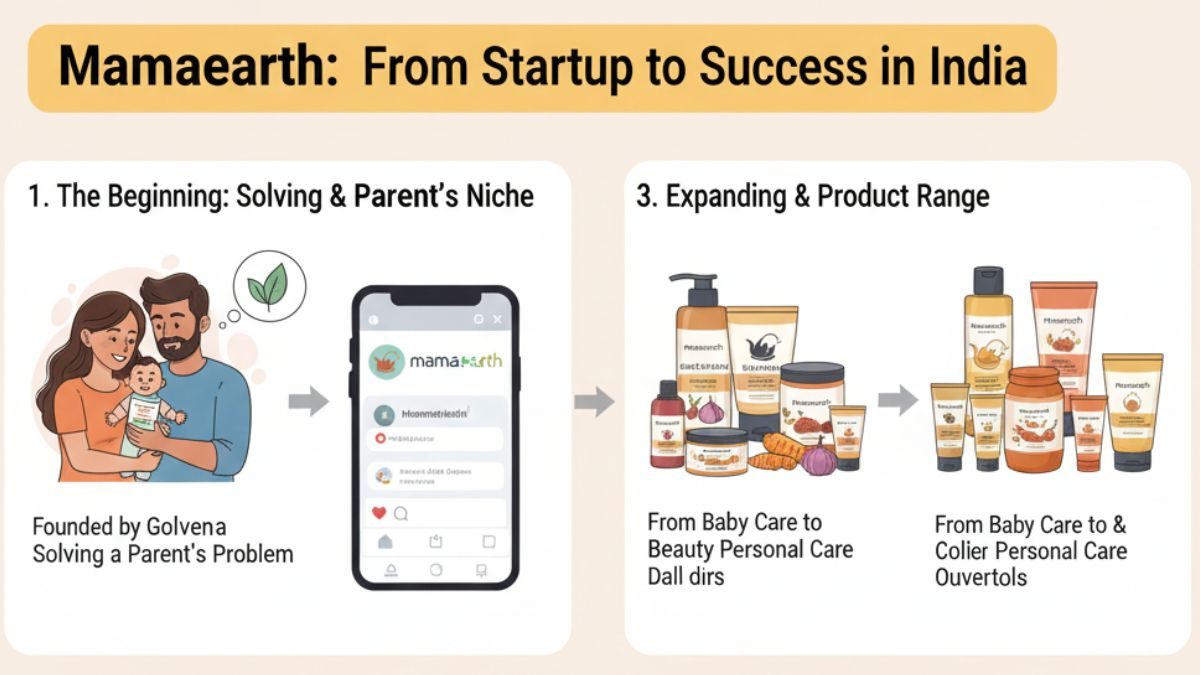
The Origins of Mamaearth: From Parental Concern to Purpose-Driven Brand
Mamaearth did not begin as a startup idea scribbled on a whiteboard or a trend spotted in a consulting report. It began with worry. The quiet, unsettling kind that creeps in when something feels wrong but you cannot immediately fix it. In 2016, Ghazal and Varun Alagh were new parents, navigating the exhausting and emotional early months of raising their first child. Like many young parents, they trusted what was available on store shelves. And like many, they learned the hard way that trust was misplaced. Their baby developed skin rashes, and repeated doctor visits led them to examine product labels more closely than they ever had before.
What they found disturbed them. Ingredients banned or restricted in other countries were freely used in products meant for infants in India. Labels were vague. Claims were loud, but accountability was absent. There were imported alternatives, but they were expensive, inaccessible, and built for climates and skin types very different from India’s. That moment of discomfort did not fade. It stayed. And over time, it transformed into a question that would shape the rest of their professional lives. Why should Indian parents have to choose between affordability and safety?
Mamaearth was born out of that question
Mamaearth was born out of that question. Based in Gurugram, the company started with a narrow focus on baby care products that were positioned as toxin-free and transparent in their ingredients. It launched online, selling directly to consumers at a time when India’s FMCG industry still relied heavily on offline distribution and television advertising. Over the years, Mamaearth expanded into skin care, hair care, and wellness, eventually becoming the largest brand under Honasa Consumer Limited, which listed on Indian stock exchanges in 2023. This is the story of How Mamaearth Built and Scaled in India, not as a flawless success story, but as a sequence of decisions made under uncertainty, shaped by conviction, timing, and constant course correction.
1. The Market Mamaearth Walked Into
Before Mamaearth arrived on the scene, India’s personal care market ran on assumptions. Brands assumed loyalty; consumers assumed safety. Few questioned what went into the products they smeared on their babies’ skin, washed over their faces, or massaged into their hair every day. For decades, marketing had done the talking, and the rest—the ingredients, the sourcing, the chemical composition—remained buried in fine print that most didn’t read or understand. Trust was inherited, not earned.
By the mid-2010s, however, the landscape was quietly shifting. Urban consumers, particularly young parents, were becoming more inquisitive. They were reading more, scrolling online, comparing labels, asking questions. Social media and global discussions around clean beauty, sustainability, and ingredient safety had reached Indian households. Parents were increasingly unwilling to take products at face value—they wanted transparency, reassurance, and simplicity.
What the market lacked was not demand, but an Indian brand willing to meet that curiosity openly, to speak plainly, and to earn trust rather than assume it. Mamaearth stepped into that silence. It recognized that modern parents didn’t just want products—they wanted certainty, guidance, and a sense that someone understood the responsibility of caring for a child. The opportunity was enormous, but it was also nuanced: the brand had to balance science with empathy, education with approachability, and transparency with aspirational storytelling.
Mamaearth didn’t just enter a market; it entered a mindset shift. It arrived when consumers were ready to listen, and it gave them a language they had been waiting for—a way to care consciously without confusion, a bridge between skepticism and trust, and a brand that made transparency not intimidating, but reassuringly human.
2. Founders Who Did Not Set Out to Build an Empire
2.1 Varun Alagh and the Weight of Execution
Varun Alagh brought more than ambition to Mamaearth—he brought discipline, systems thinking, and a hard-earned understanding of the fragility of physical products. His experience in FMCG and digital companies had shown him how scaling a product without losing control was one of the hardest challenges a business could face. Manufacturing delays, quality lapses, inventory mismanagement, or logistic breakdowns were not abstract possibilities—they were real, costly risks waiting to compound.
From the very beginning, Varun approached Mamaearth with restraint. Every decision, from sourcing ingredients to designing packaging, was filtered through a lens of operational feasibility. Growth mattered—but only if the foundations could hold it. In those early months, he spent countless nights tracking shipments, negotiating with suppliers, and auditing quality control. For him, each small operational success was a victory in itself, and every misstep a lesson that could save the company from far costlier mistakes down the line. This careful, deliberate approach laid the backbone of a business that would later scale rapidly without compromising trust.
2.2 Ghazal Alagh and the Language of Trust
While Varun built systems, Ghazal Alagh built connection. She understood people in a way that numbers alone cannot teach. She knew that fear-based marketing—the industry’s default tactic of highlighting dangers or creating anxiety—would not cultivate loyalty. Parents didn’t want to be scared; they wanted clarity, reassurance, and honesty.
Ghazal’s voice became the emotional center of Mamaearth’s early communication. Not as a polished spokesperson, but as someone who sounded like the audience itself: empathetic, relatable, and attentive. Every post, every description, every interaction carried her sensibility. She translated complex ingredient lists into plain language. Made transparency feel personal, and built a bridge between a brand and consumers who were hungry for trust. Her work ensured that Mamaearth was not just selling products. It was offering certainty, care, and guidance, qualities that parents could rely on every day.
2.3 Early Doubt and Quiet Resistance
The journey was far from smooth. Manufacturers questioned whether a small, ingredient-conscious brand could survive in a price-driven market. Retailers were hesitant to allocate shelf space. Investors asked whether Indian consumers truly cared about ingredient safety, or if it was just a niche conversation with no commercial potential.
The founders heard “no” more often than “yes.” And yet, they learned to move forward anyway. Each rejection became a test of conviction, each skepticism a chance to refine their story, processes, and approach. They understood that building trust and operational excellence could not be rushed. The quiet resistance they faced in the early days shaped their resilience. Sharpened their focus, and instilled in Mamaearth a culture of patience, care, and perseverance. A culture that would eventually allow the brand to not just enter the market, but transform it.
3. The Problem Was Never Just Ingredients
Mamaearth’s defining insight was less about unsafe products than it was about a profound sense of consumer disempowerment. For years, personal care in India operated on assumption. Labels felt opaque, claims sounded rehearsed. And consumers had little reason to question what they applied to their own skin or that of their children. There was no dialogue—only instruction. Confidence wasn’t earned; it was taken for granted.
Mamaearth set out to reverse that dynamic. It didn’t scream, advertise, or rely on celebrity endorsements. Instead, it explained. It broke down ingredients, demystified formulations, and spoke slowly and deliberately in a market accustomed to noise and exaggeration. Every blog post, every packaging label, every social media interaction was a conversation. A patient, empathetic guide rather than a salesman pushing a product.
This approach did not scale overnight. Early traction was slow. Parents were cautious, retailers skeptical, and growth measured in small, deliberate steps. But in those early months, the brand built something far more fragile—and far more valuable—than reach or viral attention: it built belief. Parents didn’t just buy products; they trusted them. They returned, shared experiences, and became advocates not because of marketing hype, but because someone had taken the time to speak plainly, honestly, and humanly.
In hindsight, this patience and focus on trust became Mamaearth’s differentiator. In a crowded, commoditized market, the brand’s quiet insistence on clarity and empowerment turned skepticism into loyalty, and created a foundation that could support rapid growth without ever sacrificing integrity.
4. Building Products Without Owning Factories
4.1 Learning Through Iteration
Mamaearth did not begin with perfect products. It began with intent—and a willingness to learn in public. Early formulations were tested rigorously, often rejected, refined, and sometimes scrapped entirely. Feedback loops were short and brutal: one batch of lotion that irritated sensitive skin, one shampoo that failed to lather properly, and the team had to go back to the drawing board. Mistakes were expensive, both financially and emotionally, but each misstep became a lesson in understanding the nuances of Indian skin, hair, and climate.
Through this process, the team discovered that what works globally does not always work locally. Humidity, water quality, lifestyle, and cultural expectations shaped how products were formulated, packaged, and presented. Each iteration wasn’t just product development—it was an education in empathy, a deep study of the customer’s lived experience. These lessons built more than products; they built credibility, trust, and the quiet confidence that Mamaearth could deliver solutions that were genuinely suited to the Indian context.
4.2 Choosing Transparency as a Constraint
From the start, Mamaearth made a bold choice: to position its products as toxin-free, clean, and safe. But with this promise came a responsibility that could not be taken lightly. Claims had to withstand scrutiny. Certifications could not be symbolic; they had to be authentic. Compliance became a daily discipline, embedded in every process, not a checkbox to satisfy regulations or marketing.
This approach slowed the brand down. It demanded meticulous sourcing, detailed testing, and painstaking documentation. Shortcuts were tempting, especially when competitors moved faster, but the founders understood that any compromise would erode the fragile trust they were building. In choosing transparency as a constraint, Mamaearth protected its credibility and created a competitive advantage that would pay dividends in loyalty and brand equity. Parents returned not because of hype, but because they believed—deeply and personally—that this brand cared as much about their children’s safety as they did themselves.
5. Early Customers and the Long Road to Validation
5.1 Selling One Parent at a Time
Mamaearth’s first customers were not captured through flashy campaigns or mass advertising. They were won slowly, deliberately, one parent at a time. Every sale was accompanied by reassurance—explaining ingredients, addressing concerns in comment sections, responding patiently to inbox messages. Trust was earned in conversations, not impressions.
Growth was uneven. Some months brought unexpected orders that validated months of effort; other months were quiet, leaving the founders questioning whether their painstaking approach would ever scale. But through it all, repeat customers returned. That consistency mattered far more than spikes in traffic or temporary buzz. It was proof that the brand was not selling products alone—it was selling confidence, clarity, and a sense of care that parents could feel and trust.
5.2 Content as a Relationship, Not a Funnel
From the start, Mamaearth treated content not as a marketing asset, but as a form of service. Blog posts, ingredient explainers, and educational videos were designed to answer questions, calm anxieties, and build understanding. They were not pushy ads—they were guides, companions in a parent’s journey of care.
Over time, this content did something no conventional campaign could: it created familiarity, credibility, and emotional connection. Parents learned that Mamaearth’s voice was reliable, its information trustworthy, and its advice human. This approach became central to the brand’s digital-first FMCG strategy, where education didn’t simply support conversion—it nurtured it. By focusing on relationships rather than funnels, Mamaearth turned early skepticism into lasting loyalty, proving that trust and transparency could drive both growth and meaningful impact in a crowded, price-sensitive market.
6. The Mamaearth Business Model Took Shape Slowly
6.1 D2C as Control, Not Just Margin
For Mamaearth, direct-to-consumer (D2C) was never just about higher margins—it was about control. Selling directly to parents gave the founders oversight of pricing, communication, and, most importantly, customer experience. But control came with responsibility. Every return, every complaint, every delayed shipment landed squarely on the founders’ desks. There was no distributor to deflect blame, no middleman to absorb mistakes.
This unfiltered feedback was brutal, but invaluable. It forced the team to confront weaknesses immediately, refine processes, and truly understand their customers’ expectations. By facing issues head-on, rather than hiding behind third-party channels, Mamaearth could iterate quickly, strengthen trust, and ensure that the experience they promised online matched the one parents received in reality. D2C wasn’t just a channel; it was the laboratory where the brand’s values, operational rigor, and relationship with customers were tested daily.
6.2 Offline Expansion as a Necessary Compromise
Scaling a brand, however, required a presence beyond the screen. Entering offline retail was a strategic necessity, but it came with trade-offs. Negotiating margins, managing inventory across multiple stores, and ensuring consistent messaging meant compromises—sometimes the story of transparency and care became diluted, and the founders had to accept that.
Yet the benefits were undeniable. Offline expansion opened doors to millions of customers who would never actively search for Mamaearth online. Supermarkets, pharmacies, and multi-brand stores became channels for discovery, allowing the brand to reach households that valued familiarity and accessibility over digital research. It was a delicate balance: maintaining brand integrity while navigating the operational and communicational complexities of offline retail. In doing so, Mamaearth proved that growth and trust are not mutually exclusive—they require strategy, discipline, and a relentless focus on the customer at every touchpoint.
7. Funding, Belief, and Pressure
Mamaearth’s journey attracted early believers who saw potential beyond immediate numbers. Fireside Ventures was among the first to place trust in the founders’ vision, followed by Sequoia Capital India, whose backing provided not just capital but validation. Funding enabled speed: faster product development, wider distribution, and larger marketing experiments. Yet with that support came pressure—the kind that tests both strategy and conviction.
Investors encouraged rapid expansion, more categories, and aggressive defense of shelf space. Every decision was scrutinized, every milestone weighed against ambitious growth expectations. For the founders, the challenge was nuanced: knowing when to absorb guidance and scale responsibly, and when to resist moves that could compromise the brand’s integrity or overextend its operational capacity.
The pressure was real, constant, and sometimes isolating. But it also sharpened discipline. One early investor recounts how Varun and Ghazal would push back on a tempting partnership, arguing that rushing would risk the very trust they were building with parents. Months later, that restraint paid off: products launched thoughtfully, communications remained authentic, and the brand avoided shortcuts that could have eroded credibility. In the delicate dance of funding and autonomy, Mamaearth learned that belief from investors is only valuable when it aligns with the vision—and that courage to resist, when necessary, is as critical as the ability to scale.
8. Marketing That Felt Human Until It Didn’t
8.1 Influencers as Modern Word-of-Mouth
Mamaearth leaned heavily into influencer marketing in its early growth phase. Carefully chosen voices—parent bloggers, wellness advocates, and credible voices in the clean beauty space—helped the brand feel omnipresent yet intimate. It was a period when Mamaearth seemed everywhere, yet each interaction still carried a personal touch. Parents discovered the brand through voices they trusted, and slowly, the promise of transparency and care began to resonate.
But scale has its consequences. As campaigns multiplied, so did scrutiny. Every claim was dissected, every ingredient questioned, and every message analyzed under a magnifying glass. What worked as a strength—visibility and reach—also exposed vulnerabilities. The brand learned a vital lesson: attention magnifies both credibility and flaws. A misstep could no longer be contained quietly; a promise broken reached thousands in moments.
This period of heightened visibility forced Mamaearth to double down on operational rigor, compliance, and honest communication. Influencer marketing was not just a tool for growth—it became a mirror reflecting the brand’s integrity. It taught the founders that growth cannot be separated from accountability, and that the louder the brand’s voice, the more disciplined and transparent it must be behind the scenes. In other words, attention is powerful, but trust is fragile—and every campaign must honor that balance.
9. Growth, Criticism, and Course Correction
Mamaearth’s rapid rise did not come without turbulence. As the brand gained visibility, product claims were challenged, advertising practices were questioned, and public trust—the most carefully cultivated asset—proved unexpectedly fragile. For a company built on transparency, these moments were jarring. Every critique, every online debate, felt intensely personal to the founders.
The response was deliberate and uncompromising. The team revisited internal processes, tightened communication, and engaged with feedback publicly rather than hiding from it. Every critique became a lesson, every complaint an opportunity to reinforce credibility. These were uncomfortable, often humbling experiences—moments when shortcuts could have been tempting, but the founders resisted.
In hindsight, these challenges accelerated Mamaearth’s maturity. The brand learned that trust is not static; it must be continually earned, maintained, and protected. Public scrutiny sharpened operational discipline, deepened empathy for consumers, and reinforced the principle that integrity cannot be sacrificed, even under pressure. Through adversity, Mamaearth discovered that resilience is built not only in moments of success, but in the courage to confront mistakes openly and the discipline to emerge stronger.
10. From Startup to Listed Company
With Honasa Consumer Limited’s IPO in 2023, Mamaearth entered a new chapter—one that demanded a different kind of vigilance and discipline. The language of the business shifted almost overnight. Transparency, once a deliberate choice and a differentiator, became regulated, mandatory, and scrutinized at a level the founders had never experienced. Growth was no longer measured by the quiet satisfaction of returning parents; it was now reported quarterly, in charts and percentages, under the watchful eye of investors, analysts, and the public.
The brand that had once spoken softly, building trust one parent at a time, now had to answer loudly. Every claim, every product launch, every marketing campaign was dissected for compliance, credibility, and financial impact. The intimacy of the early days—the patient conversations, the small victories, the slow accumulation of loyalty—was replaced by a faster, more public rhythm that tested the company’s operational rigor, governance, and emotional resilience.
For the founders, this was both exhilarating and daunting. It was a reminder that the careful, empathetic culture they had nurtured needed to scale alongside the business. Processes that once felt sufficient in a small, controlled environment now had to withstand scrutiny at thousands of touchpoints. Yet, through this transition, the essence of Mamaearth—its commitment to care, clarity, and honesty—remained a guiding light. The challenge was not just growth, but growing without losing the trust, empathy, and integrity that had defined the brand from its very first bottle.
11. How Mamaearth Built and Scaled in India, Really
Mamaearth’s growth story is not one of flawless execution or effortless expansion. It is a story of alignment—between the founders’ personal beliefs and the moment in the market when parents were ready to listen. It is about identifying a gap that no one else had addressed and meeting it with honesty, patience, and empathy. In a category that had long relied on inherited trust, Mamaearth earned credibility one parent at a time, turning skepticism into loyalty through transparency, consistency, and care.
The brand’s journey is also a reminder of the fragility of purpose. Scaling a mission-driven business exposes it to scrutiny—from consumers, investors, regulators, and the public. Every claim, every product, every marketing message is examined. Yet Mamaearth demonstrated that purpose, when deeply rooted and executed with discipline, can survive scrutiny and even emerge stronger from it.
Ultimately, Mamaearth’s story is about more than revenue, distribution, or growth metrics. It is about human connection—understanding parents’ fears, hopes, and expectations—and building a brand that honors that trust. It shows that alignment between vision, execution, and empathy is what transforms a company from a product maker into a household companion, and that real growth is measured not only in scale, but in the depth of belief a brand inspires in those it serves.
Future Outlook: How Mamaearth Built and Scaled in India and What It Must Protect Next
The next chapter for Mamaearth will not be about discovery or rapid visibility. It will be about consistency—the quiet, unglamorous discipline of maintaining standards, delivering on promises, and nurturing trust day after day. In a market crowded with lookalike products, louder claims, and fleeting trends, survival will hinge on the brand’s ability to honor the careful foundations it built over the past decade.
Every interaction, every product, every communication must reinforce the reliability that parents have come to expect. This is the slow work of a brand that does not chase attention for its own sake but earns it repeatedly, deliberately. The discipline of consistency—often invisible to outsiders—is what transforms a company from a fleeting sensation into a trusted household name.
If Mamaearth succeeds in this phase, its story will remain more than a tale of growth or market capture. It will stand as a case study in restraint, integrity, and empathy—a blueprint for how a purpose-driven brand can scale responsibly, survive scrutiny, and maintain the human connection at the heart of its journey. In the end, the measure of Mamaearth will not be how loud it can shout, but how faithfully it can continue to do the small, essential work that builds enduring trust.
About foundlanes.com
foundlanes.com is an independent Indian platform that studies startups beyond funding rounds and headlines. It documents founder journeys, business models, and market decisions with depth and context, offering readers a clearer understanding of how companies are actually built in India.