


Introduction
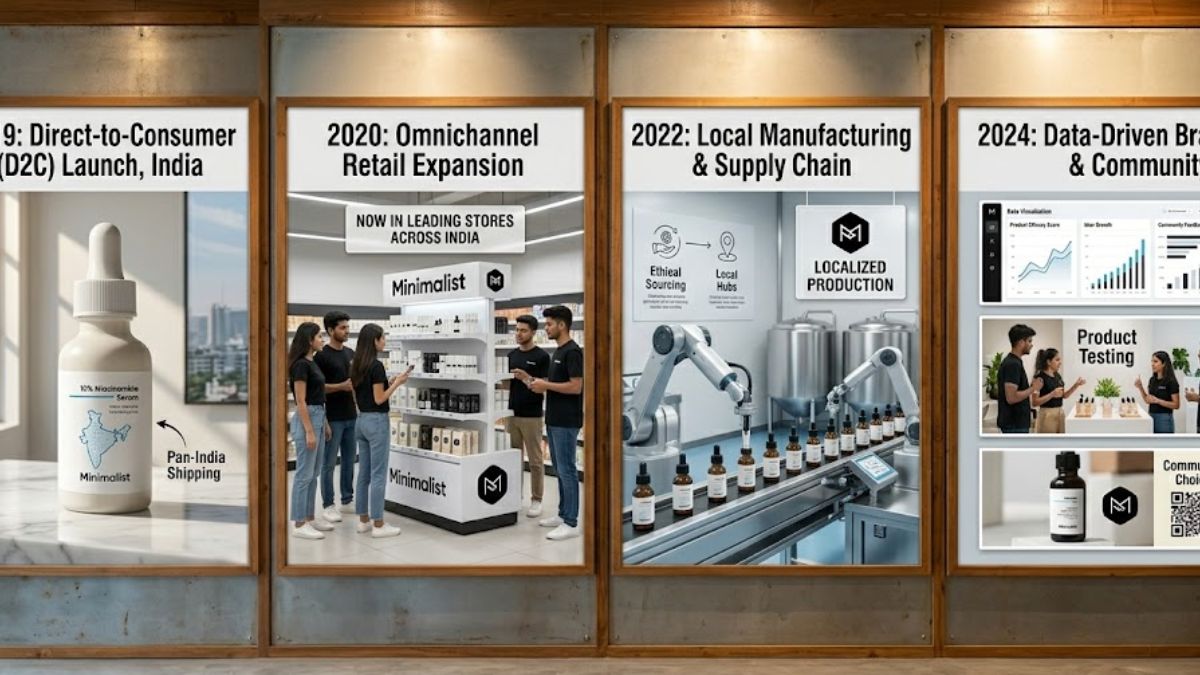
Minimalist is a direct-to-consumer skincare brand from India that focuses on ingredient transparency, science-backed formulations, and affordable pricing. This Minimalist case study explores how a relatively new entrant disrupted a crowded beauty market by challenging traditional marketing narratives and building trust through simplicity. The company was founded by Mohit Yadav and Rahul Yadav, entrepreneurs who identified a growing gap between what skincare brands promised and what they actually delivered. Headquartered in Jaipur, India, Minimalist was launched in 2020 at a time when consumers were becoming more aware of ingredients and increasingly skeptical of exaggerated claims in beauty advertising.
The brand operates on a straightforward model. It develops skincare products based on active ingredients, communicates clearly about concentrations and benefits, and sells directly to consumers through its website and marketplaces. This approach positioned Minimalist differently from many Indian D2C skincare brands that relied heavily on influencer marketing and lifestyle branding.
Minimalist gained early traction through digital channels, particularly among educated urban consumers looking for effective and honest skincare solutions. Its rapid growth has been supported by strong repeat purchase behavior and word-of-mouth referrals rather than aggressive advertising. While exact revenue and funding figures have been selectively disclosed in public sources, the company has raised capital from venture investors and has reportedly achieved significant scale within a short period. This Minimalist startup case study examines the journey from its early days to becoming one of the most talked-about skincare brands in India, offering insights into product strategy, branding, execution, and long-term positioning.
1. The Origin Story and Early Background
Minimalist didn’t enter the market as just another beauty brand trying to stand out with packaging or storytelling. It came in at a time when India’s skincare space was already crowded, but oddly still confusing for the average buyer. People were buying products without really knowing what was inside them or why they worked. That gap became the starting point. The founders, Mohit Yadav and Rahul Yadav, came from a strong digital and business background, which shaped how they looked at the problem. Instead of thinking like traditional beauty entrepreneurs, they approached it more like product builders. They kept asking a simple question: why is skincare still being sold like emotion, not science?
What they noticed was very clear. Most brands were leaning heavily on branding, claims, and aspirational messaging, but very few were actually explaining what the product did at an ingredient level. That disconnect between marketing and real understanding became the foundation of Minimalist. The idea wasn’t to “reinvent beauty,” but to strip away the noise and rebuild trust through clarity.
2. Founder Journey, Motivation, and Early Struggles
2.1 The Vision Behind Minimalist
The early vision behind Minimalist was not built around disruption for the sake of it. It was built around frustration that many consumers quietly felt but couldn’t articulate. Mohit and Rahul believed skincare should feel understandable, almost like reading a simple label rather than decoding a promise. They also saw a shift happening globally. Ingredient-led skincare was already becoming mainstream in more informed markets, and Indian consumers were catching up faster than expected. People were researching, comparing, and questioning more than ever before. The founders wanted to bring that level of transparency to India without making it expensive or complicated.
2.2 Early Challenges and Market Skepticism
The early days were not smooth. In fact, trust was the hardest part. In skincare, results are not instant, and that delay makes every promise fragile. When Minimalist entered the market, it had to prove itself without the luxury of legacy trust. Another unexpected challenge was perception. The packaging was intentionally simple, almost clinical. But in a market used to heavy branding and premium-looking jars, simplicity was often misunderstood as “low effort” or “low quality.” The team had to slowly undo that perception through consistency, product performance, and patience that most startups struggle to maintain.
3. The Problem Minimalist Identified in the Market
The Indian skincare market at that time was not short of products. It was short of clarity. Consumers were overwhelmed with claims but under-informed about ingredients. Most products didn’t clearly explain concentrations, actives, or expected outcomes in a way that felt honest or usable. Over time, this created a gap between expectation and reality, which quietly built frustration among users.
At the same time, a more aware audience was emerging. People were reading ingredient lists, watching dermatology content online, and trying to understand what actually works for their skin. This shift toward ingredient-based skincare in India was subtle at first, but it was real. Minimalist spotted this shift early. The core problem was not lack of products. It was lack of transparency that made decision-making harder than it should be.
4. Product Development and Evolution
4.1 Building an Ingredient-First Portfolio
Instead of starting with broad skincare “ranges,” the brand focused on building products around specific actives like niacinamide, salicylic acid, and retinol. Each product was treated like a focused solution rather than a lifestyle item. What made this approach different in India at the time was the level of honesty in communication. Ingredient percentages were clearly mentioned, and product intent was not hidden behind vague promises. That alone changed how a section of customers evaluated skincare. It made them feel more in control of what they were buying.
4.2 Continuous Improvement and Feedback Loop
Minimalist didn’t treat product launch as an endpoint. It treated it as the beginning of a conversation. Customer reviews, returns, and even complaints were taken seriously as product signals rather than noise. This constant feedback loop helped the brand refine formulations and expand thoughtfully instead of aggressively. Over time, this approach built quiet but strong loyalty, especially among customers who had previously struggled to find consistency in skincare results.
5. Early Traction and Validation
Minimalist didn’t really “launch with noise.” It grew in a quieter, more organic way that felt almost earned rather than pushed. The first wave of traction came from digital spaces where skincare conversations were already happening, like Instagram, YouTube, and niche skincare forums. What made things interesting was the kind of audience that showed up first. These weren’t casual buyers. They were people already deep into ingredient research, people who could read labels, compare formulations, and call out marketing fluff instantly. Winning this crowd mattered more than any ad campaign, because they don’t just buy, they verify.
When early users started sharing results, it created a chain reaction. Not polished testimonials, but very honest, almost personal feedback like “this actually worked for my skin” or “finally something that explains what it does.” That kind of response carried weight. It didn’t feel like marketing. It felt like lived experience being passed along. That early validation quietly confirmed something important for the founders: if you are honest about what your product does and actually deliver on it, people don’t need convincing, they need time to trust. And trust, once earned in skincare, tends to stick.
6. Business Model and Revenue Approach
The business structure of Minimalist is built around a direct-to-consumer mindset, even when the channels expanded. The idea was simple but powerful: remove unnecessary layers between the product and the customer. By selling through its own website and major e-commerce platforms, the brand managed to balance control and scale. The website allowed them to shape the narrative, explain ingredients properly, and control pricing clarity. Marketplaces, on the other hand, gave them reach and visibility that would have taken years to build independently.
This hybrid approach wasn’t just about distribution. It was about learning. Different channels showed different customer behaviors, what people searched for, what they hesitated on, and what made them come back. Over time, this data quietly shaped everything from product bundling to communication style. On the financial side, margins were always a balancing act. Manufacturing costs in skincare are relatively fixed, but what often eats into profitability is customer acquisition. Instead of depending heavily on flashy advertising, the brand leaned more on content and organic discovery. That decision didn’t just protect margins, it shaped the brand identity itself.
7. Funding and Investor Involvement
Minimalist has attracted venture capital backing over time, which helped the company move faster on product development, hiring, and scale. But what stands out is not just the funding itself, but how it was used. Instead of rushing into aggressive expansion, the capital was directed toward strengthening the core. Better formulations, stronger supply chains, and deeper product testing. That kind of discipline is not always common in fast-growing consumer startups, where growth pressure can easily overshadow product quality. The founders maintained a fairly steady approach to scaling. The mindset wasn’t “how fast can we grow,” but more “how much trust can we handle without breaking consistency.” That difference quietly shaped how the brand expanded in a crowded market.
8. Go-to-Market Strategy and Distribution Channels
The go-to-market approach of Minimalist was heavily digital from the start, but not in a loud or aggressive way. Instead of pushing ads first, the brand focused on education first. A large part of its early visibility came from explaining skincare itself. Ingredient breakdowns, usage guides, and simple educational posts became the backbone of its communication. In a market where skincare was often sold through aspiration, this felt noticeably different. It felt like someone was finally explaining things without trying to oversell them.
Distribution also evolved in a careful sequence. The brand started with its own platform, where it had full control over how products were presented. Once demand stabilized, it expanded to major marketplaces to capture wider audiences. Each step was deliberate, not rushed. What made this strategy effective was consistency. Whether a customer discovered the brand through content or a marketplace listing, the experience felt aligned. That consistency slowly built recognition, not just awareness.
9. Brand Positioning and Messaging Evolution
From the beginning, Minimalist positioned itself differently from most beauty brands in India. It didn’t try to sound emotional or aspirational. It tried to sound clear. Almost clinical, but in a way that built trust rather than distance. The messaging focused heavily on honesty. No exaggerated promises, no vague claims, just straightforward explanations of what each ingredient does and why it is included. For many consumers, especially those frustrated with overpromising skincare ads, this felt refreshing.
Over time, the brand didn’t abandon this identity, but it softened it. Educational storytelling became richer, more visual, more relatable, but still grounded in facts. That balance helped it avoid becoming either too technical or too commercial. What’s interesting is how this positioning slowly created a loyal audience segment. Not everyone connected with it, but those who did tended to stay longer. In skincare, that kind of trust is harder to build than attention, and far more valuable in the long run.
10. Competitive Landscape and Differentiation
The Indian skincare market is crowded in a way that almost feels overwhelming. Every few months, a new brand enters claiming to be cleaner, safer, more natural, or more premium than the last. In this space, Minimalist had to find a position that wasn’t just different on paper, but actually meaningful in practice. Brands like Mamaearth and WOW Skin Science had already built strong visibility with large-scale marketing and “natural” positioning. Their communication leaned heavily into emotional appeal, family safety, and ingredient purity. That approach worked well for mass audiences, especially first-time skincare buyers.
Minimalist went in the opposite direction. Instead of saying “trust us,” it tried to explain “here is why this works.” The comparison between Minimalist and Mamaearth almost feels like two different philosophies of skincare. One speaks in emotion and lifestyle, the other speaks in formulation and function. This difference wasn’t just branding. It shaped the entire customer base. Minimalist naturally attracted people who were more curious, more analytical, and more willing to understand ingredients. Over time, that clarity created a smaller but deeply loyal audience, which became its real competitive advantage.
11. Key Challenges, Failures, and Turning Points
The journey of Minimalist wasn’t smooth, and it never pretended to be. As demand started building, the biggest challenge wasn’t marketing or visibility. It was execution. Scaling a skincare brand sounds simple from the outside, but behind the scenes it is fragile. A small variation in formulation, sourcing, or manufacturing can completely change customer experience. As orders increased, maintaining that consistency became harder than expected. Some batches faced feedback issues, and customers didn’t hesitate to point them out. In skincare, feedback is immediate and very honest because people apply it directly on their skin.
What stood out during these moments was not the problem itself, but the response. Instead of hiding behind branding or silence, the company leaned into transparency. Issues were acknowledged, investigated, and corrected. That approach slowly built credibility, even when things weren’t perfect. One of the biggest turning points came from this phase. The founders realized that in skincare, perfection is not what builds trust, consistency and honesty do. Once that mindset settled in, it changed how decisions were made across product, operations, and communication.
12. Operational Execution and Scaling Decisions
As Minimalist grew, operations quietly became the backbone of the business. Marketing might bring attention, but operations decide whether that attention turns into long-term trust. The company invested heavily in manufacturing partnerships that could handle both scale and precision. Skincare is not forgiving when it comes to inconsistency, so quality control systems became a priority rather than an afterthought. Every formulation had to remain stable across batches, which required tighter checks than early-stage production typically demands.
Logistics and fulfillment also had to evolve quickly. As demand increased across cities, delays or stockouts could easily damage trust. So the brand worked on improving warehouse efficiency and delivery timelines, making sure the customer experience stayed predictable even during high growth phases. Customer support also became more important than it usually is in consumer brands. Instead of treating it as a cost center, it slowly turned into a feedback loop. Complaints were not just resolved, they were studied. That learning fed back into product and operations decisions, creating a system that improved itself over time.
13. Growth Metrics and Milestones
The growth of Minimalist has been steady in a way that feels more structural than explosive. Instead of sudden spikes followed by plateaus, the brand has shown consistent expansion in both product reach and customer base. One of the strongest signals of performance has been repeat purchases. In skincare, getting someone to try your product is one thing, but getting them to come back is where real validation sits. The brand has seen strong repeat behavior, which suggests that the product experience is meeting expectations over time, not just once.
The portfolio has also expanded meaningfully, moving from a focused set of actives into a broader skincare ecosystem. This expansion wasn’t random. It followed demand patterns, customer feedback, and observed gaps in routines that users were trying to build. While exact numbers vary across reports, what stands out more than any single metric is the trajectory. The brand has moved from being a niche ingredient-focused label to a widely recognized name in Indian skincare, which in itself reflects a shift in consumer mindset as much as brand strategy.
14. Team Building and Leadership Approach
Inside Minimalist, team building has never been treated like a numbers game. The founders, Mohit Yadav and Rahul Yadav, have consistently focused on bringing in people who actually understand the philosophy behind the brand, not just the job description. What stands out in their approach is how intentional hiring feels. It is not about filling roles quickly, but about finding people who are comfortable with clarity, structure, and accountability. In a brand that thrives on transparency externally, that same expectation naturally flows internally as well.
As the company scaled, the team structure had to evolve from a small, tightly connected group into a more layered organization. That transition is often where many startups lose their original culture. In this case, the effort went into preserving decision-making clarity, even as the complexity increased. Leadership stayed close to both product and customer feedback, making sure the distance between “what is built” and “what is experienced” never became too wide.
15. Technology, Operations, and Supply Chain Insights
Technology quietly sits at the center of how Minimalist functions today. It is not visible in the product itself, but it shapes almost everything behind it, from inventory flow to customer understanding. Inventory management systems help the brand track demand patterns in real time, which is critical in a category where stockouts can directly impact trust. Customer data is not just collected, it is studied carefully to understand what people are searching for, what they are repurchasing, and where drop-offs happen. That feedback loop becomes part of product planning rather than just reporting.
On the supply chain side, the focus has been less about owning everything and more about controlling quality through partnerships. Manufacturing partners are selected and managed with strict expectations around consistency. Skincare does not forgive small deviations, so processes are built to reduce variation rather than just increase output. What this creates is a system that feels stable from the outside, but is actually constantly adjusting underneath. That balance between flexibility and control is one of the reasons the brand has been able to scale without losing product reliability.
16. Regulatory and Industry-Specific Hurdles
The skincare industry in India comes with a level of regulation that often feels invisible to consumers but very real for brands. Safety standards, labeling rules, and ingredient disclosures are not optional, they are foundational. For Minimalist, compliance was not treated as a checklist exercise. It became part of the brand identity. Clear labeling and honest ingredient communication aligned naturally with regulatory expectations, but also reinforced customer trust at the same time.
Still, navigating this space is not always straightforward. Regulations evolve, interpretations vary, and scaling a product portfolio means constantly updating documentation and processes. For a growing brand, this adds an additional layer of operational pressure that sits quietly behind the scenes. What matters here is consistency. Staying compliant is not a one-time task, it is an ongoing discipline. And in a category where trust is everything, even small lapses can have outsized consequences.
17. Current Status of the Startup
Today, Minimalist stands as one of the most recognized names in India’s ingredient-focused skincare space. What started as a niche idea has now become a mainstream reference point for people who actively look at formulations before buying. The brand continues to expand its product line while staying anchored to its original philosophy of clarity and function. Its presence across digital platforms has also strengthened, making it accessible to a much wider audience than in its early days.
What is interesting is how the market itself has evolved alongside the brand. Consumer awareness around ingredients has grown significantly, and Minimalist has benefited from that shift, but it also played a role in accelerating it.
18. Long-Term Vision and Future Outlook
The long-term path for Minimalist is shaped by a simple but demanding idea: growth without dilution. As demand increases and markets expand, the real challenge is not just scaling operations, but preserving clarity in communication and consistency in product experience. The broader skincare landscape in India is moving toward more informed decision-making. Consumers are no longer satisfied with vague promises; they want clarity, proof, and reliability. That shift works strongly in favor of brands built on transparency.
If the company continues on this path, its opportunity is not limited to India alone. The same principles that shaped its early growth, ingredient clarity, honest communication, and functional product design, are globally relevant. But global expansion will test the same thing that built it in the first place: discipline. At its core, this Minimalist case study shows something simple but powerful. When a brand commits fully to clarity in a noisy market, it does not just compete, it quietly changes how people choose.
About foundlanes.com
foundlanes.com is India’s leading startup idea discovery platform. It helps entrepreneurs find actionable startup opportunities, market insights, and industry-specific guidance to turn ideas into real businesses. With deep research and practical resources, foundlanes supports founders at every stage, from idea validation to launch and growth.