


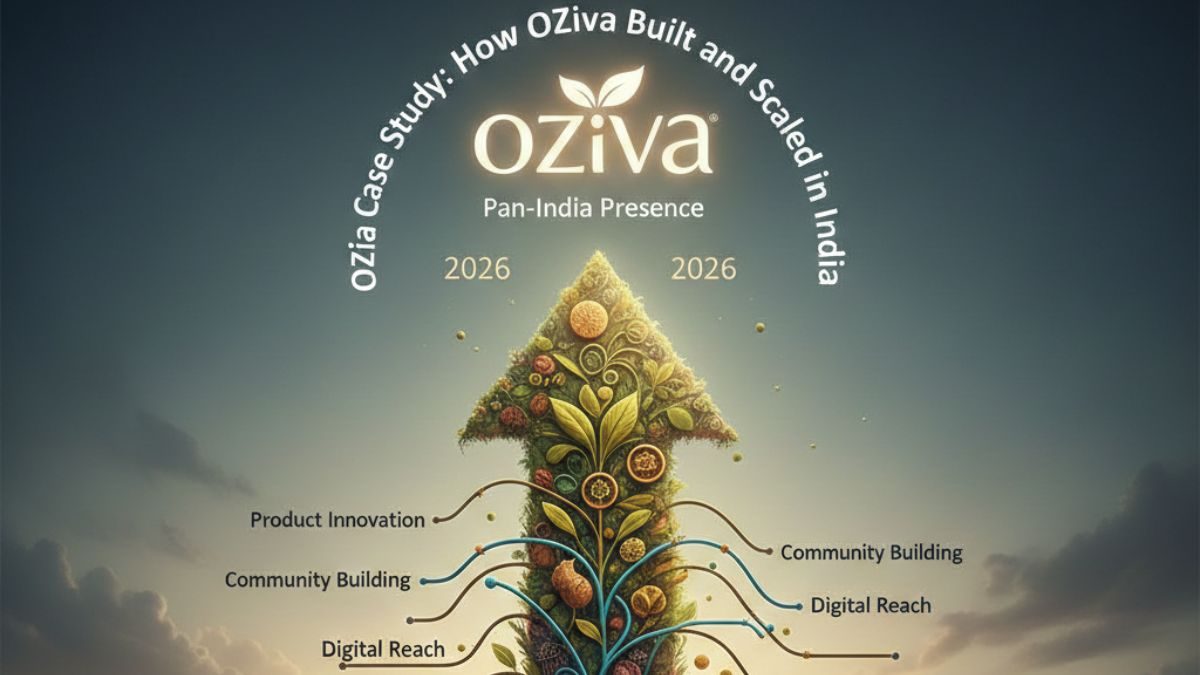
OZiva began as a quiet challenger in India’s cluttered nutrition market, but its rise from a small Mumbai-based venture to one of the country’s most recognisable clean nutrition brands reflects a significant shift in how Indians think about health. This OZiva Case Study traces that entire journey. The company was founded in 2016 by Aarti Gill and Mihir Gadani, two entrepreneurs who believed that nutrition in India needed a reset. They built OZiva with a clear idea: most people wanted to improve their health but didn’t know where to begin, and the information available was confusing, contradictory, or simply too generic to be useful.
The startup provides plant-based supplements and clean nutrition products designed for everyday wellness, fitness, and beauty needs. From women’s health blends to vegan proteins and men’s wellness offerings, the brand positioned itself early around safety, credibility, and ingredient transparency. Headquartered in Mumbai, OZiva launched commercially in 2016 with a direct-to-consumer model that relied heavily on digital discovery. Its product development approach blends nutrition science with herbal and plant-based ingredients, while its business model revolves around online sales, communities, and content-led engagement. As of the latest publicly available data, OZiva has raised funding across several rounds including investments from Matrix Partners India, Titan Capital, Eight Roads Ventures, F-Prime Capital, and most recently an acquisition-driven investment from Hindustan Unilever Limited (HUL), which now holds a 51 percent stake.
The company works by deeply integrating nutrition advice into the buying experience. It began with personalised diet consultations, followed by curated product recommendations and lifestyle plans. This combination of digital assessments and clean-label products helped OZiva stand out at a time when most supplement brands sold generic powders without guidance. Over time, the brand expanded into wider categories like hair, skin, hormonal balance, and holistic fitness. The result is a consumer brand built not only on product sales but also on trust, habit formation, and an evolving ecosystem of nutrition-led wellness. This case study explores how OZiva grew, the challenges it faced, the strategies that shaped its identity, and the turning points that defined its journey in India’s fast-growing D2C nutrition market.
1. The Origin Story of OZiva
The story of OZiva begins long before its incorporation. It traces back to the personal experiences of co-founder Aarti Gill, who grew up in a household where health was important but not always well understood. In interviews, she has often recalled how people around her made decisions about food and fitness based on hearsay rather than facts. After studying engineering and later pursuing management education, she became increasingly interested in preventive health. She noticed that despite rising awareness, the country lacked accessible, science-backed nutrition solutions tailored to Indian lifestyles.
Her early work experience exposed her to behaviour change patterns in urban consumers. She realised people weren’t struggling because they lacked motivation. They struggled because they lacked structured guidance. This insight stayed with her and eventually became the foundation for OZiva. When she met co-founder Mihir Gadani, who brought experience in product development and technology, the partnership clicked. Both felt the Indian market was ready for a new category of clean, plant-based nutrition, something that could compete with global standards while still resonating with local needs.
2. Early Sparks and Founding Motivation
OZiva’s founding motivation came from a simple but pressing question: why was nutrition still treated as an afterthought in a country facing rising lifestyle diseases? The founders believed that if nutrition was made simpler, more transparent, and more personalised, people would adopt healthier habits more consistently. In one interview, Gill mentioned that the idea was never just to sell products. It was to help people transform how they approached health.
The earliest version of OZiva was not a product catalogue but a wellness platform. The founders started with personalised coaching and nutrition consultation, observing recurring patterns. Many users wanted to build muscle or manage weight, but the market’s mainstream supplements were either confusing, heavily processed, or poorly explained. There was a trust gap. People wanted clean ingredients and clarity about what they were consuming. That insight led the founders toward plant-based formulations, a segment that was almost nonexistent in India at the time.
Gadani’s role was equally crucial. With his understanding of technology, he helped build the platform that powered personalised assessments and guided users through their health goals. For a young brand with limited capital, this tech-enabled approach created differentiation without requiring massive upfront investment. The founders began experimenting with product prototypes, working with nutritionists and experts to create early formulations. They wanted products that were simple, transparent, and safe enough for long-term use.
The early years were challenging. Convincing manufacturers to work on small production runs, navigating regulatory requirements, and creating awareness around plant-based supplements required persistence. But traction came from unexpected places. Fitness enthusiasts on social media began discovering the brand. People who struggled with hormonal imbalances or nutritional deficiencies found value in the personalised plans. As word spread, OZiva began building a community of loyal customers who saw genuine results.
3. The Moment of Validation
Every young startup needs a moment that signals it’s on the right track. For OZiva, that moment arrived when its early protein products began gaining traction among women, a segment often overlooked by supplement brands. Women were seeking clean, non-synthetic options and appreciated OZiva’s focus on ingredients, lifestyle guidance, and transparency. This became a turning point. The founders realised they weren’t just building a nutrition brand—they were addressing a structural gap in the health and wellness market.
OZiva leaned into this insight. It expanded its product portfolio with women’s health formulations, targeting needs such as hormonal balance, skin health, and overall wellness. At a time when most competitors talked to men or fitness professionals, OZiva consciously positioned itself for a broader, more diverse demographic. This differentiated the brand early and shaped its evolution.
4. Building the First Line of Products
Product development for OZiva wasn’t rushed. The founders spent months refining formulations, ensuring each ingredient had both scientific backing and traditional relevance. They collaborated with experts in nutrition, Ayurveda, and food technology. Many of the brand’s first reviews came from customers who appreciated that the products didn’t feel synthetic or chemical-heavy.
One of OZiva’s early strengths was the ability to communicate complex nutritional concepts in simple language. The team created educational content explaining benefits, ingredient sourcing, and usage guidance. This clarity built trust, especially among first-time supplement users. It also allowed the brand to operate in a category where skepticism was high and informed decision-making was essential.
5. The Role of Community in Early Growth
Long before community-building became a standard D2C playbook, OZiva invested in it. The founders knew that people needed reassurance, reminders, and encouragement to stay consistent with health goals. They created digital groups, offered free consultations, and ran challenges to keep customers engaged. This created what many D2C brands later tried to replicate: a habit-driven ecosystem. Customers didn’t buy a product and disappear. They returned for advice, shared progress updates, and eventually became advocates. This organic community was one of OZiva’s strongest early advantages and helped the brand scale without relying solely on paid marketing.
6. The Evolution of OZiva’s Product Philosophy
As OZiva gained its early users, the founders realised the company needed a product philosophy that could stand the test of time. The Indian nutrition market was shifting fast, with new D2C brands entering every few months. Many leaned heavily on marketing-driven strategies, but Gill and Gadani believed product integrity would be the company’s long-term differentiator. In interviews, Gill has often said that people trust brands that respect their intelligence. This shaped how OZiva approached product development after its initial traction.
The brand strengthened its research and development processes, investing in formulation testing and ingredient validation. It began working with herbal and plant-based nutraceuticals that could be traced back to reliable sources. The team expanded its internal expertise, bringing in specialists from nutrition science, biochemistry, and quality control. Every new product had to pass a rigorous internal screening process that balanced Indian dietary habits with global nutrition standards.
The founders also noticed that customers wanted solutions, not isolated products. For instance, someone dealing with hair fall wasn’t only looking for a supplement. They wanted guidance on diet, stress, sleep, and hormonal balance. This led to OZiva’s more holistic product ecosystem where each category—beauty, fitness, wellness—came with supportive content and often personalised recommendations.
As the brand grew, it added blends for skin, ageing, immunity, digestion, and women’s hormonal health. The company leaned on clean-label positioning, a space that was still underdeveloped in India. Clean-label products avoided unnecessary additives and synthetics, and OZiva made that a core principle. This helped reinforce the perception that the brand was safer and more transparent than many legacy supplement companies.
7. When Early Traction Turned Into Meaningful Market Demand
OZiva started seeing real momentum around 2017 and 2018. Digital fitness communities were exploding, and social platforms were filled with users looking for advice on healthier living. The founders tapped into this cultural shift with two strategic decisions: investing in content and amplifying trust.
Content played a central role. The brand began producing videos, short explainers, and lifestyle guides that broke down complex health topics. This helped demystify plant-based nutrition, an area that was still unfamiliar to many Indians. Customers weren’t just buying products; they were learning how to change their habits. Trust was the second pillar. OZiva introduced certifications, third-party lab tests, and transparent sourcing details. Customers could track ingredients and understand why certain herbal extracts or plant compounds were used. This level of disclosure was rare in the category.
Orders rose steadily. The brand noticed that its biggest traction did not come from metropolitan fitness enthusiasts alone. Tier-2 and tier-3 cities were driving significant traffic. Many were first-time supplement buyers looking for reliable, easy-to-use options. OZiva’s clear, educational approach resonated with them. In interviews, Gadani has mentioned that the company wasn’t trying to chase viral growth. It focused on building a strong repeat-customer base. Over time, this strategy proved to be its strongest asset. Retention remained high because customers saw results and felt guided throughout their journey.
8. The Business Model That Took Shape
By the time OZiva reached steady traction, the founders understood that they were building more than a D2C brand. Their business model blended community, guidance, and product sales into a single ecosystem.
The primary revenue model came from direct product sales through the brand’s website and marketplaces. But what differentiated OZiva was its layered structure:
- A digital platform that assessed customer health goals
- Personalised plans as part of the buying experience
- A large content ecosystem that educated customers
- Nutritionists and advisors offering free guidance
- A strong product lineup designed for long-term use
This made the brand more resilient than younger D2C startups that relied only on paid acquisition. For OZiva, the community generated organic discovery and word-of-mouth. Its Facebook groups, consultation sessions, and online challenges strengthened user loyalty.
The founders realised that nutrition is a high-retention category when solved correctly. As a result, they doubled down on habit formation. Instead of pushing one-time purchases, they encouraged customers to follow a guided routine. This approach allowed the company to keep customer acquisition costs manageable while improving lifetime value. Many of its early loyal customers have stayed with the brand for years, even as competition intensified.
9. A Digital-First Go-to-Market Strategy
OZiva entered the market at a time when D2C wasn’t yet mainstream, and this shaped its go-to-market strategy in unique ways. The brand couldn’t rely on large offline distribution networks, so it focused on digital channels. Its website served as the primary sales engine in the early phase. This allowed the brand to maintain control over the customer experience, gather feedback, and test new offerings quickly. Social media discovery was another major part of the funnel. Instead of influencer-heavy campaigns, OZiva focused on educational content, relatable storytelling, and practical tips.
The company also leveraged early partnerships with fitness coaches and wellness influencers. These weren’t celebrity-driven endorsements but collaborations with people who worked directly with consumers. Their credibility helped spread awareness in small but meaningful circles.
Marketplaces like Amazon and Flipkart became additional revenue streams once the brand had enough traction. Rather than treating marketplaces as primary channels, the founders used them for visibility and customer acquisition. OZiva retained its strongest engagement on its own website, where customers could access consultations and guided plans. This mix of channels—direct website sales, marketplaces, and organic content—allowed the brand to scale sustainably without relying heavily on expensive mass advertising.
10. The First Wave of Funding and What It Enabled
OZiva operated on a lean budget in its early years. The founders focused on product-market fit and used revenue to fund growth. But by 2019, the company reached a stage where deeper investments were necessary. Demand was rising, product lines were expanding, and regulatory requirements needed more dedicated resources. The brand secured its Series A funding with participation from Matrix Partners India and Titan Capital. The investment helped strengthen three core areas: supply chain capability, R&D expansion, and brand building.
Supply chain improvements were crucial. With rising order volumes, OZiva needed better production capacity and quality control infrastructure. Funding allowed it to streamline sourcing, improve manufacturing partnerships, and ensure consistency across batches.
R&D investment allowed the team to explore new formulations and refine existing ones. This eventually paved the way for OZiva’s broader categories in beauty, hormonal wellness, immunity, and stress management. Brand building became the third strategic pillar. While OZiva had relied mostly on organic traction until then, funding allowed it to scale its digital marketing efforts. The brand also began shaping stronger messaging around clean nutrition, ingredient purity, and modern wellness. This positioned OZiva as a credible alternative to global brands that Indian consumers had historically trusted.
11. A Turning Point: The Rising Demand for Women’s Health Solutions
One of the most defining moments for OZiva came when the founders realised how strong the demand for women’s health products was. Most supplement brands marketed aggressively toward men and performance-focused athletes. Women’s health was an underexplored category, despite being a large and growing market. OZiva’s early products for skin, PCOS, hormonal balance, and energy support found strong traction among women in both metro and non-metro cities. Conversations on social media revealed a deeper reality: women were looking for clear, non-clinical information about their health. Many faced stigma or confusion around hormonal issues, fertility, or nutrition gaps.
This insight shaped OZiva’s brand identity. The company leaned into women-centric content, created targeted formulations, and worked with specialists to refine blends. This move differentiated it from competitors and opened a large category that was underserved in India. Gill became the face of this positioning. Her interviews and public conversations resonated with young women who saw her as relatable and trustworthy. It reinforced the idea that OZiva wasn’t just a brand selling products—it was a company trying to build a healthier and more informed community.
12. How OZiva Shaped Its Brand Positioning in a Crowded Category
By the time OZiva crossed its early growth curve, India’s nutrition landscape had started shifting. New D2C brands were entering the market, gyms were expanding, and consumers were getting exposed to global wellness trends through social media. The supplement aisle, once dominated by imported powders and generic domestic blends, was becoming competitive. This forced OZiva to sharpen its brand identity. The founders understood that their advantage lay in trust. They didn’t want OZiva to become just another protein provider or wellness label. They wanted to anchor the brand in the clean nutrition movement. This meant the company had to stand for transparency, plant-based formulations, scientific validation, and responsible communication. The team made these principles part of every product story.
A critical moment in this evolution came when the founders realised customers were overwhelmed by misinformation. The wellness world was full of contradictory advice, celebrity fads, and oversimplified hacks. OZiva made the deliberate choice to keep its communication calm, factual, and educational. Instead of fear-driven messaging, it explained the science behind ingredients, the role of nutrition in the body, and the importance of sustained habits. This approach built a distinct personality for the brand. It felt modern but rooted in tradition, scientific but accessible. Many Indian consumers, especially women, found comfort in a brand that didn’t lecture them but guided them. Over time, this identity helped OZiva become one of the most recognisable clean nutrition brands in the country.
13. How Content Became the Heart of the Brand
OZiva’s rise cannot be understood without examining its content engine. Years before content marketing became a standard D2C playbook, the brand was already writing blogs, recording podcasts, and making educational videos. The team covered everything from vitamin deficiencies to PCOS myths to the science of plant proteins. The founders saw content as a service, not a sales tactic. They wanted people to make informed choices, even if they didn’t buy an OZiva product immediately. This patience paid off. Users who first encountered the brand through an article or a video often returned months later to buy a supplement or join a wellness program.
Verified founder interviews show that this long-term mindset was intentional. Gill often said that trust cannot be built with discounts or aggressive marketing. It is built through consistency. The company invested in nutrition coaches, wellness advisors, and knowledgeable content creators to ensure that information was accurate and approachable. This strategy also helped OZiva stand out from competitors who relied primarily on influencer-heavy promotions. While influencers played a role, they weren’t the core engine. The strongest driver was the brand’s own educational ecosystem, which shaped consumer perception and created lasting loyalty.
14. Marketing Strategy That Blended Authenticity and Data
OZiva’s marketing strategy evolved as the brand scaled. In the early years, the team focused on targeted social media discovery, relying heavily on Facebook and Instagram communities. Over time, the company expanded its approach with performance marketing, marketplace optimisation, and influencer partnerships.
What differentiated OZiva was not the channels but the philosophy behind them. The founders avoided broad, splashy campaigns. They preferred smaller, authentic stories told by people who used the products themselves. Many influencers were nutritionists, fitness coaches, or wellness bloggers who resonated with audiences seeking practical guidance. The brand also understood the power of data. Every purchase on the website generated insights about user goals, pain points, and behaviour patterns. The team used these insights to refine product recommendations, improve customer service, and optimise marketing spend. Repeat users received more personalised communication. New customers encountered guided assessment tools that helped them choose the right products.
Marketplace marketing played a supporting role. OZiva optimised product listings carefully, using storytelling and ingredient transparency to stand out in categories crowded with mass-produced supplements. Reviews and user-generated content reinforced its credibility. Throughout these phases, the brand avoided loud, unrealistic promises. It framed wellness as a journey. This made the marketing feel more human and less transactional, aligning perfectly with the brand’s identity.
15. Competing in India’s Fast-Growing Nutrition Market
By 2019 and 2020, the number of nutrition brands in India had multiplied. Global players were expanding aggressively, gyms were selling private-label supplements, and domestic D2C startups were raising significant capital. OZiva differentiated itself in three ways. First, it built a product ecosystem instead of isolated SKUs. A customer dealing with skin concerns, for instance, could find a supplement, a detailed guide, and nutrition advice under one roof. Competitors that focused only on product sales couldn’t match this depth of engagement.
Second, the brand leaned on clean-label positioning. Many supplements in the Indian market still used artificial flavours, fillers, and synthetic compounds. OZiva avoided these and highlighted plant-based ingredients instead. This appealed strongly to younger consumers and those looking for safer long-term options.
Third, it built a strong trust narrative. Certifications, transparent sourcing, and expert-backed formulations positioned OZiva as a credible choice. At a time when misinformation was rampant, this emphasis on verification helped the brand rise above noise. The company also navigated competition by expanding its categories steadily. Instead of trying to dominate a single vertical, it gradually built offerings for fitness, beauty, immunity, digestion, and women’s hormonal health. This diversification helped sustain its relevance and reduced dependence on any one product line.
16. Operational Challenges and How OZiva Navigated Them
Behind the brand’s clean and calm public identity, OZiva faced several operational challenges. The early years were tough because manufacturers weren’t always willing to work with small-volume startups. Convincing them required persistence and a willingness to accept slower growth in exchange for high standards.
Scaling production brought its own complexities. As order volumes grew, maintaining consistency became crucial. The company invested in tighter quality control, standardised formulations, and improved supplier relationships. These steps increased operational costs, but they also ensured that the brand could withstand scrutiny as it became more visible. Regulatory compliance was another challenge. India’s nutraceutical sector is governed by detailed guidelines under the Food Safety and Standards Authority of India (FSSAI). As the brand expanded into more categories, compliance requirements multiplied. OZiva strengthened its internal processes to ensure every batch met regulatory expectations.
Inventory and logistics presented additional hurdles. The brand was selling across India through both direct and marketplace channels. Ensuring timely deliveries, reducing stockouts, and managing returns became key priorities. The founders invested in technology-led solutions to optimise inventory and fulfilment. These operational improvements helped the brand prepare for larger milestones in the years ahead, including significant funding events and a strategic corporate partnership.
17. Funding Milestones and the HUL Turning Point
The first few rounds of funding helped OZiva build a solid operational foundation. But one of the most defining milestones in the brand’s journey came with its Series B round. In 2021, the company raised a substantial investment led by Eight Roads Ventures, with participation from F-Prime Capital and Matrix Partners India. This infusion allowed OZiva to deepen its R&D pipeline and strengthen its presence in retail and digital channels. The founders expanded the team, added specialists in nutrition and product development, and invested in new technology features for its digital platform.
The growth from these investments caught the attention of large consumer goods companies. In late 2022, Hindustan Unilever Limited (HUL) acquired a 51 percent stake in OZiva, marking one of the most significant deals in India’s D2C wellness space. The acquisition signalled two trends. First, clean-label nutrition had become mainstream enough to attract legacy FMCG giants. Second, OZiva’s product philosophy and brand identity had proved durable enough to integrate with a large-scale corporation.
HUL’s involvement gave OZiva access to deeper distribution networks, stronger supply chain capabilities, and enhanced regulatory expertise. For the founders, it represented a chance to scale without compromising product integrity. Public statements from both companies highlighted a shared vision of strengthening India’s preventive health ecosystem. This acquisition didn’t mean the end of OZiva’s startup journey. Instead, it opened a new chapter where the brand could leverage both startup agility and corporate scale. The company continued operating independently while benefiting from HUL’s wider organisational support.
18. Scaling a Startup After a Landmark Corporate Partnership
The acquisition by Hindustan Unilever Limited marked a significant shift in OZiva’s growth trajectory. After years of operating as a lean D2C-led startup, the brand now found itself backed by one of India’s most influential consumer goods companies. The founders suddenly had access to infrastructure, expertise, and distribution networks they could not have built on their own. But with this access came a complex challenge: how to scale without losing the authenticity that made the brand successful in the first place.
OZiva handled this transition carefully. The founder leadership remained in place, and the brand continued operating independently. HUL did not rewrite OZiva’s playbook. Instead, it provided support in areas like compliance, quality control, manufacturing, and offline distribution. The partnership also accelerated product testing and market research timelines. This helped OZiva bring new formulations to market faster and with higher precision. The company used this period to refine its internal processes. It strengthened its supply chain end-to-end, working with better-equipped manufacturing partners, improving ingredient sourcing, and tightening documentation. These adjustments aligned OZiva with corporate-level expectations while retaining startup flexibility.
Gill and Gadani’s biggest priority during this phase was preserving the trust the brand had earned. They reiterated in interviews that the company would continue to operate with clean-label principles. This reassurance mattered. Customers often worry when independent brands get acquired, fearing shifts in quality or philosophy. OZiva avoided that concern by maintaining transparency and reinforcing its science-backed narrative. The post-acquisition years also allowed the company to pursue long-term projects that earlier required significant capital. This included deeper research into botanicals, more robust clinical testing, and exploring new product verticals related to preventive wellness and longevity.
19. Building a Team for Scale
Scaling a brand is not just about funding or distribution. It requires a leadership mindset capable of sustaining culture, consistency, and operational discipline. Over the years, OZiva built a team that blended domain expertise with startup adaptability. The company’s early team was small and multi-functional. People moved across roles, learned as they went, and contributed to parts of the business outside their formal designations. As the company grew, roles became more specialised. Nutritionists focused on consultations and content accuracy. Product managers worked with experts during formulation stages. Operations teams managed manufacturing and logistics. Marketing staff developed campaigns rooted in trust and education.
One of the leadership challenges was keeping the team aligned with the brand’s mission. In wellness, the messaging must be careful, factual, and sensitive. The founders made a conscious effort to hire people who shared the company’s philosophy, especially in content and nutrition roles. Misinformation is common in the wellness industry, and OZiva actively tried to avoid contributing to it.
Internal training became part of the culture. The team attended sessions on nutrition science, ingredient benefits, and customer behaviour trends. This helped maintain message consistency across the company’s communication channels. As HUL came on board, OZiva gained access to a wider talent pool and advanced operational processes. But the founders ensured that the company retained an entrepreneurial culture. Team members were encouraged to experiment, propose new ideas, and solve problems quickly. Maintaining this balance—startup agility with corporate structure—is one of OZiva’s more notable achievements.
20. How Technology Quietly Powered OZiva’s Growth
Although OZiva became widely known as a nutrition brand, technology played a central role in its evolution. From the early days of personalised assessments to the later stages of customer lifecycle management, data and digital tools shaped how the company operated. The first version of OZiva’s digital platform was built to simplify consultations. Users could enter their goals, dietary habits, and lifestyle details. The system, combined with nutritionist input, generated personalised plans. This feature served as a strong differentiator when most supplement brands sold products without guidance.
As the business expanded, technology took on more roles. The team built tools for customer segmentation, behaviour tracking, and habit monitoring. They used analytics to understand which products worked well for different demographics, which content formats improved engagement, and which customer concerns were becoming more common. This data-driven approach influenced product development. If many customers reported energy issues despite balanced diets, the team explored adaptogens and herbal solutions. If skin health conversations increased, the company built blends targeting collagen, hydration, or antioxidant needs. User behaviour became a real-time research engine.
Technology also helped streamline operations. Inventory systems improved demand forecasting, reducing stockouts. Fulfilment processes became faster and more predictable. Customer support tools allowed nutritionists to handle more queries without compromising quality. Even after the HUL acquisition, OZiva maintained its digital-first mindset. While the brand expanded in retail stores, the direct-to-consumer ecosystem remained central. The digital platform still plays a key role in retention, community engagement, and personalised communication.
21. Supply-Chain Decisions That Enabled Consistency
In the nutraceutical category, supply chain management can make or break a brand. The quality of raw materials, consistency of formulations, and hygiene standards of manufacturing partners shape how customers experience the product. OZiva faced these challenges early.
In the early years, manufacturing partners were hesitant to do small runs for a new brand. The founders had to persuade them with detailed formulations, third-party testing commitments, and a vision of long-term growth. Once traction became evident, production partnerships strengthened. Ingredient sourcing was another careful process. The company worked with suppliers who offered traceability, ensuring that plant-based compounds were sourced ethically and tested for purity. Since many herbal extracts can vary in potency depending on geography and crop cycles, OZiva invested in standardised ingredient protocols.
As product categories expanded, the supply chain needed to scale. The company improved batching procedures, implemented stricter quality audits, and collaborated closely with labs for testing. This ensured that the brand could meet higher demand without compromising standards. The HUL acquisition improved the supply chain significantly. With access to one of India’s strongest FMCG infrastructures, OZiva could operate at much larger volumes. It also benefited from advanced quality control systems and regulatory expertise. This strengthened the brand’s ability to introduce new categories with confidence.
22. Navigating Legal and Regulatory Requirements
The nutraceutical sector in India requires careful navigation of guidelines set by the Food Safety and Standards Authority of India (FSSAI). Compliance involves not only ingredient approvals but also labelling, claims, dosage guidelines, and testing protocols. For a young startup, this can be daunting. OZiva invested early in regulatory compliance. It worked closely with experts to ensure that every product met FSSAI requirements and avoided unverified claims. This conservative approach earned the brand credibility.
As the company introduced more specialised products—especially in women’s health—it had to be even more careful. Hormonal health supplements attract scrutiny because claims must be backed by credible research. The brand leaned heavily on ingredient studies, third-party certifications, and verified scientific literature. The partnership with HUL strengthened regulatory capabilities further. HUL’s compliance infrastructure ensured that OZiva could meet more stringent standards, including international guidelines. This allowed the company to address a broader audience, especially customers who compared Indian nutraceutical brands with global ones.
2.22 Revenue Trends and Milestones
Publicly available filings show that OZiva’s revenue grew steadily in the years following its Series A and B rounds. The brand gained traction across categories such as plant-based proteins, women’s wellness blends, and skin supplements. Revenue spikes often followed the launch of new product lines or major marketing campaigns. After the HUL acquisition, revenue growth was more moderate in FY24 as the brand adjusted to integration processes. But by FY25, the company reported strong improvements in operating revenue and a significant reduction in losses. This suggested that the integration was stabilising and that the brand was positioned for renewed scale.
The key drivers of revenue included repeat customers, wider product adoption, and increased retail presence. While the brand’s website remained its strongest channel for engagement, marketplaces contributed meaningfully to scale. Offline retail began to grow after HUL’s involvement, giving OZiva access to neighbourhood stores and pharmacies. Revenue trends also reflected the rising interest in preventive health and clean nutrition. As more Indians sought alternatives to synthetic supplements, plant-based brands like OZiva found themselves well positioned.
23. OZiva’s Current Status
Today, OZiva operates as a hybrid brand—part startup, part corporate-backed consumer label. Its product ecosystem spans fitness, beauty, women’s health, digestion, and immunity. The company continues to introduce new formulations, often combining modern nutrition science with botanical ingredients. The brand maintains a strong digital presence through content, consultation, and community programs. Its educational DNA remains intact, even as it expands into wider offline channels. The founders continue to guide the brand, ensuring that its early philosophy—trust, clean ingredients, scientific grounding—remains central.
While competition has intensified, OZiva retains a strong identity built over years of careful positioning. Its partnership with HUL has given it the stability and infrastructure needed to scale at a national level, without abandoning the roots that made it a leading clean nutrition brand in India.
24. Competitive Threats in a Crowded Wellness Market
As the nutrition and wellness sector grew in India, OZiva faced increasing competition from both established FMCG brands and emerging D2C players. What started as a largely untapped space in 2016 quickly became one of the most contested categories. On the D2C side, brands like Plix, Kapiva, and Wellbeing Nutrition gained momentum by adopting similar strategies: plant-based formulations, modern branding, and influencer-led communication. Some went deeper into niche categories like effervescents, gummies, or Ayurveda-centric solutions.
Meanwhile, multinational companies introduced their own versions of clean-label supplements. Pharmacies also expanded private-label offerings, often priced lower than premium D2C brands. The landscape became crowded enough that differentiation was no longer based merely on product categories. It shifted to credibility, scientific validation, and customer experience.
OZiva’s response to competition has been strategic rather than reactive. The company continues to invest heavily in nutrition science, clinical backing, and branded education. Its emphasis on transparency and community programs helps retain long-term users. The brand also benefits from HUL’s reach, especially in retail visibility and supply chain reliability. The company’s biggest moat remains its early mover advantage in modern plant-based nutrition and its strong foundation in storytelling. Rather than competing on discounts or aggressive product launches, OZiva focuses on trust, lifestyle integration, and consistency.
25. Customer Behaviour Shifts Shaping OZiva’s Strategy
India’s health and wellness behaviour has evolved dramatically over the last decade. Customers are more informed, willing to try plant-based ingredients, and more open to long-term preventive habits. But they are also more skeptical. They question labeling, demand transparency, and want brands to prove the claims they make. This shift has forced players to communicate more clearly. Customers now read ingredient lists, compare scientific references, and check online reviews before they purchase. They expect brands to offer context, guidance, and accountability.
OZiva adapted well to this behaviour shift. Its entire communication strategy is built around simplifying information rather than exaggerating outcomes. The brand breaks down complex topics—like hormonal balance, gut health, or micronutrient deficiencies—into relatable explanations. Its consultations reinforce customer confidence by answering real questions instead of pushing products.
Another behavioural shift is the rise of habit-oriented consumption. Customers want long-term solutions rather than quick fixes. Subscriptions, personalised plans, and follow-up support help capture this trend. OZiva’s digital-first approach, especially with personalised assessments and email journeys, aligns well with this behaviour. The brand also leveraged the rise of content-driven discovery. With wellness topics gaining traction on Instagram, YouTube, and podcasts, OZiva could reach people who were not actively searching for supplements but were open to lifestyle improvements. This content ecosystem continues to feed its funnel.
26. How HUL Benefits from the OZiva Partnership
From HUL’s perspective, the acquisition of OZiva was strategic. The company recognised a clear shift toward preventive health, clean-label nutrition, and online wellness brands. Rather than building a new division from scratch, HUL chose to acquire a consumer-loved brand with strong recall and established credibility. OZiva helps HUL tap into a younger, more health-conscious demographic. It also gives the FMCG leader access to an agile digital-first team—a capability that large corporations often struggle to replicate internally.
HUL benefits from OZiva in several ways:
- Portfolio Expansion: Supplements and nutraceuticals diversify HUL’s product categories beyond traditional FMCG items.
- Digital Expertise: OZiva’s strong D2C play adds depth to HUL’s digital ecosystem.
- Future-Proofing: As consumers shift from reactive healthcare to preventive wellness, HUL gains from early positioning.
- Research Leverage: Combining corporate research infrastructure with startup agility allows faster market experimentation.
For OZiva, HUL offers stability, compliance expertise, and distribution scale. For HUL, OZiva represents relevance in a fast-changing landscape. The partnership is symbiotic.
27. Where OZiva Stands in the Indian D2C Landscape Today
OZiva remains one of the most recognisable names in India’s D2C health and wellness category. While many brands have entered the space, few have maintained consistent recall or customer trust for as long. The brand’s positioning—clean, plant-based, science-backed, and woman-founder-led—gives it a distinct identity. Its integration with HUL provides a strong backbone without diluting its startup persona.
In the broader D2C ecosystem, OZiva stands out because:
- It built brand equity before the D2C boom became mainstream.
- Its value proposition aligns with long-term lifestyle behaviour.
- It did not chase unsustainable discount-driven growth.
- It avoided over-expansion into too many experimental categories.
- It maintained authenticity even while scaling marketing.
As consolidation increases and only the strongest wellness brands survive, OZiva is well positioned. Its combination of trust, science, and scale gives it resilience that new entrants often lack.
28. Long-Term Vision and Future Outlook
OZiva’s future direction revolves around deeper credibility, wider access, and more personalised wellness. The brand has signaled interest in expanding research-driven product lines, especially those focusing on women’s health, longevity, and holistic lifestyle support. Personalised nutrition remains a promising frontier. With advancements in metabolic health tracking, hormone testing, and gut diagnostics, the company can build more tailored programs that combine supplements with structured guidance. International expansion is another potential path. With clean-label certification and HUL’s regulatory expertise, the brand could target markets where Indian botanicals and plant-based solutions already have demand.
OZiva’s long-term success will depend on its ability to keep innovating while preserving trust. The brand’s early decisions—transparent labeling, credible ingredients, and consistent messaging—serve as strong foundations. If it can maintain this ethos while expanding its scientific and digital depth, OZiva can continue to shape the future of preventive wellness in India.
29. Final Thoughts
OZiva’s journey is a study in clarity, timing, and disciplined execution. It began when clean nutrition was not yet popular and grew during a period when consumer behaviour shifted dramatically. The founders built a brand by listening to customers, communicating transparently, and staying patient with growth. The HUL acquisition was not just a milestone. It validated the category. It showed that preventive wellness, once seen as a niche D2C trend, had become central to how Indians think about their health. OZiva today is more than a supplement brand. It’s an ecosystem built on education, personalised support, and scientific grounding. Its future depends on how well it balances agility with scale, but its foundation is solid.
About foundlanes.com
foundlanes.com is India’s leading startup idea and deep-dive platform built for founders, operators, and serious entrepreneurs. We go beyond surface-level advice to deliver grounded, research-backed, and experience-driven startup content.
Every guide on foundlanes.com is designed to help readers think clearly, act strategically, and build sustainably. This cloud kitchen startup guide is part of our mission to document real business pathways in India’s evolving startup ecosystem.