


Introduction
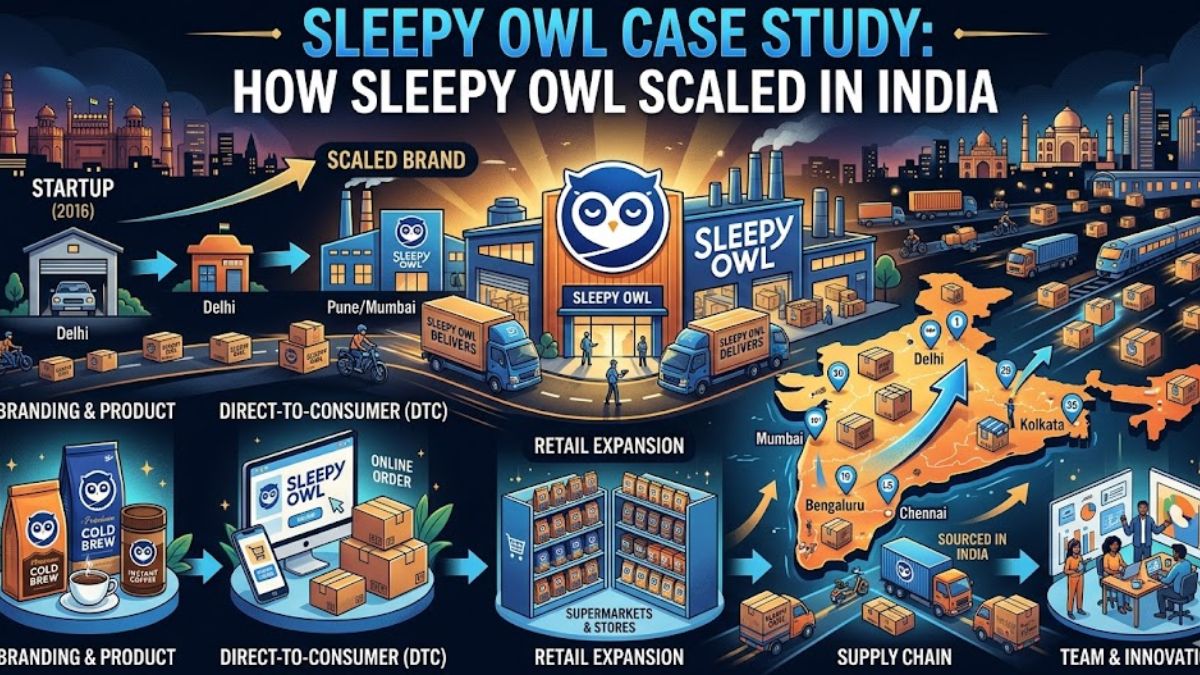
Sleepy Owl Case Study captures the rise of one of India’s most recognizable direct-to-consumer coffee brands that transformed how urban consumers experience coffee at home. Founded in 2016, Sleepy Owl is a packaged beverage startup focused on making high-quality cold brew coffee accessible, convenient, and consistent for Indian consumers. The company entered the market at a time when coffee consumption was growing but remained fragmented between instant coffee and premium café chains. The startup was founded by Ashwajeet Singh, Arman Sood, and Ajai Thandi, who identified a gap between expensive café experiences and low-quality instant coffee options. Based in New Delhi, Sleepy Owl aimed to bridge this gap by offering ready-to-drink cold brew coffee that could be consumed anywhere, without the need for brewing equipment or barista skills.
Sleepy Owl operates through a D2C-first model, selling its products via its website, marketplaces, and retail stores. Its product line includes cold brew bottles, hot brew coffee bags, instant coffee, and ready-to-drink coffee cans. The company focuses on quality sourcing, modern packaging, and strong brand recall. Over the years, Sleepy Owl has raised funding from investors such as DSG Consumer Partners and Rukam Capital, among others, with publicly reported funding running into millions of dollars. It has expanded its presence across major Indian cities and entered modern retail and quick commerce platforms. This Sleepy Owl case study India explores how the brand built a strong identity in the crowded coffee startup India ecosystem, scaled its operations, and carved a niche in the growing ready to drink coffee India segment.
1. The Origin Story and Early Background
The story of Sleepy Owl begins with a simple consumer insight. Coffee in India was either too basic or too expensive. The founders experienced this gap firsthand. While traveling and studying abroad, they were exposed to cold brew coffee and specialty coffee culture. Returning to India, they realized that such options were largely unavailable in a convenient format.
They saw an opportunity to introduce cold brew coffee India consumers could enjoy without visiting cafés. This idea formed the foundation of the Sleepy Owl startup journey. Initially, the company started with a focus on bottled cold brew coffee. The concept was still new in India, and consumer awareness was limited. This meant the founders had to not only build a product but also educate the market.
2. Founder Journey, Motivation, and Early Struggles
The founders came from diverse professional backgrounds, but all shared a common interest in building a consumer brand. Their motivation stemmed from a desire to create a product that combined quality with convenience. They wanted to make premium coffee accessible beyond café environments. The early days were challenging. Building a packaged beverage startup in India involves complexities in sourcing, production, and distribution. Cold brew coffee requires precise brewing techniques and consistency.
Another challenge was convincing consumers to try something new. Cold brew coffee was not widely understood, and pricing it above instant coffee required strong value communication. The founders focused on small-batch production and direct customer feedback. This helped refine the product and build initial trust.
3. The Problem Sleepy Owl Identified
3.1 Fragmented Coffee Consumption in India
Before brands like Sleepy Owl entered the picture, India’s coffee culture felt uneven and almost split into two completely different worlds. On one side, there was instant coffee sitting quietly in most Indian homes. It was cheap, familiar, and easy. People used it not because they loved it, but because it was available, fast, and required no effort. It became a habit more than an experience.
On the other side, café culture was growing in cities. Chains and boutique cafés were offering high-quality coffee, better beans, better brewing, and a lifestyle experience around it. But this came with a cost. It wasn’t something people could casually enjoy every day at home. That gap in the middle was the real problem. There was no strong “in-between” option. Something that tasted good, felt premium, but didn’t require a café visit or expensive setup. This is where the opportunity quietly existed. Consumers were slowly becoming more aware of quality, but the market hadn’t fully caught up to that shift yet.
3.2 Lack of Ready-to-Drink Options
The ready to drink coffee India space was still in its early, messy phase. Whatever existed in the market often felt more like flavored sugar drinks than actual coffee. Most bottled or packaged options were overly sweet, heavily diluted, or inconsistent in taste. They were designed more for mass appeal than for coffee lovers who actually cared about flavor, aroma, and balance.
There was also a trust gap. People were unsure whether they were getting real coffee experience or just a beverage with coffee branding. What consumers really wanted was simple: something that felt like café-style coffee, but available instantly, without compromise. But the market wasn’t delivering that. So most people either stuck to instant coffee or waited for café visits, treating good coffee as an occasional luxury rather than a daily habit. That gap became even more visible as urban lifestyles got busier and people started expecting better quality even in everyday consumption.
3.3 Complexity of Brewing Good Coffee
Good coffee is not just about taste. It is about process. And that process itself became a barrier for most Indian consumers. Brewing quality coffee traditionally requires equipment like French presses, pour-over setups, grinders, and knowledge about ratios, water temperature, and brewing time. For someone just trying to get a good cup in the morning, it felt like too much effort.
Even when people tried, results were inconsistent. One day it tasted great, another day it felt off. That inconsistency slowly pushed many back to instant coffee simply because it was predictable. Sleepy Owl recognized something important here. The problem was not lack of interest. It was friction. People did not want to become coffee experts. They just wanted a reliable, good-tasting cup without thinking too much about it. That insight shaped the foundation of what the brand would eventually build.
4. Building the Product and Early Evolution
Sleepy Owl did not start with a broad catalog or complicated strategy. It started with a single, focused idea: cold brew coffee that people could actually enjoy at home without effort. Cold brew itself was a deliberate choice. Unlike traditional hot brewing, cold brew is made by steeping coffee grounds in cold water for hours. The result is smoother, less bitter, and naturally more balanced in taste. For many new coffee drinkers, this felt more approachable and less harsh compared to strong espresso-style drinks.
But building this product in a scalable, consistent way was not easy. The early days were filled with experimentation. Small batches were tested repeatedly. Coffee beans had to be sourced carefully because even slight variations changed the final taste. Brewing time, extraction levels, and storage conditions all had to be refined until the product felt stable and repeatable. Packaging became just as important as the coffee itself. Since the product was meant for convenience, it had to stay fresh, travel well, and feel premium without being complicated. The team spent a lot of effort ensuring that what reached the customer tasted exactly like what was intended in production.
4.1 In the beginning, feedback loops were very tight
In the beginning, feedback loops were very tight. Early customers were not just buyers, they were almost collaborators. Their responses directly influenced improvements in taste, sweetness levels, and packaging formats. As acceptance grew, something interesting started happening. Consumers who were earlier split between instant coffee and café visits began trying Sleepy Owl as a daily option. It wasn’t replacing cafés completely, but it was filling that missing “everyday premium” space.
This validation gave the brand confidence to expand beyond cold brew. Over time, Sleepy Owl gradually introduced hot brew bags, instant coffee, and ready-to-drink cans. Each new product was not just an addition, but a response to real usage patterns. Some people wanted convenience in the morning, others wanted portability, and some still preferred traditional brewing methods but with better quality. This evolution was less about chasing trends and more about listening to how people actually consumed coffee in real life.
5. Early Traction and Validation Phase
The early growth of Sleepy Owl was not loud or sudden. It was slow, steady, and very closely tied to real customer reactions. The brand started by focusing heavily on direct-to-consumer channels. Instead of waiting for retail shelves or large distribution networks, the founders chose to sell directly through online platforms. This decision changed everything in the early phase because it removed the middle layer between product and customer.
Every order became a feedback loop. Every review, complaint, or appreciation was read carefully and fed back into product improvement. That level of closeness with customers gave the brand something most early-stage FMCG companies struggle with, real-time clarity on what was working and what was not. The first wave of customers came mainly from urban millennials. These were people already exposed to café culture, international brands, and new food experiences. They were curious, slightly experimental, and open to trying something different from regular instant coffee.
5.1 What mattered most was not just purchase behavior
What mattered most was not just purchase behavior, but repeat behavior. Many of these early users came back again. That repeat purchase signal was the first real validation that Sleepy Owl was not just a novelty product, but something that could become part of daily routine. Word-of-mouth started building quietly. People were not just drinking the coffee, they were talking about it. Sharing it at home, recommending it to friends, and posting about it online. That organic loop became one of the strongest early growth engines.
Social media also played a surprisingly powerful role. The brand’s packaging was clean, modern, and visually distinct. It naturally fit into Instagram-style sharing culture. Without heavy advertising, Sleepy Owl started appearing in lifestyle posts, morning routines, and café-at-home setups. This phase confirmed something very important for the founders. The demand for cold brew coffee India consumers could trust was real. It was not a niche curiosity. It was a missing habit waiting to be built.
6. Sleepy Owl Case Study: Business Model and Revenue Approach
The Sleepy Owl business model was designed around one core belief: control the customer experience first, then scale distribution later. At its foundation, the company followed a direct-to-consumer first strategy. The website was not just a sales channel, but the primary place where the brand learned how customers thought, what they liked, and what they expected. This direct relationship helped reduce dependency on traditional retail in the early days.
Revenue came through multiple layers, but each was added carefully over time rather than all at once. The first layer was online direct sales through the brand’s own platform. This allowed higher margins and full control over pricing, packaging, and customer experience.
The second layer was marketplaces like Amazon and Flipkart. These platforms brought scale, but also introduced competition and pricing pressure. Still, they were important for visibility and discovery, especially for first-time buyers. The third layer was offline retail and modern trade. This was a major shift because it moved the brand from digital screens into physical shelves. It also changed how consumers interacted with the product. In retail, first impression matters more than storytelling, so packaging and shelf presence became critical.
Pricing strategy played a quiet but powerful role in positioning. Sleepy Owl deliberately avoided competing with instant coffee on price. At the same time, it stayed below café-level pricing. This middle zone became its strongest positioning advantage. It created a simple psychological equation for consumers. “Better than instant, but still affordable enough for everyday use.” That positioning helped the brand maintain healthier margins while still building mass appeal among middle-class urban consumers who wanted premium experiences without premium guilt.
7. Funding Journey and Investor Backing
The funding journey of Sleepy Owl reflected growing confidence in India’s changing coffee culture and the rise of D2C brands. Early investors like DSG Consumer Partners and Rukam Capital saw something important beyond just coffee. They saw a shift in consumption behavior, especially among younger consumers who were willing to pay more for better everyday products. This was not just capital infusion. It was validation at an ecosystem level.
The funds were used very strategically. A large portion went into improving production capabilities because maintaining consistency at scale is one of the hardest parts of the food and beverage industry. Small inconsistencies in taste or quality can quickly damage brand trust. Another major focus area was distribution expansion. As demand grew, the company needed to ensure that supply chains could actually support wider availability without breaking freshness or quality standards.
Marketing also became a key investment area, but it was not traditional advertising-heavy marketing. Instead, the brand leaned into storytelling, digital engagement, and lifestyle positioning. The idea was to make coffee feel personal again, not just functional. The Sleepy Owl funding and valuation journey also highlighted a broader trend. Investors were increasingly interested in D2C coffee brands India, not just for current revenue potential but for long-term lifestyle shifts in urban consumption patterns. Each funding round was less about survival and more about acceleration, moving from a promising niche brand to a scalable consumer company.
8. Go-to-Market Strategy and Distribution Channels
Sleepy Owl’s go-to-market strategy started with a simple but powerful decision: go digital first, learn fast, and expand carefully. In the beginning, the focus was entirely on online channels. This allowed the brand to control everything from messaging to delivery experience. More importantly, it allowed rapid experimentation. If something did not work, it could be changed quickly without waiting for retail cycles or distributor approvals.
This phase was all about learning real consumer behavior. When do people order coffee? What formats do they prefer? What price points feel acceptable? These insights shaped every future decision. As the brand gained traction, offline expansion became inevitable. But instead of rushing into every store, Sleepy Owl chose modern retail and curated placements. This ensured that the brand appeared in environments where consumers could understand and appreciate it, rather than being lost among mass-market products.
Supermarkets, premium grocery stores, and cafés became key touchpoints. Each offline placement acted like a physical advertisement, silently reinforcing brand legitimacy. Then came quick commerce platforms, which changed everything again. The ability to order coffee and receive it within minutes brought the product closer to impulse consumption. It reduced friction further and increased frequency of purchase. This multi-channel structure created a strong distribution flywheel. Online built awareness, offline built trust, and quick commerce built convenience. Together, they made Sleepy Owl accessible in almost every possible consumption scenario.
9. Brand Positioning and Messaging Evolution
From the beginning, Sleepy Owl was never trying to be just another coffee brand. It was trying to change how people think about coffee at home. The brand positioned itself as modern, simple, and deeply relatable. Instead of using overly technical coffee language, it spoke in everyday terms. This made it approachable for new coffee drinkers while still appealing to enthusiasts. The tone of communication was intentionally casual. It felt more like a friend recommending coffee than a company selling a product. This emotional softness helped build early trust, especially among younger audiences who were tired of overly formal branding.
Packaging became one of the strongest storytelling tools. Clean design, minimal clutter, and distinctive visuals made the products instantly recognizable. In many cases, the first interaction with the brand happened visually before taste even entered the equation. Over time, the messaging evolved. Initially, the focus was heavily on cold brew as a category creator. But as the product range expanded, the narrative shifted toward a complete coffee experience.
This meant positioning Sleepy Owl not as a single-product company, but as a daily coffee companion across different moods and moments. Morning coffee, work breaks, travel consumption, and casual home drinking all became part of the story. That evolution helped the brand move from being a niche cold brew experiment to a broader lifestyle coffee brand with multiple entry points into a consumer’s daily life.
10. Key Challenges, Failures, and Turning Points
For Sleepy Owl, growth never came in a straight line. It was messy, uncertain, and full of moments where the team had to stop and rethink everything they were building. One of the earliest and most persistent challenges was education. Cold brew coffee was still a new idea for most Indian consumers. Many people did not understand why coffee needed hours of brewing or why it tasted different from what they were used to. Some even confused it with cold coffee or flavored drinks. This created a real gap between product and perception. The team had to invest heavily in awareness, not just advertising. Content, storytelling, and simple explanations became just as important as the product itself. Every customer interaction carried an educational layer. It was slow work, but necessary for building trust.
Another major struggle was supply chain consistency. Coffee is sensitive. Small changes in beans, roasting, temperature, or storage can completely alter taste. Early on, maintaining that consistency across batches was difficult. There were moments when customer feedback reflected slight variations, and those signals were taken very seriously.
10.1 The founders quickly realized that in FMCG
The founders quickly realized that in FMCG, product inconsistency is not a small issue. It directly impacts brand trust. Fixing this required tightening vendor relationships, improving quality checks, and building more controlled production systems. A major turning point came when Sleepy Owl moved beyond a single-product identity. Initially, the brand was heavily associated with cold brew. While that helped in early positioning, it also created a limitation. Growth depended too much on one category.
Expanding into hot brew bags, instant coffee, and ready-to-drink cans changed that completely. Suddenly, the brand was no longer tied to one consumption style. It could enter different moments of a consumer’s day. Morning routines, office breaks, travel, and casual home use all became relevant. Another key shift came with offline expansion. Moving from digital-first to physical shelves was not just a distribution decision, it was a psychological one. Seeing the product in retail stores changed how consumers perceived the brand. It felt more established, more real, and more trustworthy. That moment marked a quiet but powerful shift from being a “startup coffee experiment” to becoming a mainstream consumer brand.
11. Operational Execution and Scaling Decisions
Scaling a packaged beverage company is often where many D2C brands struggle, and Sleepy Owl faced this reality early. The biggest operational challenge was not demand, but consistency. When orders are small, maintaining quality is manageable. But when volumes grow, even small inefficiencies become visible across thousands of customers. To address this, the company invested early in manufacturing discipline. Instead of relying on fragmented production, systems were built to ensure repeatability. Every batch had to match the same taste profile, aroma, and freshness standard.
Logistics became another critical layer. Coffee is not just a product that is shipped. It is something that degrades if not handled properly. Temperature, transit time, and packaging protection all played a role in preserving quality. The company had to design systems that protected the product even as it moved across different geographies. Inventory management added another level of complexity. Unlike software or digital products, beverages have shelf life constraints. Overproduction leads to waste, underproduction leads to stockouts. Finding that balance required constant forecasting and adjustment.
What stands out in Sleepy Owl’s approach is its preference for controlled scaling over aggressive expansion. Instead of chasing every possible market opportunity at once, the company focused on building stable systems first. That discipline helped prevent quality dilution, which is one of the most common reasons FMCG brands lose early trust. Over time, this operational maturity became one of the hidden strengths of the brand. While marketing created awareness, operations ensured that promise was actually delivered.
12. Competitive Landscape and Differentiation
The coffee startup India ecosystem has become increasingly crowded over the years. From global giants to local artisanal roasters and new-age D2C brands, competition exists at every price point and every format. In such a market, survival is not about being present. It is about being distinct. Sleepy Owl carved its differentiation in three important ways. First was product innovation. At a time when most brands were still focused on instant coffee or café-style offerings, Sleepy Owl pushed cold brew and ready-to-drink formats into the mainstream conversation. This gave the brand an early identity that stood apart from traditional coffee categories.
Second was accessibility. While premium coffee brands often leaned heavily into complexity, jargon, or exclusivity, Sleepy Owl kept things simple. The idea was not to intimidate consumers with coffee knowledge, but to make good coffee easy to enjoy. Third was branding. The visual identity, tone of communication, and packaging design all worked together to create familiarity. It did not feel like a luxury brand or a mass commodity brand. It sat in a middle space that felt modern, relatable, and everyday.
This positioning created a strong psychological advantage. Consumers did not feel like they were making a “special occasion” purchase. Instead, they felt like they were upgrading something they already did daily. That subtle shift made adoption much easier.
13. Growth Metrics and Milestones
Over time, Sleepy Owl moved from a niche experiment into a recognized name in India’s D2C coffee landscape. Its expansion across major Indian cities reflected not just distribution growth, but increasing acceptance of better coffee at home. What once felt like a metro-city curiosity slowly became part of everyday consumption habits in many urban households.
The brand’s presence in retail outlets reached thousands of points over time, covering supermarkets, convenience stores, and modern trade formats. This physical visibility played a huge role in reinforcing trust, especially for first-time buyers who had not encountered the brand online. On the digital side, the company built a strong and consistent customer base. Repeat purchases became one of the clearest indicators that the product was not just attracting trial users but forming habits.
While exact revenue numbers are not always publicly shared, the overall trajectory clearly reflects strong demand within the D2C coffee brands India segment. More importantly, it shows something deeper than numbers alone. It shows a shift in behavior. People in India were no longer satisfied with just “coffee as caffeine.” They were beginning to expect taste, convenience, and experience in the same cup. Sleepy Owl’s journey sits right at the center of that shift, not just as a participant, but as one of the early brands that helped shape it.
14. Team Building and Leadership Approach
Behind the steady rise of Sleepy Owl is a team that was built with intention, not just urgency. In the early days, the founders did not chase large headcounts. They focused on building a lean team that could think, adapt, and execute without constant supervision. Every hire mattered. When you are small, one wrong hire does not just slow you down, it changes the energy of the entire team. So the focus was not only on skills, but on mindset. People who joined had to be comfortable with uncertainty, open to feedback, and aligned with the larger vision of simplifying coffee for everyday consumers.
What made the culture stand out was its openness to experimentation. Whether it was product development or marketing campaigns, the team was encouraged to test ideas without overthinking failure. Not every experiment worked, and many did not. But each attempt brought clarity. Leadership was not about control. It was about direction and trust. The founders created space for people to take ownership, make decisions, and learn from outcomes. This built a sense of responsibility that is hard to enforce but powerful when it grows organically. As the company scaled, this culture became one of its biggest strengths. It allowed Sleepy Owl to stay agile even when operations became more structured.
15. Technology, Operations, and Supply Chain Insights
At first glance, coffee might seem simple. But behind every bottle or brew bag from Sleepy Owl is a chain of processes that need to work perfectly together. It starts with sourcing. The quality of beans defines everything that follows. Even slight variations can change taste, aroma, and consistency. This means sourcing is not just procurement, it is curation.
Then comes roasting and brewing. These are not one-time setups. They are controlled processes that require constant monitoring. Brewing cold brew, for example, is time-intensive and sensitive. Small changes in timing or temperature can affect the final result significantly. Packaging is another critical layer. It is not just about branding. It is about preserving freshness, maintaining shelf life, and ensuring the product reaches the customer in the same condition it left production.
To manage this complexity, Sleepy Owl gradually invested in technology and process optimization. Systems were introduced to standardize production, reduce human error, and improve repeatability. This was essential because scaling without consistency can damage trust quickly. Supply chain management became equally important. Coffee products have a life cycle. If inventory is not managed well, it leads to wastage or compromised quality. Balancing production with demand required careful forecasting and constant adjustments. What stands out is the discipline behind operations. Growth was never allowed to outpace the company’s ability to deliver quality. That balance is what kept the brand reliable as it expanded.
16. Regulatory and Industry Considerations
Operating in the food and beverage space comes with responsibilities that go beyond product and branding. Sleepy Owl had to build its systems while staying compliant with strict regulatory frameworks. Food safety standards, labeling requirements, and quality certifications are not optional. They are the foundation of trust in this industry. Every product that reaches a customer must meet defined safety and hygiene benchmarks. Compliance also becomes more complex as a company scales. Different regions may have variations in regulations, and distribution across multiple states adds layers of oversight. Managing this requires structured processes and constant vigilance.
But beyond compliance, there is also perception. When a consumer picks up a packaged beverage, they are placing trust in the brand without seeing how it was made. Meeting regulatory standards is one part of that trust. Consistently delivering quality is the other. For Sleepy Owl, compliance was not treated as a checkbox. It became part of the operating culture, ensuring that growth did not compromise safety or credibility.
17. Current Status of Sleepy Owl
Today, Sleepy Owl is no longer just an emerging brand experimenting with cold brew. It has grown into a recognized name in India’s evolving coffee landscape. The brand has expanded far beyond its original product. From cold brew to hot brew bags, instant coffee, and ready-to-drink formats, it now caters to multiple consumption habits. This diversification has allowed it to stay relevant across different consumer needs.
Its presence across online platforms, retail stores, and quick commerce channels reflects how far it has come from its early D2C beginnings. What started as a digital-first experiment is now visible across shelves and delivery apps alike. More importantly, the brand has built a loyal customer base. People are not just trying the product once. They are incorporating it into their routines. That shift from trial to habit is what defines real growth. The company continues to evolve, not just by adding products, but by refining its understanding of how Indians consume coffee in daily life.
18. Sleepy Owl Case Study: Future Outlook
Looking ahead, the future for Sleepy Owl feels both promising and challenging at the same time. India’s coffee consumption is clearly on the rise. More people are moving beyond instant coffee and exploring better quality options. At the same time, convenience is becoming non-negotiable. Consumers want good coffee, but they want it fast, easy, and consistent. This is exactly where Sleepy Owl sits today. Right at the intersection of quality and convenience.
But the market is also evolving quickly. New brands are entering, global players are expanding, and consumer expectations are rising. Standing still is not an option. The next phase of growth will depend on how well the company can continue to innovate. This could mean new formats, better packaging, stronger distribution, or even deeper personalization of products.
The Sleepy Owl case study ultimately shows something simple but powerful. A focused product, when combined with clear positioning and disciplined execution, can build a brand that goes beyond just selling a product. It becomes part of everyday life. In the coming years, Sleepy Owl’s real challenge will not just be growth. It will be staying relevant in a market that is learning, changing, and expecting more with every cup.
About foundlanes.com
foundlanes.com is India’s leading startup idea discovery platform. It helps entrepreneurs find actionable startup opportunities, market insights, and industry-specific guidance to turn ideas into real businesses. With deep research and practical resources, foundlanes supports founders at every stage, from idea validation to launch and growth.