


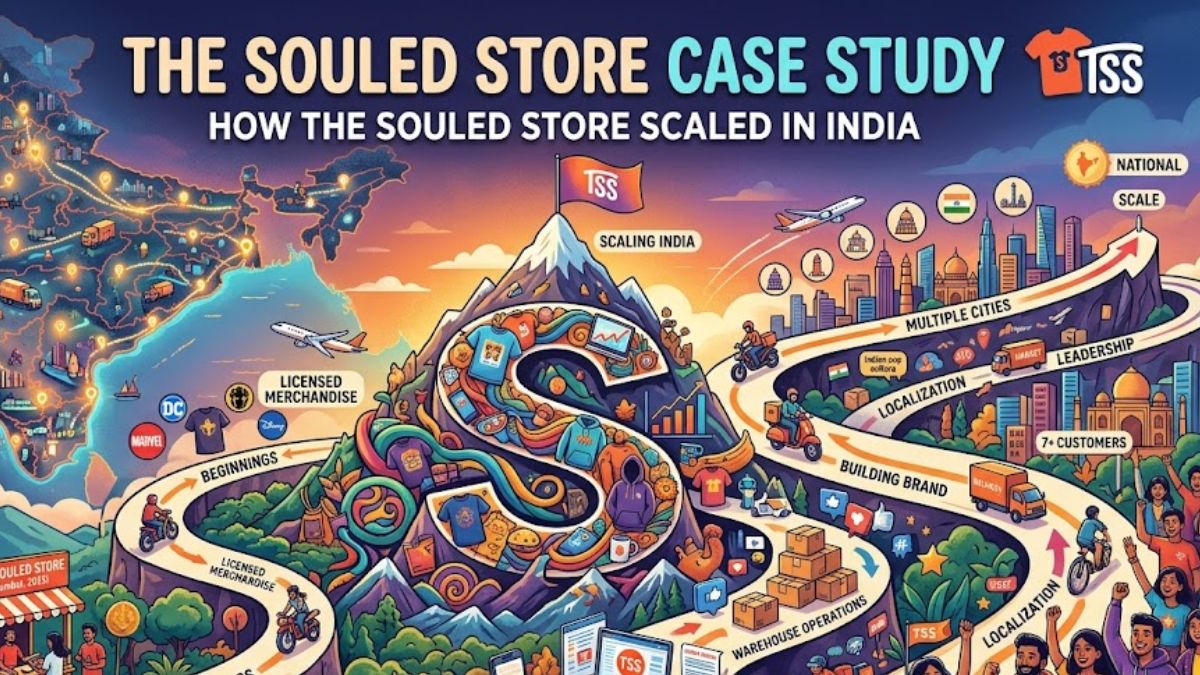
The Souled Store Case Study captures the journey of one of India’s most recognizable homegrown pop culture merchandise brands that built a strong youth following in a highly competitive fashion market. Founded in 2013 by Vedang Patel, Aditya Sharma, Dhawal Parikh, and Harsh Lal, The Souled Store is a direct-to-consumer lifestyle brand that designs and sells licensed apparel and accessories inspired by movies, TV shows, sports teams, and internet culture. The company is headquartered in Mumbai, India, and operates primarily through its online platform, alongside a growing offline retail presence.
The startup was launched to address a clear gap in India’s merchandise ecosystem. At the time, fans had limited access to authentic, high-quality licensed products related to global entertainment franchises. The founders identified an opportunity to create a brand that combined official licensing with trendy designs and accessible pricing.
The Souled Store works by collaborating with global licensing partners and creating in-house designs that appeal to Indian audiences. Its product range includes t-shirts, hoodies, joggers, and accessories, all sold through its website, app, and retail stores. Over time, the company expanded its portfolio to include sports collaborations and original intellectual properties. The company has raised funding from investors such as Elevation Capital and others, although it also focused heavily on building a sustainable business model. According to publicly available data, The Souled Store has achieved significant revenue growth over the years, becoming one of the leading D2C brands in India’s licensed merchandise space.
1. The Origins of The Souled Store: Identifying a Cultural Gap
The Souled Store’s journey began with a simple observation. Indian consumers, especially younger audiences, were increasingly exposed to global pop culture through movies, television, and the internet. However, access to authentic merchandise was limited. Most available products were either unlicensed, poor in quality, or overpriced imports. The founders saw this gap as an opportunity to build a brand that could bring officially licensed merchandise to India in a localized and affordable format.
1.1 Early Idea and Validation
The idea started as an experiment. The founders initially explored selling quirky, original designs through an online platform. Early traction came from social media and word-of-mouth. Customers responded positively to designs that reflected relatable humor and cultural references. This early validation gave the founders confidence to expand into licensed merchandise.
2. Founder Journey: Building a Brand from Scratch
The Souled Store did not start with a perfect plan or a ready playbook. It began with a simple but slightly rebellious idea: why should India settle for dull, uninspired merchandise when fandom is such a powerful emotion here? The founders came from different professional paths, none of them rooted in fashion. That actually became their advantage. They were not carrying the “rules” of the industry in their heads, so they questioned everything that others treated as fixed. Why should licensed merch always be expensive? Why should pop culture products feel like souvenirs instead of something people actually want to wear daily? That curiosity slowly turned into a brand direction.
But the early days were far from smooth. There was excitement, yes, but also a lot of confusion that most outsiders never see. They had to learn everything the hard way. Fabric sourcing, production cycles, sizing consistency, vendor reliability, packaging standards. Each small mistake came back as a cost, sometimes financial, sometimes reputational. There were moments when inventory decisions went wrong and products just sat unsold. And when you are a young brand, unsold stock is not just a number, it feels personal. It feels like doubt staring back at you.
2.1 Early Challenges and Learning Curve
One of the biggest early hurdles was licensing. Convincing global IP holders to trust a small Indian startup was not easy. Most licensing partners were used to working with established brands, not a new name trying to prove itself from scratch. There were long conversations, repeated rejections, and a constant need to prove seriousness. The founders had to show that they were not just another merchandise experiment. They were building a structured business that respected brand guidelines, quality control, and long-term consistency.
At the same time, supply chain chaos was a constant companion. Manufacturing timelines would shift without warning. Quality would vary from batch to batch. Sometimes designs that looked perfect on screen would not translate well on fabric. Instead of breaking the team, these issues forced them to become detail-obsessed. Slowly, systems were built. Better vendor relationships. More predictable production cycles. Tighter quality checks. What looked like small operational fixes at the time eventually became the backbone of the company. Looking back, these struggles were not side problems. They were the foundation itself.
3. The Problem The Souled Store Solved
The core issue was surprisingly simple but deeply overlooked. India had fans of global movies, comics, TV shows, and pop culture at scale. But there was almost no reliable access to authentic merchandise that felt both affordable and wearable in everyday life.
If someone wanted official merch, the options were limited. Either import it at very high prices or settle for low-quality counterfeit products that did not last and often looked nothing like the original designs. That gap created frustration. Fans were willing to spend, but the market was not respecting that intent. The Souled Store stepped directly into that gap. Not just as a seller, but as a translator between global pop culture and Indian everyday fashion. The idea was not only to sell T-shirts. It was to make fandom something you could wear to college, to a café, to work, without it feeling out of place.
3.1 Bridging the Gap Between Fans and Brands
The real breakthrough came when the company positioned itself as a bridge rather than just a retailer. On one side were global entertainment franchises protecting their intellectual property. On the other side were Indian consumers who wanted authenticity but at accessible prices. The Souled Store built trust with both sides, which is harder than it sounds.
Licensing partners needed assurance that their brands would not be misused or diluted. Customers needed assurance that they were not being overcharged for basic merchandise. The company balanced both by sticking closely to official licensing structures and maintaining strict design discipline. Every product had to feel “real” in a way that fans could immediately recognize and respect. Over time, this approach built something more valuable than sales. It built credibility. And in a category driven heavily by emotion, credibility becomes currency.
4. Building the Product: From Quirky Tees to a Lifestyle Brand
The starting point was narrow on purpose. The early catalog focused heavily on graphic T-shirts with witty, pop-culture-inspired designs. It was simple, almost experimental. But something interesting happened once customers started responding. People were not just buying one piece. They were coming back. They were asking for more variety. Wanted the same identity expressed in different forms.
That feedback loop shaped the next phase of growth. Slowly, The Souled Store evolved from a “T-shirt brand” into something much broader, a lifestyle brand built around fandom and everyday comfort wear. The emotional shift here is important. Customers stopped seeing it as occasional merch and started seeing it as part of their daily wardrobe.
4.1 Licensed Merchandise Strategy
The decision to go deeper into licensed merchandise changed everything. Instead of relying only on in-house creative designs, the company began collaborating with global franchises. This meant working within strict guidelines, approvals, and design restrictions. It sounds limiting, but it actually created clarity.
Every design had to pass through multiple filters. Does it respect the original IP? Does it feel locally relevant? Would a fan actually wear this outside? This discipline improved product quality significantly. It also helped build long-term trust with licensors, which is not easy to earn in this industry. The shift also had a direct business impact. Licensed collections tend to drive stronger demand because they carry built-in emotional value. A hoodie is no longer just a hoodie. It becomes a connection to a character, a movie, or a memory.
4.2 Expanding Product Categories
Once the brand had established trust in apparel, expansion became a natural next step. Hoodies, joggers, shirts, and accessories were introduced gradually. Not as aggressive expansion, but as a response to customer behavior. People who liked the brand did not want to switch when seasons changed. They wanted continuity. This expansion had a very practical effect on business performance. Average order value increased, but more importantly, repeat purchases grew. Customers began building wardrobes around the brand instead of buying single items. That shift is what separates a product company from a brand company.
5. Early Traction and Customer Growth
Growth did not come from traditional advertising in the early phase. It came from digital behavior. Social media became the first real distribution engine. People shared designs not because they were told to, but because they felt personally connected to them. A T-shirt with a familiar pop culture reference often did more marketing than any paid campaign. This organic sharing created a loop. Visibility brought traffic. Traffic brought purchases. Purchases brought more visibility. But the real strength was not just numbers. It was emotional engagement.
5.1 Community-Driven Growth
What made the early customer base powerful was the sense of belonging. The Souled Store was not just selling products. It was quietly building a shared identity among fans who previously felt underserved. Customers interacted with the brand like it was part of their circle. They commented on designs, suggested ideas, and even waited for drops like events. This is where the brand crossed an invisible line. It stopped being a seller and started becoming a cultural participant. And once that happens, growth stops feeling like marketing and starts feeling like momentum.
6. Business Model and Revenue Strategy
The company follows a direct-to-consumer model, which means it owns the entire customer journey from discovery to delivery. This is not just a structural decision. It is a control mechanism. By removing middle layers, the brand maintains tighter control over pricing, storytelling, and customer experience. It also learns faster because every interaction happens directly with the customer.
6.1 Pricing a-nd Margins
Pricing strategy sits in a delicate balance. On one side is the need to remain affordable for a young, pop-culture-driven audience. On the other side is the reality of licensed production costs, quality control, and operational overheads. The approach has been to focus on perceived value rather than just low pricing.
Customers are not only paying for fabric or print. They are paying for authenticity, design relevance, and emotional connection to something they already love. Operational efficiency plays a big role here. Better forecasting, improved vendor relationships, and tighter inventory management help protect margins without compromising on price positioning. Over time, this balance has allowed the company to stay competitive while still building a sustainable business model.
7. Funding Journey and Investor Backing
The Souled Store didn’t scale in isolation. At a certain point, the ambition outgrew what organic cash flow alone could support. That’s when external capital entered the picture, not as a starting point, but as an accelerator. For investors, the appeal was not just “another fashion brand.” It was the combination of two things that rarely come together: strong emotional demand and a structured, repeatable D2C engine.
India’s D2C wave was still forming, but the signals were already clear. Consumers were shifting online, discovering niche brands, and showing willingness to pay for identity-driven products. In that environment, a brand built around fandom felt less like a niche experiment and more like a long-term category creator. But funding was never just about validation. It was about speed. The reality inside the company at that stage was simple: demand was growing faster than execution capacity. More designs, more SKUs, more orders, more expectations. Without capital, growth would have been forced to slow down. With capital, it could be structured.
7.1 Growth Fueled by Capital
Once funding came in, the shift inside the business was visible almost immediately. The first big change was product depth. Instead of cautiously expanding categories, the company could now experiment more freely. New collections, seasonal drops, and larger licensed collaborations became possible without constantly worrying about cash constraints. The second shift was marketing maturity. Earlier growth relied heavily on organic reach and community buzz. Post-funding, performance marketing and brand campaigns started playing a bigger role. Not as a replacement, but as a reinforcement layer.
But the most important investment went into distribution. Offline retail expansion began to take shape. Physical stores are expensive, slow to build, and operationally demanding. But they do something digital platforms cannot: they make the brand tangible. For customers, walking into a store changes perception. You are no longer just scrolling through a website. You are standing inside the brand’s world. That emotional shift translated into stronger trust and higher conversion rates.
8. Go-To-Market Strategy and Distribution Channels
From the beginning, the go-to-market approach of The Souled Store was unapologetically digital-first. There was a clear understanding that India’s young consumers were already living online. Instagram, YouTube, and online communities were not just entertainment platforms; they were discovery engines.
So instead of relying on traditional retail distribution, the brand built its own digital ecosystem. Website traffic, social engagement, email marketing, and drop-based launches formed the core growth loop. What made this approach effective was timing. The brand didn’t try to fight offline retail dominance. It simply went where attention already was. And attention, in this case, converted into sales surprisingly well because the product itself carried emotional relevance.
9.1 Offline Expansion
But over time, something interesting happened. Even digital-first brands started realizing a gap: experience. You can show a product online, but you cannot fully recreate how it feels in hand, how the fabric sits, or how the design looks in real life lighting. That gap matters more than people assume, especially in fashion.
So offline stores were introduced, not as a shift away from digital, but as an extension of it. These stores became experience hubs. People walked in already knowing the brand. They were not being introduced; they were being validated. The impact was subtle but powerful. Store visits often led to higher basket sizes, stronger brand recall, and better retention. Customers who touched the product once were far more likely to come back online later.
10. Brand Positioning and Identity
The positioning of The Souled Store was never accidental. It was built around a very specific emotional space: fun, youthful, and self-aware identity expression. This is not a brand that tries to be formal or aspirational in a traditional sense. It does not speak in polished corporate tones. It speaks like a friend who gets your interests.
That tone matters more than it looks on paper. Because in fashion, especially youth fashion, relatability often wins over authority. The brand’s identity consistently reinforces one idea: what you wear should reflect what you enjoy. Not status. Not pressure. But personality. That clarity helped it stand out in a crowded D2C market where many brands were competing on fabric quality alone.
10.1 Pop Culture as a Core Theme
Pop culture is not just a design choice for the company. It is the foundation. Every collection ties back to something people already emotionally recognize. Movies, series, characters, and cultural references become design inputs, not just inspiration.
This creates a powerful shortcut in marketing. Instead of explaining a concept from scratch, the brand taps into something customers already feel strongly about. And that emotional familiarity drives conversion in a way traditional advertising rarely can. Over time, this positioning turned into a moat. Competitors can copy products, but they cannot easily replicate licensing relationships, cultural relevance, and community trust at the same time.
11. Challenges and Turning Points
Scaling a brand like The Souled Store is not a straight upward curve. It is a constant negotiation between growth and complexity. One of the biggest challenges has always been inventory management. When you operate across hundreds of SKUs, multiple sizes, and multiple licensed collections, even small forecasting errors multiply quickly. A single misjudgment can mean overstock in one category and stockouts in another. Both are painful in different ways. Overstock locks capital. Stockouts lose customers. There were phases where the team had to rethink how they plan demand entirely, moving from intuition-driven decisions to more data-led forecasting.
11.1 Competition in the D2C Space
As India’s D2C ecosystem expanded, competition became unavoidable. New fashion startups entered the market every few months. Many offered similar pricing, similar designs, and similar online presence. On the surface, everything started to look the same. In that environment, survival was not about being first. It was about staying relevant. The brand had to continuously refresh collections, strengthen licensing partnerships, and keep improving customer experience. Stagnation was not an option. What helped them stay ahead was consistency. While many brands focused on short-term trends, they kept building around a long-term emotional theme: fandom and identity.
12. Operational Execution and Scaling
Behind the visible brand experience, the real story of scale sits in operations. The Souled Store invested heavily in supply chain systems, vendor relationships, and internal process discipline. This is not the glamorous part of the business, but it is the part that decides whether growth survives or collapses. As volumes increased, manual decision-making stopped being enough. Systems had to take over. Inventory tracking, demand planning, quality checks, and fulfillment processes became more structured.
12.1 Managing Licensed Inventory
Licensed merchandise adds a layer of responsibility most brands don’t deal with. Every design has to follow strict guidelines. Every product must maintain brand integrity. Even small deviations can lead to compliance issues or loss of licensing trust. This creates pressure, but it also forces discipline.
The company had to build internal approval systems, design review layers, and quality validation steps that ensured nothing went out unchecked. Over time, this rigor became part of the company culture. It slowed things down slightly in the beginning, but it prevented much bigger failures later. And that is the quiet truth of scaling a brand like this: speed matters, but controlled speed is what actually lasts.
13. Competitive Landscape and Differentiation
The fashion and D2C space in India is crowded to the point where it often feels saturated. New brands launch almost every month, each trying to grab attention with discounts, trends, or aggressive marketing. In that noise, standing out is not easy. The Souled Store carved its space by not trying to compete on the same terms as everyone else. While many brands focused on being “fashion-forward” or “premium basics,” this brand anchored itself in something more emotional and harder to replicate: licensed pop culture merchandise.
That difference is subtle but powerful. A plain T-shirt is replaceable. A T-shirt tied to a beloved character or franchise is not. It carries memory, identity, and emotion. This emotional layer became the real differentiator. Competitors could match pricing or fabric quality, but they could not easily replicate licensing relationships or the cultural depth behind each collection. Over time, this created a kind of protective moat. Not a technical one, but an emotional one.
14. Growth Metrics and Milestones
The company’s growth story has not been a sudden spike. It has been a steady climb shaped by repeat customers, expanding categories, and increasing brand trust. Early on, growth came from curiosity. People discovered the brand through social media or word of mouth and tried it once. But what really mattered was what happened after that first purchase. Many customers came back. That repeat behavior quietly became one of the strongest indicators of product-market fit. It meant the brand was not just attracting attention, it was retaining emotion.
As collections expanded from graphic tees into hoodies, joggers, shirts, and accessories, average order values naturally increased. But more importantly, customers began building long-term wardrobes around the brand instead of making one-time purchases. Offline expansion also marked a major milestone. Physical stores changed how people experienced the brand, turning digital interest into real-world confidence. Each of these shifts, retention, basket growth, and offline presence, reflects a deeper evolution from a startup selling products to a brand building lifestyle identity.
15. Team and Leadership Approach
Inside The Souled Store, the culture is not built around rigid hierarchy. It is built around participation. The founders have consistently encouraged a mindset where ideas can come from anywhere. Designers, marketers, operations teams, even interns are often part of early brainstorming discussions. That openness matters in a business that depends so heavily on creativity and cultural awareness.
There is a noticeable emphasis on experimentation. Not every idea is expected to succeed. In fact, failure is treated as part of the process, especially in product design and marketing campaigns. But what is important is learning speed. If something doesn’t work, the feedback loop is expected to be fast, not slow or bureaucratic. This kind of environment creates a certain energy. People are not just executing tasks. They are constantly testing what resonates with customers, what feels fresh, and what doesn’t land. And in a brand built on pop culture, staying culturally relevant is half the battle.
16. Technology and Operations
Behind the visible creativity of the brand, there is a deeply operational engine running quietly. Technology plays a central role in keeping that engine stable. From inventory tracking to demand forecasting, from order management to customer insights, digital systems help reduce guesswork. When you are dealing with thousands of SKUs and constantly changing trends, intuition alone is not enough anymore. The Souled Store uses data not just to track sales, but to understand behavior. What people browse but don’t buy. What they return to. designs get saved or shared. These signals slowly build a clearer picture of customer intent.
This feedback loop influences everything from production planning to marketing campaigns. Operationally, the biggest challenge has always been coordination. Design, manufacturing, warehousing, and fulfillment all need to move in sync. Even a small delay in one part can ripple across the entire system. Technology helps reduce that friction, but it doesn’t eliminate the need for discipline. Systems only work well when people use them properly and consistently.
17. Regulatory and Licensing Challenges
Working with licensed merchandise sounds exciting from the outside, but in reality, it is one of the most structured and restrictive parts of the business. Every partnership comes with detailed agreements that define how characters, logos, and designs can be used. There are approvals at multiple stages, design restrictions, and strict quality expectations. For The Souled Store, this means that creativity always operates within boundaries. A design that feels great internally still has to pass external review before it can reach customers. That adds time. Sometimes it adds frustration. But it also builds discipline.
There have been moments where designs had to be revised multiple times because they didn’t fully align with licensing guidelines. Instead of seeing this as a setback, the team gradually learned to design with constraints in mind from the start. This process also strengthened trust with global licensors. When partners see consistency, compliance, and respect for intellectual property, they are more willing to expand collaborations. And in the licensing world, trust is everything.
18. Current Status of The Souled Store
Today, The Souled Store stands in a very different place compared to its early days. It is no longer just an emerging D2C experiment. It has grown into one of India’s recognizable lifestyle brands in the pop culture and casual wear segment. The brand operates across both online and offline channels, with a presence that feels more structured, more mature, and more scalable than its early phase.
What stands out at this stage is stability. Growth is no longer just about acquiring new customers. It is about deepening relationships with existing ones while continuing to expand product categories and retail footprint. There is also a visible shift in perception. Customers no longer see it as a niche T-shirt brand. They see it as a full wardrobe option for expressive, everyday fashion.
19. Future Outlook: The Souled Store Case Study
The future of this journey is not just about selling more products. It is about expanding what the brand represents. The Souled Store is expected to continue strengthening its offline presence, especially in high-traffic retail spaces where brand experience can directly influence purchase decisions. Physical stores are likely to play an even bigger role in building emotional connection, not just transactions.
On the product side, expansion into new categories feels like a natural progression. As long as pop culture remains the core language, there is room to experiment with different formats of expression beyond apparel. But the real long-term strength lies in something less visible: community. The brand has built a customer base that doesn’t just buy, but identifies. That kind of emotional connection is not easy to replicate, even in a highly competitive market.
As India’s consumer landscape continues to evolve, especially with younger audiences becoming more expressive and identity-driven, brands like this are positioned in a very interesting space. Not just selling fashion, but participating in how people express who they are.
20. About foundlanes.com
foundlanes.com is a platform that documents and analyzes startup journeys, business models, and growth strategies across India’s entrepreneurial ecosystem. It publishes detailed case studies and founder insights aimed at entrepreneurs and professionals.