1. How Swiggy Built and Scaled in India
Swiggy is one of India’s largest consumer internet companies, best known for building a nationwide food delivery and hyperlocal commerce platform that connects restaurants, delivery partners, and customers through technology-led logistics. The startup was founded to solve a deeply Indian problem: the lack of reliable, fast, and scalable last-mile delivery infrastructure for food and local commerce.
Swiggy was founded in 2014 by Sriharsha Majety, Nandan Reddy, and Rahul Jaimini. The company is headquartered in Bengaluru, Karnataka, and was launched after the founders observed firsthand how fragmented restaurant delivery operations were across Indian cities. Most restaurants either lacked delivery capabilities or relied on unreliable third-party riders. Swiggy’s core idea was not food discovery but logistics. The company built its own last-mile delivery fleet instead of depending on restaurants, allowing it to control customer experience end to end. This decision became the foundation of Swiggy’s growth story in India and its long-term competitive advantage in the Indian food delivery market.
1.1 Swiggy operates through a mobile-first platform
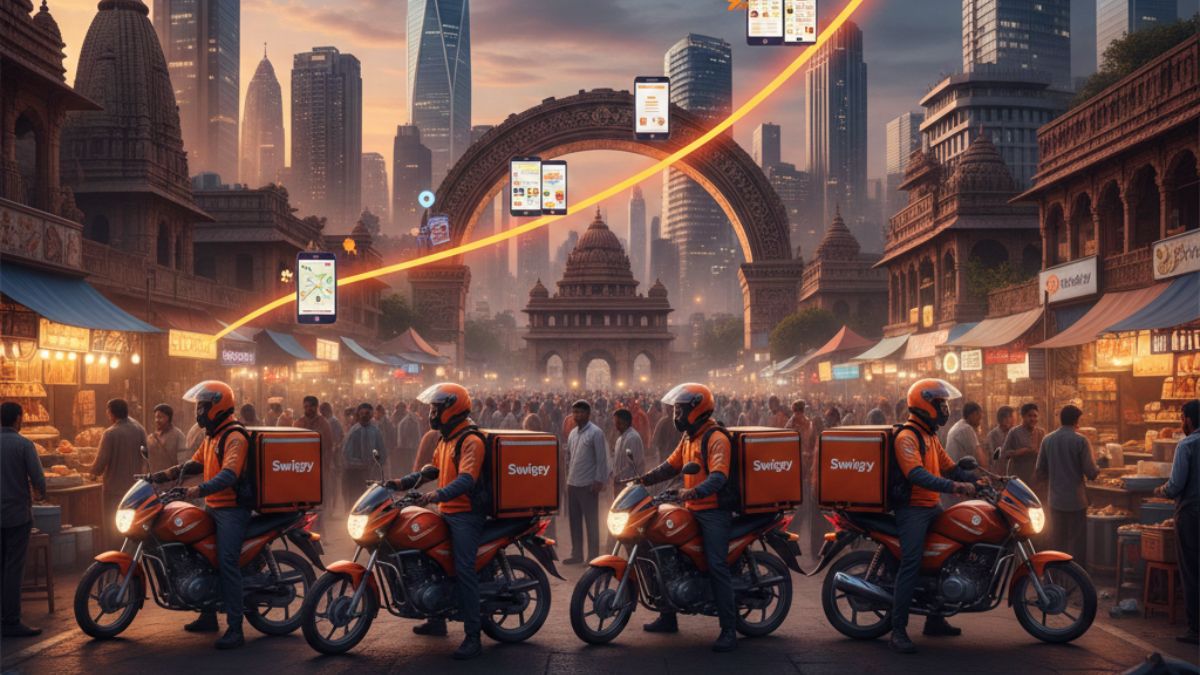
Swiggy operates through a mobile-first platform where users browse restaurants, place orders, and track deliveries in real time. Restaurants receive demand without managing delivery, while delivery partners are onboarded, trained, and routed using Swiggy’s proprietary logistics algorithms. Over time, this logistics backbone expanded beyond food into Instamart, Genie, and other hyperlocal services.
Since its launch, Swiggy has raised multiple rounds of funding from global investors, including Prosus, Accel, and SoftBank, making it one of India’s most well-capitalized startups. While profitability figures are not consistently disclosed, Swiggy’s scale, valuation, and IPO plans position it as a central player in India’s consumer internet economy. This case study examines how Swiggy built and scaled in India, focusing on its origin story, business model, operational decisions, competitive battles, and future outlook.
2. The Origins of How Swiggy Built and Scaled in India
2.1 The Problem Before Swiggy Entered the Market
Before Swiggy, food delivery in India was largely unstructured. Restaurants managed their own delivery boys, often with limited reach and inconsistent service quality. Orders were taken over phone calls, menus were outdated, and delivery times were unpredictable. Aggregators existed, but they focused primarily on discovery and listings rather than fulfillment.
In the Indian food delivery market, logistics was the missing layer. Consumers wanted convenience, restaurants wanted incremental demand, but neither side had the infrastructure to scale reliably. This gap created an opportunity for a logistics-first company rather than a marketplace-first one.
2.2 The Founders’ Early Exposure to the Problem
Sriharsha Majety and Nandan Reddy were classmates at IIM Calcutta. Before Swiggy, they experimented with a logistics startup called Bundl, which focused on courier aggregation. While Bundl did not scale, it gave the founders a deep understanding of India’s last-mile delivery India challenges.
Rahul Jaimini, who joined as the third co-founder, brought technical depth, having worked at Amazon. His experience with large-scale systems influenced Swiggy’s early engineering and data-driven culture. The failure of Bundl was not a dead end. It became the learning ground that shaped Swiggy’s obsession with execution, delivery reliability, and unit economics.
3. How Swiggy Built and Scaled in India: The Founding Moment
3.1 The Decision to Build a Logistics-First Food Company
When Swiggy was being conceived, the obvious play in food tech seemed to be discovery. Menus, ratings, photographs, and endless scrolling. Almost every early food startup in India was trying to become the “Zomato of ordering,” assuming that consumers needed help deciding what to eat. Swiggy’s founders saw something very different on the ground.
Indian consumers, especially in large cities, rarely suffer from choice paralysis. They already know what they want—biryani from the place down the road, butter chicken from the trusted Punjabi joint, dosas from that one breakfast spot that never fails. The frustration wasn’t discovery. It was delivery. Food arrived late, cold, or not at all. Orders were cancelled casually. Phone calls went unanswered. Excuses had become normalised. That gap — reliability — is where Swiggy chose to plant its flag.
3.2 Building a media-heavy restaurant browsing platform
Instead of building a media-heavy restaurant browsing platform, Swiggy made a counterintuitive decision: logistics first, everything else later. The founders believed that in India, trust would not be built through five-star ratings or glossy interfaces, but through the quiet discipline of showing up on time, every time.
This philosophy shaped Swiggy’s earliest conversations with restaurant owners. There was no complicated pitch deck or grand vision of “platform scale.” The message was refreshingly practical: “You focus on cooking. We’ll handle the rest.” Swiggy would bring the orders. Swiggy would manage the delivery fleet. would deal with customer calls, complaints, and last-mile chaos. For restaurant owners accustomed to juggling food preparation with unreliable third-party delivery boys or their own overstretched staff, this offer landed with immediate clarity.
The result was a different kind of partnership. Restaurants weren’t being asked to learn technology or marketing jargon. They were being offered relief. And that simplicity helped Swiggy onboard partners faster than many better-funded competitors who were still debating features and categories. More importantly, this decision created a cultural spine for the company. From day one, Swiggy wasn’t in the “food app” business. It was in the operations business — messy, thankless, and deeply human.
3.3 Early Days in Bengaluru
Swiggy’s launch in Bengaluru in 2014 was anything but glamorous. There were no city-wide rollouts or viral marketing campaigns. Instead, the company started with a handful of neighbourhoods, a short list of restaurants, and a tiny delivery fleet that was learning in real time. The founders themselves were everywhere — on phones, on bikes, in kitchens, and in awkward late-night conversations with frustrated customers.
If a delivery partner didn’t show up, a founder would step in. If a restaurant delayed an order, someone from the core team would walk into the kitchen and wait it out. a customer complained, it wasn’t routed to a “support queue.” It landed directly with people who were building the company brick by brick. This phase was exhausting, but it was formative.
Bengaluru’s traffic, weather, and unpredictable apartment layouts forced Swiggy to confront the realities of Indian last-mile delivery early. GPS errors. Guards refusing entry. Lifts not working. Customers changing addresses mid-order. Every small failure became a lesson — not written in slide decks, but etched through missed deliveries and uncomfortable apologies. Growth in those early months was slow. Painfully so. But it was honest. Orders didn’t increase because of heavy discounts or cash burn. They increased because something rare was happening: food was arriving when it was promised. In a market conditioned to expect delays and excuses, consistency felt almost radical.
3.4 Customers noticed. Not loudly at first, but quietly
Customers noticed. Not loudly at first, but quietly, through repeat orders. Restaurants noticed too. Kitchens began to trust Swiggy’s riders. Staff timed their preparation to Swiggy’s arrival windows. The system started syncing — imperfectly, but meaningfully. What Swiggy was building in Bengaluru wasn’t just an operational model. It was a reputation. One built not on marketing claims, but on lived experience. On nights when the food arrived hot. On days when no one had to chase the delivery boy. moments when a startup did what it said it would do. That trust became Swiggy’s earliest and most durable asset — long before scale, before funding headlines, and before the brand became a household name.
4. The Product That Powered How Swiggy Built and Scaled in India
If logistics was Swiggy’s philosophy, product was its muscle. From the outside, the Swiggy app looked deceptively simple. A list of restaurants. A cart. A delivery timer ticking down. But beneath that clean interface was a system built with the scars of real-world failure — missed turns, cold food, angry phone calls, and exhausted delivery riders. Swiggy’s product was not imagined in conference rooms. It was forged in traffic jams, stairwells, and late-night debugging sessions. This difference mattered. Because Swiggy wasn’t building for hypothetical users. It was building for people who were hungry right now.
4.1 Building the Swiggy App and Backend
From day one, Swiggy made a crucial decision that many early startups ignored: this was not a single product, but three deeply interconnected ones.
- There was the customer.
- There was the delivery partner.
- there was the restaurant.
Most competitors obsessed over only one of these. Swiggy treated all three as equally critical — because if even one broke down, the entire experience collapsed. For customers, the app needed to feel effortless. Hunger is impatient. No one wants to tap through ten screens when they are tired after work. Swiggy stripped the interface down to speed and clarity. Load times mattered. Search mattered. The ability to reorder the same meal without friction mattered even more. Each second saved was a small act of respect toward the user’s time.
For delivery partners, the app carried a very different emotional weight. This wasn’t about convenience — it was about livelihood. Navigation had to be reliable. Earnings needed to be visible and understandable. Incentives couldn’t feel arbitrary. Early feedback from riders shaped everything from route suggestions to how orders were batched. When riders trusted the app, they stayed longer. When they stayed longer, delivery quality improved. Swiggy learned quickly that empathy, in this case, was operational efficiency.
4.2 Reduce chaos inside the kitchen
For restaurants, the dashboard was designed with one goal: reduce chaos inside the kitchen. Orders had to be clear. Timing had to be predictable. There was no room for ambiguity when a rush hit at 8:30 pm. By simplifying order management, Swiggy reduced errors, shortened prep times, and earned the confidence of restaurant staff who had little patience for “tech experiments.”
Behind all this sat Swiggy’s real differentiator: its backend systems. These systems were built to solve brutally practical problems. How do you assign the right delivery partner to the right order at the right moment? How do you minimize idle time without overloading riders? do you increase order density so one trip delivers two meals without compromising quality?
Every improvement showed up on the street. Fewer late deliveries. Shorter wait times. Better utilisation of riders. This was not innovation for press releases. It was quiet, compounding progress — the kind that only shows results after thousands of orders. Over time, this technology-first approach became the invisible engine of Swiggy’s logistics network. By the time competitors tried to catch up, Swiggy wasn’t just an app anymore. It was a finely tuned delivery machine.
4.3 Continuous Product Evolution
What truly set Swiggy apart was not what it built early — but how relentlessly it kept rebuilding itself. As order volumes grew, so did complexity. Static systems stopped working. Predicting delivery times became harder. Demand fluctuated by minute, weather, and locality. Swiggy responded by leaning deeply into data science and machine learning — not as buzzwords, but as survival tools.
Delivery time predictions became smarter, adjusting in real time based on traffic, rain, restaurant load, and rider availability. Pricing models evolved to reflect supply-demand realities without breaking trust. Real-time order tracking wasn’t added for novelty — it was added because uncertainty creates anxiety, and anxiety kills loyalty. Every data point represented a human moment. A rider stuck at a signal. A customer refreshing the app. A restaurant rushing to keep up. Swiggy’s systems learned to read these moments at scale.
The company also experimented — often quietly — with new features that expanded its relevance. Scheduled orders helped families plan ahead. Group ordering reflected how Indians actually eat — together. Cloud kitchen integrations weren’t just a business expansion; they were a response to demand patterns that traditional restaurants couldn’t efficiently serve. Some experiments worked. Some failed. But none were ignored. This continuous evolution created a powerful flywheel. Better data led to better predictions. Better predictions led to smoother deliveries. Smoother deliveries built trust. And trust brought repeat usage — the most valuable currency in consumer tech.
By the time Swiggy began scaling aggressively across cities, the product wasn’t just supporting growth. It was pulling the company forward. Swiggy didn’t win because it built the flashiest app.
It won because it built a product that understood hunger, work, pressure, and time — and respected all four.
5. Early Traction and Validation
5.1 Winning Restaurants One Street at a Time
In the early days, Swiggy didn’t aim to conquer an entire city overnight. The founders understood a simple truth: scale without control is chaos. So they chose a different path—hyperlocal expansion. Each neighborhood, each busy street became a carefully chosen battlefield. By concentrating on high-density clusters, Swiggy could guarantee faster deliveries, fewer mishaps, and a smoother experience for both customers and partner restaurants.
For the restaurants, the results were immediate and tangible. They were no longer juggling delivery logistics while trying to run their kitchens. Orders started flowing in more predictably. Staff, once stretched thin, found relief, and suddenly, the idea of partnering with Swiggy didn’t feel like a risk—it felt like a lifeline. Word-of-mouth spread organically. Chefs and owners began calling each other, sharing stories of sudden spikes in orders and happy customers. Every positive anecdote became a catalyst, and onboarding restaurants snowballed naturally. This wasn’t just growth; it was proof that Swiggy’s model worked in the messy, unpredictable world of real streets and real kitchens.
5.2 Customer Trust as a Growth Lever
Swiggy’s early users weren’t lured by flashy discounts or splashy promotions—they stayed because the promise of Swiggy was simple but rare: reliability. In an era when food delivery often meant long waits, missed orders, and cold meals, Swiggy delivered consistency. A hot meal arriving on time wasn’t just convenience—it was reassurance, a small but meaningful thread in the daily lives of busy professionals and young families.
This repeat usage became Swiggy’s most powerful validation. Each returning customer was a quiet vote of confidence, a signal that the system was working not just in theory, but in practice. Founders watched these numbers with a mix of relief and exhilaration. Retention wasn’t just a metric; it was a story of trust earned, day after day, street after street. Unlike competitors who chased fleeting spikes with discounts, Swiggy’s growth was rooted in human experience—the relief of a hungry customer, the gratitude of a small restaurant seeing steady orders, the subtle thrill of a startup turning reliability into loyalty. This human-first, retention-driven strategy didn’t just differentiate Swiggy; it defined its identity.
6. Swiggy Business Model and Revenue Architecture
6. The Business Engine Behind How Swiggy Built and Scaled in India
Behind every smooth delivery experience lies a far messier truth: food delivery is an unforgiving business. Thin margins. High expectations. Zero tolerance for failure. Swiggy learned early that growth without economic discipline would only delay collapse. What followed was not a chase for quick profits, but a long, uncomfortable journey toward sustainable unit economics — one delivery at a time. This is where Swiggy’s story becomes less glamorous, and far more impressive.
6.1 Understanding the Swiggy Revenue Model
At its core, Swiggy’s revenue model appears straightforward. But in practice, it is a carefully balanced ecosystem built on shared incentives and constant negotiation with reality. The largest revenue stream comes from commissions charged to restaurant partners on every order. This wasn’t positioned as a tax, but as a trade-off. Restaurants paid Swiggy not just for demand, but for logistics, customer support, and operational predictability. For many small and mid-sized kitchens, this arrangement replaced the cost and headache of running their own delivery operations.
Delivery fees added another layer of revenue, particularly as customer expectations around speed increased. While consumers loved free delivery, Swiggy understood something critical: someone always pays for convenience. Over time, delivery charges were calibrated based on distance, demand, and order value, allowing Swiggy to nudge customers toward economically healthier behavior without openly alienating them.
Peak-hour surge pricing was introduced carefully — not as exploitation, but as a pressure-release valve. Dinner rushes, weekends, and rain-heavy evenings stretched the system. Surge pricing helped balance rider supply, compensate partners fairly, and keep deliveries moving when demand spiked beyond normal capacity.
Advertising and sponsored listings quietly became another meaningful contributor. Restaurants eager for visibility paid for placement, turning Swiggy’s app into a performance-driven marketplace. Unlike traditional ads, these were measurable, transactional, and tied directly to outcomes — a model restaurant owners could understand and justify.
Over time, Swiggy made a deliberate decision to reduce its dependence on food delivery alone. New verticals like Instamart and Genie were not distractions — they were strategic hedges. Groceries, essentials, and hyperlocal delivery increased order frequency, improved asset utilization, and created new revenue streams that operated on the same logistics backbone. This diversification didn’t just add revenue. It stabilized the business.
6.2 Unit Economics and Cost Structures
If revenue was one side of the battle, costs were the war. Delivery expenses, rider incentives, refunds, and discounts consistently threatened to overwhelm margins. Every order carried risk. A late delivery could mean compensation. A cancelled order meant sunk costs. A disengaged rider meant longer delivery times across the system.
Swiggy’s response was not denial — it was engineering. The company became obsessed with order density. The idea was simple but powerful: the more orders a delivery partner could complete in a single trip or within a tight radius, the healthier the economics became. This led to smarter batching algorithms, tighter delivery zones, and constant recalibration of routing logic. Average delivery distances were scrutinized relentlessly. Shorter routes meant faster deliveries, lower fuel costs, and happier riders. It also meant customers received food hotter — a small emotional win that translated into repeat usage.
Rider incentives evolved from blunt-force bonuses to more nuanced structures tied to efficiency, availability, and performance. The goal was not to squeeze delivery partners, but to align effort with system-wide outcomes. When riders earned predictably and fairly, churn reduced. When churn reduced, training costs dropped. training costs dropped, service quality improved.
6.3 Discounts, once a blunt growth lever, became more targeted
Discounts, once a blunt growth lever, became more targeted. Swiggy learned that indiscriminate discounting attracted disloyal customers. Instead, incentives were increasingly personalized — nudging behavior rather than bribing it. What emerged from all this was not overnight profitability, but something more valuable: control. Swiggy reached a point where each order told a clear story — how much it earned, how much it cost, and how it could be improved. This clarity allowed the company to scale without the fear of implosion that haunted many logistics-heavy startups.
Understanding how Swiggy built and scaled in India requires understanding this phase deeply. The real victory wasn’t growth charts or funding rounds. It was surviving — and improving — inside one of the hardest consumer businesses in the country, without losing operational sanity. Swiggy didn’t outrun its costs. It learned to live with them, shape them, and slowly, methodically, bend them in its favor.
7. Funding History and Investor Confidence
Money, in Swiggy’s journey, was never just fuel for growth. It was a vote of belief — in a hard idea, in a patient strategy, and in a business model that demanded endurance more than speed. At every stage, Swiggy’s funding story mirrored its operating philosophy: build the backbone first, worry about optics later.
7.1 Early-Stage Funding and Belief in Logistics
When Swiggy first went out to raise capital, it wasn’t selling an easy story. Food delivery in India was already crowded with failures and half-successes. Margins looked brutal. Logistics scared investors. And the founders were unapologetically clear about one thing: profitability was not around the corner. What they were offering instead was conviction.
Early backers like Accel and SAIF Partners didn’t invest because Swiggy had flashy traction or explosive unit economics. They invested because the founders understood the real problem — and weren’t trying to shortcut it. These investors believed in the logistics-first thesis at a time when most of the ecosystem was still obsessed with marketplaces and discovery layers. They understood that if Swiggy could solve last-mile delivery at scale in Indian cities, everything else would become defensible over time.
That belief translated into patience. Early capital was used aggressively, but not recklessly. Swiggy expanded city by city, neighborhood by neighborhood, knowing that each launch would bleed money before it stabilized. Investors supported this expansion even when burn rates climbed and returns felt distant. There was no illusion of quick wins — only the long, grinding work of building muscle where others avoided the pain.
This phase shaped Swiggy’s DNA. Founders learned to operate with accountability, knowing investor trust had been earned, not rented. Investors, in turn, learned that Swiggy wouldn’t chase vanity metrics just to look good in the next round.
7.2 Growth Capital and Valuation Expansion
As Swiggy scaled and competition intensified, the stakes rose sharply. Global capital began to enter Indian consumer tech with unprecedented force. Swiggy raised larger rounds from investors like Prosus and SoftBank — names synonymous with long-horizon bets and category-defining ambitions.
This capital wasn’t deployed simply to “grow faster.” It was deployed to grow deeper. Funds went into strengthening core technology — better routing systems, smarter predictions, and infrastructure that could survive spikes without breaking. Swiggy expanded beyond metros into smaller cities, where operational challenges were different, margins tighter, and brand trust harder to earn.
New verticals were built not as experiments, but as extensions of the logistics network. Each investment decision reflected a belief that Swiggy’s real asset wasn’t discounts or branding — it was its ability to move goods reliably, repeatedly, at scale.
Valuation milestones followed, but they were never framed around short-term profits. Investors valued Swiggy based on what it had quietly built: a dense delivery network, deeply embedded restaurant relationships, and technology that improved with every order. Even during periods of intense competitive pressure, investor confidence remained anchored to fundamentals. Swiggy wasn’t being judged by quarterly optics, but by whether its core engine was getting stronger.
Understanding Swiggy’s funding history is essential to understanding how Swiggy built and scaled in India. Capital didn’t arrive because the business was easy. It arrived because the hardest parts were being confronted head-on. In a startup ecosystem often addicted to speed, Swiggy attracted investors willing to wait — because they saw something rare being built beneath the surface: a company designed not just to grow, but to last.
8. Competitive Landscape and the Swiggy vs Zomato Competition
No story about India’s food delivery boom can be told without confronting the rivalry that defined it. For nearly a decade, the Swiggy vs Zomato competition was not just a business contest — it was a clash of philosophies, cultures, and beliefs about how Indian consumers would ultimately choose convenience. On the surface, both apps looked similar. Restaurants. Menus. Delivery timers. But underneath, they were built on very different truths about the Indian market. And those differences mattered more than any discount ever did.
8.1 Two Philosophies, One Market
Zomato began its journey as a discovery-first company. It understood restaurants deeply, built strong relationships with them, and became synonymous with dining out culture in India. Reviews, ratings, and listings were its original moat. Ordering and delivery came later, layered on top of an already powerful brand.
Swiggy, by contrast, entered the market with no legacy to protect — and no shortcuts to rely on. From day one, Swiggy was built like a logistics company pretending to be a consumer app. Delivery was not an add-on; it was the core product. Control over the last mile wasn’t optional — it was existential. This meant hiring, training, and managing delivery partners directly, absorbing complexity that others preferred to outsource or defer.
This single decision shaped everything. Swiggy’s end-to-end control over delivery allowed it to offer something Indian consumers rarely experienced at scale: predictability. Food arrived when promised. Complaints were resolved faster. Restaurants knew exactly when a rider would show up. The experience felt engineered, not improvised.
Zomato, meanwhile, leaned on its deep restaurant ecosystem, powerful brand recall, and discovery-led traffic. Its strength lay in demand creation and merchant relationships built over years. Where Swiggy optimized operations, Zomato optimized reach and influence.
Neither approach was inherently superior. But they produced different cost structures, different user expectations, and different internal cultures. Swiggy spent more upfront to control quality. Zomato leveraged scale and brand to move faster across markets. The competition wasn’t about who had more users on paper. It was about whose underlying system could withstand stress — rain, festivals, dinner rushes, and unforgiving Indian streets.
8.2 Price Wars and Strategic Discipline
There were moments when the rivalry turned brutal. Discounts flew freely. Free deliveries became normal. Cashbacks trained customers to chase deals rather than loyalty. For a time, the market felt like a race to the bottom, where whoever burned slower survived longer. Swiggy participated — it had to. But it never fully surrendered to the idea that discounts alone could win India.
Instead of matching every promotion rupee-for-rupee, Swiggy doubled down on execution. Faster deliveries. Fewer cancellations. More accurate ETAs. Better rider availability during peak hours. These were harder to market, but far more durable. This discipline showed its value when subsidies were inevitably reduced.
Many users didn’t leave — because Swiggy had quietly become part of their routine. They trusted the app on late workdays, during rainstorms, and on nights when hunger left little patience for uncertainty. Habit, once formed, proved stronger than discounts. Restaurants, too, stayed. Consistency mattered more than temporary volume spikes. Kitchens preferred a platform that respected timing and reduced chaos, even if it promised fewer flashy promotions. The Swiggy vs Zomato competition was never about defeating the other outright. It was about endurance. About who could keep showing up, day after day, without breaking their own system.
In the end, Swiggy’s restraint during the loudest phases of the price wars revealed something fundamental about how it built and scaled in India. Growth was important — but control was sacred. And in a market as complex as India, control often becomes the quiet difference between surviving and disappearing. This rivalry didn’t just shape two companies.
It shaped an entire industry’s understanding of what it truly takes to deliver food at scale in India.
9. Scaling Operations Across India
Scaling in India is never about repetition. What works in one city often collapses in another. Roads change. Habits change. Even hunger behaves differently. Swiggy learned this the hard way — and that learning became its greatest advantage.
What followed was not a linear rollout, but a deeply human exercise in adaptation.
9.1 Expansion Beyond Metro Cities
Moving beyond metro cities was not a victory lap for Swiggy. It was a reckoning. Tier II and Tier III cities looked promising on paper — rising incomes, smartphone penetration, aspirational consumption. But the moment Swiggy entered these markets, the assumptions that held in Bengaluru or Delhi began to crack.
Order values were lower. Distances between restaurants and homes were longer. Demand peaked sharply at specific hours and disappeared just as fast. The luxury of dense neighborhoods — the invisible engine behind healthy unit economics — was suddenly gone.
Swiggy had to rethink everything. Delivery economics were redesigned city by city. Rider allocation models became more flexible. Incentive structures were adjusted to reflect local earning expectations rather than metro benchmarks. Delivery zones were resized to match reality, not ambition.
Restaurant onboarding also became intensely local. In smaller cities, brand names mattered less than trust. Many restaurant owners had never worked with aggregators before. Swiggy teams spent time on the ground — explaining payouts, resolving fears around commissions, and sometimes just sitting down to listen. Technology alone could not bridge that gap.
Instead of forcing a uniform playbook, Swiggy allowed the system to bend. This adaptability showed results. Order volumes stabilized. Delivery reliability improved. More importantly, Swiggy began to feel native to these cities — not like a metro import, but like a service built with local rhythms in mind.
9.2 Building a Nationwide Logistics Network
As Swiggy expanded, logistics stopped being a department. It became the company’s identity. Hundreds of thousands of delivery partners formed the backbone of this network — riders navigating traffic, weather, and fatigue to keep promises made on an app screen. Retaining them wasn’t just an HR challenge; it was an operational necessity.
Swiggy invested heavily in training, onboarding, and safety protocols. Clear earnings visibility reduced anxiety. Predictable incentive structures built trust. Safety measures — from insurance coverage to in-app support — acknowledged a truth often ignored in tech narratives: delivery partners are not “resources,” they are people with lives that extend beyond each order. This focus paid off. Lower churn meant better-trained riders. Better-trained riders meant faster deliveries and fewer errors. And fewer errors strengthened customer trust — the most fragile currency in logistics. Over time, this nationwide delivery network became Swiggy’s quiet superpower.
It allowed the company to think beyond food. The same riders, routes, and algorithms could move groceries, essentials, documents, and packages. Hyperlocal commerce was no longer a leap — it was a natural extension. What Swiggy built across India was not just scale. It was reach with reliability. Scaling operations in India isn’t about being everywhere. It’s about working everywhere. Swiggy’s expansion story proves that growth doesn’t come from ignoring complexity — it comes from respecting it, city by city, rider by rider, delivery by delivery.
10. Cloud Kitchens, Instamart, and New Bets
Once Swiggy had built scale, a harder question emerged inside the company: what should this logistics engine power next? Growth for the sake of growth was dangerous. Every new bet had to respect the same unforgiving reality that shaped food delivery — margins, reliability, and human behavior.
What followed was a phase of experimentation that revealed Swiggy’s maturity as a company: not every idea had to become a headline success to be worth pursuing.
10.1 Cloud Kitchens and Supply Chain Strategy
Cloud kitchens were born out of frustration as much as opportunity. Swiggy could see the data clearly. Customers wanted certain cuisines at certain times — late-night biryani, affordable meals for office lunches, regional comfort food that traditional restaurants couldn’t always deliver at scale. In many locations, demand simply exceeded supply.
Cloud kitchens became a way to test an uncomfortable but necessary idea: what if Swiggy could fix supply itself? These kitchens allowed Swiggy to experiment with menus, pricing, preparation times, and location strategy without the constraints of dine-in operations. Data replaced guesswork. Swiggy could see which cuisines travelled well, which price points converted consistently, and which neighborhoods were underserved despite high demand.
Not all of it worked. Some brands failed to build loyalty. Some locations struggled with consistency. models looked good on spreadsheets but collapsed under real-world operational pressure. Swiggy didn’t hide these failures — it learned from them.
The most valuable outcome wasn’t revenue. It was insight. Cloud kitchens taught Swiggy how food behaves in transit. How packaging affects quality. How preparation time impacts delivery efficiency. demand changes by micro-market. These learnings fed back into the core marketplace, making Swiggy a smarter partner to existing restaurants.
Over time, Swiggy made a conscious decision: cloud kitchens would remain a strategic lever, not a core identity. They were tools for understanding supply chains — not a replacement for the restaurant ecosystem that powered the platform. In India’s cloud kitchens landscape, Swiggy wasn’t trying to dominate. It was trying to understand.
10.2 Instamart and Hyperlocal Commerce
If cloud kitchens were about fixing supply, Instamart was about redefining urgency. Hunger has patience. Convenience does not. Swiggy had already built something rare: a dense, reliable delivery fleet active throughout the day. The question became inevitable — could this same network deliver more than food?
With Instamart, Swiggy made its boldest pivot yet. Groceries, daily essentials, forgotten items — things people didn’t plan to buy, but suddenly needed. Instamart wasn’t about replacing monthly shopping. It was about rescuing moments — when milk runs out, when guests arrive unexpectedly, when time matters more than price.
This move demanded a different kind of discipline. Dark stores. Inventory management. Demand forecasting at a hyperlocal level. Margins were tight. Expectations were brutal. Delivery windows shrank from an hour to minutes. But Swiggy had something few others did: operational muscle already tested at scale.
Instamart leveraged the same routing intelligence, the same delivery partners, the same obsession with predictability. Over time, it reshaped how consumers perceived Swiggy — not just as a food delivery app, but as a convenience layer over everyday life. This repositioning was subtle but powerful. Swiggy stopped being something you opened only when hungry. It became something you opened when you were short on time.
Understanding how Swiggy built and scaled in India means understanding this phase deeply. Cloud kitchens taught the company where supply breaks. Instamart showed where urgency lives. Together, these bets signaled Swiggy’s evolution — from a food delivery startup into a logistics-led consumer platform, built not on grand promises, but on an intimate understanding of how Indians live, wait, and need things now.
11. Team Building and Leadership Culture
Swiggy’s technology, capital, and logistics often take center stage. But beneath all of it sat something far harder to engineer: a culture that could survive chaos. In a business where thousands of small things break every day, Swiggy learned that strategy only works if the people executing it believe deeply in why they are doing the work. Culture, at Swiggy, was not posters on walls. It was behavior under pressure.
11.1 Founder-Led Decision Making
At the heart of Swiggy’s leadership culture was Sriharsha Majety — not as a distant CEO, but as an operator who never fully stepped away from the ground. Even as Swiggy scaled into a national company, founder involvement didn’t dilute. Decisions were not outsourced upward into abstraction. Leadership remained close to reality — rider availability, delivery delays, restaurant complaints, city-level economics. This wasn’t micromanagement. It was accountability.
Sriharsha’s leadership style leaned heavily toward long-term thinking, often at the cost of short-term comfort. He resisted the temptation to optimize for quarterly optics if it risked weakening the system underneath. That meant saying no to reckless expansion, pulling back on unsustainable discounts, and investing in unglamorous infrastructure that would only show results years later.
Equally important was empathy — not as a slogan, but as a decision-making filter. Founders consistently asked uncomfortable questions: Is this fair to delivery partners? Will this actually help restaurant kitchens? Does this reduce friction for customers, or just move it elsewhere? Because leadership stayed close to the problem, Swiggy avoided a common scaling trap: believing dashboards over lived experience. Founders trusted data, but they trusted people on the ground just as much. That balance created clarity across the organization — priorities were real, not theoretical. The result was a company that didn’t panic easily. When things broke — and they often did — the instinct was to fix systems, not assign blame.
12.2 Hiring for Execution
Swiggy’s hiring philosophy reflected the reality of its business: execution beats pedigree. Flashy resumes and brand-name credentials mattered far less than the ability to solve messy, unstructured problems. Swiggy needed builders — people comfortable with ambiguity, friction, and failure. People who could look at a delivery delay not as an exception, but as a signal. Operators were prized. Those who had run warehouses, managed field teams, negotiated with vendors, or handled large-scale operations thrived inside Swiggy. These were individuals who understood that Indian last-mile logistics does not respect theory. It respects persistence.
This culture shaped teams that were deeply practical. Engineers learned to think about traffic patterns and human behavior, not just code. Product managers learned that features only mattered if they reduced real-world friction. City teams were empowered to adapt rather than blindly follow central playbooks.
Hiring for execution also created humility. No one was too senior to listen. No role was insulated from reality. This flattened ego and strengthened collaboration — essential traits in a company where success depended on tight coordination between tech, operations, and on-ground teams. Over time, this culture became self-reinforcing. People who joined Swiggy understood that the work would be hard, often invisible, and rarely celebrated externally. But they also knew it would be meaningful.
Understanding how Swiggy built and scaled in India requires understanding this leadership and team culture deeply. The company didn’t succeed because it avoided problems. It succeeded because it hired people — and built leaders — who were willing to sit with problems until they broke them down. In a country as complex as India, Swiggy’s real competitive advantage wasn’t just logistics or technology.
It was people who stayed close to reality, long after scale made distance convenient.
13. Regulatory and Industry Challenges
If scale was Swiggy’s greatest achievement, regulation was its most persistent test. Building a logistics-led platform in India means operating in a space where laws are evolving, expectations are emotional, and every decision is examined not just for efficiency, but for fairness. Swiggy did not face these challenges in isolation — but the way it responded revealed the seriousness of its long-term intent. These were not problems you could “growth-hack” your way out of. They demanded responsibility.
13.1 Labor Classification and Partner Welfare
Few issues in India’s platform economy have been as sensitive — or as human — as delivery partner classification. At the heart of the debate lay a difficult truth: delivery partners were neither traditional employees nor casual freelancers. They were people whose incomes, safety, and dignity were directly tied to an algorithm they did not control. For Swiggy, this wasn’t an abstract policy discussion — it was lived reality, visible every day on the streets. As scrutiny grew from courts, media, and civil society, Swiggy was forced to confront a question with no easy answers: how do you scale flexibility without transferring all risk downward?
The company’s response evolved over time. Swiggy introduced insurance coverage to protect delivery partners against accidents — a crucial step in a profession where risk is constant and often invisible. Earnings guarantees during low-demand periods were rolled out to reduce income volatility. Safety initiatives, helplines, and in-app support systems were strengthened to ensure riders were not left alone when something went wrong.
These measures did not silence all criticism — nor did they claim to solve a systemic issue overnight. But they reflected a shift in posture. Swiggy moved from seeing welfare as a cost center to recognizing it as an operational necessity. Riders who felt protected stayed longer. Longer retention meant better service, lower churn, and a more resilient network.
Importantly, Swiggy began engaging more openly with regulators and public discourse instead of avoiding it. In an industry often accused of running ahead of the law, this willingness to participate — even when uncomfortable — signaled maturity. Behind every policy update was a simple realization: you cannot build a national logistics network on human exhaustion alone.
13.2 Food Safety and Compliance
If labor was the most visible challenge, food safety was the most complex. As an intermediary, Swiggy did not cook the food — but it carried the responsibility. A single hygiene failure at a restaurant could damage trust across the entire platform. Managing this risk at scale, across thousands of partners, required far more than checklists.
Swiggy had to align with evolving regulations set by bodies like FSSAI, ensuring that partner restaurants met licensing, hygiene, and compliance standards. This was not a one-time verification exercise. Restaurants opened, closed, relocated, and changed staff constantly. Technology became a critical ally. Swiggy built systems to verify licenses, flag non-compliance, and pause listings when requirements were not met. Restaurants were nudged — and sometimes forced — to upgrade practices that had been informal for years. For small kitchens, this transition was often painful, requiring education as much as enforcement.
At the same time, Swiggy had to balance strict compliance with marketplace realities. Over-policing risked shrinking supply. Under-policing risked eroding trust. Every decision sat at the intersection of regulation, business continuity, and customer safety. The company also invested in packaging standards, tamper-proof seals, and clearer accountability across the delivery chain. These measures reassured customers that food safety didn’t end at the kitchen door. What emerged was not perfection, but progress.
Understanding how Swiggy built and scaled in India means acknowledging that growth came with responsibility — and that responsibility often slowed things down. But in a sector dealing directly with livelihoods and health, slowing down was sometimes the most strategic choice. Swiggy’s journey through regulatory and industry challenges shows that real scale isn’t just about reach.
It’s about standing in the uncomfortable space between innovation and obligation — and choosing not to look away.
14. Current Status of Swiggy
Today, Swiggy stands at a very different place from where it began — but it carries the weight of every step it took to get here. What once started as a small logistics experiment in a few Bengaluru neighborhoods now operates across hundreds of Indian cities, touching daily life in ways that are often invisible until something goes wrong. Food delivery remains the heart of the business, but it is no longer the whole story. Quick commerce, hyperlocal logistics, and convenience-led services now sit alongside it, all powered by the same operational backbone.
This breadth did not arrive accidentally. Swiggy’s scale is the outcome of years spent solving unglamorous problems: rider availability at odd hours, inventory movement in dense localities, restaurant reliability during peak stress, and customer expectations that only grow sharper with time. Each vertical — food, quick commerce, hyperlocal delivery — feeds the same ecosystem. Orders improve density. Density improves efficiency. Efficiency strengthens the network.
Profitability, candidly, remains a work in progress. But within Swiggy, profitability has never been treated as a switch to flip — it is treated as a destination reached through discipline. The company today understands its costs, its margins, and its levers far better than it did during its early hyper-growth years. Losses are no longer abstract. They are measured, segmented, and actively managed.
14.1 Swiggy now operates with predictable systems
What matters more is control. Swiggy now operates with predictable systems, mature governance, and a leadership team shaped by real adversity. Brand strength is no longer built only through advertising, but through habit. Millions of users don’t consciously “choose” Swiggy anymore — they default to it. That kind of trust cannot be bought; it is earned over time, order by order.
Public discussions around an IPO reflect this evolution. An IPO is not just about capital — it is about scrutiny. About reporting discipline. About being accountable not just to investors, but to the public market. The fact that Swiggy can even credibly enter this conversation signals confidence in its internal processes, compliance standards, and long-term roadmap.
Importantly, Swiggy today is not chasing perfection. It is chasing endurance. In an ecosystem where many startups burned brightly and disappeared just as fast, Swiggy has chosen the harder path — to become an infrastructure company disguised as a consumer brand. One that moves food, groceries, and essentials not because it is fashionable, but because it has learned how India actually works.
Understanding Swiggy’s current status is understanding maturity. It is a company no longer defined by what it promises, but by what it consistently delivers — and by the quiet belief that if it can keep doing that, quarter after quarter, it will outlast cycles, competitors, and hype. Swiggy today is not the finish line. It is the proof that the foundation held.
15. How Swiggy Built and Scaled in India: Future Outlook
Swiggy’s future lies in deepening its logistics moat, improving unit economics, and expanding non-food use cases. The company is likely to focus on profitability discipline while defending market share. As India’s digital consumption grows, Swiggy’s logistics-first DNA may enable it to become a foundational layer for urban commerce. How Swiggy built and scaled in India offers lessons in patience, execution, and the power of solving real problems at scale.
About FoundLanes.com
foundlanes.com is an independent Indian platform that documents and analyzes startup journeys, business case studies, and founder stories shaping the country’s entrepreneurial ecosystem. It focuses on long-form, research-driven storytelling that explains how companies are built, scaled, and sustained in real market conditions.