
News Summary
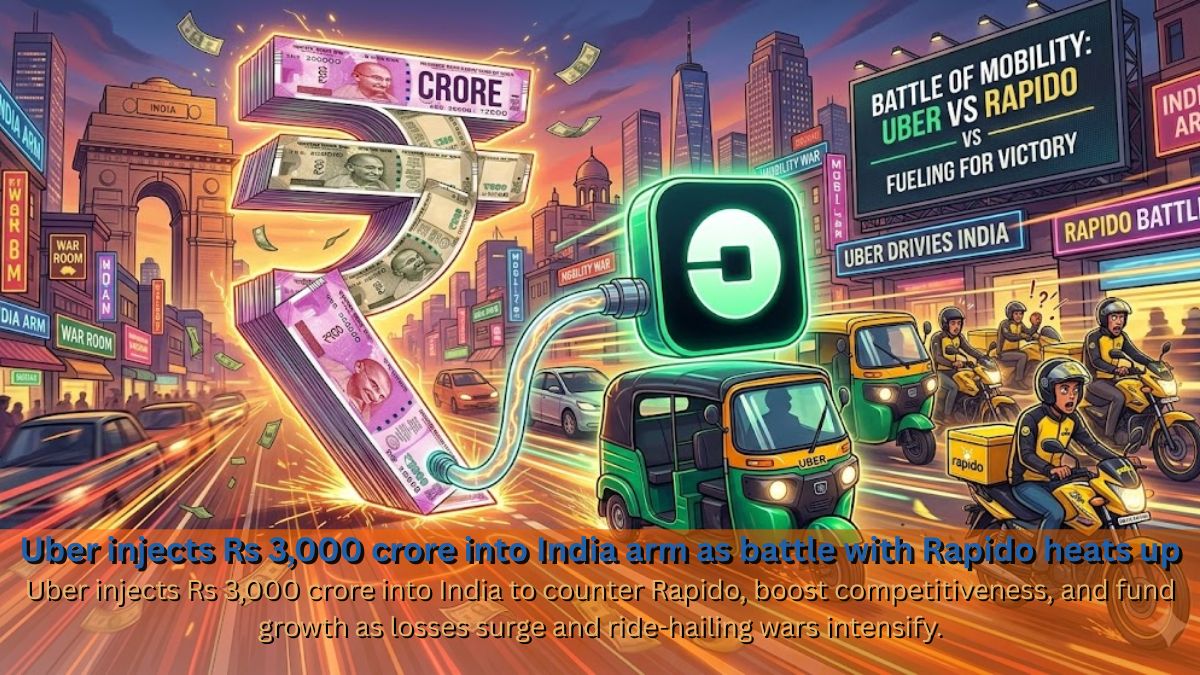
Uber injects Rs 3000 crore into its India business in a bold move to counter intensifying competition from Bengaluru-based rival Rapido and stay competitive in the country’s fast-evolving ride-hailing market. The capital infusion, equivalent to around $330 million, was directed into Uber India Systems Pvt Ltd in two tranches Rs 200 crore in November 2025 and Rs 2,721 crore in January 2026 through the allotment of 14.4 million equity shares at an issue price of Rs 2,022.85 each to its Dutch parent, Uber B.V., according to filings with the Registrar of Companies. This strategic financing underlines Uber’s long-term commitment to its Indian operations even as its finances show pressures from rising costs and mounting losses.
The ride-hailing giant’s India arm
The ride-hailing giant’s India arm, which recorded modest top-line growth to about Rs 3,849 crore in FY25, saw its net loss surge nearly 15x to Rs 1,511 crore, reflecting intensified competitive spending on incentives and service expansion. By contrast, Rapido’s revenue grew 44 per cent to Rs 934 crore in the same period, with total income crossing Rs 1,000 crore and losses narrowing. The rapid rise of Rapido, especially in two- and three-wheeler segments where it commands around 65 per cent market share, has made it the toughest rival to Uber in India, surpassing even Ola Cabs in total ride volume.
Industry analysts point out that higher cash reserves enable companies to offer attractive incentives to drivers and riders a core battleground in ride-hailing wars and that Uber’s “Uber injects Rs 3,000 crore” push signals a shift into a new, aggressive phase of competition. While Uber still holds around 45 per cent of India’s four-wheeler ride-hailing market, Ola’s share has slipped and Rapido continues to chip away at incumbents across categories. This article unpacks how Uber’s operations work in India, why it made the Rs 3,000 crore commitment, what the competitive landscape looks like, and what lessons startups can draw from this chapter in the mobility sector’s evolution.
1. Understanding Ride-Hailing: Working and Revenue Models
1.1 How Ride-Hailing Platforms Operate
Ride-hailing businesses connect passengers with drivers through mobile apps. Users enter pick-up and drop-off points, view estimated fares, and confirm rides. The platform dispatches a nearby driver, and riders pay either through digital wallets or cashless methods. Companies like Uber and Rapido rely heavily on technology, real-time mapping, and robust software to match supply and demand efficiently. Riders benefit from convenience, cashless payments, and real-time tracking. Drivers benefit from flexible earning opportunities and access to a larger customer base. The two-way marketplace must balance demand, driver supply, pricing, and service quality continuously to remain competitive.
1.2 Ride-Hailing Revenue Streams
Ride-hailing platforms earn primarily by charging commissions on each completed trip. A percentage of the fare is retained by the company, while the rest goes to the driver. Over time, many platforms have diversified revenue models to include surge pricing during peak hours, subscription offerings for regular users, and partnerships with businesses for corporate travel. Rapido introduced innovative models like subscription-driven zero-commission for drivers, shifting away from traditional commission structures. This change helped attract drivers and grow supply rapidly, especially in two- and three-wheeler segments.
1.3 Capital and Operational Costs
Scaling a ride-hailing platform requires substantial investment in technology, marketing, driver incentives, and customer acquisition programs. High competition drives up spending, which can compress unit economics. As Uber’s India financials show, modest revenue growth can be overshadowed by rising costs when incentives and operating expenses grow faster than topline.
2. Uber’s Journey in India
Uber entered the Indian market in 2013, positioning itself as a modern alternative to traditional taxis and auto-rickshaws. The early days saw rapid adoption in metropolitan cities where smartphone use and online payments were increasing. Uber’s ability to offer seamless ride booking initially set it apart. Over the years, Uber expanded beyond four-wheelers to include auto-rickshaws, bikes, and other mobility services. Its aggressive pricing, robust app infrastructure, and global technology stack helped it build a strong presence. For much of the last decade, Uber India competed primarily with Ola Cabs locally founded and equally aggressive in pricing and driver incentives.
However, the landscape began to shift as new mobility players, particularly Rapido, gained traction. Rapido’s focus on two-wheelers and subscription-based earnings for drivers resonated with markets beyond major metro cities, and its rapid expansion altered competitive dynamics.
3. Rapido: An Emerging Competitor
Founded in 2015 by Aravind Sanka, Pavan Guntupalli, and SR Rishikesh, Rapido started as a bike taxi aggregator. Over time, it expanded services to include auto-rickshaws, cabs, parcel delivery, and logistics offerings. With operations in over 100 Indian cities, Rapido has carved a niche in segments where traditional four-wheeler ride-hailing was less efficient or more expensive. Rapido’s growth accelerated significantly after it introduced zero-commission and subscription models that boosted driver earnings and attracted supply. In FY25, the company grew revenues 44 per cent to Rs 934 crore and crossed Rs 1,000 crore in total income. Its losses also narrowed, reflecting improving unit economics.
The company’s investors include WestBridge Capital and Nexus Venture Partners, which backed the business through significant funding rounds. Earlier, Swiggy exited its stake at over 2.5 times returns, underscoring confidence in Rapido’s growth story.
4. Competitive Landscape: Uber, Rapido, and Ola
India’s ride-hailing market is fiercely competitive. Uber and Ola have long dominated four-wheeler services. Ola, founded in 2010, grew rapidly across India and challenged Uber head-on. But shifting dynamics in the mobility sector, including changes in urban commuting preferences and the rise of alternative segments like bike taxis, have reshaped competition.
Rapido’s success highlights this shift. It has overtaken Uber to command around 50 per cent of total ride volume across segments, with particularly strong leads in bikes and three-wheelers. Uber still maintains roughly 40 per cent of total rides but trails Rapido overall. In four-wheelers specifically, Uber holds around 45 per cent, while Ola accounts for 25-30 per cent and Rapido has grown to over 20 per cent since entering that segment in late 2023.
5. Why Uber Injects Rs 3,000 crore Now
5.1 Financial Pressures
Uber India’s financials for FY25 show a modest 2.3 per cent rise in revenue to Rs 3,849.2 crore, while operating loss ballooned to over Rs 1,051 crore with net loss nearing Rs 1,511 crore. The sharp decline in profitability was largely driven by rising incentive spending and operating costs as the company fought to retain market share. Despite consistent gross revenue from commissions roughly Rs 2,604 crore in FY25 net revenue from ride-hailing plummeted, indicating heavy discounting and incentive outlays to drivers and riders.
5.2 Competitive Positioning
With Rapido’s rapid rise and improved earnings profile, Uber needs stronger financial backing to sustain its competitive plays. High cash reserves allow firms to offer incentives without immediate profitability, a key lever in ride-hailing where demand and supply are sensitive to pricing and earnings. Uber CEO Dara Khosrowshahi has publicly acknowledged that Rapido is now the company’s biggest competitor in India, overtaking Ola as the main threat.
5.3 Strategic Intent
The Rs 3,000 crore infusion signals Uber’s commitment to the Indian market. It shows that the company views India not merely as a tactical geography but as a strategic growth engine where mobility demand continues to expand and diversify. This injection strengthens Uber’s balance sheet and provides flexibility to scale operations and innovate service offerings.
6. Industry Trends in Ride-Hailing
Ride-hailing is part of the broader mobility and shared transportation revolution in India. Rapid urbanisation, increasing smartphone penetration, and digital payment adoption have fuelled growth. Riders seek convenient, app-based options for everyday commuting and intercity travel.Two-wheeler ride-hailing carved out a distinct segment, lowering costs for users and creating new revenue models for drivers. Subscription-based and zero-commission models have become important competitive differentiators.
This evolution reflects broader trends in tech innovation, platform economics, and consumer behaviour that define modern startup ecosystems. Investments by major global players, including Uber, signal confidence in long-term demand and market potential.
7. Challenges Ahead
Despite the capital infusion, Uber India must wrestle with profitability and operational efficiency. Balancing growth with sustainable unit economics remains crucial. Drivers’ earnings, customer retention, and service quality are vital levers that define competitive advantage. Regulatory dynamics also affect ride-hailing operations, as seen in recent federal support for alternative models like Bharat Taxi, a cooperative platform backed by the government offering drivers shareholder stakes a development that could reshape future competition.
8. Learning for Startups and Entrepreneurs
The ride-hailing battle between Uber and Rapido holds lessons for startups. Large markets attract intense competition, and nimble local players can disrupt established incumbents by innovating business models and focusing on underserved segments. Rapid experimentation with pricing, incentives, and driver economics can redefine market share. Capital is critical, but deployment must be strategic. Deep pockets help sustain battlefield incentives, yet long-term success requires building loyal user bases, improving operational efficiency, and anticipating shifts in customer behavior. Entrepreneurs should balance growth with sustainable economics rather than chase scale alone.
About foundlanes.com
foundlanes.com is India’s leading startup idea discovery platform. It helps entrepreneurs find actionable startup opportunities, market insights, and industry-specific guidance to turn ideas into real businesses. With deep research and practical resources, foundlanes supports founders at every stage, from idea validation to launch and growth.