Summary
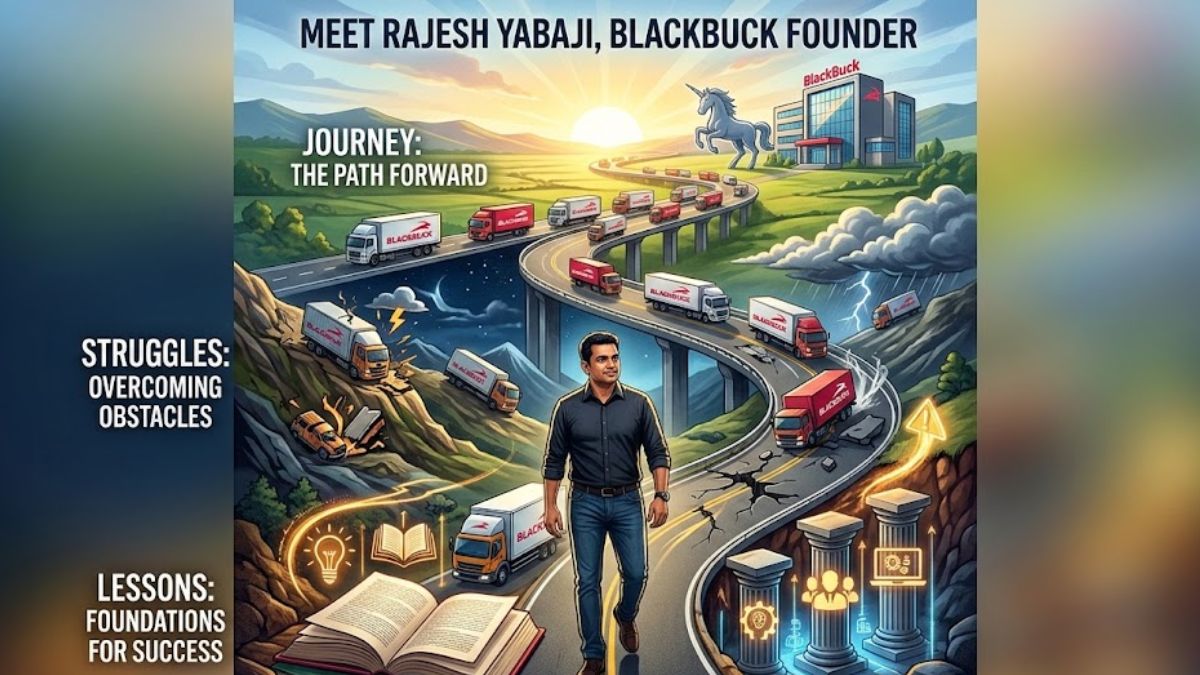
The story of Rajesh Yabaji is one of the most compelling founder journeys in the modern logistics landscape of India. As the co-founder and CEO of BlackBuck, he has built one of the country’s most transformative freight and trucking platforms. His work sits at the intersection of technology, operations, and on-ground challenges that many entrepreneurs underestimate until they are deep within the system. His journey is not just about building a company; it is about reimagining an entire sector that was fragmented, opaque, and near-impossible to standardize at scale.
This article explores who he is, what shaped him, how he built one of India’s most influential logistics startups, why the idea emerged, and what the journey has taught him. We also look at the personal sacrifices, turning points, and visions that continue to drive his work. The narrative is built for readers seeking an in-depth, honest, and carefully researched profile of a founder who has spent years building through chaos.
The story begins in Warangal
The story begins in Warangal, moves through the classrooms of IIT Kharagpur, and expands into factory floors during his years at ITC Limited. These years shaped his understanding of large-scale supply chains and the realities of Indian trucking. By the time he entered entrepreneurship, he already knew the logistics sector from the inside. The industry he decided to serve was massive, yet plagued by inefficiency. It had thousands of fleet operators and millions of drivers, but lacked any unified digital ecosystem. This was the gap he wanted to solve.
The company he founded in 2015 became one of the earliest tech-driven freight marketplaces in the country. It offered a structured way for shippers to connect with truckers and for truckers to find reliable loads. The idea grew organically, but the execution required deep operational intensity. It also needed trust-building with small fleet owners who traditionally avoided digital platforms. His entrepreneurial journey has been filled with challenges: cash-flow crunches, operational failures, technology gaps, leadership mistakes, hiring missteps, scaling limitations, self-doubt, burnout, and the emotional toll of building in a sector known for instability. Yet these setbacks shaped his leadership.
As of today, the company remains one of the prominent players in the trucking ecosystem, supported by technology and operational infrastructure that serves enterprises and small transporters at scale. His long-term vision continues to revolve around solving structural inefficiencies in freight movement and creating a transparent, trusted, tech-driven transportation network in the country. This is the full story based on reliable public information, founder interviews, and the evolution of the logistics sector. It is written for readers of FoundLanes.com who seek depth, nuance, and real founder insights.
1. Background and Early Life
1.1 Early life and family background
Rajesh grew up in Warangal, a region that was not known for startup activity at the time. His early years were shaped by a middle-class upbringing that valued education and discipline. His family emphasized academic performance and practical thinking, which influenced his structured approach to life. Growing up in a smaller city gave him an early understanding of grassroots India, where mobility and transportation were part of everyday conversations. This exposure stayed with him even as he moved on to pursue higher education.
His childhood was filled with curiosity. He often showed an inclination toward solving problems and understanding how things worked. He was not necessarily the stereotypical entrepreneur in school but someone who liked decoding systems. These interests later aligned perfectly with the world of operations and logistics.
1.2 Education and early influences
Rajesh’s academic journey took him to IIT Kharagpur, where he pursued mechanical engineering. IIT Kharagpur has a reputation for shaping strong technical minds, and his years there gave him exposure to complex engineering systems, leadership opportunities, and a diverse peer group. He developed an interest in large-scale systems, management, and how traditional industries operated under stress.
During these years, he was influenced by mentors, industry exposure programs, and project-based learning. His curiosity for real-world problem solving deepened. He wasn’t oriented toward the world of startups yet, but he was beginning to lean toward industries where processes were complex and where scale demanded precision. Logistics and operations naturally aligned with this mindset. His time at IIT did not revolve around entrepreneurship, but it certainly laid the foundation for his analytical skills and managerial thinking. When he later joined ITC Limited, these experiences helped him adapt to one of the country’s most challenging supply chain environments.
2. Founder and Company Overview
2.1 Introduction to the founder
Rajesh entered the professional world as someone who understood engineering deeply but was also trying to explore where he fit within the larger industrial landscape. He wanted to understand on-ground realities, not just theoretical frameworks. This appetite for learning directly influenced the career choices he made after graduation. During his early professional journey, he developed a habit of observing systems closely. He could understand why operations broke down, why certain inefficiencies persisted, and why people resisted change. These observations became important later when he started working on structural problems in logistics.
2.2 Company overview and offerings
BlackBuck was founded with a simple mission: bring order and reliability to India’s trucking ecosystem. The company operates as a freight marketplace that connects shippers with truck owners. Over time, it expanded into offering services that help fleet owners manage operations, track vehicles, access fuel cards, and streamline their workflows. The company sits in the B2B trucking ecosystem and focuses on enabling both large enterprises and small transporters. It provides digital tools that replace manual paperwork and verbal communication, which previously dominated logistics operations. At its core, the company aims to create an integrated trucking infrastructure powered by technology.
2.3 Target audience and market served
The startup primarily serves businesses that need to ship goods across the country and transporters who own or operate trucks. This includes enterprises in manufacturing, FMCG, e-commerce, and various industrial segments. On the other side, it serves fleet owners who manage anywhere from one truck to several hundred trucks.
The market it operates in is enormous. India’s logistics industry involves millions of trucks and thousands of intermediaries. The lack of reliable digital systems made it difficult for businesses to find trucks and for truckers to secure consistent work. This gap created the opportunity for a structured freight marketplace.
2.4 Year of founding and business stage
The company was founded in 2015. Over the years, it transitioned from being a fast-growing startup to becoming a mature player within the logistics ecosystem. Its evolution involved multiple pivots, expansion of offerings, and a shift from purely marketplace-focused services to broader fleet management and trucking infrastructure tools.
3. The Problem, Insight, and Trigger
3.1 Core problem identified
The logistics sector in India was notorious for its fragmentation. The trucking ecosystem was overwhelmingly unorganized, with limited transparency, unreliable pricing, operational delays, and manual processes. Fleet owners often struggled with return loads, delayed payments, inconsistent fuel costs, and difficulty tracking vehicle movement. Shippers faced their own problems: unpredictable load availability, fluctuating prices, and unreliable service. These inefficiencies affected industries at every scale. This was the problem Rajesh identified early during his years in supply chain management. He realized the entire system lacked digital infrastructure, and introducing technology could streamline processes significantly.
3.2 Personal insight behind the idea
Much of the idea came from his time at ITC Limited where he oversaw supply chain operations. He regularly interacted with transporters, truck drivers, and logistics partners. He saw first-hand how broken the system was and how small inefficiencies at the ground level created massive losses at the enterprise level. Realized that solving trucking inefficiencies meant solving supply chain issues for nearly every sector. That insight convinced him that logistics technology would be one of the biggest opportunities of the decade.
3.3 Trigger moment to start
The trigger was a combination of frustration and clarity. By the time he decided to quit his job, he knew the logistics sector wasn’t going to change on its own. It needed entrepreneurs who were ready to spend years in an unpredictable environment and solve problems from the ground up. The turning point was understanding that the problem wasn’t just operational or technical. It was a trust issue. Transporters didn’t trust digital platforms, and businesses didn’t trust fragmented trucking networks. Building trust required a marketplace that could show reliability from day one. That belief pushed him into entrepreneurship.
4. Early Days and Initial Struggles
4.1 Early assumptions and naivety
Like most first-time founders stepping into a complex sector, Rajesh began with ambition, optimism, and a few assumptions that reality quickly challenged. He imagined that building technology for logistics would be hard, but not impossibly hard. He believed transporters would adopt digital tools once they saw the benefits. Assumed that businesses would shift from phone calls and middlemen to transparent systems simply because it made sense.
But the logistics world moves differently. It operates on deeply rooted habits built over decades. Relationships matter more than dashboards. Trust outweighs technology. Rajesh soon realized that digital adoption wouldn’t happen overnight. What he thought would take months stretched into years. Every conversation became an exercise in patience. Every demo required emotional stamina. The early days felt like pushing a rock uphill in an industry comfortable with staying the same.
4.2 Entrepreneurial initial struggles
Building the platform was only one part of the journey. The real struggle was stitching together technology with a sector where unpredictability is part of the culture. Rajesh and his team often worked late nights managing on-ground issues, whether it was a delayed truck, a confused fleet owner, or a broken workflow. They spent long hours in transport hubs, dusty yards, and warehouses trying to understand the daily frustrations of the ecosystem.
Hiring was another challenge. They needed people who were not just skilled but also resilient individuals who could handle the pace, the chaos, and the constant firefighting. Every new lane opened revealed new logistical realities. Processes had to be redesigned again and again because no two routes behaved the same way. The team learned to operate in unstructured environments while still trying to build structured systems.
4.3 What turned out to be harder than expected
Scaling a logistics operation is never linear. Rajesh realized that every route had its own pricing complexities, every transporter had their own communication style, and every customer demanded personalized service. Standardizing such a market felt like trying to tame a wild, layered ecosystem.
Trust turned out to be the toughest barrier. Many transporters were intimidated by digital pricing transparency. Real-time tracking tools felt intrusive. Platforms made them feel they were losing control over negotiations. Winning them over required countless meetings, hand-holding, and repeated demonstrations. It wasn’t the tech that moved them it was persistence. Building trust turned into a relationship marathon rather than a tech sprint.
5. Failures, Setbacks, and Self-Doubt
5.1 Toughest phase of the journey
The toughest periods were when operational complexity collided with financial pressure. Logistics runs on thin margins, and every minor error delayed trucks, mismatched shipments, cancelled loads became a significant setback. There were months where cash flow became tight, and scaling ambitions had to be paused. Rajesh and his team had to accept that rapid expansion without strong foundations would collapse. They took difficult decisions to slow down, fix systems, and strengthen the core. These decisions hurt in the moment but saved the company in the long run. Those were the nights filled with worry, long discussions, and tough introspection. But they also marked the beginning of strategic maturity.
5.2 Early failures and major setbacks
Not every early pilot was a success. Some failed because transporters didn’t understand the platform. Others failed because customers slipped back into old habits, preferring phone calls and familiar middlemen. There were shipments that got delayed. There were deals lost due to operational glitches. Each failure felt personal. Each setback chipped away at confidence.
But every stumble taught the team something crucial. They learned that the logistics sector needed not just technology, but empathy. They refined the platform. Improved payment cycles. They simplified interfaces. They learned to support both transporters and shippers with equal care. These setbacks became the building blocks of a more durable model.
5.3 Moments of self-doubt and emotional lows
There were moments when Rajesh questioned whether the industry was ready for digital transformation. There were days when growth was painfully slow, and investor pressure felt overwhelming. Watching months of effort result in marginal progress took an emotional toll. Yet these lows shaped the leader he became. They taught him the importance of resilience, calm decision-making, and long-term thinking. They helped him understand that building in logistics isn’t about quick wins. It’s about endurance. It’s about showing up, even on the days when nothing seems to work.
6. Validation and Early Traction
6.1 First real validation or customer
Validation arrived when large enterprises began using the platform consistently. For the first time, big customers trusted the system for critical shipments. They appreciated the structured pricing, improved reliability, and transparent tracking. This was the turning point the moment the team felt the industry finally acknowledged the value of what they were building.
6.2 Early revenue growth or feedback
As more shippers joined, the feedback loop strengthened. Transporters started experiencing predictable payments, fewer empty returns, and better route visibility. They started relying on the platform not just for loads, but for stability. These small wins began adding up. Revenue grew, processes stabilized, and the platform became more defensible.
6.3 Why this moment changed belief
This phase shifted the team’s belief entirely. They realized that the platform wasn’t just a tool; it was a trust engine. It brought structure to an unorganized sector. Brought predictability to a business built on uncertainty. It offered dignity to transporters and efficiency to enterprises. This understanding fueled the team’s conviction that they weren’t just building a company they were transforming an entire ecosystem.
7. Funding, Money, and Growth Constraints
7.1 Bootstrapped or funded journey
The company eventually turned to venture funding because logistics isn’t the kind of business you can scale on optimism alone. It demands capital at every corner: technology, people, supply, compliance, on-ground operations. The early days were a constant tug-of-war between ambition and financial reality.
When funding came in, it didn’t feel like a victory lap. It felt like oxygen after holding your breath for too long. The money helped the team expand lanes, hire better operators, and build systems that didn’t collapse under scale. But with every round came sharper expectations and a new pressure to grow responsibly, not recklessly.
7.2 Capital challenges and cash flow issues
Working capital was a recurring headache. Payments from enterprises often came late, sometimes by weeks. Meanwhile, transporters needed to be paid on time to maintain trust. The margin gap between the two sides was painfully thin.
There were months when the finance team stayed late into the night, recalculating every line item and every receivable. Decisions on which lanes to prioritize weren’t just strategic they were survival calls. Every rupee had to be justified. These moments forced the company to mature faster, adopt disciplined financial planning, and get comfortable operating with uncertainty.
7.3 Early growth limitations
Growth didn’t slow down because the product was bad. It slowed down because the market wasn’t ready. Many transporters weren’t comfortable shifting from phone calls to a screen. Some lanes behaved like stubborn ecosystems too dependent on old relationships and offline systems.
The team realized that forcing growth in such environments only created instability. So they pulled back, strengthened operations, and waited for the right moment. It was humbling, but it laid the foundation for sustainable expansion later.
8. Team Building and Leadership Evolution
8.1 Early hiring mistakes
In the beginning, the team hired out of urgency rather than fit. Some hires came from traditional logistics backgrounds and struggled with a tech-first mindset. Some couldn’t adapt to the raw pace and ambiguity of a startup. Each mis-hire cost the company not just money but time, trust, and operational stability. Rajesh learned that hiring isn’t about checking boxes it’s about finding people who believe in the mission and can thrive in chaos. Those lessons reshaped the recruitment philosophy completely.
8.2 Delegation challenges
Like many first-time founders, Rajesh carried too much on his shoulders. He wanted to solve every fire, answer every customer, approve every decision. It wasn’t sustainable. Letting go was emotionally tough. Delegation felt like giving up control. But over time, he realized that the company wouldn’t grow until he trusted the people he hired. Building leadership layers became a turning point. It unlocked scale, reduced bottlenecks, and allowed him to step back and think strategically instead of firefighting every day.
8.3 Leadership learnings over time
Rajesh’s leadership evolved through trial, error, and occasional burnout. He learned how to communicate with more clarity, how to shield his team during tough times, and how to keep people focused when everything felt uncertain. He discovered that leadership isn’t about projecting confidence. It’s about honesty, consistency, and being willing to make the hard calls even when they hurt. That shift in mindset helped guide the company through some of its most difficult phases.
9. Growth, Scaling, and Operational Challenges
9.1 Brand positioning and go-to-market learnings
The company initially presented itself as a tech-powered logistics problem solver. But the market taught them something deeper: people weren’t just looking for a tool. They wanted an ecosystem they could trust. Over time, the narrative shifted. Instead of only highlighting digital efficiency, the company leaned into the idea of building a connected trucking network something India had been missing for decades. Customer feedback shaped messaging, pricing, and even the structure of the sales cycle.
9.2 Scaling challenges
Scaling logistics is like playing a game where the rules change in every city. Each trucking hub has its own culture. Prices fluctuate based on local relationships, seasonality, and even weather. Building teams across regions meant constantly unlearning and relearning how things worked on the ground. There were quarters where the company had to freeze expansion just to bring the system back into balance. These pauses weren’t signs of weakness they were signs of maturity. They made the business stronger and more resilient.
9.3 Operational breakdowns and fixes
Operational failures were part of daily life. Trucks broke down mid-route. Drivers changed phones or disappeared for hours. Shipments arrived late because of unpredictable roadblocks. Each failure carried financial penalties and emotional weight. Instead of blaming the system, the team built solutions. Better tracking tools. Automated alerts. Smarter load-matching. Real-time exception handling. Slowly, the chaos turned into structured processes. The fixes didn’t eliminate problems entirely, but they reduced the frequency and softened the impact, making the business more dependable.
10. Personal Sacrifices and Burnout
10.1 Personal costs of entrepreneurship
Building a company in logistics isn’t just a professional challenge; it becomes a personal one too. Rajesh spent years juggling late-night calls, early-morning crises, and endless travel between warehouses, customer offices, and transport hubs. The work often spilled into evenings and weekends.
He missed family events, skipped social gatherings, and lived with the constant guilt of being physically present but mentally occupied. The demands of the business grew faster than his ability to protect personal time. Over time, he realized the biggest cost wasn’t just fatigue. It was the slow erosion of normal life.
10.2 Burnout phases and emotional pressure
There were moments when the exhaustion felt bone deep. During heavy scaling cycles, he’d go days with barely any rest. Fundraising added its own layer of anxiety, because each meeting carried the pressure of securing the company’s future. Logistics doesn’t sleep. Trucks move, drivers call, emergencies unfold at odd hours. Rajesh learned what it meant to wake up drenched in stress, thinking about pending shipments or delayed payments. Some nights ended with him staring at spreadsheets and dashboards long after everyone else had gone home.
What kept him going wasn’t energy it was responsibility. People depended on him: his team, the drivers, the transport partners, the customers. That emotional weight shaped him just as much as the failures and wins.
10.3 Impact on personal life
The sacrifices seeped into every part of his life. Family dinners became rare. Vacations were short and often interrupted. Even when he was physically around, his mind was always juggling the next crisis.
But these experiences also taught him something crucial: leadership isn’t just about running a company. It’s about learning boundaries, being honest about your limits, and rebuilding balance after losing it. That realization reshaped how he approached work, health, and relationships in the years that followed.
11. Lessons, Beliefs, and Values
11.1 Core lessons learned
One of the most powerful lessons Rajesh learned was that trust moves the logistics sector more than technology does. You can build the cleanest interface or the smartest algorithm, but if a fleet owner doesn’t trust the platform, nothing moves. He learned the importance of earning respect in a sector built on relationships. He learned that patience matters more than speed and that operational discipline often decides whether a company survives the next setback. These lessons weren’t abstract they came from real missteps, delays, and hard conversations.
11.2 Beliefs that changed over time
When he started, he believed technology could bulldoze every inefficiency. But the sector taught him humility. Technology works only when it adapts to human behavior, not the other way around.
This realization shifted how products were built. Instead of thinking like engineers, the team began thinking like drivers, transporters, and fleet owners. They focused on what people would actually use, not what looked impressive in a demo. This mindset change made the product more grounded and adoption more realistic.
11.3 Non-negotiable values
Despite the ups and downs, some values stayed untouched. Persistence even when growth was slow. Transparency especially during failures. Customer obsession because the business lived or died based on reliability. These values weren’t slogans. They were survival tools. They helped the company build relationships that lasted beyond transactions. Kept the team grounded during chaotic phases and allowed the business to rebuild after setbacks.
12. Present Challenges and Future Vision
12.1 Ongoing struggles today
Even today, unpredictability remains part of the job. Fuel prices shift overnight. Regulations change without warning. Market demand fluctuates with seasons and economic cycles.
Digital adoption is improving, but convincing smaller fleet owners to change old habits still requires time and relentless effort. Every week brings a new challenge, but Rajesh knows these aren’t signs of failure they’re simply the reality of the sector he chose.
12.2 Current leadership philosophy
Rajesh leads with a different kind of clarity now. Experience has taught him to favor sustainable growth over speed and resilience over shortcuts. He focuses on building teams that can operate independently, systems that don’t break under pressure, and customer relationships that outlast market cycles.
His leadership today is quieter, more deliberate, and rooted in long-term thinking. He understands that building trust and structure in logistics is a marathon, not a sprint.
12.3 Long-term vision
His vision is still ambitious. He wants to see a fully digitized trucking ecosystem where drivers don’t have to chase opportunities, where payments are transparent, and where logistics runs on predictability rather than guesswork. He imagines a future where millions of truckers benefit from structured systems, fair pricing, and dependable routes. That vision keeps him going, even on difficult days.
At its core, his mission hasn’t changed: fix the structural issues that have held India’s logistics sector back for decades. His journey stands as proof that real change requires more than technology. It demands endurance, empathy, and a founder who refuses to give up on a problem simply because it’s hard.
About foundlanes.com
foundlanes.com is India’s leading startup idea discovery platform. It helps entrepreneurs find actionable startup opportunities, market insights, and industry-specific guidance to turn ideas into real businesses. With deep research and practical resources, foundlanes supports founders at every stage, from idea validation to launch and growth.