How Boat Built and Scaled in India
boAt is one of India’s most successful consumer electronics brands, best known for making audio accessories such as earphones, headphones, speakers, and true wireless earbuds mainstream for young Indian consumers. The company operates at the intersection of lifestyle branding, aggressive pricing, and a deeply localized understanding of India’s fast-growing consumer electronics market.
boAt was started to solve a clear gap in the Indian audio accessories market. International brands dominated shelves with products priced beyond the reach of mass consumers, while cheaper alternatives lacked durability, design, and brand trust. The founders believed Indian consumers wanted stylish, reliable audio products without paying a global brand premium.
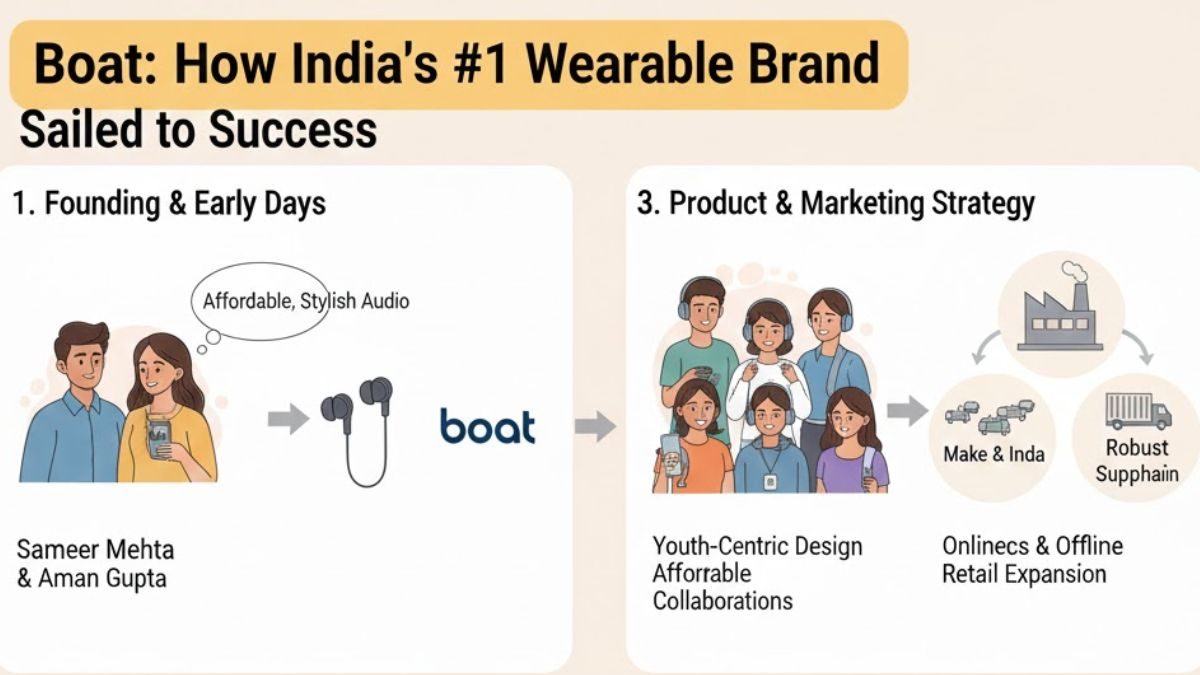
The company was founded in 2016 by Aman Gupta and Sameer Mehta under the parent entity Imagine Marketing Pvt. Ltd.. boAt is headquartered in Mumbai, Maharashtra, and was launched as a digital-first brand focused on urban millennials and Gen Z users. boAt works by designing products in-house, sourcing manufacturing through global supply-chain partners, and selling primarily through online marketplaces and its own direct-to-consumer channels. The company focuses heavily on design, influencer-led marketing, and fast product refresh cycles rather than proprietary hardware innovation.
Since its launch, boAt has raised capital from institutional investors including Warburg Pincus and Fireside Ventures. The company has publicly disclosed strong revenue growth over the years and has been among the top sellers in categories such as earphones and true wireless earbuds in India. While profitability and exact margins are not consistently disclosed, boAt’s scale, valuation, and IPO plans have positioned it as a defining success story in India’s D2C brands ecosystem. This case study examines how Boat built and scaled in India by combining branding, distribution, and operational discipline rather than traditional manufacturing-heavy strategies.
1. The Market Context Before boAt Built Its Empire in India
1.1 The Indian Consumer Electronics Landscape Before boAt
In the years leading up to boAt’s entry, the Indian consumer electronics market was a study in contrasts. At one end, premium global brands like Sony and JBL captured the imagination—and the wallets—of affluent urban buyers, promising cutting-edge technology and design. At the other, the market was flooded with unbranded or cheaply imported gadgets, products that seemed almost disposable. Earphones snapped after a few months, chargers failed unexpectedly, and warranties were often meaningless promises.
For most consumers, audio accessories were functional tools, not lifestyle statements. There was little joy in buying them, no sense of pride in owning them. Yet, beneath this frustration simmered an unspoken yearning: a desire for products that could combine style, reliability, and affordability. Parents buying for teens, young professionals commuting in bustling metros, college students navigating hostel life—all of them shared the same quiet dissatisfaction: “Why can’t good, stylish audio gear exist at a price I can afford?” This gap, as subtle as it was urgent, became the crack through which boAt would later enter. But spotting a gap is one thing; transforming it into a cultural movement is another.
1.2 Audio Accessories: The Overlooked Playground
While smartphones, laptops, and gaming devices drew the bulk of attention and innovation, audio accessories were largely ignored. Manufacturers competed ruthlessly on price, while design, durability, and brand identity were afterthoughts. No one had paused to ask what it felt like to own an earphone that reflected your personality, that made you feel seen in a world of faceless, generic gadgets.
boAt saw what others missed: audio accessories were not just utilitarian; they were deeply personal. They could carry emotion, identity, and aspiration. This realization became the guiding philosophy behind how boAt built and scaled in India. Instead of merely selling a product, boAt aimed to create an experience—something young Indians could rally around, share on social media, and feel proud to own.
This was audacious. Transforming a low-interest, low-involvement commodity into a brand-driven phenomenon required more than marketing; it demanded understanding the pulse of a generation and giving them something to believe in. And boAt did just that, turning ordinary earbuds into cultural symbols, reshaping not just the audio market, but how Indian consumers thought about value, style, and self-expression.
2. Founder Background and Early Motivation
2.1 Aman Gupta’s Industry Exposure
Aman Gupta didn’t stumble into the consumer electronics world by accident. Before boAt, he cut his teeth at global audio giants like Harman and JBL, navigating boardrooms, product labs, and marketing campaigns designed for international audiences. Those years gave him more than technical knowledge—they gave him perspective. He saw how meticulously engineered products often fell flat in India because the market wasn’t just about specs; it was about perception, accessibility, and trust.
Gupta recognized a paradox: Indian consumers cared about quality and style, yet most audio brands treated price sensitivity as a hurdle, not a design principle. A high-quality product might exist, but if it felt inaccessible, it was irrelevant. Conversely, affordable products were often unreliable and forgettable. He began to imagine what it would take to bridge this divide—a brand that could offer premium design at an attainable price, without sacrificing the emotional connection that made people fall in love with a product. This wasn’t just business insight; it was a personal conviction born from years of witnessing both triumphs and failures in the industry.
2.2 Sameer Mehta’s Operational Perspective
Sameer Mehta, boAt’s co-founder, brought a different, equally crucial lens. Raised in a family entrenched in consumer electronics distribution, Mehta had an intimate understanding of the country’s supply chains, import logistics, and the economics of moving products across India’s fragmented retail landscape. He had seen firsthand how even the best product could fail if it didn’t reach the right shelves, in the right quantities, at the right time.
Where Gupta brought brand vision, Mehta brought execution precision. Where Gupta thought about how a product could speak to youth culture, Mehta thought about how it could physically reach that culture without breaking the fragile economics of affordability. Together, they formed a rare synergy: the creative audacity of a marketer married to the disciplined pragmatism of an operations expert.
This combination would define boAt’s DNA. The company’s early strategies—innovative product launches, aggressive digital campaigns, and partnerships with e-commerce platforms—were not just ideas on paper. They were the outcome of two complementary visions converging: one that understood hearts, and one that understood the pathways to reach them. The results spoke for themselves: within the first few years, boAt didn’t just enter the market; it redefined it, proving that emotional branding, combined with operational excellence, could turn even a commodity category into a cult phenomenon.
3. The Origin Story of boAt
3.1 The Spark That Led to boAt
The birth of boAt was as much emotional as it was entrepreneurial. The idea didn’t come from a market report or an investor pitch deck; it came from irritation—the kind that lingers quietly until it demands action. Aman Gupta and Sameer Mehta were tired of replacing earphones that barely lasted a few months. Tangled wires, broken plugs, fading sound quality—these weren’t just inconveniences. They were small, repeated disappointments that reflected a market indifferent to the everyday frustrations of Indian consumers.
They asked themselves a simple but radical question: why should durability be a premium feature? Why should style and reliability exist only in products designed for the affluent? Instead of challenging global giants with massive budgets and decades of legacy, they decided to carve a different path—a local brand that understood India at a granular level.
They envisioned products that aligned with Indian usage patterns: earphones that survived sweaty commutes, rugged urban lifestyles, and college backpacks. They imagined designs that resonated with a youth culture hungry for self-expression, without inflating prices. Pricing psychology, style, and emotional resonance became their compass, turning a personal grievance into a business mission that would soon redefine an entire category.
3.2 Early Experiments and Learning
boAt’s first attempts were simple, tangible experiments: rugged, tangle-free earphones designed to last longer than the typical budget accessory. But ambition alone was not enough. Every product launch was treated as a live experiment. Early adopters offered candid, sometimes harsh feedback, highlighting what truly mattered: build quality, comfortable fit, and warranty support that didn’t feel like an afterthought.
Instead of ignoring criticism, boAt embraced it. They refined materials, improved connectors, and instituted hassle-free replacements. The company’s early focus on customer experience—responding promptly to complaints, honoring warranties, and listening to real-world usage—set it apart in a market where poor after-sales service was the norm.
This feedback-driven approach became a defining philosophy. It wasn’t just about selling gadgets; it was about earning trust, one satisfied customer at a time. These lessons formed the foundation for how boAt built and scaled in India, transforming a commodity category into a brand that people didn’t just buy, but emotionally connected with. Within a few years, these small but deliberate steps would compound into massive loyalty, proving that attentiveness to detail, empathy for users, and a willingness to learn were as powerful as any marketing campaign or technology advantage.
4. Product Philosophy and Evolution
4.1 Designing for Indian Use Cases
From the very beginning, boAt’s product philosophy was simple but profound: design for real people, not for benchmarks. Unlike global audio brands chasing the next technological breakthrough, boAt prioritized usability in the Indian context. They asked themselves questions few brands had considered: How do commuters in sweltering metros experience earphones? How long should a cable endure the daily tug of backpacks, pockets, and gym bags? How should sound feel to a generation obsessed with bass-heavy music and vibrant beats?
The answers shaped every decision. Sweat resistance became a baseline, not a premium add-on. Cables were reinforced to survive the rough-and-tumble of urban life. Sound profiles were tuned to resonate with youth tastes—powerful bass, clear highs, and an immersive audio experience without overengineering. Every design choice was a story of empathy, reflecting lived experiences rather than lab tests.
This approach turned ordinary products into companions for daily life. A boAt earphone wasn’t just a gadget; it was the soundtrack to a student’s commute, a professional’s workout, or a music lover’s escape. It was tangible proof that someone understood the struggles, preferences, and joys of Indian consumers—a trust that competitors had long ignored.
4.2 Expanding the Product Portfolio
Once the brand had earned credibility with earphones, boAt approached expansion with the same care and insight. The move wasn’t random—it was strategic, almost surgical. Each new category—headphones, speakers, smartwatches, true wireless earbuds—was selected based on real demand, gap analysis, and pricing psychology. Every product launch followed a clear playbook: enter a category with aggressive pricing, ensure design and durability met user expectations, and amplify the brand voice boldly and consistently.
This deliberate diversification allowed boAt to grow beyond a single product line. Consumers who trusted the brand for earphones were willing to experiment with headphones or smartwatches, creating a network effect of loyalty and advocacy. By the time true wireless earbuds became the market rage, boAt already had the credibility, distribution, and brand love to make an immediate impact.
The results were tangible: within a few years, boAt’s portfolio spanned multiple high-demand segments, creating multiple revenue streams while reinforcing a single brand identity. More than just a company, boAt became a cultural reference point—proof that understanding user behavior, designing empathetically, and expanding with purpose could turn everyday gadgets into aspirational products.
5. Early Traction and Market Validation
5.1 Leveraging Online Marketplaces
In the early days, boAt didn’t have sprawling retail stores or massive ad budgets. Instead, it turned to India’s rapidly growing online marketplaces—Amazon, Flipkart, and others—as its launchpad. These platforms were more than just distribution channels; they were windows into consumer behavior. Every rating, review, and question was a real-time insight into what users loved, what frustrated them, and what could be improved.
boAt’s products quickly stood out. Rugged designs, bass-heavy sound, and a promise of durability resonated with buyers tired of disposable accessories. Positive reviews snowballed, creating a virtuous cycle: higher rankings attracted more visibility, which drove more sales, which in turn generated even more authentic customer feedback. Within months, boAt was climbing category charts, not because of aggressive marketing spend, but because the products genuinely earned their place.
This early success was more than numbers—it was a confidence boost. It validated the founders’ belief that a brand could thrive on quality, relatability, and design, even in a market dominated by low-cost imports.
5.2 Word-of-Mouth and Youth Adoption
Yet, numbers alone didn’t capture boAt’s most powerful advantage: emotional resonance. College campuses, co-working spaces, and urban cafés became informal arenas of brand adoption. Young Indians didn’t just buy boAt; they recommended it to friends, shared images on social media, and treated it as a badge of personal style. The combination of accessible pricing and aspirational design made boAt feel like a secret advantage—a way to own premium aesthetics without paying premium prices.
This organic, youth-driven momentum was perhaps the most convincing proof of concept. It showed that branding wasn’t reserved for high-ticket luxury items; it could work in everyday, price-sensitive segments if executed with insight, empathy, and cultural relevance. By listening to its early adopters, boAt learned not just what products to make, but how to make its brand feel alive, personal, and essential—a lesson that would underpin every subsequent step in its meteoric rise.
6. boAt Business Model and Revenue Strategy
6.1 Understanding the boAt Business Model
boAt’s business model is a study in precision and focus. The company deliberately chose an asset-light approach, concentrating on areas where it could create the most value: product design, branding, and distribution. Manufacturing was outsourced to trusted partners, allowing boAt to avoid the heavy capital costs and operational complexities of owning factories. This structure gave the brand freedom to experiment with new products, adapt quickly to trends, and scale aggressively across India without being tied down by fixed infrastructure.
Revenue streams followed a straightforward but disciplined logic. boAt primarily earned from product sales, leveraging both online marketplaces and a growing network of offline retail partners. High volumes were the lifeblood of the model—thin per-unit margins were offset by millions of customers across cities, towns, and campuses. Early traction on platforms like Amazon and Flipkart validated this approach: strong reviews, repeat purchases, and rising category rankings proved that the model was not just efficient but emotionally resonant with consumers. Each sale was more than revenue; it was trust earned and loyalty built.
6.2 Pricing and Margin Discipline
Pricing at boAt is both strategic and emotional. The brand deliberately positioned itself between unbranded, low-cost imports and expensive global alternatives, creating a sweet spot that felt aspirational yet attainable. It avoided deep discounting, understanding that slashing prices could undermine the very perception of quality and style that made consumers fall in love with the brand in the first place.
This balance—affordable yet desirable—was central to how boAt built and scaled sustainably in India. By maintaining disciplined margins, the company ensured funds were available for product innovation, marketing campaigns, and customer service initiatives that reinforced its promise of quality. It wasn’t just a pricing decision; it was a statement of brand integrity. Consumers learned that boAt products were reliable, stylish, and fairly priced—a combination that turned early buyers into loyal advocates and created a foundation for the brand’s meteoric growth.
7. Funding History and Investor Confidence
7.1 Bootstrapping to Institutional Capital
In the beginning, boAt was a lean operation fueled by grit, vision, and careful financial discipline. The founders relied largely on bootstrapping, stretching every rupee to maximize impact—investing in design, branding, and customer experience rather than expensive infrastructure. Cash flow was king, and every decision reflected a careful balance between ambition and sustainability.
This period of self-reliance wasn’t easy. Scaling a brand across India’s diverse markets meant navigating logistics, inventory challenges, and marketing on a shoestring. Yet, it was precisely this disciplined approach that built credibility and resilience. When institutional investors finally took notice, boAt had a proven track record of traction, loyalty, and revenue. Fireside Ventures and Warburg Pincus came onboard not just with capital, but with a validation of the brand-first thesis: that a company could thrive in a price-sensitive category by focusing on design, lifestyle relevance, and emotional resonance rather than chasing fleeting trends or technology alone.
7.2 Valuation and IPO Conversations
As boAt’s revenues scaled and its cultural footprint expanded, investor confidence grew. Valuation discussions began to reflect more than just financial performance; they were a testament to the brand’s emotional connection with millions of users. By consistently delivering strong sales, repeat purchases, and widening category leadership, boAt demonstrated that it was not a fad, but a durable brand with long-term growth potential.
Public conversations about a potential IPO underscore the company’s maturity, governance, and ambition. It signals that boAt is ready to evolve from a startup that captured hearts to a corporate entity that can sustain momentum, attract broader capital, and continue innovating. For the founders, it is more than a financial milestone—it is proof that vision, discipline, and relentless attention to consumer trust can turn a personal frustration with disposable earphones into a brand that defines a generation’s audio experience.
8. Go-to-Market Strategy and Distribution
8.1 Digital-First, Not Digital-Only
boAt’s early strategy embraced the power of online marketplaces, but the founders understood that India’s diversity required more than just a digital presence. While platforms like Amazon and Flipkart provided rapid visibility and national reach, limiting the brand to screens alone would have left millions of potential customers untapped—especially in tier-2 and tier-3 cities where offline retail still dominated buying behavior.
The solution was an omnichannel approach. boAt carefully expanded into retail stores, electronics outlets, and lifestyle chains, creating touchpoints where consumers could physically experience the products. This offline presence did more than drive sales—it lent legitimacy. Seeing boAt headphones or speakers on a store shelf alongside established global brands reassured buyers that this was a serious, high-quality brand, not a flash-in-the-pan online fad. By bridging the online-offline divide, boAt ensured that its reach was comprehensive, its credibility reinforced, and its products accessible to every corner of the country.
8.2 Influencer-Led Brand Building
At the heart of boAt’s marketing strategy was a deep understanding of aspiration. The brand didn’t just want to be heard; it wanted to be felt. To achieve this, boAt leaned into influencer and celebrity partnerships, aligning itself with personalities who resonated with its youthful audience. Cricketers, Bollywood actors, and social media stars became not just endorsers, but cultural amplifiers, embodying the energy, ambition, and style that the brand represented.
These endorsements were carefully chosen, not random celebrity tie-ins. They spoke to the dreams and lifestyles of boAt’s target consumers, turning products into symbols of identity. A young professional wearing boAt earphones on a commute or a college student flaunting a boAt speaker at a gathering wasn’t just using audio accessories—they were participating in a cultural conversation, one amplified by influencers they admired.
This approach created a powerful network effect. Every post, review, or mention on social media sparked curiosity and trust, driving organic word-of-mouth. In a category that had long been utilitarian and unremarkable, boAt’s marketing strategy transformed perception, turning everyday gadgets into objects of desire. It wasn’t just selling products; it was cultivating a lifestyle, and in doing so, it redefined how Indian consumers thought about audio accessories.
9. Brand Positioning and Messaging Evolution
9.1 Building a Lifestyle Brand
From the outset, boAt refused to be just another audio gadget brand. The founders understood that in a market crowded with low-cost imports and utilitarian products, functionality alone wouldn’t create loyalty. Instead, they aimed to build a lifestyle brand—one that resonated with passion, energy, and self-expression.
Campaigns were carefully crafted around music, fitness, and urban lifestyles, connecting the brand to moments that mattered in consumers’ daily lives: the rhythm of a morning run, the escape of a late-night playlist, or the confidence of a commuter tuned into their favorite beats. boAt didn’t just sell earphones and speakers; it sold a sense of identity. This emotional positioning allowed the brand to transcend price wars and commoditized competition. Consumers weren’t just buying a product—they were buying into a vision, a culture, a lifestyle that felt aspirational yet attainable.
9.2 Consistency Across Touchpoints
Equally critical to boAt’s brand success was an almost obsessive consistency across every touchpoint. From packaging that mirrored youthful energy to social media content that spoke directly to its audience’s voice, every element reinforced the brand’s personality. Customer interactions, product imagery, website design, and even unboxing experiences were harmonized to deliver the same message: boAt understood you, your world, and your tastes.
This consistency didn’t just enhance brand recall; it built trust. A customer buying their first boAt earphones in Delhi could walk into a store in Pune, pick up a boAt speaker, and experience the same energy, quality, and vibe. That predictability, paired with a strong emotional narrative, created deep loyalty. Over time, boAt evolved from a product company into a cultural reference point, a brand that people recognized, shared, and championed—not just for its functionality, but for the way it made them feel.
10. Key Challenges and Turning Points
10.1 Quality Control at Scale
Growth is exhilarating, but it comes with hidden pressures. For boAt, success brought a new challenge: maintaining quality as production volumes surged. What worked flawlessly for hundreds of units had to perform consistently across hundreds of thousands. Early feedback from customers—earphones with frayed wires, connectors that loosened too quickly—highlighted the risks of scaling too fast.
The response was deliberate and systematic. boAt tightened supplier audits, instituted multi-stage quality checks, and built internal feedback loops that treated every customer complaint as an opportunity to improve. This wasn’t just process optimization; it was a commitment to the promise they had made to consumers: reliability without compromise. Each improvement reinforced trust, turning early frustrations into a signal of responsiveness. Customers who once hesitated became advocates, impressed not only by the product itself but by the brand’s dedication to listening and delivering.
10.2 Competition Intensifies
Success rarely goes unnoticed. boAt’s rapid rise caught the attention of global giants and nimble local startups alike. Established brands began offering aggressive pricing, while new direct-to-consumer entrants emerged with innovative campaigns and products. The threat was real: complacency could quickly erode the hard-won market share.
boAt’s response combined speed, strategy, and creativity. Product launches accelerated, ensuring the brand stayed ahead in key categories like true wireless earbuds and fitness wearables. Marketing campaigns were intensified, leveraging influencers, social media, and youth-centric storytelling to strengthen emotional resonance. But beyond speed, boAt leaned on what set it apart: deep consumer understanding, consistent quality, and an aspirational yet relatable brand identity. Competitors could mimic features, but they couldn’t replicate the trust, loyalty, and cultural connection that boAt had painstakingly built.
These turning points—navigating quality challenges and fending off intensified competition—were defining moments. They tested the founders’ vision, operational discipline, and ability to stay close to consumers. And in overcoming them, boAt not only survived but solidified its position, proving that resilience, empathy, and strategic agility were as critical as design and branding in building a lasting empire.
11. Operations, Supply Chain, and Manufacturing Strategy
11.1 Global Sourcing and Local Assembly
Behind boAt’s sleek earphones, speakers, and smartwatches lies a supply chain engineered for speed, flexibility, and resilience. The company sources components from trusted global suppliers, primarily in Asia, where expertise in audio technology and mass production is mature and reliable. But boAt didn’t stop there—it strategically integrated local assembly and leveraged India’s manufacturing incentives to reduce costs, improve turnaround times, and comply with government initiatives.
This hybrid approach allowed the brand to scale rapidly without investing heavily in physical infrastructure. New product lines could be launched swiftly, production volumes could be adjusted according to demand, and quality could be maintained consistently. It was a delicate balancing act: relying on global expertise while remaining agile and cost-efficient for the Indian market. Every shipment that reached a customer’s hands reflected not just design and brand intent, but a complex orchestration of suppliers, assembly lines, and logistics that the average buyer rarely sees—but deeply experiences in product reliability and timely delivery.
11.2 Inventory and Demand Forecasting
boAt’s operational edge also came from meticulous demand planning. Using data-driven forecasting models, the company tracked consumer trends, seasonal demand spikes, and product lifecycle stages to ensure that inventory levels matched market needs. This reduced the twin risks of overstocking and obsolescence, which can cripple consumer electronics businesses with fast product cycles.
Fast-moving product cycles meant that every quarter could bring new launches, tuned to consumer feedback and emerging trends. By combining forecasting analytics with flexible sourcing, boAt ensured that popular models were always available, underperforming lines could be retired swiftly, and production resources were allocated efficiently. This operational discipline translated into reliability in the market, reinforcing consumer trust. Customers weren’t just buying products—they were buying confidence that boAt understood their needs and would deliver consistently, even as the brand scaled at unprecedented speed.
Through global sourcing, local assembly, and data-driven inventory management, boAt built an operational backbone that didn’t just support growth—it amplified it. The strategy allowed the company to respond to changing tastes, scale nationally, and sustain the quality and accessibility that had become its signature promise to millions of Indian consumers.
12. Competitive Landscape and Differentiation
boAt entered a battlefield crowded with global giants, nimble local startups, and a flood of unbranded imports. Brands like Sony and JBL dominated the premium space with decades of legacy and technological expertise, while low-cost, no-name products captured price-sensitive segments with sheer affordability. For a new entrant, the challenge was daunting: how could a homegrown brand survive, let alone thrive, in such a fragmented and competitive landscape?
The answer lay in clarity of focus and relentless execution. boAt didn’t try to out-engineer global players or undercut unbranded imports on price alone. Instead, it carved differentiation along three key pillars: branding, speed, and disciplined pricing. Its brand wasn’t just a logo—it was a lifestyle statement, resonating deeply with India’s youth through music, fitness, and urban culture. Speed mattered in product launches, marketing campaigns, and supply chain responsiveness, allowing boAt to stay ahead of trends while competitors lagged. Pricing discipline ensured aspirational products remained accessible without eroding perceived value, a balance that competitors often failed to maintain.
This triad of differentiation transformed boAt from just another electronics brand into a cultural phenomenon. Consumers didn’t just buy a boAt product—they bought reliability, style, and a sense of belonging to a community that understood their tastes and ambitions. In a market crowded with options, this focus created a gravitational pull that competitors struggled to match. It wasn’t technology alone that drove boAt’s success; it was an emotional, operational, and strategic clarity that allowed the brand to scale rapidly and sustainably, proving that even in a crowded field, a thoughtfully executed vision could redefine an entire category.
13. Growth Metrics and Public Milestones
boAt’s trajectory has been nothing short of remarkable, a story of rapid expansion and cultural resonance reflected in its growth metrics. Year after year, the brand has reported strong revenue growth, driven not by sporadic hits but by consistent performance across multiple product lines. Headphones, earphones, and more recently, smartwatches and speakers have all contributed to category leadership, with boAt frequently topping industry rankings in India by volume and market presence.
While exact profitability figures remain closely held, the company’s market footprint tells a clear story: millions of units sold, high repeat purchase rates, and a loyal consumer base that spans metros, tier-2 cities, and beyond. Its products are no longer just commodities—they are aspirational symbols of style, lifestyle, and reliability, proving that the combination of design, pricing discipline, and emotional branding can translate into tangible business results.
These public milestones are more than numbers; they are validation of a brand-first, consumer-centric approach. From its early days of bootstrapping and online-only sales to commanding shelf space in retail stores and dominating social media conversations, boAt has built a blueprint for scaling a homegrown brand in India’s competitive electronics market. Each metric—whether market share, volume sold, or social engagement—reflects the careful orchestration of product strategy, marketing ingenuity, and operational discipline.
In the larger narrative, boAt’s growth metrics are proof of something deeper: that a brand born from frustration with disposable earphones could evolve into a market leader, shaping consumer expectations and redefining how India experiences audio. It is a story of vision, execution, and relentless focus, where numbers meet emotion and strategy meets culture.
14. Team Building and Leadership Culture
At the heart of boAt’s rise was a leadership philosophy that balanced control with empowerment. The founders maintained a firm grip on brand decisions—every product, design choice, and campaign was carefully curated to reflect the vision of a brand that could connect emotionally with India’s youth. Yet, when it came to execution, teams were given space to experiment, take ownership, and iterate quickly.
Hiring was unconventional by industry standards. Rather than prioritizing resumes with legacy experience in consumer electronics, the founders sought adaptability, curiosity, and a willingness to learn on the job. Employees who thrived were those unafraid to challenge norms, test bold ideas, and embrace failure as a learning tool. This approach fostered a culture where rapid experimentation wasn’t just tolerated—it was celebrated.
The results were tangible. Product launches happened faster, campaigns could pivot in real time, and insights from the ground fed directly back into strategy. This balance of disciplined vision and flexible execution became boAt’s defining edge: a team capable of moving at startup speed without losing coherence in brand identity. Over time, this culture didn’t just build products—it built a resilient, motivated organization that could scale alongside the ambition of the brand, proving that leadership is as much about people as it is about strategy.
15. Regulatory and Industry Considerations
boAt’s journey was shaped not just by market opportunity, but by the intricate realities of India’s regulatory landscape. From import regulations to mandatory quality standards and e-waste compliance norms, every step in product development and distribution carried layers of complexity. These were not mere bureaucratic hurdles—they were factors that could make or break timelines, influence costs, and shape consumer trust.
Navigating these requirements demanded diligence and foresight. Delays in certification, changes in standards, or missteps in compliance could stall launches or damage credibility. Yet, these challenges also became strategic advantages. By mastering regulatory complexities early, boAt built operational resilience and established barriers that deterred casual entrants. Competitors who underestimated these demands often faltered, while boAt leveraged compliance as a foundation for reliability—a signal to consumers that the brand was serious about quality, safety, and sustainability.
In essence, regulatory navigation was not a constraint to growth; it was part of the scaffolding that allowed boAt to scale confidently, ensuring that every product reaching a consumer’s hands met both expectations and legal rigor.
16. Current Status of boAt
Today, boAt stands as one of India’s most recognizable direct-to-consumer brands, a homegrown success story that has reshaped the country’s perception of audio and lifestyle electronics. From its humble beginnings as a maker of rugged, tangle-free earphones, the company has expanded into a diverse portfolio that includes headphones, true wireless earbuds, speakers, smartwatches, and other lifestyle accessories. Each new product reflects the same design ethos, pricing discipline, and consumer-first mindset that fueled its early growth.
boAt’s presence is more than commercial—it is cultural. The brand has built strong recall among India’s youth, who see it not just as a gadget manufacturer but as a symbol of style, self-expression, and aspirational living. Its products are integrated into daily life, from the commute to the gym, from college hostels to urban homes, creating touchpoints that deepen loyalty and reinforce trust.
The company continues to push boundaries, entering new categories while staying true to the values that made it a household name: durability, design, and an emotional connection with its audience. Its journey illustrates how a brand can grow not just by selling products, but by becoming part of the lifestyle and identity of millions of consumers—a rare feat in a market often dominated by price wars and fleeting trends. boAt today is more than a company; it is a benchmark for how a consumer electronics brand can scale, resonate, and endure in India.
17. How Boat Built and Scaled in India: Future Outlook
The story of boAt is far from over. As the brand looks ahead, its focus is on deepening its identity as a lifestyle powerhouse while continuing to expand its reach beyond urban centers. Offline retail, which has already strengthened credibility in smaller cities, remains a key growth lever, ensuring that the brand is accessible to millions who still prefer seeing and experiencing products before purchase. At the same time, maintaining profitability in an increasingly crowded market will require careful balancing of pricing discipline, product innovation, and operational efficiency.
17. The company’s discussions around an IPO mark a significant evolution
The company’s discussions around an IPO mark a significant evolution. Moving from the agility of a startup to the rigor demanded by public markets will test governance, transparency, and long-term strategic thinking. Yet, this transition also reflects the confidence boAt has earned—from investors, consumers, and the industry alike—proving that a brand built on empathy, insight, and cultural resonance can stand on its own in both private and public spheres.
boAt’s journey offers a blueprint for aspiring D2C brands aiming to capture mass markets without owning factories or inventing new technology. It demonstrates that success lies not in reinventing the wheel, but in understanding people—what they value, how they live, and how a product can become a meaningful part of their daily life. From bootstrapped beginnings to category leadership, boAt shows that a combination of emotional branding, operational excellence, and relentless consumer focus can turn a simple frustration—poor-quality earphones—into a movement that reshapes an entire industry.
In many ways, boAt’s future will be defined by the same principles that drove its past: listening deeply, moving swiftly, and making products that don’t just meet needs, but inspire pride, loyalty, and joy in every user. The blueprint it has created for scaling in India is not just about audio; it is about how a brand can resonate, endure, and become an integral part of people’s lives.
About foundlanes.com
foundlanes.comis an independent Indian platform that documents, analyzes, and publishes in-depth startup case studies, founder journeys, and business insights. It focuses on evidence-based storytelling that explains how Indian companies are built, scaled, and sustained across industries.