News Summary
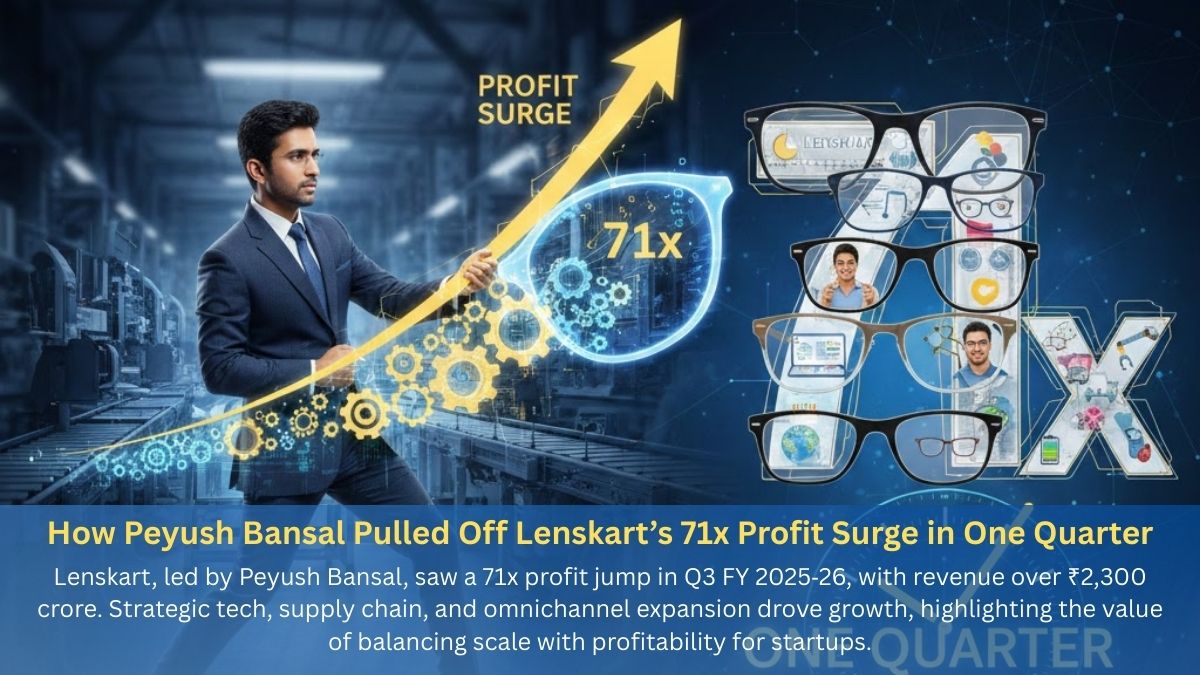
Lenskart’s 71x Profit in the third quarter of the financial year 2025‑26 is one of the most striking earnings results from an Indian startup this year. The Gurugram‑based eyewear company, led by founder and CEO Peyush Bansal, reported a dramatic jump in profit for the quarter ending December 2025. The consolidated profit after tax surged from around ₹1.85 crore in the same period last year to approximately ₹131 crore, representing a roughly 71‑fold increase. Revenue also climbed sharply, rising by about 38.3 percent to over ₹2,300 crore, driven largely by expanded store reach, higher volumes, and substantial growth in customer demand.
This leap did not come from short‑term cost cutting or one‑off accounting adjustments. Instead, the result reflects the payoff from strategic investments in technology, supply chain integration, store network expansion, and strong operating leverage. Peyush Bansal has repeatedly emphasised that the company’s focus on improving unit economics, margin expansion, and scalable operations positioned Lenskart for this moment of profitability after years of fast growth and market building.
As a tech‑enabled omnichannel retailer, Lenskart blends online sales with a growing brick‑and‑mortar presence. The company conducted over 6.3 million eye tests in the quarter, up more than 50 percent year‑on‑year, reflecting deeper consumer engagement. Store additions, particularly in smaller cities, contributed to revenue growth and broader market penetration.
Investors and analysts see this result as validation of Bansal’s long‑term strategy: a shift from a pure growth‑at‑all‑costs model to one that balances expansion with meaningful profitability. Lenskart’s performance, widely covered in startup ecosystem and tech news, holds lessons for other founders navigating scale, cost discipline, and customer value. It also underlines the increasing demand for business models that marry tech innovation with real financial returns in India’s highly competitive retail and startup ecosystem.
1. Background: Lenskart’s Journey to a Breakthrough Quarter
1.1 Founding and Early Vision
Lenskart was founded in 2008 by Indian entrepreneur Peyush Bansal, along with Amit Chaudhary and Sumeet Kapahi. The company’s roots were in tech and retail, and the founders saw a gap in how eyewear was sold in India. For years, glasses and contact lenses were hard to find, expensive, and disconnected from consumer needs. Lenskart set out to change that by combining e‑commerce with an expanding offline presence, creating a seamless omnichannel experience.
Bansal himself had a tech background, having studied engineering at McGill University and later management at IIM Bangalore. He once worked at Microsoft but chose to dive into entrepreneurship, driven by the desire to build something that solved real customer problems and created lasting value.
In its first decade, Lenskart focused primarily on online sales, scaling product variety and brand partnerships, and building customer trust. By designing its own products and later integrating manufacturing into the business. Lenskart could control quality and pricing while offering a broader range than traditional retail competitors.
1.2 Revenue Model and Business Model
Lenskart’s revenue model is rooted in direct product sales. It earns income through prescription glasses, sunglasses, contact lenses, and related eyewear products sold via its website, mobile app, and retail stores. Its omnichannel approach bridges digital ease with in‑person fitting and service, strengthening customer engagement and loyalty. The company also runs membership and loyalty programs that help boost repeat sales. In many recent quarters, these members contributed a significant share of overall revenue. Signaling stronger lifetime customer value and stickier demand.
From a broader tech and startup perspective. This model is typical of successful Indian D2C (direct‑to‑consumer) brands that combine online reach with offline services to improve both sales and customer experience. The emphasis on creating value at every touchpoint helped Lenskart build a loyal base across demographics and geographies.
2. The Making of Lenskart’s 71x Profit
2.1 What Happened in the Third Quarter
In the financial quarter ending December 31, 2025. Lenskart reported net profit after tax of around ₹131 crore. Roughly 71 times higher than ₹1.85 crore reported in Q3 FY25. Revenue climbed to approximately ₹2,308 crore, up 38 percent year‑on‑year. The growth was broad‑based, with India sales up over 40 percent and international revenue rising 33 percent.
This astonishing profitability jump captured headlines in both business and tech news and became a defining example of how operating leverage can change a company’s financial performance without cutting core investments. CEO Bansal described the results as proof that “compounding has begun” and emphasised structural improvements rather than cost slashing.
Revenue expansion came from multiple sources. Store openings accelerated, with 169 new stores in India and 26 abroad added during the quarter. The company also conducted millions of eye tests, up significantly year‑on‑year. Signaling stronger consumer traction for both vision care services and product sales.
2.2 Operating Leverage and Margin Expansion
Key to Lenskart’s performance was improving operating leverage, meaning that as revenue rose, more of each sales rupee flowed into profit. This shift was backed by scale in manufacturing, stronger unit economics, and disciplined expense management. EBITDA (earnings before interest, tax, depreciation and amortisation) surged nearly twofold in the quarter, and margins expanded significantly.
Investors saw this as a turning point. Margin expansion is what allows a fast‑growing company to transform top‑line growth into bottom‑line results. For long‑time followers of Indian startups and venture capital trends, this is crucial because it shows maturity in how startups balance growth with financial sustainability.
2.3 Investments and Strategic Moves Ahead of Profit Surge
Lenskart did not get to this moment by chance. Years of steady investment in technology, vertical integration of supply chain, and retail network expansion laid the groundwork. For example, the company’s manufacturing facility and proprietary product lines helped reduce cost of goods sold and improve control over product quality and margins.
In addition, the firm pursued strategic acquisitions, adding technologies and businesses that complement core operations and broaden future growth options. This diversification helped sustain both revenue and margin momentum.
3.0 Industry Trends and Competitive Landscape
3.1 India’s Retail and Opticals Market
India’s eyewear market is large but historically fragmented. It includes unorganised players, local shops, and niche boutiques. Lenskart’s omnichannel strategy combined with tech and logistics provided a competitive edge by offering convenience, variety, and often better pricing.
E‑commerce growth in India, driven by rising internet penetration and digital payment adoption, benefited tech‑led retail startups. Customers began to purchase not just general goods, but premium and healthcare‑related items like glasses online. This shift allowed brands like Lenskart to scale faster and capture market share from conventional players.
3.2 Competitors and Market Challenges
Lenskart operates in a sector with both direct and indirect competitors.
- Direct competitors include other eyewear brands, D2C platforms, and organised retail players focused on glasses and contact lenses.
- Indirect competition comes from general optical chains and global brands entering the Indian market.
Despite this competition, Lenskart’s mix of proprietary products, technology‑enabled sales, and scale gave it an advantage most rivals have struggled to match. The company’s ability to handle logistics, optimise inventory, and offer both online ordering and in‑person fittings helped it attract customers who value choice and convenience.
4. Leadership and Entrepreneurial Strategy
4.1 Peyush Bansal’s Role and Vision
The remarkable story behind Lenskart’s 71x Profit is inseparable from Peyush Bansal’s leadership journey. For Bansal, profitability was never a target to chase in isolation it was always a reflection of creating meaningful value for customers and building a business model that could endure market shifts. He believes that if the company consistently delivers value and optimizes efficiency, profits will naturally follow a philosophy that turned into tangible results this quarter.
Bansal’s path to this achievement is rooted in diverse experiences. After gaining exposure in tech roles abroad, he returned to India with a vision to merge technology, retail, and customer experience in eyewear. He understood early that online retail alone could not sustain customer loyalty; Lenskart needed omnichannel integration, operational rigor, and a data-driven approach to inventory, supply chain, and customer engagement. Strategic decisions such as pre-IPO buybacks were not just financial maneuvers. They were statements of confidence in the business and its trajectory, signaling to the market, employees, and investors alike that Lenskart was built to last.
Beyond numbers, Peyush’s leadership is marked by empathy and hands-on involvement. Teams describe him as a founder who listens to ground-level feedback, whether from store managers. Engineers, or customers, and uses those insights to drive impactful changes. The 71x profit surge is therefore more than a financial milestone. It is a manifestation of thoughtful leadership, calculated risk-taking, and relentless attention to execution.
4.2 Implications for the Startup Ecosystem
Lenskart’s performance in this quarter sends ripples across India’s startup ecosystem. Investors and founders alike are taking note that scale without sustainable unit economics can no longer define success. The company’s focus on operating leverage, efficient inventory management, and customer lifetime value exemplifies a maturing startup environment where profitability and growth are intertwined.
For emerging entrepreneurs, this moment highlights that success is rarely accidental. It is built over years of disciplined execution, experimentation, and learning from both wins and setbacks. Bansal’s journey demonstrates that even in a hyper-competitive D2C landscape. Startups can achieve extraordinary results by aligning technology, strategy, and customer-centric thinking. Lenskart’s story is now a case study for founders who aim to balance rapid growth with sustainable, repeatable profit generation.
5. Learning for Startups and Entrepreneurs
5.1 Focus on Scale and Leverage
Lenskart’s 71x profit surge demonstrates the transformative power of structural operating leverage. As the company scaled. Fixed costs like technology infrastructure, logistics, and retail operations were spread more efficiently across growing revenue streams. This shift didn’t happen overnight it was the result of years of meticulous planning and constant iteration. By improving unit economics, each pair of glasses sold contributed more meaningfully to the bottom line. For startups, this highlights a crucial lesson: growth alone is not enough. Scaling intelligently, with a clear eye on cost structures and efficiency, can turn modest revenue gains into remarkable profitability.
5.2 Balanced Growth and Profitability
Many startups chase top-line growth at any cost, often sacrificing margins and long-term stability. Lenskart’s Q3 results show a different story. By prioritizing profitability alongside expansion, the company earned the confidence of investors, strengthened its balance sheet, and built a foundation that can sustain future growth. This balance is rooted in data-driven decision-making tracking customer acquisition costs, repeat purchases, and operational efficiency ensuring every move contributes to both scale and resilience. Founders should note that rapid expansion without financial discipline can be seductive but risky, whereas combining growth with profit creates lasting value.
5.3 Long-Term Strategy Matters
Lenskart’s success underscores the importance of long-term investment in fundamentals. Years of building robust technology platforms, optimizing supply chains, and refining customer engagement strategies created a backbone capable of supporting explosive growth. For example, the home-trial model and smart inventory management systems weren’t quick fixes—they were strategic investments designed to improve customer experience and operational efficiency over time. Leaders who stay committed to these core elements can weather market disruptions, economic downturns, or competitive pressures. The lesson is clear: patience, discipline, and strategic foresight compound into extraordinary outcomes.
5.4 Adaptation and Flexibility
Another critical takeaway from Lenskart’s journey is the value of adaptation. The pivot from pure e-commerce to an omnichannel strategy allowed the company to deepen its connection with customers, offer personalized experiences, and expand market reach. Stores became not just points of sale but touchpoints for customer engagement, reinforcing brand trust and loyalty. Startups must embrace flexibility experimenting with business models, testing new channels, and iterating on product offerings. In competitive markets, those who remain rigid in strategy risk being outpaced, whereas those who combine vision with adaptability can uncover hidden opportunities and accelerate growth.
About foundlanes.com
foundlanes.com is India’s leading startup idea discovery platform. It helps entrepreneurs find actionable startup opportunities, market insights, and industry-specific guidance to turn ideas into real businesses. With deep research and practical resources, foundlanes supports founders at every stage, from idea validation to launch and growth.