The D2C Opportunity in India
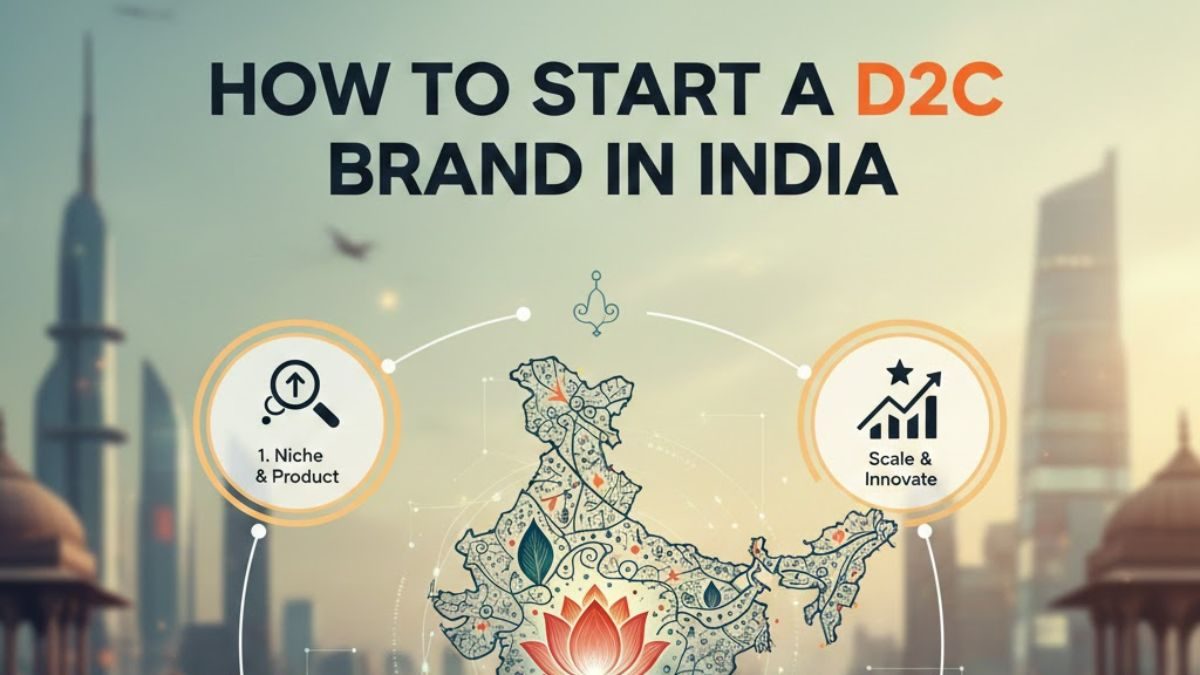
To start a D2C brand in India today is to participate in one of the most meaningful shifts the Indian consumer market has seen since the rise of e-commerce. Direct-to-consumer, or D2C, refers to brands that sell directly to customers without intermediaries like distributors, wholesalers, or large retail chains. Instead of relying on shelf space, these brands rely on storytelling, digital distribution, and direct relationships.
The reason D2C has taken off is simple. Indian consumers are no longer satisfied with anonymous mass products. They want transparency, better value, faster innovation, and brands that speak their language. Founders want control over margins, customer data, and brand narrative. D2C solves both sides of this equation. This opportunity is being seized by first-time founders, legacy manufacturers, creators, and operators across India. From Bengaluru to Surat, Delhi to Coimbatore, anyone with a differentiated product and distribution clarity can start a D2C brand in India today.
Timing matters. India’s internet penetration
Timing matters. India’s internet penetration, UPI adoption, logistics infrastructure, and social commerce boom have aligned. The cost of launching an ecommerce business in India has dropped dramatically compared to a decade ago, while access to customers has expanded. The “how” is no longer mysterious. Brands are built through smart product sourcing in India, Shopify-led storefronts, digital-first D2C marketing strategies, influencer-driven trust, and disciplined execution. Entry costs can range from ₹5–25 lakhs depending on category, with many bootstrapped D2C brands achieving profitability early.
This article is written for FoundLanes.com readers who want depth, realism, and execution clarity. It explains how to start a D2C brand, not as theory, but as a repeatable business model grounded in India’s market realities.
1. Startup Idea Overview
To start a D2C brand is to build a consumer business that owns its product, brand, and customer relationship end to end. The core idea is not selling online. It is owning demand. Traditional brands depended on distributors and retailers to reach customers. D2C brands bypass that dependency. They sell directly through their own websites, marketplaces, and social platforms, using digital storytelling to create trust.
In India, this model has enabled everything from skincare brands and fashion labels to food startups and electronics accessories to scale rapidly. Indian D2C startups like boAt, Mamaearth, Sugar Cosmetics, and Lenskart proved that digital-first brands can become category leaders. The solution D2C offers is control. Control over pricing, margins, customer feedback, brand voice, and innovation cycles. For founders, this control is the real asset.
2. Problem Statement & Solution
For years, the Indian consumer market felt like a maze built to confuse and extract value. Every product you bought traveled through a chain of middlemen, each layer quietly adding cost and complexity. By the time the product reached the customer, the original manufacturer had already lost control of quality, packaging, and pricing. This meant that consumers paid more, but got less—less accountability, less consistency, and less honesty.
Behind the scenes, brands suffered too. Manufacturers worked on wafer-thin margins and faced long, unpredictable cycles of demand. They had no direct connection with the people buying their products. So they relied on distributors, retailers, and agents to deliver growth, even though these intermediaries often had their own priorities. Innovation became slow because feedback came through delayed and distorted channels. When customers complained, the brand often never heard it directly. The result was a market full of generic products, weak differentiation, and a constant struggle to maintain trust.
The D2C model changed this fundamentally. It was not a marketing trend. It was a structural correction. By selling directly to consumers, brands removed the layers that inflated prices and diluted responsibility. This allowed companies to reinvest savings into product development, packaging, customer support, and user experience. The difference wasn’t just in pricing—it was in control. A D2C brand could now shape the entire customer journey, from discovery to delivery.
But the real transformation came from speed. D2C brands operate with feedback loops that are shorter, sharper, and more honest. A product can be launched, tested, and improved within weeks, not months. This agility explains why many of India’s fastest-growing D2C startups outperform legacy brands. They are not just faster—they are closer to the customer. And in a market where trust is fragile, closeness becomes a powerful advantage.
3. Target Audience & Customer Persona
A D2C brand cannot succeed by being “for everyone.” That is the most common mistake founders make. D2C is not mass-market by default. It is niche-first. It requires a clear understanding of who you are serving and why.
In India, the D2C customer is often digitally native, price-aware, and brand-curious. They are the people who scroll through Instagram and YouTube not just for entertainment, but for discovery. They search on Google for real reviews and peer recommendations. tired of generic products and tired of brands that don’t speak their language. value authenticity more than celebrity endorsements because they’ve learned to spot marketing noise from a mile away.
The core audience has been urban millennials and Gen Z, but the most interesting shift is happening beyond the big cities. Tier 2 and Tier 3 India is now driving a large share of ecommerce growth. These consumers are more aspirational, more price-sensitive, and more receptive to brands that speak in regional languages. They want products that feel made for them, not adapted from a “one-size-fits-all” strategy.
Customers choose D2C brands because they feel seen. A D2C brand doesn’t just sell a product. It sells a promise: we understand your life, your problem, and your aspiration. That emotional connection is the real reason customers stay.
4. Market Opportunity & Timing
India’s D2C market has shifted from being an experiment to becoming inevitable. Millions of small brands launch every year, and yes, the competition is intense. But saturation is still far away. The real challenge now is not just building a brand—it’s building a profitable, sustainable D2C brand without endless funding.
Several trends are converging to create this opportunity. Internet access is widespread, and digital payments have removed friction from buying. Logistics networks have expanded into deep pin codes, and the cost of reaching customers has reduced dramatically. Content creation has become democratized, which means that brand stories can be told without expensive production budgets.
This is why now is the right time to launch a D2C brand in India. Customer acquisition is still affordable compared to global markets. Product sourcing is competitive, and India offers cost advantages that many brands in other countries don’t have. But the most important shift is psychological: consumer trust in online brands has matured. People are willing to try new brands if they feel authentic and relevant.
The opportunity is not just about launching brands. It is about building profitable D2C brands that can survive and grow without constant capital injections. That is the real future of D2C in India—and the most exciting part of this new era.
5. USP & Value Proposition
A D2C brand lives or dies by its USP. That might sound like a simple statement, but it is actually the difference between a brand that people remember and one that disappears into the noise. In the D2C world, differentiation is not optional. Distribution alone cannot save a brand that lacks a clear reason for existence.
The value proposition can come from many places: product quality, pricing transparency, design, cultural relevance, or convenience. Some brands win on speed—fast delivery, quick support, instant gratification. Others win through storytelling—building a community, a vibe, or a shared identity. But the strongest brands win by combining both. They solve a real problem and do it in a way that feels personal.
Founders must articulate why a customer should switch. That clarity cannot stay in a pitch deck or a business plan. It must be reflected in every touchpoint—product pages, ads, packaging, and post-purchase communication. Customers can sense when a brand is unsure of itself. They can feel when a brand is merely copying what others are doing. That lack of conviction kills trust.
High-margin D2C products often succeed because they combine functional benefit with emotional appeal. The functional benefit might be better ingredients, a cleaner design, or a faster solution. But the emotional appeal is what turns a first purchase into a lifetime relationship. When customers feel understood, they don’t just buy—they become loyal. And loyalty is the rarest currency in the D2C world.
6. Business Model & Pricing Strategy
The D2C model is straightforward in theory: sell directly to the customer through owned channels. In practice, it requires discipline, patience, and a deep understanding of unit economics. The primary sales happen on the brand’s website, supported by marketplaces for reach and discovery. This is the practical reality of the Indian market. Marketplaces still drive massive traffic, but the brand needs to own the customer relationship. Without that, the business becomes dependent on someone else’s rules.
Pricing strategy is the balancing act between margin and volume. Without distributors, gross margins can range from 50–70 percent in many categories. But marketing and logistics become the biggest costs. Many brands fail because they underestimate these expenses. They price their products based on production cost, not on customer acquisition cost, delivery cost, or return rate. The result is a product that looks profitable on paper but collapses in reality.
Subscription models, bundles, and repeat purchase incentives are not just marketing tactics—they are survival tools. These strategies improve unit economics and reduce reliance on constant new customer acquisition. Many bootstrapped D2C brands focus on early profitability rather than scale-at-all-costs. This discipline helps them survive when marketing becomes expensive or consumer sentiment changes.
The goal is to build a scalable D2C brand where CAC (Customer Acquisition Cost) and LTV (Lifetime Value) remain predictable. When these numbers are stable, the brand can grow confidently. When they are not, growth becomes a gamble.
7. Execution Plan & Launch Strategy
Execution begins with product-market fit. This is where many founders fail—not because the idea is bad, but because they rush. In D2C, the market is unforgiving. If the product does not resonate, marketing cannot save it. Demand must be validated before scale. Many successful brands start with small batches, pre-orders, or marketplace testing. This approach is not a shortcut; it is a learning strategy. It helps founders understand what customers truly want, what they are willing to pay, and what needs improvement. The feedback is direct, fast, and brutally honest.
The first version of the brand should focus on one hero product. This is the product that carries the brand’s identity. Expansion comes later. Many founders fail by launching multiple SKUs too early, diluting focus and resources. The result is a brand that looks broad but feels shallow.
Launching a D2C brand involves aligning product readiness, website experience, logistics, and customer support before spending aggressively on marketing. It is not just about making a product. It is about building a system that can deliver consistently. A brand is only as strong as its weakest touchpoint, and in D2C, every touchpoint is visible. The most successful founders learn to be patient, to listen to feedback, and to respect the grind. D2C is not a sprint. It is a long, emotional journey where trust is earned slowly and lost instantly. And that is exactly why the brands that succeed are the ones that truly understand their customers.
8. Budget, Resources & Infrastructure
Starting a D2C brand in India is not a fixed number. The cost varies widely because D2C is not one business model—it’s a framework. A lean launch can happen within ₹5–10 lakhs, especially for categories like personal care, small lifestyle products, or basic apparel. But for manufacturing-heavy categories like electronics, premium furniture, or large-scale FMCG, the investment can be significantly higher.
The major costs are predictable: product development, inventory, branding, website setup, marketing, and compliance. In the early days, founders often underestimate one hidden cost: returns and quality issues. A product that fails after a few uses becomes a brand liability. That’s why early investment in quality control pays off. Technology stacks today are affordable and scalable, making it possible to build a strong digital foundation without burning capital.
The infrastructure of a D2C brand is usually asset-light. Warehousing can be outsourced. Fulfilment partners handle logistics. This flexibility reduces upfront risk and allows founders to test demand without locking money into fixed assets. But the emotional reality is tougher: outsourcing means you lose direct control. You rely on partners to represent your brand. That’s why the best D2C brands don’t just choose vendors—they choose partners who understand their values.
9. Brand Strategy
Brand is not a logo. perception built over repeated interactions. A strong D2C brand has a clear voice, a consistent visual identity, and a positioning that feels authentic. It knows what it stands for—and what it rejects. In the D2C world, customers are not buying a product; they are buying a feeling. They want to feel understood, respected, and represented.
Brand names are chosen not just for creativity but for memorability and domain availability. Logos are designed for digital-first consumption because most customer touchpoints happen on screens. The tone of communication is conversational, not corporate. Customers today can detect inauthenticity instantly. They can feel when a brand is speaking at them instead of speaking with them.
Online brand building requires consistency across every touchpoint. From product pages to packaging, from social media captions to customer support messages—every interaction must reflect the same personality. The brand is built not by one big campaign, but by thousands of small moments where the customer feels seen.
10. Vendor & Partner Strategy
Behind every successful D2C brand is a reliable vendor ecosystem. India offers depth in product sourcing, but quality control remains the biggest challenge. The market is vast, and it is easy to be overwhelmed by choices. Founders often learn the hard way that cheaper suppliers can become expensive when quality issues start showing up.
Founders evaluate suppliers on reliability, scalability, compliance, and communication. A supplier who can scale with your growth is worth more than a cheaper one who only delivers once. Long-term partnerships outperform transactional relationships because they build trust, reduce risk, and improve consistency. In D2C, consistency is the core of trust.
Logistics, packaging, and technology partners become extensions of the brand. Packaging is not just a box; it is the first physical touchpoint. Logistics is not just delivery; it is the brand promise. The right partners help founders maintain the same standard of experience even as they scale.
11. Go-to-Market & Customer Acquisition Channels
Customer acquisition defines survival in D2C.
Early traction often comes from organic content, influencer collaborations, and word of mouth. This is where the emotional connection is formed. A good product can attract attention, but a strong story makes people share it. In the early stages, founders who build communities rather than customers tend to grow faster.
Paid advertising scales growth once messaging is validated. But paid growth is not a strategy—it’s a tool. Without a clear brand story, paid ads will only bring temporary results. SEO, email marketing, and community-building improve retention and reduce dependence on paid channels. These channels are the backbone of long-term growth.
D2C marketing strategies evolve continuously. What works at launch may fail at scale. The brands that succeed are the ones that keep listening, keep learning, and keep adapting. D2C is not just a business model. It is a relationship built over time—and relationships require constant attention.
12. Growth & Retention Strategy
Growth without retention is expensive. This is a truth that every founder learns the hard way. Many brands focus on acquisition because it feels exciting, fast, and measurable. But the real test is whether customers come back. If they don’t, every rupee spent on ads becomes a temporary win.
Successful D2C brands invest early in building repeat purchase behavior. They don’t wait until the second year or the third funding round. They start with loyalty programs, subscription models, and customer feedback loops from day one. These are not just tactics—they are survival mechanisms. Repeat purchases increase lifetime value and reduce dependence on costly marketing channels. When customers return, it means the brand has delivered value consistently, not just once.
Community engagement is the next level of retention. Brands that build communities turn customers into advocates. A loyal customer becomes a storyteller, sharing experiences with friends and family. That’s how the fastest-growing D2C startups compound. Growth becomes self-sustaining, driven by trust rather than constant spending.
13. Team Structure & Responsibilities
In the early days, teams are small and cross-functional. Founders often wear multiple hats—product, marketing, operations, customer support. This is not a romantic image; it is a daily reality. The founders’ lives become a series of decisions made under pressure, with limited time and resources.
Core hires usually focus on operations, marketing, and customer experience. These are the functions that directly impact the customer and the brand’s reputation. Non-core functions like accounting, logistics, or specialized tech development are often outsourced to reduce fixed costs. This keeps the business agile.
As the brand scales, specialization follows. The team becomes more structured. Roles become clearer. But the early phase always shapes the company’s culture. Founders who build a culture of ownership and accountability early on create teams that can scale without losing speed.
14. Risks, Challenges & Mitigation
D2C is not risk-free. The industry is competitive and fast-moving. Customer acquisition costs can rise unexpectedly, especially when multiple brands compete for the same audience. Inventory mismanagement can block cash and lead to stockouts or overstock. Both scenarios damage customer trust. Competition is intense. Copycats emerge quickly, often offering similar products at lower prices. This can squeeze margins and force brands into a price war.
Mitigation comes from focus, discipline, and strong unit economics. The best brands don’t try to win every battle. They focus on one category, one customer segment, and one core promise. They build a product that cannot be easily replicated. keep track of CAC and LTV like their life depends on it because, in reality, it does.
15. Legal, Compliance & Fundamentals
To start a D2C brand legally, founders must register their business, comply with GST, and follow consumer protection laws. These steps are not just paperwork—they are the foundation of trust. Clear return policies, data privacy compliance, and transparent communication build credibility. When a brand handles returns smoothly and communicates honestly, customers feel respected. That respect becomes loyalty.
Compliance is not optional. It is brand insurance. A single compliance mistake can destroy a brand’s reputation overnight. In D2C, reputation is the most valuable asset. Protecting it should be a priority from day one.
16. Long-Term Vision & Goals
For most founders, the long-term vision is not just revenue. Revenue is a number that can rise and fall with marketing spend, market cycles, or short-lived trends. Brand equity is something deeper. It is the trust people place in your promise, even when you are not present in their lives. It is the emotional relationship customers build with your brand over time. That relationship becomes a legacy.
16.1 Building a Brand That Can Outlast You
In the first year, founders are often obsessed with sales. In the second year, they start chasing scale. But the brands that last think beyond that. They think in 3–5 year horizons. They imagine what the brand will stand for when it is no longer the founder’s baby. plan for a future where the brand exists independently of one campaign or one product.
A D2C brand can expand across categories, geographies, and channels. But this expansion is not automatic. It must be built on a foundation of customer trust and operational discipline. Many brands make the mistake of diversifying too early, chasing growth instead of building depth. When this happens, the brand becomes scattered, the product quality drops, and the customer feels betrayed. The result is a slow, painful decline.
16.2 What Lasting Brands Do Differently
The brands that endure are the ones that build a strong foundation first. They focus on one category, one promise, and one customer segment. They become experts in that space. Over time, they expand carefully and intentionally. They do not expand because they can. They expand because they have earned the right.
Some D2C brands become acquisition targets for larger companies. Others become enduring companies that define a category. But the common trait among both is the same: a strong identity that customers trust. That identity becomes the brand’s shield against competition, price wars, and market noise.
16.3 The Future Belongs to Brands That Listen
The future belongs to brands that listen faster than they sell. In the D2C world, listening is not a soft skill—it is a strategic advantage. Listening creates insight. Insight creates products that truly solve problems. And that is what builds lasting brands.
When founders truly listen, they stop guessing. They stop building what they think customers want. They start building what customers actually need. This is the difference between a brand that grows and a brand that lasts.
In the end, the long-term goal is not to sell more. It is to become irreplaceable. And that requires patience, humility, and the courage to focus on the customer even when no one is watching.
17. Future Outlook
Starting a D2C brand in India today is a bet on decentralized brand power. Distribution no longer belongs to gatekeepers. It belongs to storytellers who execute. As Indian consumers become more discerning, D2C brands will shape culture, not just commerce. The next decade will create thousands of sustainable, founder-led brands. Many will fail, but the ones that succeed will define new categories and new standards.
For readers of FoundLanes.com, the message is clear: D2C is not easy, but it is accessible. With clarity, patience, and execution, building a D2C brand is no longer a privilege. It is a process. A process that can be learned, repeated, and refined.
About foundlanes.com
foundlanes.com is India’s leading startup idea and deep-dive platform built for founders, operators, and serious entrepreneurs. We go beyond surface-level advice to deliver grounded, research-backed, and experience-driven startup content.
Every guide on foundlanes.com is designed to help readers think clearly, act strategically, and build sustainably. This cloud kitchen startup guide is part of our mission to document real business pathways in India’s evolving startup ecosystem.