A Practical Guide to Starting a Food Truck Business in India
At 6:47 pm on a humid Bengaluru evening, traffic crawls near a tech park gate. Helmets come off. Office badges slide into pockets. Hunger arrives quietly before it becomes urgent. On the corner, a matte-black food truck flicks on its lights. Steam rises. A ladle hits steel. Someone orders without looking at the menu because they already know what they want. This is what it means to start a food truck business in India today.
A food truck is not just a vehicle with a kitchen bolted inside. It is mobility meeting timing. It is food reaching people instead of people chasing food. In a country where eating out is emotional, impulsive, social, and deeply habitual, food trucks sit perfectly in the gaps left by restaurants and street vendors alike. Why does this business exist? Because India’s cities have changed faster than their infrastructure. Office hours stretch. Commutes lengthen. Rents explode. Consumers want food that is fast but trustworthy, affordable but branded, familiar but exciting. Food trucks answer all of that without asking founders to burn ₹1 crore before the first customer walks in.
For first-time founders who want a real business
Who is this for? It is for chefs who don’t want landlords dictating their dreams. For first-time founders who want a real business, not a food Instagram page. For professionals tired of PowerPoint but still hungry for control. It is for anyone willing to trade certainty for independence. Where does it work? Everywhere demand gathers briefly and intensely—IT parks, college zones, highways, festivals, residential communities, nightlife clusters. When does it work? Right now. Post-pandemic India prefers open air, quick service, visible kitchens, and brands that feel human.
How much does it take? A realistic food truck investment cost in India sits between ₹8 lakh and ₹20 lakh. Less than most café interiors. More than a street cart. Just enough to make founders careful. This is not a dreamer’s guide. This is a ground-level, lived-in, brutally honest walkthrough of how to open a food truck business in India, written for founders who want to last.
2. Startup Idea Overview
The food truck idea did not arrive in India as a revolution. It arrived as a correction. For decades, Indian food entrepreneurship lived at extremes. On one end were street vendors—low capital, high effort, invisible margins. On the other end were restaurants—high capital, high risk, and dependence on location more than food. The food truck emerged quietly between these two worlds.
To start a food truck business is to accept one powerful truth: location matters, but ownership matters more. A food truck gives founders control over where they operate, when they operate, and who they serve. That control is rare in food businesses. At its core, the idea is operational simplicity disguised as creativity. A compact kitchen. A limited menu. A vehicle designed for movement. A brand that lives on wheels. Unlike restaurants that scale vertically through rent and décor, food trucks scale horizontally—by time, place, and repetition.
In India, food trucks resonate because they feel local even when they are branded. They can sell momos one day and artisanal burgers the next, depending on demand, without renegotiating leases or redesigning interiors. This adaptability is the real innovation. The startup idea works because it respects India’s food psychology. People here don’t eat only because they are hungry. They eat because they pass something tempting at the wrong moment. Food trucks monetize that moment.
3. Problem Statement & Solution
3.1 What Is Broken in the Current Market
Every food business in India begins with friction. Street food is beloved but distrusted. Customers love the taste but worry about hygiene. Cafés are aspirational but expensive. Restaurants are comfortable but inflexible. For founders, the math is even harsher. Rents demand revenue before reputation. Fixed locations punish experimentation.
There is also a visibility problem. A new restaurant hides behind walls, hoping customers find it. A food truck lives on the street, advertising itself by existing. The market is broken because cost structures and consumer expectations are misaligned. People want affordable, clean, quick food. Businesses are forced to charge high prices just to survive.
3.2 How a Food Truck Fixes This Gap
Food trucks don’t fix everything. They fix enough. By removing rent, they lower break-even points. By limiting menus, they reduce waste. staying mobile, they follow demand instead of guessing it. This alignment creates a business that breathes with the city instead of fighting it.
For customers, the solution feels intuitive. They see the food being cooked. They recognize the truck. Pay less than a café and trust it more than a cart. For founders, the solution is psychological as much as financial. Risk becomes visible and manageable. Failure doesn’t trap them in a lease. Success can be moved, duplicated, or paused. That is why food trucks persist even when trends fade.
4. Target Audience & Customer Persona
A food truck does not serve “everyone.” It serves moments, often fleeting ones. The core customer is urban and transitional. They exist in the in-between spaces of the day. Between office and home. Between lectures and deadlines. errands, traffic, and fatigue. They are not planning a meal in advance. They are responding to hunger, convenience, and the quiet need for something familiar after a long stretch of effort.
These customers value speed because time feels scarce. They value predictability because decision fatigue is real. Fair pricing matters, but consistency matters more. They do not return because the food surprised them once. They return because it tasted the same every time, arrived just as quickly, and never made them feel uncertain about what they would get.
In India, food trucks find their strongest footing among young professionals aged 22–40, students balancing schedules, night-shift workers coming off long hours, and families in gated communities looking for easy evenings. This audience is digitally aware but physically rooted. They may discover a truck through Instagram or Google Maps, but loyalty is built through routine. The truck becomes part of their week, not a one-time experience.
Understanding this persona changes operational decisions. Menu design favors items that travel well and cook fast. Operating hours align with traffic patterns and work shifts, not personal convenience. Even portion sizes and pricing reflect the emotional state of the customer in that moment.
Food trucks that misread their audience rarely fail loudly. They fade through empty queues and irregular footfall. The ones that endure are those that understand who they are feeding, when, and why, and then show up consistently to meet that need.
5. Market Opportunity & Timing
The Indian food services market has always been large. What has changed is not its size, but its rhythm.
India is in the middle of a structural shift in how people eat. Eating out is no longer reserved for celebrations or weekends. It has slipped into everyday life. Office cafeterias struggle to keep pace with flexible work hours. Home cooking competes with exhaustion more than intention. Delivery apps solve convenience, but they add fees, waiting time, and emotional distance from the food itself.
Food trucks live in the space between. They offer physical presence without permanence. Visibility without rent-heavy real estate. Familiarity without the formality of a restaurant.
Urban India today is denser, younger, and more impatient than it was a decade ago. Disposable incomes have grown unevenly, but spending on food remains one of the most resilient categories. Even during slowdowns, food does not disappear. It adapts. Portions change. Frequency shifts. Formats evolve.
This is why starting a food truck business step by step today makes sense. Regulations are clearer than they were in the early years of the format. Consumers are more educated about hygiene and pricing. Social media has lowered the cost of discovery. Most importantly, the model has proven demand without tipping into saturation.
The real opportunity is not in copying trucks that already exist. It lies in understanding micro-markets within cities. One neighborhood, one time slot, one craving pattern. Food trucks that read these signals well build steady queues while others wonder why footfall never arrives.
6. USP & Value Proposition
Every successful food truck eventually answers one uncomfortable question with clarity: why this truck and not the next one parked ten meters away? The strongest USPs are rarely complex. They are narrow and deliberate. One dish done exceptionally well. A regional flavor translated into a portable format. A fusion that respects both traditions instead of confusing them.
The value proposition is built on trust more than novelty. Customers trust that the food will taste the same tomorrow as it did today. They trust prices will not jump unpredictably. They trust hygiene will not be sacrificed when the queue grows long. Food trucks that try to cater to every preference dilute their identity. Large menus slow service, confuse customers, and strain operations. The trucks that win commit to a single promise and execute it relentlessly. Loyalty forms faster when customers know exactly what they are coming back for. This is the point where brand stops being decoration and becomes discipline.
7. Business Model & Pricing Strategy
The food truck business model looks simple from the outside. The reality is more exacting. Revenue comes primarily from direct food sales. Some trucks add catering orders, events, or brand collaborations, but daily survival depends on walk-up customers. Every menu item, every price point, must balance accessibility with sustainability. In India, most food trucks price their offerings between ₹120 and ₹350. This places them above street food and below casual dining. Gross margins typically range from 55 to 70 percent, depending on ingredient sourcing, portion control, and wastage management.
Profit is not built on one great day. It is built on repetition. Predictable footfall matters more than viral moments. A well-run truck focuses on steady volume, consistent pricing, and controlled costs. Once operational discipline settles in, a food truck can generate reliable monthly income. The real question founders ask is not whether a food truck business is profitable in India. It is whether they can run it with enough consistency to let that profitability show up month after month.pends entirely on execution, not concept.
8. Execution Plan & Launch Strategy
8.1 Concept Finalization
Every food truck story begins with a choice that feels small but carries disproportionate weight: what will you sell? Many founders pick cuisines emotionally, chasing nostalgia or personal preference. The trucks that endure choose strategically. The ideal concept balances the founder’s skill, ingredient availability, and local demand. It is not enough for the food to be good. It must be feasible under the constraints of a moving kitchen and daily repetition.
Menus must travel well, cook quickly, and withstand the relentless grind of rush hours. Complexity is the enemy in a mobile kitchen. Dishes that look impressive on paper can collapse under heat, humidity, or a long line of impatient customers. Founders who simplify without compromising identity create resilience—dishes that deliver the same experience at 5 p.m. and 9 p.m., rain or shine. The right concept also accounts for logistics: sourcing, storage, waste management. Inexperienced founders discover the hard way that the perfect burrito or sushi roll can be impossible when refrigeration is limited or prep space is tiny. Strategic selection saves time, money, and sanity.
8.2 Vehicle and Kitchen Setup
The food truck is not just a vehicle. It is the foundation of the business. Size and design determine menu flexibility. Too small, and the menu shrinks, speed slows, and staff fatigue rises. Too large, and mobility suffers, fuel costs climb, and parking becomes a nightmare. Kitchen layout dictates service speed. Flow must be intuitive—ingredients, cooking, plating, and payment should move seamlessly from one point to the next. Exhaust systems are more than comfort—they preserve energy and morale during long hours in high heat.
Mistakes at this stage are expensive. Retrofitting a poorly designed truck can cost more than starting fresh. Smart founders learn by observing. They visit existing trucks, watch staff work, map bottlenecks, and design backward from service speed rather than aesthetic ambitions. They plan for cleaning, storage, and emergency contingencies.
A well-designed truck does not just cook food. It sustains staff energy, preserves quality, and allows founders to focus on the business rather than firefighting every day.
8.3 Pilot Launch
The first launch is never about profit. It is about learning.
Pilot launches test everything: locations, rush patterns, pricing, portion sizes, and staff readiness. They expose hidden weaknesses in menu execution and operational flow. Founders who rush to scale without piloting discover failures on live customers, often at the cost of reputation.
During this phase, feedback is currency. Observing how customers move, how long lines tolerate wait times, and how dishes survive transport informs every subsequent decision. Staff training is refined, recipes are adjusted, and service patterns are etched into muscle memory.
Founders who treat this stage seriously build businesses that endure beyond novelty. They understand that the first plate sold is not a victory; the first repeat customer, satisfied after multiple visits, is the true marker of a sustainable food truck.
9. Budget, Resources & Infrastructure
Every food truck journey eventually arrives at numbers. Not the hopeful kind written on a whiteboard, but the hard kind that decide how long a founder can hold their nerve when queues are thin and doubts get loud. Money does not guarantee success in a food truck business. But misunderstanding money almost always guarantees failure.
The food truck business cost in India varies sharply based on city, cuisine, and ambition. Some founders start lean and stay disciplined. Others overspend before the first plate is served. The difference is rarely effort or passion. It is planning. Those who survive respect cash flow early, even when excitement pushes them to upgrade too soon. A basic truck conversion alone can absorb ₹4–8 lakh. Add kitchen equipment and another ₹2–4 lakh quietly disappears. Licenses, branding, and initial raw material purchases feel manageable in isolation, but together they compress breathing room faster than expected. What looks affordable on paper often feels heavy in practice.
Then there are the invisible costs. Fuel, daily cleaning, maintenance, staff meals, broken utensils, and small replacements that add up month after month. Founders who ignore these expenses do not fail suddenly. They bleed slowly. Infrastructure is not about size. It is about flow. A cramped kitchen with poor movement costs more in lost orders and frustrated customers than any premium equipment ever will. Efficiency, not aesthetics, decides how long a truck lasts.
10. Brand Strategy
Food trucks do not get second chances. A restaurant can rebrand quietly. A food truck announces itself every time it parks. The truck, the menu board, the queue, and even the way orders are called out become part of the brand instantly. Branding begins with the name. It does not need to be clever for attention. It needs to be memorable enough to travel through conversation. The strongest food truck names in India sound local even when the cuisine is not. They feel like they belong on the street corner they occupy.
Visual identity carries unusual weight in this format. The truck is a moving poster. Colors must stand out after sunset. Fonts must be readable from across the road. Logos must survive dust, rain, heat, and poor lighting. What works on Instagram must also work at a traffic signal. Brand voice matters just as much. Food trucks succeed when they sound human. Not corporate. Not rehearsed. Customers want to feel they know who is cooking for them, even if they never step inside the kitchen. Strong branding reduces the need for constant promotions. Weak branding forces discounts to do the talking.
11. Vendor & Partner Strategy
Behind every successful food truck is a network of people who never appear in photographs. Vegetable suppliers who deliver before dawn. Meat vendors who maintain consistency week after week. Equipment technicians who answer calls late at night. Packaging vendors who do not cut corners when costs rise. These relationships hold the business together when things go wrong. Choosing vendors is less about price and more about reliability. A cheaper supplier who fails during a weekend rush costs far more than a premium supplier who never misses a delivery. Consistency protects reputation, and reputation protects revenue.
Partnerships extend beyond ingredients and equipment. Event organizers, corporate parks, residential communities, and college campuses create repeat opportunities. These relationships stabilize cash flow and reduce daily uncertainty. Founders who treat vendors as replaceable eventually discover how replaceable they themselves become. Trust, once built on both sides, is one of the most valuable assets a food truck can have.
12.Go-to-Market & Customer Acquisition Channels
Food trucks do not announce their arrival. They simply show up. The first customers usually come not because of a launch campaign, but because the truck exists in the right place at the right time. Location is the true acquisition engine. Footfall, visibility, and timing do the work long before marketing steps in. Promotion only amplifies what location already proves. Social media plays a supporting role, not a starring one. Instagram builds familiarity and recognition. Google Maps builds trust through photos, timings, and reviews. Customer feedback builds momentum over weeks, not days. Influencer coverage may create short bursts of attention, but it rarely builds durability.
The most powerful acquisition channel is repetition. When customers see the same truck parked in the same spot at predictable hours, trust forms without conscious effort. The truck becomes part of their routine, not a discovery. Real growth begins the day customers stop asking what you sell and start asking, “Will you be here tomorrow?”
13. Growth & Retention Strategy
Growth in food trucks is often misunderstood, especially by first-time founders. It is not always about adding more trucks or chasing new locations. Often, it comes from stretching the existing model. Extending late-night hours. Introducing a lunch service where footfall already exists. Catering private events or office orders during slow periods. These moves increase revenue without multiplying complexity. Retention is built on predictability. The same taste every visit. The same portion size. same hygiene standards. same behavior at the counter, even on busy nights. Customers tolerate boredom. They do not tolerate inconsistency.
Loyalty programs only work when the product works first. Points and discounts cannot compensate for fluctuating quality or service gaps. True scaling begins when systems replace memory. Recipes are documented, not remembered. Staff is trained through process, not instruction. The founder steps back from daily firefighting and focuses on decisions. When the business can function without constant intervention, growth becomes sustainable.
14. Team Structure & Responsibilities
Most food truck founders begin alone, or very close to it. Early teams are small by necessity. One cook handling the core menu. One helper managing prep and cleaning. One cashier or service person handling orders. In the beginning, the founder often fills every gap, from procurement to customer interaction. This phase builds deep understanding, but it is not sustainable without structure. Clear role definition prevents burnout and mistakes. Cooking is not service. Service is not procurement. Procurement is not compliance. When responsibilities overlap without clarity, errors multiply and stress follows.
Outsourcing accounting, compliance, and design makes sense early on, but only when founders stay involved enough to understand the numbers and obligations. Delegation without awareness creates blind spots. At its core, a food truck is a people business disguised as a food business. The quality of the experience depends as much on the team behind the counter as it does on what is served from the pan.
15. Risks, Challenges & Mitig15. Risks, Challenges & Mitigation
Every food truck collects bad days the way kitchens collect heat. There are rainy evenings when footfall disappears without warning. Days lost to permissions and inspections. Days when staff does not show up, suppliers arrive late, or nothing seems to move in the right order. These moments are not exceptions. They are part of the rhythm. Weather is the most visible risk. Rain reduces impulse buying. Extreme heat shortens patience. Regulatory changes create uncertainty overnight. Staff turnover breaks flow. Equipment failure can shut down service completely, turning a busy evening into a silent loss.
Mitigation does not begin with solutions. It begins with acceptance. Founders who expect smooth operations are the ones most shaken when reality arrives. Buffers matter. Savings matter. Emotional resilience matters just as much as cash. Diversifying locations reduces dependence on a single spot. Maintaining basic backup equipment limits downtime. Keeping emergency funds prevents panic decisions. None of this removes risk, but it softens impact. Founders who survive are not those who avoid problems. They are the ones who assume problems will come and design their business to withstand them.
16. Legal, Compliance & Fundamentals
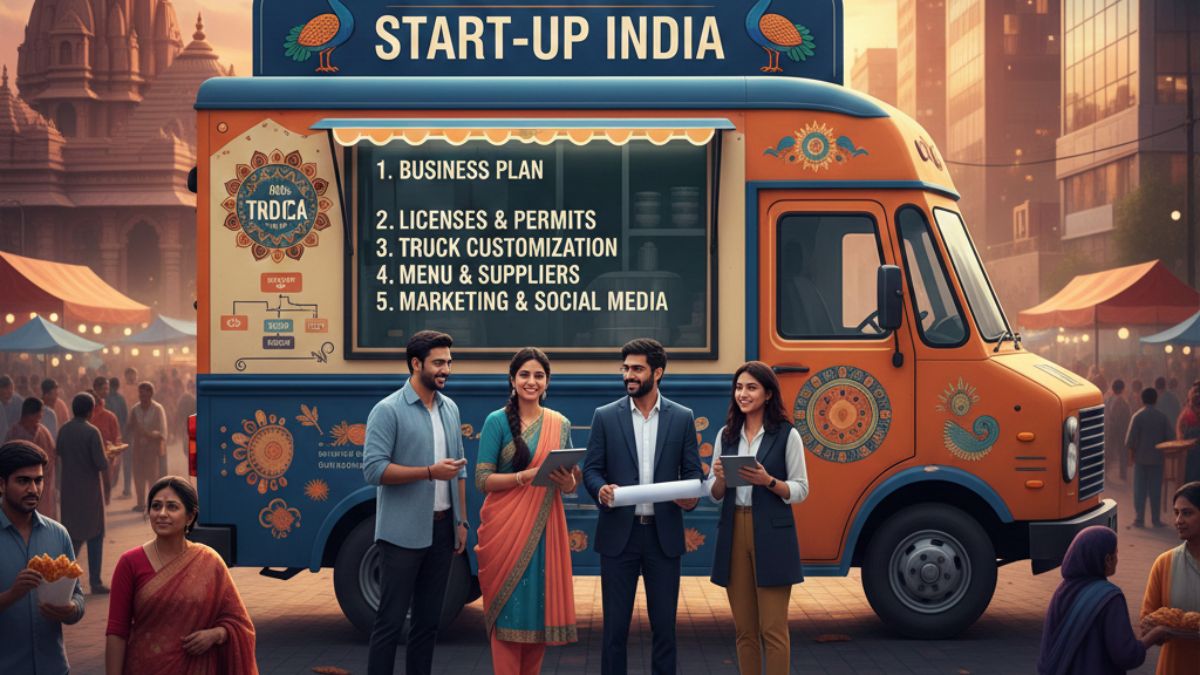
Compliance is where ambition meets structure. To legally start a food truck business in India, founders must navigate multiple authorities, often with overlapping jurisdictions. Food truck license requirements vary by city but usually include municipal permissions, trade licenses, and in some cases police NOCs. These may also be referred to as mobile food vending permits, street food operation licenses, or local body approvals. The terminology changes, but the obligation does not.
FSSAI registration for food truck operations is mandatory across India. Whether called food safety registration, FSSAI food business license, or edible goods compliance certification, it forms the foundation of legal operation. Without it, the business remains exposed, regardless of how well it performs commercially. Additional approvals may include fire safety clearances, pollution certificates, and vehicle fitness certificates. Many founders delay these steps, believing enforcement is inconsistent. Ignoring compliance does not eliminate risk. It postpones consequences, often to the worst possible moment.
Authoritative sources matter here. The official FSSAI portal and state municipal websites provide updated and accurate guidelines. Relying on hearsay or outdated advice leads to costly mistakes. Compliance may feel bureaucratic, but it creates stability. When paperwork is in order, founders sleep better, scale faster, and negotiate with confidence. In the long run, legality is not a hurdle. It is a quiet form of protection.
17. Long-Term Vision & Goals
The first year of a food truck business is survival. The second is stability. The third is choice. By the third year, founders face decisions that shape the story of their venture. Some expand into fleets, multiplying presence across neighborhoods. Others transition into permanent outlets, bringing the brand off wheels and into a brick-and-mortar space. Some license their identity, turning their recipes and reputation into passive income streams. Others deliberately stay small, preserving control and simplicity.
Success is not uniform. It is personal. It is measured not only in revenue but in freedom, pride, and the ability to make intentional decisions rather than reactive ones. A realistic 3–5 year vision includes stable monthly profits, operational systems independent of the founder, and the flexibility to choose growth paths. Metrics that matter are repeat customers, consistent daily sales, cost efficiency, and operational resilience. These are the silent indicators of a truck that can endure—not just survive. Food trucks reward founders who can balance the grind of today with the foresight of tomorrow. Those who focus only on immediate sales often lose sight of longevity; those who plan ahead while executing well create something enduring.
18. Future Outlook
The future of food trucks in India is steady, not explosive. As cities grow denser and real estate costs climb, mobility becomes a strategic advantage. Trucks can reach customers where restaurants cannot. As consumers increasingly value transparency, open kitchens and visible hygiene gain trust. As founders look for low-investment, high-flexibility food ventures, trucks remain an attractive option.
Starting a food truck business in the coming years will require more professionalism than ever. Compliance, branding, and operational consistency will separate the survivors from the experiments. Trucks that lack discipline may still operate, but they will struggle to grow sustainably. Food trucks will not replace restaurants. They will coexist, complement, and specialize. Each will carve its niche. Some will become neighborhood staples. Others will serve late-night cravings. Some will evolve into full-scale brands. And somewhere, at another traffic signal, another truck will switch on its lights, quietly staking its claim in the city’s rhythm, ready to serve the next hungry customer who simply needs something familiar, fast, and reliable.
About foundlanes.com
foundlanes.com is India’s leading startup idea and deep-dive platform built for founders, operators, and serious entrepreneurs. We go beyond surface-level advice to deliver grounded, research-backed, and experience-driven startup content.
Every guide on foundlanes.com is designed to help readers think clearly, act strategically, and build sustainably. This cloud kitchen startup guide is part of our mission to document real business pathways in India’s evolving startup ecosystem.