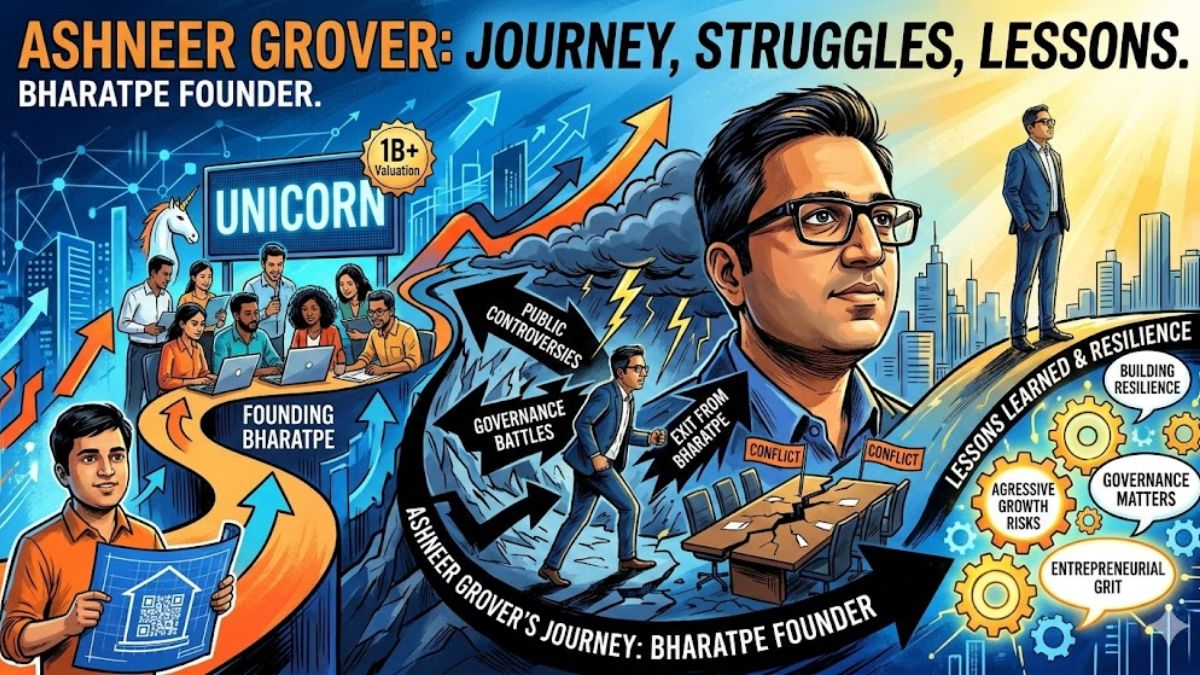
The story of Ashneer Grover BharatPe founder is one of the most talked-about entrepreneurial journeys in India’s fintech ecosystem. Known for his sharp business instincts and blunt public persona, Ashneer Grover rose to national attention after building BharatPe into one of India’s fastest-growing fintech startups and later appearing as a judge on Shark Tank India.
Grover is an Indian entrepreneur and investor who played a key role in building financial infrastructure for small merchants across the country. He co-founded BharatPe in 2018 in New Delhi with Shashvat Nakrani. The company was created to simplify digital payments and financial services for India’s millions of small businesses, many of whom struggled to accept digital payments due to complex systems and high transaction fees.
The idea emerged during a time when India’s digital payments ecosystem was rapidly expanding after the launch of the National Payments Corporation of India backed Unified Payments Interface. While UPI made peer-to-peer transfers easy, small merchants still faced fragmented systems when accepting payments from multiple apps. BharatPe built a simple solution. The startup introduced a single QR code that allowed merchants to accept payments from multiple UPI apps. Over time, the company expanded into merchant lending, financial services, and payment infrastructure for small businesses.
Grover’s entrepreneurial journey did not begin with BharatPe. Before entering the startup world, he built a career in finance and consulting, working at companies like Kotak Mahindra Bank, American Express, and Grofers, now known as Blinkit. However, Grover’s rise also came with controversy and challenges. His tenure at BharatPe ended in a highly public leadership conflict in 2022 that attracted widespread media attention. This long-form founder story explores the Ashneer Grover entrepreneur journey, tracing his early life, career decisions, entrepreneurial struggles, startup growth, setbacks, leadership lessons, and his continuing influence in India’s startup ecosystem.
1. Background and Early Life
1.1 Early Life and Family Background
The Ashneer Grover early life story begins in Delhi, where he was born into a middle-class family. His father worked as a chartered accountant, while his mother was a school teacher. Education and discipline were central values in the household. Growing up in an academically focused environment shaped Grover’s competitive mindset. From an early age, he was encouraged to pursue excellence in studies and analytical thinking. This environment later played a crucial role in his ability to navigate demanding academic institutions and competitive corporate environments.
1.2 Education and Early Influences
Grover studied engineering at Indian Institute of Technology Delhi, one of India’s most prestigious technical institutions. While at IIT Delhi, he studied electrical engineering and developed strong analytical and problem-solving skills. During his undergraduate years, Grover also participated in an international student exchange program at INSA Lyon in France. Exposure to global education systems broadened his perspective on business, technology, and entrepreneurship.
After completing his engineering degree, Grover pursued an MBA from Indian Institute of Management Ahmedabad. IIM Ahmedabad is widely considered one of India’s top business schools, and the experience helped Grover develop strong foundations in finance, strategy, and business management. These academic experiences would later shape the Ashneer Grover startup journey.
2. Founder and Company Overview
2.1 Introduction to the Founder
The Ashneer Grover founder of BharatPe story reflects a mix of corporate discipline and entrepreneurial risk-taking. Before launching BharatPe, Grover built a career in finance and corporate strategy. His early professional years exposed him to banking, payments, and financial systems, industries that would later become the foundation of his startup.
2.2 Professional Career Before Entrepreneurship
Grover began his career at Kotak Mahindra Bank in the investment banking division. This role exposed him to financial markets, corporate transactions, and business strategy. He later joined American Express, where he worked in corporate development. At American Express, Grover gained exposure to global financial products, payments infrastructure, and large-scale financial operations. These experiences helped him understand how payment networks function. Grover later joined Grofers as chief financial officer. At Grofers, he worked closely with the leadership team during a period of intense competition in India’s online grocery market. The experience gave him direct exposure to startup operations and venture capital fundraising.
2.3 Founding BharatPe
In 2018, Grover co-founded BharatPe with Shashvat Nakrani. The startup focused on building digital financial tools for small merchants in India. The company initially launched a QR-based payment solution designed specifically for offline retailers. Merchants could accept UPI payments from multiple apps through a single QR code. The simplicity of the product helped BharatPe gain rapid adoption among small businesses.
3. The Problem, Insight, and Trigger
The BharatPe story began with a stark observation about India’s digital payments ecosystem. Despite a surge in mobile payments, small merchants were struggling. Each payment platform Paytm, PhonePe, Google Pay required separate QR codes, forcing merchants to juggle multiple apps, reconcile transactions manually, and navigate a confusing maze of interfaces. This fragmented experience slowed adoption and frustrated shopkeepers who wanted simplicity.
Ashneer Grover and Shashvat Nakrani recognized an untapped opportunity. Their insight was deceptively simple: if a single QR code could accept payments from all UPI apps, the friction would disappear. This idea wasn’t just about convenience it was a solution to a real operational problem affecting thousands of small businesses. The simplicity of the concept belied the challenge of execution, but it became the guiding principle for BharatPe’s product development and market strategy.
4. Early Days and Initial Struggles
The initial phase of BharatPe was a test of grit, patience, and persistence. The fintech landscape was already crowded with major players like Paytm, PhonePe, and Google Pay. Convincing merchants to try a new platform in such a competitive market required more than a good product—it demanded trust. Grover and his team spent countless hours on the ground, visiting shops, demonstrating the single QR code system, and addressing skepticism directly.
Distribution posed a massive challenge. Many small shopkeepers had never used digital payments before, and some were wary of new technology. Building credibility was critical. Grover’s approach was human-centered: he listened to merchants’ pain points, adjusted the product to meet real-world needs, and personally followed up to ensure adoption. The team learned early that success wasn’t just about technology it was about relationships, trust, and empathy for the people who would rely on their product every day.
5. Failures, Setbacks, and Self-Doubt
Like any high-stakes startup, BharatPe faced moments of doubt and setbacks that could have derailed the journey. The fintech sector is highly regulated, and even small errors in compliance or financial operations could have long-term consequences. Early operational inefficiencies, logistical bottlenecks in onboarding merchants, and technical challenges forced Grover and his team to continually refine their strategy.
There were nights when the founders questioned whether they could scale in a market dominated by billion-dollar players. Yet, their conviction in the merchant-first model kept them moving forward. Every challenge whether regulatory, operational, or competitive became a learning experience. The team iterated on their processes, strengthened their backend systems, and doubled down on support for merchants, slowly turning skepticism into trust.
6. Validation and Early Traction
The first true validation of BharatPe’s vision came when merchants began seeing tangible benefits. Shopkeepers appreciated the convenience of a single QR code that accepted payments from all UPI apps. Daily reconciliation became simpler, and transactions smoother. The product wasn’t just functional—it addressed a real business pain point, which naturally drove adoption.
Word-of-mouth proved powerful. Within months, BharatPe QR codes appeared in thousands of retail shops across Indian cities. The traction was more than numbers; it was evidence that the company had solved a genuine problem. Early users became advocates, strengthening confidence not only among merchants but also among investors who began to recognize BharatPe’s potential. This period of validation laid the foundation for scaling the platform nationwide and set the tone for a merchant-first approach that continues to define the company today.
7. Funding, Money, and Growth Constraints
As BharatPe gained traction, the company’s journey from a single-QR code solution to a full-fledged fintech platform required significant capital. Investors quickly took notice of its unique merchant-first approach. Firms such as Sequoia Capital India, Ribbit Capital, and Insight Partners provided venture funding that became the lifeline for scaling operations. These funds were not just financial injections they were endorsements of the company’s vision and validation of its market strategy.
The funding allowed BharatPe to expand its merchant network aggressively and build new financial products. One of the most transformative moves was launching merchant lending services. Many small businesses in India struggle to access bank credit due to complex documentation, rigid collateral requirements, or slow approval processes. BharatPe stepped into this gap, offering tailored loans that empowered merchants to manage inventory, grow operations, and sustain cash flow. Merchant financing soon became a cornerstone of the company’s revenue model and a clear differentiator in a competitive fintech landscape.
Yet, securing funding was only part of the story. Managing capital efficiently while growing rapidly required discipline, foresight, and constant adaptation. Grover’s team had to balance aggressive expansion with operational prudence, ensuring that every new initiative could scale sustainably. This period of rapid growth was both exhilarating and stressful financial support unlocked opportunity, but it also brought immense responsibility to deliver tangible results.
8. Team Building and Leadership Evolution
No startup can scale without a capable team, and BharatPe was no exception. Grover focused on assembling a high-performance team from the fintech, banking, and technology sectors. Talent acquisition was strategic: the company needed people who could execute quickly, navigate regulatory complexity, and innovate in a competitive market.
Grover’s leadership style became a defining feature of BharatPe. He was known for his intensity, relentless drive, and results-oriented approach. Deadlines were strict, and accountability was non-negotiable. This leadership style pushed the company forward at a pace few competitors could match. Yet, it came with trade-offs. Internal tensions arose as the pressure to deliver high growth collided with individual work styles and organizational culture. Navigating these dynamics required maturity, empathy, and careful mentoring of key executives. Over time, the company evolved not just in scale but in leadership structure, learning to balance high performance with sustainable culture.
9. Growth, Scaling, and Operational Challenges
Scaling BharatPe across India’s vast merchant ecosystem was a herculean task. The company expanded beyond payments into lending, onboarding millions of merchants and processing billions of dollars in transactions annually. Partnerships with banks and financial institutions extended its product suite, including credit lines, insurance, and payment infrastructure. Each addition brought complexity not just in technology, but in operations, compliance, and risk management.
Regulatory compliance became a constant priority. BharatPe had to ensure that its products met financial regulations while still being user-friendly for small business owners. Risk management systems were implemented to assess creditworthiness and minimize defaults. Operational discipline became critical as the scale of transactions grew exponentially. Even minor system failures could disrupt merchant operations and erode trust built over years.
These challenges tested every aspect of BharatPe’s leadership from governance to strategic decision-making. The experience demonstrated that scaling a fintech company in India requires more than innovation; it demands resilience, adaptability, and a deep understanding of both technology and the human side of business. Grover and his team learned firsthand that rapid growth can only succeed when backed by strong operational foundations, rigorous financial discipline, and an unwavering commitment to the people who depend on the platform.
10. Personal Sacrifices and Burnout
The Ashneer Grover journey with BharatPe was not just about business it was a test of personal endurance. Building a startup at breakneck speed meant relentless working hours, continuous travel across cities, and making high-stakes decisions every single day. The pressure of scaling a fintech platform that handled billions in transactions weighed heavily, not just on the team but on Grover himself.
Public attention added another layer of intensity. Grover’s appearance on Shark Tank India made him a household name, admired for his boldness and candid communication. Yet, visibility came with scrutiny. Every statement, decision, and leadership choice was dissected in the media. The fame amplified criticism, creating stress that went beyond boardrooms and merchant meetings. Behind the confident, sometimes brash persona was a founder confronting the human cost of entrepreneurship sleepless nights, mental fatigue, and the constant push to deliver against enormous expectations.
11. Lessons, Beliefs, and Values
Grover’s experience offers a masterclass in the realities of startup leadership. Speed, he emphasizes, is not optional; in a competitive market, hesitation can be fatal. Calculated risk-taking is another core philosophy without bold moves, early-stage startups rarely break through entrenched incumbents.
Equally important is a focus on solving real-world problems. The BharatPe QR code system was born out of empathy for merchants, not simply as a technological experiment. Grover believes that startups succeed when products directly address the pain points of their users. Resilience is non-negotiable: setbacks, regulatory hurdles, and operational failures are inevitable, but founders must persist through uncertainty, learning and iterating relentlessly.
These beliefs shaped BharatPe’s culture: fast execution, problem-focused innovation, and uncompromising standards for results. They also provide a blueprint for aspiring founders navigating India’s complex startup ecosystem.
12. Present Challenges and Future Vision
The later chapters of Grover’s BharatPe story are among the most widely discussed in India’s startup circles. In 2022, governance disputes with the board culminated in his resignation. The controversy sparked national media attention, turning a founder’s operational and strategic decisions into public debates about leadership, ownership, and corporate governance.
Despite this, Grover has remained deeply engaged in India’s startup ecosystem. He continues to mentor founders, invest in early-stage startups, and share insights from his journey. His story marked by both meteoric success and intense scrutiny serves as a reminder that entrepreneurship is as much about human resilience as it is about innovative products. The lessons from his tenure at BharatPe resonate beyond fintech, offering guidance on leadership, accountability, and the balance between ambition and sustainability in high-pressure startup environments.
13. Future Outlook
The Ashneer Grover success story India continues to evolve. While his tenure at BharatPe ended amid controversy, his influence on India’s fintech ecosystem remains significant. BharatPe itself continues to operate as a major merchant payments platform. Grover’s journey offers lessons about ambition, speed, and the risks that come with aggressive growth. For entrepreneurs studying the Ashneer Grover BharatPe journey, the story highlights both the opportunities and complexities of building high-growth startups in India. His career illustrates how founders can rise rapidly in the startup ecosystem but must also navigate leadership challenges, governance expectations, and public scrutiny. The Ashneer Grover startup lessons therefore extend beyond fintech. They reflect broader truths about entrepreneurship, leadership, and resilience in the modern startup world.
About foundlanes.com
foundlanes.com is a digital platform dedicated to documenting founder journeys, startup case studies, and business insights from across India’s entrepreneurial ecosystem. The platform publishes long-form stories that explore how startups are built, scaled, and sustained, offering readers deep insights into the strategies, struggles, and lessons behind modern entrepreneurship.