
Summary
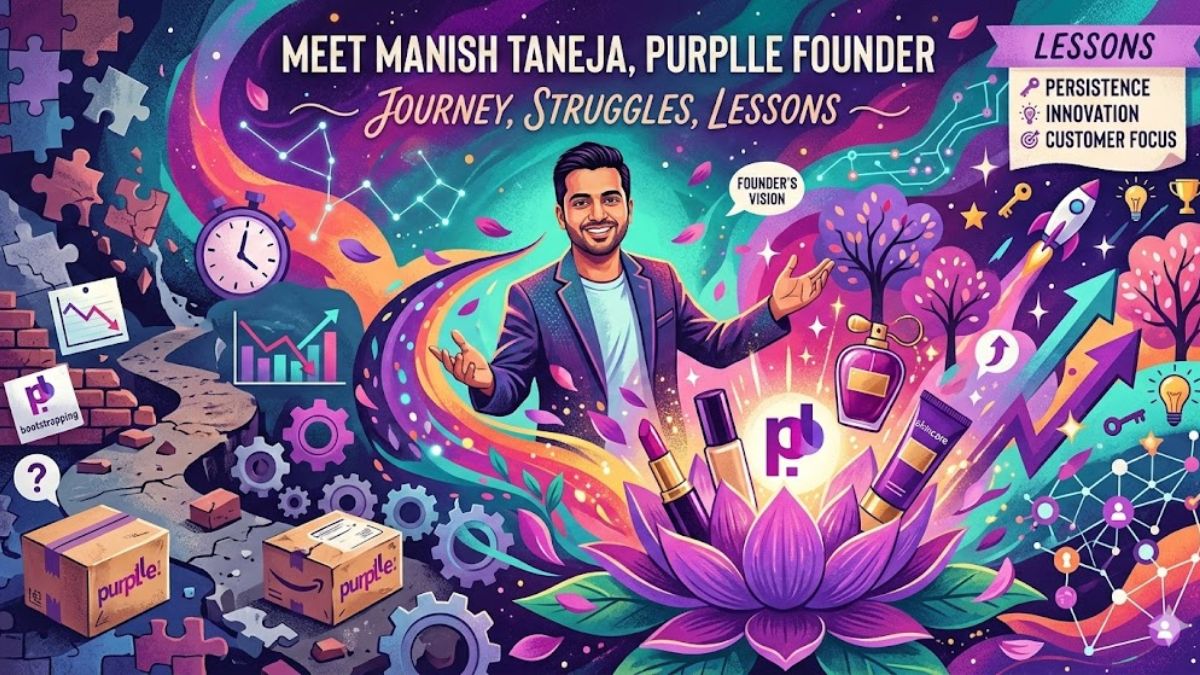
Manish Taneja is the co-founder and chief executive officer of Purplle, the Indian beauty ecommerce platform that has become a household name for beauty and personal care products across the country. What began in 2012 as a small online shop has grown into one of India’s most closely watched beauty startups, valued above $1 billion and backed by top global investors including Goldman Sachs, Sequoia Capital India, ADIA, and Premji Invest. Based in Mumbai, Purplle serves millions of customers with an expansive catalogue of over 60,000 products from more than 1,000 brands, including its own private-label offerings such as Good Vibes, Carmesi and NY Bae.
Taneja’s journey to founding Purplle began with an education in engineering at the Indian Institute of Technology Delhi, followed by stints in the financial services industry where he worked with Fidelity Growth Partners India and Avendus Capital. These early professional roles shaped his analytical approach and gave him deep exposure to business strategy and investment thinking. Along with co-founders Rahul Dash and Suyash Katyayani, he chose to pursue the underserved beauty space at a time when ecommerce was still finding its footing in India.
The company’s core insight was simple but powerful: Indian consumers
The company’s core insight was simple but powerful: Indian consumers, especially in tier II and tier III cities, were hungry for quality beauty products but had limited access, trust, or choice online. By leveraging+ technology, data-driven decision-making, and a marketplace ecosystem that blended international brands with strong private labels, Purplle has carved out a distinct place in the market. Today the platform is not just a marketplace but an omnichannel business with growing offline presence, innovative product recommendations powered by proprietary tools, and plans to deepen its footprint both online and offline.
This long-form profile explores how Taneja identified the opportunity, navigated challenges in the early years, dealt with self-doubt and setbacks, found validation, raised capital, built a team, scaled a complex business, faced personal and professional pressures, and continues to lead Purplle with a clear vision for the future.
1. Background and Early Life
Manish Taneja’s early life shaped his analytical mindset and later entrepreneurial instincts, though much of his personal upbringing remains private in the public record. What is well documented is that he pursued engineering at the Indian Institute of Technology (IIT) Delhi, where he studied electrical engineering. IIT Delhi exposed him to a rigorous academic environment and to peers who would go on to become some of India’s most influential entrepreneurs.
While at IIT, Taneja developed a fascination with technology and business. He saw how innovators from his peer group were transforming industries by harnessing digital tools and data. These observations planted early seeds of ambition to start something on his own. Graduating with strong technical foundations, he went on to pursue opportunities in financial services, believing that exposure to finance would help round out his understanding of strategy and business execution.
After graduating in 2007, Taneja entered the workforce at the height of global economic uncertainty. His first professional role was at Lehman Brothers during the 2008 financial crisis, an experience that taught him resilience and grounded his understanding of markets under stress. After Lehman’s collapse, he moved into investment banking and private equity roles at firms such as Avendus Capital and Fidelity Growth Partners India. In these positions he gained exposure to corporate growth strategies, financial analysis, and capital markets, insights that would later serve him well as a founder.
It was during these early professional years in Mumbai, while working with financial teams and industry executives, that Taneja began having conversations about entrepreneurship and the possibilities of building a technology-enabled consumer business. These discussions with peers and mentors helped crystallize his desire to start a company of his own, rather than build a long corporate career in finance.
2. Founder and Company Overview
2.1 Introduction to the Founder
Manish Taneja is best known as the co-founder and CEO of Purplle, the online beauty and personal care platform that has become one of India’s most successful ecommerce startups. His leadership is defined by a blend of technical rigor, strategic thinking, and an ability to anticipate market shifts well ahead of peers.
Under his guidance, Purplle has grown from a startup with modest beginnings to a company with millions of monthly active users, extensive product listings, and multiple strong private brands. Taneja’s vision for democratizing beauty access, especially for underserved consumers outside major metro areas, continues to shape the company’s culture and strategy.
2.2 Company Overview and Offerings
Founded in 2012 and headquartered in Mumbai, Purplle began as an online marketplace for beauty and personal care products. At a time when the space was dominated by general ecommerce platforms and a few niche players, Purplle focused on building a dedicated destination for cosmetics, skincare, haircare, fragrance, and wellness products.
Today, Purplle’s platform hosts over 60,000 products from more than 1,000 national and international brands. It also features a portfolio of private label brands such as Good Vibes, Carmesi, NY Bae, and Faces Canada. These brands are developed to offer quality alternatives at accessible price points, often with strong margin profiles for the company.
More recently, Purplle has embraced an omnichannel strategy, opening physical stores and assisted retail outlets across India. This reflects a broader understanding that beauty retail, even in a digital age, benefits from tactile experiences and personal consultations especially in smaller cities and towns where consumer trust and product exploration remain important.
2.3 Target Audience and Market Served
Purplle’s target audience spans urban, semi-urban, and rural consumers, with a strong emphasis on women aged 18 to 45 who are engaged with beauty, personal care, and lifestyle trends. The platform’s technology-driven recommendation systems and personalized interfaces help tailor experiences to diverse consumer needs and preferences.
Significantly, over 60 percent of Purplle’s revenue is reported to come from tier II and tier III cities, a demographic often overlooked by early ecommerce beauty players. Taneja and his co-founders believed that aspirational buyers in these markets wanted quality products at fair prices but had limited access to curated offerings. Purplle addressed that gap by democratizing choice and using technology to match products with individual user preferences.
2.4 Year of Founding and Business Stage
Purplle was founded in 2012, two years before Nykaa, another well-known beauty startup. From its early days as a purely online marketplace, the company has steadily expanded its reach and offerings. Strategic investments in private brands, proprietary technology, and an omnichannel retail presence have marked its evolution from a niche ecommerce platform to a beauty-focused consumer brand with both digital depth and offline access.
Today, Purplle stands as a mature startup with unicorn status, having raised substantial funding and achieved meaningful scale in gross merchandise value (GMV) and customer engagement. Its presence across India both online and in physical stores positions it for continued growth as a leader in beauty ecommerce.
3. The Problem, Insight, and Trigger
3.1 Core Problem Identified
When Taneja and his co-founders examined the Indian beauty ecosystem, they saw a market ripe for disruption. Traditional retail channels were dominated by fragmented distributors and legacy outlets, while general ecommerce platforms did not offer specialized, curated experiences tailored to beauty and personal care. Brands often overlooked the needs of consumers outside major metros, who had limited availability and choice in quality products.
This gap meant many Indian beauty buyers either stuck with familiar local products or resorted to expensive brands that were not easily discoverable online. Further, buyers in smaller towns lacked trusted channels for exploring new products, exacerbating the challenge. Purplle’s founders viewed this as a structural opportunity rather than a niche gap.
3.2 Personal Insight Behind the Idea
Taneja’s time in financial services had given him a front-row seat to how customer behaviour was shifting with the rise of mobile internet and ecommerce. He saw that beauty and personal care was a category with high margins, frequent repeat purchases, and emotional engagement ideal for an online marketplace with strong data insights.
The team believed that a data-driven platform could help consumers discover products more meaningfully than generic ecommerce sites. This insight led Purplle to invest early in a proprietary toolset that could analyse beauty data points, anticipate trends, and personalise recommendations. Such a technological backbone was uncommon among beauty retailers at that time, giving Purplle an edge.
3.3 Trigger Moment to Start
The actual trigger for launching Purplle came in the early 2010s when smartphones started becoming mainstream in India and digital commerce began reshaping consumption habits. Taneja and his co-founders recognised that this shift would unlock new demand for beauty products if supported by easy discovery, transparent information, and wide selection. They founded Purplle in 2012 with this vision, deploying personal savings and early seed investments to bring the idea to life.
4. Early Days and Initial Struggles
4.1 Early Assumptions and Naivety
In the initial phase, the Purplle team assumed that consumers would readily embrace an online-only beauty marketplace. They believed that good selection and competitive prices would drive rapid growth. But beauty products are inherently tactile, and trust plays a big role in purchase behaviour—especially when consumers are exploring new brands or categories. Convincing customers to buy lipstick, foundation, and skincare without trying them in person was harder than anticipated.
The founders also underestimated the complexity of logistics and supplier relationships in beauty retail. Managing long-tail SKUs, dealing with expiry dates, ensuring authentic products, and maintaining reliable delivery networks quickly proved to be challenging in the early years.
4.2 Entrepreneurial Initial Struggles
Early traction was slow. With limited marketing budgets and stiff competition from larger ecommerce players offering discounts and cashback, Purplle had to fight for visibility and customer attention. Lack of initial demand made it difficult to negotiate favourable terms with suppliers, and margins were tight.
Moreover, the company struggled to build a technology stack robust enough for personalisation at scale. Building a data infrastructure capable of analysing millions of beauty data points required patience and investment, yet early resources were stretched thin.
4.3 What Turned Out to Be Harder Than Expected
What the team didn’t fully anticipate was the need to educate consumers. Many buyers in India were unfamiliar with online marketplaces dedicated to beauty. They needed guidance, reviews, and recommendations before feeling confident about purchasing products online. This insight shifted Purplle’s early strategy toward content, recommendations, and tools that could assist discovery.
Further, competition in the beauty ecommerce segment intensified quickly, with well-funded rivals like Nykaa attracting customers and press attention. Purplle had to differentiate itself not just on price, but on understanding niche customer needs, especially outside major cities.
5. Failures, Setbacks, and Self Doubt
Purplle’s journey was not a straightforward climb. There were phases where growth lagged expectations, consumer trust was slow to build, and operational complexity strained the young team. During these moments, Taneja and his co-founders had to confront self-doubt and pressure from stakeholders. One such setback was when initial user engagement failed to scale rapidly despite investment in marketing. The team had to reassess its approach, pulling back from broad digital campaigns to focus on targeted regional engagement, community building, and curated product experiences.
Operational failures, such as delayed deliveries, inventory mismatches, or poor initial customer reviews on quality or packaging, also created emotional lows within the leadership team. In an industry where trust is critical, these issues demanded swift responses and quality improvements. At times, Taneja faced internal pressure to pivot or change strategy rapidly. Balancing investor expectations against a long-term vision tested his resolve. But he leaned on core beliefs about customer needs and the underlying opportunity in the beauty space, staying committed to refining the company’s model rather than abandoning it.
6. Validation and Early Traction
6.1 First Real Validation or Customer
The first meaningful validation came when Purplle began seeing repeat purchases and positive reviews from its early user base. Instead of just attracting one-time buyers, the platform started to build loyal customers who returned for multiple categories of products. These repeat transactions signalled that consumers truly valued the curated selection and personalised experience Purplle offered.
6.2 Early Revenue Growth or Feedback
By 2015, Purplle had secured its first institutional funding from IvyCap Ventures, a milestone that provided not just capital but external validation of its business model and potential. This investment encouraged the team to double down on technology, data, and marketplace expansion. Further funding rounds followed, including a Series C led by Goldman Sachs and Verlinvest that raised over $30 million in 2019, enabling Purplle to build supply chain strength and brand partnerships.
By 2022, a significant Series E round took Purplle to unicorn status with a valuation exceeding $1.1 billion. Strong growth in gross merchandise value (GMV), a diversified product ecosystem, and rising monthly active users reinforced belief in the company’s mission.
6.3 Why This Moment Changed Belief
Securing marquee investors and achieving unicorn status transformed internal belief at Purplle. It signalled that the market, investors, and users saw value in the company’s differentiated position. For Taneja, this moment confirmed that the long-term strategy was working: combining technology, private brands, and marketplace depth to serve diverse customers nationwide.
7. Funding, Money, and Growth Constraints
From the outset, capital was both an enabler and a constraint for Purplle. Early seed funding in the mid-2010s allowed the company to build technology and inventory infrastructure. But scaling an ecommerce business especially in categories like beauty with wide SKUs and complex supplier networks—required substantial capital. The company raised over INR 1,500 crore collectively over multiple rounds, partnering with prominent investors such as Goldman Sachs, Blume Ventures, Sequoia Capital India, JSW Ventures, Premji Invest, and Paramark Ventures.
A landmark funding event in 2024 saw a Rs 1,000 crore investment led by a subsidiary of the Abu Dhabi Investment Authority, a vote of confidence in Purplle’s strategy and operational maturity. Despite strong funding, growth constraints surfaced in inventory financing, logistics optimization, and customer acquisition costs. Balancing growth with disciplined spending on marketing and technology was a tightrope walk. At times, the company had to prioritise features or geographic expansion that aligned with available capital, rather than pursue every opportunity at once.
8. Team Building and Leadership Evolution
8.1 Early Hiring Mistakes
In its first years, Purplle made some of the common hiring missteps that many startups face: scaling teams too quickly in some functions while under-resourcing others. Recruiting talent with expertise in beauty retail, data science, and customer experience was challenging in a market where technology jobs were booming. Mistakes in early hiring sometimes led to misaligned expectations or slower execution in critical functions like product curation or supply chain management.
8.2 Delegation Challenges
As the team grew, Taneja faced the classic founder’s challenge of delegation. Trusting leaders to own categories, markets, or functions required building clear performance structures and decision rights. Learning to step back from day-to-day decisions and empower teams was a key leadership evolution for him.
8.3 Leadership Learnings Over Time
Over time, Purplle developed a leadership culture that blended data-driven decisions with customer empathy. Investing in training, career progression, and accountability helped build a cohesive leadership team capable of taking strategic initiatives. This evolution allowed Taneja to focus more on vision, partnerships, and long-term growth.
9. Growth, Scaling, and Operational Challenges
9.1 Brand Positioning and Go-to-Market Learnings
Purplle positioned itself not merely as a marketplace, but as a trusted beauty destination. This required investments in technology that personalised discovery and built relevance. The platform’s Beauty Intelligence Suite helped match products to consumer needs by analysing millions of data points. Marketing strategies evolved from broad online ads to targeted campaigns that resonated with consumers in tier II and tier III cities, where personalised beauty guidance was particularly valued.
9.2 Scaling Challenges
Scaling operations across India brought challenges in logistics, quality assurance, customer service, and delivery timelines. Managing a mix of third-party seller products and private labels required robust supply chain systems. Operational complexities also emerged with offline expansion. Integrating physical outlets into an omnichannel experience demanded investments in staff training, technology for inventory sync, and store-level customer engagement.
9.3 Operational Breakdowns and Fixes
Synchronising online and offline inventory was an early operational pain point. Purplle responded by building stronger inventory systems and technology interfaces that could manage orders, returns, restocking, and fulfilment more efficiently. Network optimisation for faster delivery became a priority, leading to partnerships with regional logistics providers and investments in warehouses closer to demand hotspots. These steps helped reduce lead times and improve customer satisfaction.
10. Personal Sacrifices and Burnout
Running a high-growth ecommerce startup inevitably places personal demands on founders. For Taneja, balancing strategic decisions, investor relations, team leadership, product innovation, and customer focus required long hours and mental stamina. Sacrifices in personal time and work-life balance were part of the journey, though specific personal anecdotes are private in the public narrative. The emotional pressure to compete with larger rivals, justify investor expectations, and lead through uncertain market conditions tested endurance at various points. Coping with these pressures involved building support structures within the leadership team and learning to prioritise well-being alongside business outcomes.
About foundlanes.com
foundlanes.com is India’s leading startup idea discovery platform. It helps entrepreneurs find actionable startup opportunities, market insights, and industry-specific guidance to turn ideas into real businesses. With deep research and practical resources, foundlanes supports founders at every stage, from idea validation to launch and growth.