Summary
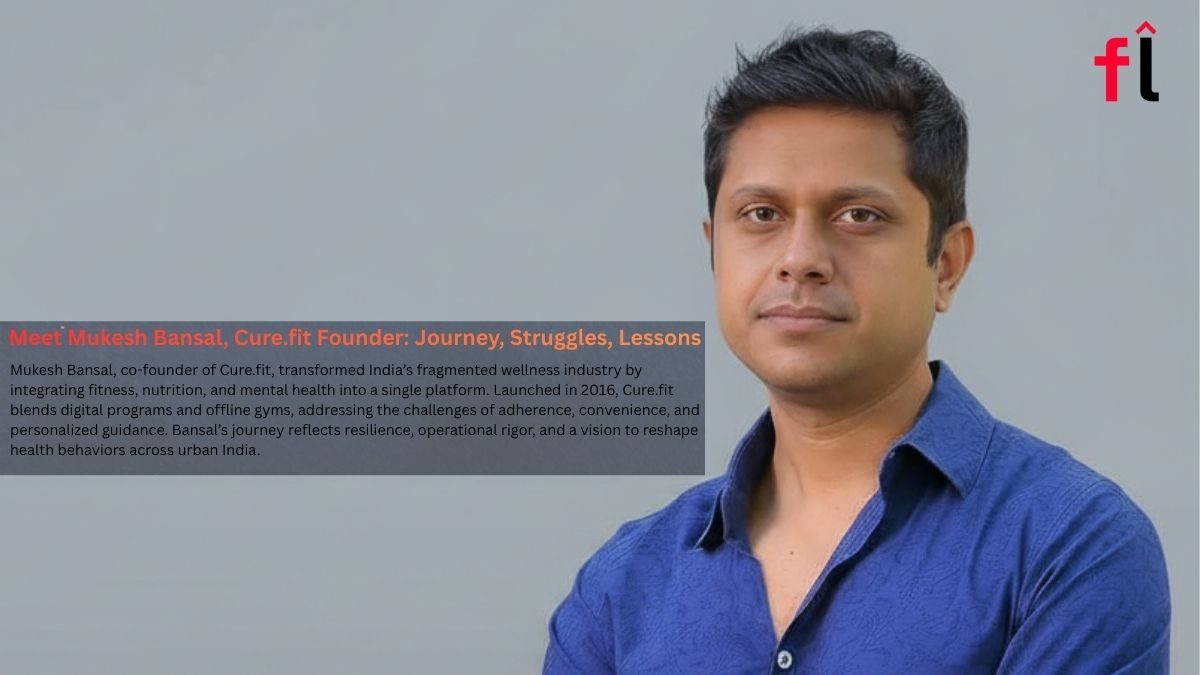
Mukesh Bansal, a veteran of India’s tech and entrepreneurial ecosystem, is best known as the co-founder of Cure.fit, a health and wellness platform that reimagined the way Indians approach fitness, nutrition, and mental well-being. Cure.fit integrates digital and offline experiences, combining gym facilities, online workouts, nutrition advice, and mental wellness tools under a single brand. The idea for Cure.fit emerged from Bansal’s observation of fragmented wellness services in India. While fitness centers, diet apps, and online coaching existed independently, there was no unified platform that delivered end-to-end health solutions with measurable impact and convenience. He wanted to address rising lifestyle diseases and growing awareness of personal health, particularly among urban professionals with limited time but increasing disposable income.
Launched in 2016 and headquartered in Bangalore
Launched in 2016 and headquartered in Bangalore, Cure.fit quickly became a pioneer in the Indian healthtech space, offering both digital fitness programs and offline gyms (Cult.fit), alongside personalized nutrition guidance and mental wellness services. The platform uses technology to track progress, deliver AI-driven insights, and integrate human coaching, creating a holistic wellness ecosystem.
Bansal’s journey to founding Cure.fit followed his earlier success with Myntra. India’s leading e-commerce fashion platform, which he co-founded and later sold to Flipkart. His experience with digital platforms, scaling startups, and building strong operational teams informed his approach to healthtech. Under his leadership. Cure.fit has raised over $400 million in multiple funding rounds from investors such as Accel. Elevation Capital, and Temasek, enabling rapid geographic expansion and technology integration. Today, Cure.fit serves millions of users across India, combining offline fitness centers with online subscription services. Mukesh Bansal’s vision extends beyond profit. Aiming to transform health behaviors at scale, while demonstrating how digital-first platforms can create measurable impact in India’s wellness ecosystem.
1. Background and Early Life
Mukesh Bansal was born in Chandigarh. A city known for its disciplined planning and educational institutions, into a family that deeply valued learning and initiative. From a young age, he displayed an unusual curiosity about how things worked. Not just in the mechanical or digital sense, but in understanding systems, patterns, and problem-solving in daily life. While other kids were focused on grades or games. Bansal would spend hours exploring software. Experimenting with early computers, and thinking about how technology could simplify or transform ordinary tasks.
The 1990s in India were a time of transition. The IT boom was beginning, the internet was emerging, and the possibilities of digital connectivity were just starting to capture the imagination of the young generation. For Bansal, it was more than just a professional opportunity; it felt like a calling. He recognized that technology could be used to reach millions, influence behavior, and create scalable solutions, long before most of his peers were thinking in those terms. These early experiences planted the seeds for what would later become a career of building platforms that combined technology, human insight, and user-centric design.
His academic journey led him to IIT Kanpur, one of India’s most prestigious engineering institutes. There, Bansal honed his analytical thinking, learned to approach problems methodically, and developed a discipline for systematic experimentation. But beyond academics, IIT exposed him to a community of like-minded peers. Ambitious students who were building startups and testing ideas alongside their coursework. These interactions, combined with his early fascination with the internet. Nurtured an entrepreneurial spirit that was restless, curious, and willing to take calculated risks. He wasn’t just learning engineering. He was learning how to turn insight into action. An ability that would later define his approach to health and wellness entrepreneurship.
2. Founder and Company Overview
In 2016, leveraging his experiences with digital platforms and scaling businesses. Mukesh Bansal co-founded Cure.fit with Ankit Nagori and a small founding team. The vision was clear yet ambitious. To create India’s first integrated health and wellness ecosystem. Where fitness, nutrition, and mental health could coexist in a single, user-friendly platform.
Headquartered in Bangalore, Cure.fit was designed to address the needs of urban professionals, millennials, and the younger generation who were becoming increasingly conscious of their health but struggling to manage it in the midst of fast-paced lives. The company offers a blend of offline and online experiences: Cult.fit gyms for physical workouts. Digital fitness programs for home or remote engagement, Eat.fit for personalized meal plans, and Mind.fit for mental wellness and meditation. By bringing these services together, Cure.fit aimed to solve a persistent problem in the Indian wellness industry—fragmentation.
The platform’s design reflects careful attention to user behavior and engagement patterns. A subscriber can track workouts on an app, book classes at a nearby gym. Follow curated diet plans, and attend mental health sessions. All within the same ecosystem. This holistic approach allows users to see tangible results, sustain behavior change, and build habits over time. The business model combines subscriptions, pay-per-service, and location-based revenue streams. Enabling the startup to scale both digital and physical operations while keeping a clear focus on delivering measurable wellness outcomes.
3. The Problem, Insight, and Trigger
Before Cure.fit, the health and wellness landscape in India was highly fragmented and inconsistent. Gyms offered memberships but no personalized guidance. Dieticians and nutritionists provided advice but lacked continuity and follow-up. Fitness apps existed but were generic, often failing to account for individual lifestyles or engagement challenges. Urban professionals struggled to integrate these disparate services into their daily routines, leading to abandonment, frustration, and suboptimal health outcomes.
Mukesh Bansal observed these gaps not only through market research but also through personal experience and the experiences of those around him. Friends and colleagues were trying multiple apps, subscribing to gym memberships, and consulting nutritionists, yet many were unable to sustain a routine. He realized that true behavioral change requires more than information—it requires convenience, personalization, motivation, and accountability.
The trigger for Cure.fit was therefore both personal and societal. Bansal understood that lifestyle diseases, rising stress, and the pressures of urban living were not just individual challenges but systemic problems. To address them, he envisioned a platform that combined technology for scalability with human expertise for personalization, ensuring users could rely on guidance that was credible, actionable, and adaptive to their progress. This insight became the foundation of Cure.fit: a holistic health ecosystem designed to fit seamlessly into daily life, while driving measurable and lasting improvements in physical and mental well-being.
4. Early Days and Initial Struggles
The early days of Cure.fit were a crucible of ambition, experimentation, and hard-earned lessons. Mukesh Bansal and his co-founders were building something that had never truly existed in India: an integrated wellness ecosystem blending offline gyms, digital fitness, nutrition, and mental health support. They poured energy into designing a platform that could track workouts, recommend personalized diets, and offer guided meditation, all while opening their first physical gym locations in Bangalore.
Yet, ambition collided with reality. Early assumptions about rapid adoption were quickly challenged. Urban users were wary of paying for digital subscriptions, questioning whether online workouts and nutrition guidance could truly deliver results. Convincing someone to trust a screen—or an app—with their health habits was an uphill battle in a country where face-to-face services were the norm. These initial hesitations revealed a broader truth: building trust was just as important as building the product.
Operational hurdles compounded the challenge. Setting up gyms demanded prime real estate, trained instructors, standardized routines, and consistent service quality, while the app required smooth interfaces, engaging content, and AI-driven personalization. Coordinating these two fronts stretched resources thin. Cash flow was tight, and every decision carried consequences. Bansal learned quickly that scaling without compromising quality would require continuous iteration, guided by user feedback, engagement metrics, and retention data. These early struggles forced the team to confront not just logistical complexity, but the human psychology of habit formation, motivation, and adherence—lessons that became the foundation for Cure.fit’s eventual growth.
5. Failures, Setbacks, and Self-Doubt
Cure.fit’s journey was punctuated by moments that tested both its strategy and Bansal’s resolve. In the first months, digital adoption lagged far behind projections. Many potential subscribers remained skeptical, hesitant to pay for online workouts or follow personalized meal plans. The challenge was not just the product. it was changing deeply ingrained perceptions of wellness and fitness in India.
Operational missteps added weight to the pressure. Some of the earliest Cult.fit gym locations faced staffing gaps, poorly designed class schedules, and layout issues, all of which impacted user experience and retention. On the digital front, app glitches, slow performance, and imperfect personalization frustrated early adopters. The convergence of offline and online complexities created a storm of challenges, with every misstep amplified by the dual nature of the platform.
For Bansal, moments of self-doubt were inevitable. Having scaled Myntra to success, he was accustomed to rapid validation and clear market signals. Cure.fit, however, demanded behavioral change, a far slower and less predictable metric. He recalls nights spent questioning whether the concept could be executed at scale, whether users would stick, and whether the team could manage the intensity of operating two interconnected ecosystems. These struggles underscored an essential truth of entrepreneurship: innovation often requires enduring uncertainty and personal pressure longer than expected.
6. Validation and Early Traction
Amid these challenges, validation began to emerge, quietly but powerfully. The first breakthrough came with a small group of urban users who consistently engaged with the platform—tracking workouts, logging meals, and reporting measurable improvements in health and energy levels. These early adopters became brand ambassadors, spreading the word organically to peers and family.
Offline gyms provided equally valuable feedback. Locations with engaged instructors, attentive staff, and active community building consistently outperformed others. Bansal noticed that while technology could guide users, human touchpoints were essential for motivation and adherence. Insights from these early users informed the evolution of app features, class schedules, nutrition programs, and even marketing messages.
This dual validation—digital adoption and offline engagement—solidified Cure.fit’s value proposition. Investors began to take notice. Seed and early-stage funding followed, affirming Bansal’s belief that a holistic, tech-enabled wellness platform could reshape health behaviors in India. The experience reinforced another lesson: success in wellness startups is as much about human empathy and insight as it is about product features.
7. Funding, Money, and Growth Constraints
Cure.fit’s model was inherently capital-intensive. Building and operating gyms, producing high-quality digital content, and developing AI-driven personalization required significant resources. While early operations were bootstrapped and supported by angel investors, scaling rapidly meant courting institutional funding. Over the next few years, investors such as Accel, Elevation Capital, and Temasek contributed to rounds totaling over $400 million, fueling both offline expansion and digital innovation.
Yet even with this capital, growth was constrained. Real estate costs for gyms were substantial, and hiring and retaining skilled trainers and coaches demanded ongoing investment. Producing engaging digital content, maintaining a smooth app, and continuously upgrading AI personalization required both technical expertise and financial resources. Bansal often emphasized that money alone could not resolve operational inefficiencies—the team had to build processes, train employees, and integrate technology effectively to maintain quality at scale.
Every expansion decision became a balancing act. Opening a new gym too quickly could dilute service quality; rushing digital features risked user frustration. The early years taught Bansal and his team a crucial principle: scalable growth must be married to operational discipline and unwavering focus on user experience. These lessons became embedded in Cure.fit’s DNA, informing every strategic decision in the years that followed.
8. Team Building and Leadership Evolution
Building the right team proved to be as complex—and as critical—as scaling the operations themselves. Cure.fit was operating at the intersection of fitness, wellness, and technology, a space that was relatively nascent in India. Early hiring efforts were fraught with challenges. Some recruits had strong technical or fitness credentials but lacked the customer-first mindset that Bansal wanted. Others were enthusiastic but inexperienced, struggling to translate strategic goals into day-to-day execution. These mismatches often resulted in execution gaps, delays, and frustration across teams.
Bansal quickly realized that technical skill alone was insufficient. He began emphasizing cultural alignment, operational rigor, and intrinsic passion for wellness as primary criteria for hiring. Structured onboarding and continuous training programs were introduced for both digital content teams and offline instructors. These programs went beyond technical knowledge, focusing on habit-forming user engagement, empathy with clients, and consistency in service delivery.
Leadership at Cure.fit evolved in tandem with team maturity. Initially, Bansal was deeply involved in micromanaging operations, from reviewing app content to monitoring gym layouts. Over time, he recognized the limits of personal oversight. Delegation became a conscious practice: regional managers were empowered to own local operations, community engagement, and user satisfaction, while strategic oversight remained centralized. By instilling ownership, accountability, and decision-making authority at multiple levels, Bansal created an organizational model capable of scaling across multiple cities without compromising the brand’s promise of high-quality service and measurable results.
9. Growth, Scaling, and Operational Challenges
Finding product-market fit was just the beginning; scaling Cure.fit presented an entirely new set of challenges. Unlike traditional tech startups, Cure.fit had to orchestrate two interdependent ecosystems—offline gyms (Cult.fit) and digital wellness platforms—simultaneously. Expansion of physical gyms involved negotiating premium real estate, recruiting skilled instructors, standardizing class schedules, and maintaining hygiene and infrastructure. Meanwhile, the digital platform demanded robust backend architecture, AI-driven personalization, high-quality content, and frictionless user experiences. Aligning these two worlds was a complex puzzle: workouts suggested in the app needed to match gym programs, meal plans had to align with user progress, and engagement metrics had to be interpreted holistically.
Bansal approached these challenges with methodical operational discipline. Weekly performance dashboards monitored both gym attendance and app engagement, while structured training modules ensured staff across locations adhered to the same service standards. He often emphasized in interviews that scaling without rigor leads to brand dilution, a mistake many fast-growing startups make.
User retention emerged as another critical challenge. Many users signed up with short-term goals—losing weight, training for an event—but dropped off once initial motivation waned. Cure.fit responded with behaviorally informed interventions: gamified challenges, community engagement, personalized coaching, and progress tracking. These measures improved long-term adherence, increased lifetime value, and reinforced the notion that sustainable health behavior is as much about psychology as it is about fitness or nutrition.
10. Personal Sacrifices and Burnout
The human cost of leading Cure.fit was enormous. Mukesh Bansal’s days routinely stretched 14 to 16 hours, balancing investor calls, operational oversight, product development, and mentoring senior managers. Travel to multiple cities to oversee gym openings and evaluate local engagement added further strain. The sheer scope of responsibility, combined with the urgency of delivering measurable health outcomes, took a toll on his mental and physical well-being.
Bansal has spoken candidly about burnout and the pressure of constant decision-making. Personal time with family was limited, and moments of self-doubt were inevitable when faced with operational failures, fluctuating revenue, or the unpredictability of consumer behavior. Yet, he drew motivation from the mission itself—transforming health behaviors at scale in a country grappling with lifestyle diseases. Personal sacrifices were framed not as burdens, but as a commitment to building something enduring. Support from co-founders, trust in senior managers, and the visible impact of early adopters helped him navigate the emotional and physical pressures of leadership.
Through these experiences, Bansal internalized a critical lesson: entrepreneurship is as much about endurance, emotional intelligence, and empathy as it is about strategy or execution. The founder’s journey at Cure.fit demonstrates that scaling a mission-driven company in India requires both operational mastery and deep human understanding of the people it serves.
11. Lessons, Beliefs, and Values
The journey of building Cure.fit was as much a test of character and judgment as it was a venture in healthtech. For Bansal, each challenge reinforced lessons that became guiding principles for leadership and decision-making. Foremost was the understanding that customer-centric innovation cannot be outsourced to technology alone. While apps and AI could track workouts or suggest meal plans, real impact came when solutions were designed around human behavior, convenience, and engagement. Success required addressing the friction points in people’s routines—making healthy habits easy, measurable, and sustainable.
Bansal also discovered the power of integrated solutions over fragmented services. In a market where gyms, dieticians, and mental wellness apps existed in isolation, Cure.fit’s combination of offline and online offerings created a cohesive ecosystem that resonated with users. This integration not only improved engagement but also made the platform indispensable for those seeking holistic wellness. Another profound insight was the importance of operational rigor. High-quality gyms, consistent training for instructors, robust app infrastructure, and meticulous data tracking were as essential as securing funding. Bansal realized early that scalable growth is built on discipline and systems, not merely ambition.
At the same time, he emphasized data-informed yet human-centered decision-making. Analytics guided app improvements, personalized diet suggestions, and content optimization. Yet, trust and adherence were cultivated through empathetic coaching, community engagement, and real human interaction. Perhaps the most enduring lesson was resilience. Facing slow adoption, operational setbacks, and the pressure of dual digital-offline operations, Bansal learned that persistence, adaptability, and a willingness to iterate constantly were non-negotiable. Core values—integrity, transparency, and measurable impact—became embedded in Cure.fit’s culture, ensuring that every business decision aligned with the mission of transforming health behaviors in India.
13. Present Challenges and Current Leadership Philosophy
Even with Cure.fit firmly established, Bansal navigates an ecosystem rife with complexity and unpredictability. India’s health and wellness market is fragmented, with shifting consumer behaviors, seasonal fluctuations in gym usage, and a crowded landscape of digital fitness solutions. Integrating telemedicine services, maintaining digital engagement, and ensuring offline gyms deliver consistent experiences are ongoing operational pressures that demand constant vigilance.
Bansal’s leadership philosophy today reflects a balance of strategic vision and empathetic management. He prioritizes mentoring his leadership team, fostering a culture of accountability, and staying close to ground-level operations to understand real-world challenges. Decisions are informed by data, but filtered through the lens of human impact—will users feel motivated, supported, and inspired? He consistently emphasizes continuous learning, adaptability, and aligning growth with purpose, recognizing that technology alone cannot sustain a mission-driven wellness ecosystem.
14. Future Vision and Strategic Roadmap
Looking ahead, Bansal envisions Cure.fit as India’s first truly holistic wellness ecosystem, seamlessly blending technology, subscriptions, and offline engagement. Telemedicine and mental wellness services are slated for expansion, providing preventive interventions and accessible care. Advanced AI and analytics are being leveraged to personalize fitness, diet, and lifestyle guidance at an unprecedented scale, ensuring users receive solutions tailored to their unique needs and goals.
Community remains at the heart of this vision. Gamified challenges, peer interactions, and structured engagement are designed to sustain motivation and long-term adherence, making wellness a shared journey rather than a solitary pursuit. Expansion into tier-2 and tier-3 cities is a strategic priority, aiming to democratize access to structured wellness solutions beyond India’s major metros. Bansal’s ambition extends beyond market share. He aims to reshape health behaviors nationwide, demonstrating that technology and human expertise can coexist to deliver tangible, measurable improvements in well-being. His roadmap reflects a founder who sees the business as a vehicle for social impact, not just profit, with a long-term commitment to improving the lives of millions.
15. Legacy and Impact
Mukesh Bansal’s journey with Cure.fit is a blueprint for visionary, mission-driven entrepreneurship in India. By integrating digital platforms with offline experiences, Cure.fit set new benchmarks for the healthtech industry, inspiring a generation of startups to think holistically about wellness. The platform has empowered millions of users, giving them structured workouts, personalized nutrition, and mental health support in one ecosystem, bridging gaps that existed for decades in urban health and fitness access.
Bansal’s legacy is both operational and cultural. He demonstrated that scaling a tech-enabled health venture requires meticulous execution, human-centered design, and relentless focus on impact. Cure.fit is not just a profitable startup; it is a movement that reshapes how Indians perceive and engage with their health. For aspiring entrepreneurs, his journey exemplifies how courage, resilience, and empathy can turn a complex vision into a tangible, transformative reality.h outcomes can coexist.
16. Conclusion and Future Outlook
Mukesh Bansal’s journey from tech entrepreneur to healthtech visionary demonstrates the challenges and rewards of building a mission-driven startup in India. Cure.fit’s success lies in understanding user behavior, combining offline and online experiences, and relentlessly iterating. As the startup evolves, Bansal continues to focus on expanding reach, integrating technology, and fostering wellness at scale, maintaining the philosophy that purpose, persistence, and operational rigor drive long-term success. His story is a roadmap for entrepreneurs seeking to solve real problems while building impactful, scalable businesses.
About foundlanes.com
foundlanes.com is India’s leading startup idea discovery platform. It helps entrepreneurs find actionable startup opportunities, market insights, and industry-specific guidance to turn ideas into real businesses. With deep research and practical resources, foundlanes supports founders at every stage, from idea validation to launch and growth.