Radhika Aggarwal: The Woman Who Brought India’s Bazaar Online
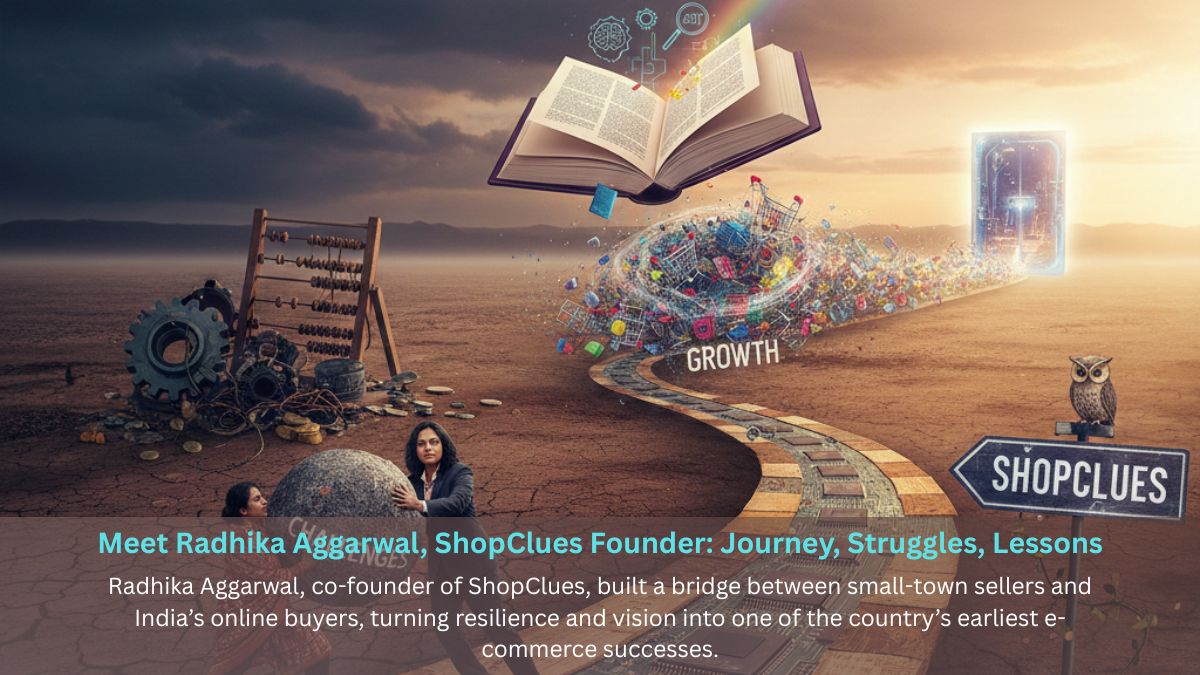
Radhika Aggarwal is not just a name in India’s startup ecosystem. She is a chapter in the country’s digital awakening — a woman who saw opportunity not in glossy malls or premium brands, but in the dusty, crowded, vibrant chaos of India’s local bazaars. Best known as the co-founder and Chief Business Officer of ShopClues, one of India’s earliest online marketplaces, Radhika didn’t just build a company. She built a bridge between small-town merchants and nationwide buyers, between aspiration and access, between the India that shopped in malls and the India that bargained in narrow lanes under tin roofs.
Her journey stretches from Army cantonments to Silicon Valley boardrooms, from structured corporate corridors at Nordstrom and Goldman Sachs to the unpredictable battlefield of Indian e-commerce. It is a story of resilience, self-doubt, reinvention and a belief so stubborn it refused to bend — the belief that India’s smallest sellers deserved the biggest stage. This is that story.
1. Background and Early Life
1.1 A Childhood in Motion
Before there were investor meetings and valuation headlines, there were railway platforms. Radhika was born into an Indian Army family a life defined by discipline, unpredictability and constant relocation. Pathankot. Ahmednagar. Jodhpur. City names that didn’t just mark geography, but chapters of adaptation. In military households, permanence is an illusion. Friendships are temporary. Schools change. Homes change. Even accents change. But something else forms quietly in such an upbringing — resilience.
Young Radhika learned early how to enter a classroom mid-session and find her place. She learned how to make friends quickly and say goodbye gracefully. She learned that discomfort is temporary, and adaptability is survival. Her father’s postings shaped the rhythm of her childhood. Her mother, a dietician, anchored the family with warmth and practicality. Between discipline and empathy, Radhika absorbed two forces that would later define her leadership — structure and sensitivity.
In the cantonments of India, she saw diversity before it became a corporate buzzword. Different cultures, languages, lifestyles all coexisting within the invisible thread of service and duty. Those years didn’t just build character. They built emotional elasticity. And entrepreneurship, though she didn’t know it then, would demand exactly that.
1.2 Education: The Quiet Architect of Ambition
Radhika’s academic journey reflected both ambition and curiosity. She completed her undergraduate studies in India, attending institutions including Devi Ahilya Vishwavidyalaya and Maharaja Sayajirao University. But India, she felt, was only part of the picture she wanted to understand.
There was a larger world out there global markets, international retail models, consumer psychology at scale. So she crossed oceans. At Washington University in St. Louis, where she earned her MBA, Radhika immersed herself in strategy, marketing and business leadership. This wasn’t just about degrees; it was about perspective. She wanted to understand how customers think, how brands are built, how systems scale.
In classrooms thousands of miles away from home, she studied frameworks and financial models. But beyond textbooks, she studied behavior why consumers buy, how trust forms, what makes marketplaces thrive. The seeds of ShopClues were not planted in India. They were planted in insight.
1.3 Corporate Life: Learning the Machine
After her MBA, Radhika entered the polished world of global corporations. At Nordstrom, she saw retail in its most refined form customer obsession elevated to art. Every interaction engineered. detail measured. Every experience curated. At Goldman Sachs, she witnessed finance at scale structured, analytical, unforgiving in its precision.
These institutions were worlds apart from the chaotic streets of Indian markets. But they taught her discipline. They taught her how systems operate. They taught her how big organizations think. Yet, somewhere between spreadsheets and strategy decks, a quiet dissatisfaction stirred. Corporate life was structured. Predictable. Measured in promotions and performance reviews. But Radhika had grown up in motion. And motion does not thrive in predictability.
2. Founder and Company Overview
2.1 Radhika Aggarwal: The Entrepreneur at the Helm
In 2011, alongside Sandeep Aggarwal and Sanjay Sethi, Radhika co-founded ShopClues. It was not a glamorous beginning. The company was conceptualized in Silicon Valley the epicenter of ambition but its heart was always set on India. At that time, Indian e-commerce was heating up. Flipkart was gaining momentum. Amazon was preparing its entry. The narrative was clear: big brands, electronics, premium fashion.
But Radhika saw something others ignored. She saw the unorganized market. She saw the shopkeepers in Tier II and Tier III cities who had never imagined selling beyond their locality. saw price-sensitive consumers who didn’t care for global brands but cared deeply about affordability. India’s retail wasn’t just malls and metros. It was bazaars. And bazaars had never been digitized properly. As Chief Business Officer, Radhika became the architect of growth strategy, category positioning and brand narrative. She believed that India didn’t need another replica of a Western marketplace. It needed something built for its own texture.
2.2 ShopClues: Bringing the Bazaar Online
ShopClues launched in July 2011. Its positioning was clear a managed marketplace built not for big brands, but for everyday sellers. Unlike competitors chasing high-margin electronics or luxury fashion, ShopClues embraced unstructured categories: affordable apparel, home goods, kitchenware, lifestyle items. The things people buy every day. The things you find in bustling Indian markets. This was not accidental. It was strategic defiance. The platform focused on merchants from smaller towns. Sellers who lacked digital infrastructure. Sellers who had inventory but no nationwide reach. ShopClues became their bridge.
Within a few years, the company grew from a team of 10 to a workforce powering hundreds of thousands of sellers. Millions of customers flocked to its value-driven campaigns like “Sunday Flea Market” a name that felt less corporate and more culturally rooted. At its peak, ShopClues reached a valuation of approximately $1.1 billion. A unicorn. And Radhika Aggarwal became one of the first Indian women to co-found a unicorn startup. But valuations don’t tell you what it felt like. They don’t tell you about the late nights. They don’t tell you about the anxiety of scaling. don’t tell you about the emotional cost.
3. The Problem, Insight, and Trigger
In 2011, Indian e-commerce was urban. Metro-centric. Brand-obsessed. But India is not just metros. It is Kanpur and Kota. It is Surat and Siliguri. small wholesalers in crowded lanes who sell without barcodes or brand labels. Radhika noticed something fundamental.
Traditional e-commerce players were ignoring the long tail of Indian retail the millions of small merchants who formed the backbone of the economy. These sellers had no online distribution. These buyers had limited options. Between them lay an invisible opportunity. ShopClues was born from a simple yet powerful belief: if you digitize the bazaar, you unlock India. The insight was not glamorous. It was practical. And practical insights often build enduring companies.
4. Early Days and Initial Struggles
Starting an e-commerce platform sounds straightforward on paper. Build a website. Onboard sellers. List products. Acquire customers. Reality was harsher. India’s digital infrastructure in 2011 was fragile. Internet speeds varied wildly. Online payments were mistrusted. Logistics networks were inconsistent outside metros. Onboarding sellers meant more than registration. It meant education. Many merchants had never listed products online. They didn’t know how to photograph items, describe them, manage returns or handle digital payments. ShopClues had to teach them. The company became part-tech platform, part-training institution.
There were long days explaining shipping labels to shopkeepers who had never used one. There were misunderstandings about customer returns. were complaints about delays. Scaling inventory without sacrificing trust became the central challenge. Investors were skeptical. Could a marketplace focused on unstructured categories truly scale? Would value-conscious consumers generate sustainable margins? Radhika and her co-founders held their ground. They believed India’s retail DNA was not premium-first. It was value-first. And belief, in the early days of a startup, is often the only fuel you have.
5. Failures, Setbacks, and Self-Doubt
There is a moment in every founder’s life when the noise fades and the doubt grows loud. For Radhika Aggarwal, that moment didn’t arrive once. It arrived in waves. In the early years of ShopClues, growth felt intoxicating. Seller sign-ups climbed. Orders increased. The narrative was beginning to form — the underdog marketplace carving its own niche. But scale, like a rising tide, does not always lift smoothly. Sometimes it crashes against fragile systems.
The very inclusivity that defined ShopClues became its most complex operational challenge. Thousands of small sellers were coming online enthusiastic, ambitious, hopeful. But many were stepping into digital commerce for the first time. They had never dealt with standardized packaging requirements. They were unfamiliar with structured customer service expectations. did not understand return ratios, delivery SLAs or product description accuracy metrics. And customers — now empowered by choice — were unforgiving. Returns increased. Complaints surfaced. Delivery timelines slipped in certain regions. Each complaint wasn’t just a transaction gone wrong; it was a fracture in trust.
Radhika found herself spending evenings reviewing escalation reports instead of strategy decks. Growth charts no longer felt like pure celebration. They carried shadows. She had to confront a painful truth: democratizing access meant inheriting chaos. There were days she questioned whether the marketplace model built on unstructured categories could ever achieve disciplined scale. Could a bazaar ever function like a mall?
But every time doubt grew louder, she remembered the sellers the man in Agra whose unbranded fashion products were now reaching customers across states. The small-town merchant who saw his first digital payout and realized geography was no longer his ceiling. Those stories anchored her. Yet the storms were far from over.
6. The Leadership Shockwave
Then came the kind of blow no business school prepares you for. When co-founder Sandeep Aggarwal faced legal trouble in the United States, the impact rippled across continents. Overnight, ShopClues wasn’t just an e-commerce company. It was a headline. Investors had questions. Employees had fears. Competitors had opinions. And the media had speculation. For Radhika, the challenge was twofold deeply personal and intensely professional.
She had to walk into the office every day with composure, even when uncertainty pressed heavily on her shoulders. She had to reassure teams that the company’s mission remained intact. Had to answer investor calls with clarity, even when answers were still forming. There is a loneliness in leadership during crisis. It is the space where you cannot fully show vulnerability, yet you are carrying more emotional weight than anyone else.
In those months, she learned a new dimension of resilience. Not the resilience of adapting to new cities like in her childhood. Not the resilience of adjusting to corporate transitions. But the resilience of standing steady when the ground feels unsteady beneath you. There were nights when self-doubt whispered relentlessly. Was the vision strong enough to outlast reputational turbulence? Would the team stay united? Would customers stay loyal? Entrepreneurship, she realized, is not only about solving market problems. It is about absorbing emotional shocks without allowing them to fracture the core. And she chose deliberately not to fracture.
6. Validation and Early Traction
Storms test foundations. But they also reveal strength. While headlines churned and competitors expanded aggressively, something quieter was happening within ShopClues. Orders from smaller towns continued to grow. Repeat purchases increased in value categories. Sellers kept joining. One of the earliest defining moments came when data showed consistent traction in Tier II and Tier III markets. These were not accidental purchases. They were deliberate choices. Customers who previously relied solely on local markets were now browsing digital aisles. The “Sunday Flea Market” campaign became more than a marketing gimmick. It tapped into something deeply Indian the joy of a deal, the thrill of discovery, the comfort of affordability.
Unlike sleek premium campaigns dominating television screens, ShopClues leaned into familiarity. Its tone felt less aspirational and more accessible. It was not trying to be glamorous. It was trying to be relevant. And relevance builds loyalty. For investors, this traction was validation. employees, it was oxygen. For Radhika, it was affirmation that the original thesis was not naïve. The bazaar could scale. It just needed structure layered onto chaos. Belief turned into conviction. And conviction changes posture. It replaces defensive energy with forward motion.
7. Funding, Money, and Growth Constraints
With validation came capital. ShopClues began attracting serious investor attention. Venture capital firms saw what the numbers revealed — a differentiated model tapping into underserved markets. Funding rounds followed. Each infusion of capital unlocked new possibilities — stronger technology infrastructure, expanded seller onboarding teams, better logistics partnerships. But funding is a double-edged sword. It accelerates growth. It also accelerates expectation.
The mid-2010s were a frenzy for Indian startups. Valuations soared. “Unicorn” became a badge of honor. When ShopClues crossed the $1 billion valuation mark, the ecosystem celebrated. Radhika became one of the first Indian women to co-found a unicorn startup. It was historic. It was symbolic. And it was heavy. Because a billion-dollar valuation is not just a milestone. It is a promise. Suddenly, quarterly performance carried amplified scrutiny. Growth had to be sustained. Market share had to be defended. Competitive intensity sharpened. Amazon was investing aggressively in India. Flipkart had deep capital reserves. Discount wars erupted. Advertising spends ballooned across the industry. ShopClues did not have the luxury of endless burn.
Radhika and her leadership team made deliberate choices. Instead of competing head-on in electronics or premium fashion, they doubled down on value-driven categories. Instead of chasing brand wars, they invested in operational discipline. It required restraint in an ecosystem addicted to scale-at-all-costs narratives. There were boardroom debates about strategy. There were discussions about market positioning. were internal pressures to expand into more lucrative verticals. But clarity the same clarity that sparked the company remained central. If ShopClues lost its identity, it would lose its advantage. So they protected it.
8. Team Building and Leadership Evolution
In the earliest days, everyone sat within arm’s reach. Decisions were fast. Roles were fluid. The team operated on instinct and adrenaline. But as the company scaled into hundreds, then thousands of employees, instinct alone could not sustain momentum. Radhika had to evolve. Transitioning from hands-on founder to systems-oriented leader was not automatic. It required letting go of control, of immediate oversight, of the comfort of knowing every operational detail. Hiring became strategic rather than urgent. She sought leaders who brought domain depth professionals who understood logistics at scale, category management, data analytics. But hiring for skill was not enough. Culture mattered.
8.1 The startup environment was intense. Pace was relentless
The startup environment was intense. Pace was relentless. Some hires from large corporations struggled with ambiguity. Others expected clear hierarchies and predictable workflows. Misalignments led to attrition. Each departure felt personal in the early years. Radhika carried responsibility for cultural mismatches. Over time, she learned a difficult truth: not everyone thrives in chaos, and not every misfit is a failure of leadership.
Delegation was another lesson carved through discomfort. She had built deep knowledge across departments. Letting others take ownership required trust. And trust requires vulnerability the acceptance that outcomes may differ from how you would have executed them. Slowly, she shifted from operator to architect. From decision-maker in every room to builder of rooms where others could decide. Her leadership matured from intensity to intentionality. She became more vocal about supporting women within the organization. As one of the few visible women founders in India’s early tech ecosystem, she understood representation mattered. She initiated programs aimed at mentorship, flexible structures and leadership pathways for women employees.
Her own journey had been isolating at times. She did not want that isolation to replicate within her company. Leadership, she realized, is not defined by authority. It is defined by responsibility to mission, to team, to culture.
9. Growth, Scaling, and Operational Reality
Scaling is often romanticized in startup storytelling. But scaling a marketplace serving hundreds of thousands of small sellers is less romance and more relentless iteration. Every festival season brought order spikes that strained infrastructure. Logistics partners faced bottlenecks. Return rates fluctuated. Fraud detection systems had to be strengthened. There were moments when operational breakdowns threatened customer trust. And in e-commerce, trust once lost is difficult to reclaim.
Radhika spent significant time strengthening seller education frameworks. Structured onboarding modules replaced informal guidance. Quality audits were introduced. Data dashboards began monitoring seller performance in real time. The bazaar was becoming disciplined. But discipline requires persistence. Competition intensified further as rivals expanded aggressively into smaller towns the very markets ShopClues had pioneered digitally.
Protecting differentiation became critical. Instead of entering burn-heavy advertising wars, ShopClues refined its positioning a value-first marketplace rooted in affordability. There was no illusion about the scale of competition. Amazon and Flipkart were formidable. But ShopClues’ strength lay in cultural understanding. It knew its buyer persona intimately — the price-sensitive consumer, the small entrepreneur, the family looking for everyday utility over brand prestige. That insight remained its compass.
9.1 The Emotional Undercurrent
Behind all operational challenges flowed an emotional current rarely captured in metrics. There were nights when Radhika questioned sustainability. There were mornings when she had to project confidence despite internal fatigue. Entrepreneurship blurred boundaries. The company was not a job; it was an extension of identity.
Success felt personal. Failure felt personal. And through it all, she carried not just performance targets, but representation. As a woman founder in a largely male-dominated ecosystem, her visibility meant her setbacks were watched more closely, and her wins symbolized possibility for many others. That weight did not break her. But it shaped her. It made her more deliberate. More reflective. More grounded.
10. Personal Sacrifices and Burnout
Success stories often arrive polished. They show valuation numbers, media features, celebratory photographs, investor quotes. They rarely show exhaustion. Rarely show the silent dinners, the missed family milestones, the mornings when ambition feels heavier than inspiration. For Radhika Aggarwal, entrepreneurship was never a 9-to-5 commitment. It was immersion. was surrender. at times, a consuming force that blurred the edges between personal life and professional mission.
In the early years of ShopClues, time lost meaning. Days flowed into nights. Strategy meetings stretched beyond sunset. Crisis calls interrupted weekends. Every small operational breakdown felt urgent because the company was still young enough to be fragile. There were periods when sleep came in fragments — interrupted by logistics updates, seller disputes, investor discussions. The phone rarely left her hand. Every notification felt like a potential fire.
And there were many fires. E-commerce in India during its formative years was unpredictable. Infrastructure faltered. Payment gateways glitched. Courier partners missed timelines. Customers complained publicly. Competitors escalated discount wars. Through it all, Radhika carried the emotional responsibility of being one of the company’s central pillars. She has often acknowledged that balance, in those years, was not elegant.
10.1 Family dinners were sometimes replaced with conference calls
Family dinners were sometimes replaced with conference calls. Celebrations were occasionally overshadowed by quarterly reviews. The entrepreneurial journey demanded presence everywhere, and that demand extracted a personal cost. But sacrifice is not always dramatic. Sometimes it is subtle a gradual trade of leisure for urgency, of quiet moments for strategic planning, of emotional space for constant vigilance. Burnout did not arrive as a single collapse. It arrived in waves. There were days when the weight of expectations felt suffocating — expectations from investors, from employees, from the media, from the ecosystem watching one of India’s first women unicorn founders.
And yet, stepping away was never a simple option. Because behind every operational chart were sellers real individuals whose businesses depended on ShopClues. The small-town merchant who hired two extra workers because online orders were increasing. The homemaker running a micro-enterprise through the platform. The wholesaler who discovered that geography was no longer a boundary. These stories made burnout feel secondary to responsibility. Responsibility has a way of silencing fatigue. But only temporarily.
10.2 The Emotional Cost of Visibility
There is a particular kind of pressure that comes with being one of the few. In India’s early startup ecosystem, women founders were not common. Women founders of billion-dollar companies were even rarer. Radhika’s success was celebrated and scrutinized.
Every strategic move was analyzed not just as a business decision, but as a statement about women in leadership. Every setback carried amplified commentary. She learned quickly that visibility is double-edged. It opens doors. It also magnifies mistakes. There were rooms where she was the only woman at the table. Investor meetings where she had to assert credibility twice as hard. Conversations where subtle biases surfaced beneath polished language.
Sometimes the doubt was external. Sometimes it was internal the quiet questioning of whether she had to constantly prove her competence in ways her male counterparts did not. But instead of shrinking, she sharpened. She became more articulate about metrics. More precise in strategy discussions. More confident in articulating long-term vision. Representation, she realized, is not a slogan. It is lived experience. It is the act of showing up repeatedly, even when the room feels unfamiliar.
And over time, she began mentoring other women entrepreneurs not from a pedestal, but from empathy. She understood isolation. She understood the absence of role models. Understood how valuable shared experience could be. Her advocacy was not performative. It was personal.
11. Lessons, Beliefs, and Values
Years of turbulence refine perspective. They strip away vanity metrics and leave behind core truths. For Radhika, one of the strongest lessons was clarity. In the hyper-competitive world of e-commerce, distraction is seductive. New categories. New geographies. Trends. Technologies. But ShopClues survived because it remained clear about who it served. Value-conscious consumers. Small sellers.
Unstructured categories. That clarity acted as armor against imitation and distraction. Another lesson was humility before data and before people. Some of the platform’s most meaningful improvements came not from top-down strategy sessions, but from listening to sellers. A merchant struggling with catalog uploads. A buyer frustrated with delivery timelines. A logistics partner highlighting inefficiencies. Entrepreneurship, she learned, is not about always having answers. It is about asking better questions. And listening deeply. Her leadership philosophy evolved from intensity to endurance. In the beginning, she believed strong leadership meant direct involvement in everything. Over time, she understood sustainability required building systems and empowering others. Delegation became strength. Trust became currency.
She also embraced the reality that failure is not an anomaly; it is embedded in growth. There were product experiments that didn’t work. Marketing campaigns that underperformed. Strategic initiatives that required recalibration. Earlier in her career, setbacks felt personal. Later, they felt instructive. This shift in emotional interpretation changed everything. Failure stopped being a verdict. It became feedback.
11.1 The Inner Compass
If there was one belief that consistently guided her, it was this: entrepreneurship must solve a real problem. ShopClues was not built to chase trend lines. It was built to address a gap the absence of digital infrastructure for small Indian sellers.
Whenever operational complexity overwhelmed strategy, she returned to that core question: Are we still solving for the small merchant? Are we still serving value-driven India? This internal compass prevented drift. It also protected identity. In an industry that often glamorizes scale over substance, she maintained an affinity for grounded growth. And perhaps that groundedness was inherited — from a childhood in Army towns where prestige mattered less than discipline, and duty mattered more than display.
12. Present Challenges and the Shift Toward Maturity
Time changes markets. It also changes founders. As Indian e-commerce matured, the narrative shifted from aggressive expansion to sustainability. Investors began asking harder questions about profitability. Consumers demanded faster delivery. Competition intensified across every category. For ShopClues, hyper-growth years transitioned into recalibration. Radhika’s focus shifted from expansion to consolidation. From acquiring sellers rapidly to ensuring seller quality. From chasing user numbers to improving user experience.
The company faced restructuring phases difficult but necessary adjustments to remain viable in an evolving ecosystem. These periods required a different kind of leadership. Less adrenaline. More patience. Less noise. More introspection. The mission did not change.But the method matured. Instead of sprinting, the organization learned to pace itself. Radhika embraced this transition. Entrepreneurship, she realized, is not always about acceleration. Sometimes it is about stabilization. And stabilization requires courage — the courage to admit what needs fixing, to restructure when necessary, to prioritize long-term viability over short-term applause.
12.1 A Broader Role in the Ecosystem
Beyond ShopClues, her role expanded. She became a mentor. An advisor. A voice advocating for women entrepreneurs navigating India’s startup terrain. She spoke about resilience without romanticizing struggle. She highlighted the need for better support networks, especially for women founders who often build without visible role models.
Her conversations grew less about valuation and more about values. Less about funding rounds and more about founder well-being. Experience had softened her edges without dulling her ambition. She understood now that building companies is only one part of building ecosystems. And ecosystems require shared wisdom.
12.2 The Quiet Evolution
Perhaps the most powerful transformation in Radhika Aggarwal’s journey is not external. It is internal. The young professional who once moved between Army schools learned adaptability. The MBA graduate learned structure. The corporate executive learned discipline. The startup founder learned resilience.
The unicorn co-founder learned responsibility. And the seasoned entrepreneur learned perspective. Perspective that success is not linear. Perspective that crises are inevitable. that identity must remain separate from valuation. She no longer measures impact solely by scale. She measures it by access. By opportunity created. sellers empowered. women encouraged. The bazaar she digitized was never just about commerce. It was about inclusion.
13. The Present Moment: Between Reinvention and Resolve
There comes a stage in every founder’s journey when survival is no longer the question. Relevance is. For Radhika Aggarwal, the present is not about chasing headlines. It is about ensuring that what was built with conviction can endure with dignity. India’s e-commerce landscape today looks dramatically different from 2011. Logistics networks are faster. Digital payments are mainstream. Consumers are more discerning. Algorithms are smarter. Artificial intelligence is shaping discovery. Quick commerce is compressing delivery windows into minutes. The chaos of early experimentation has matured into structured competition. And within that maturity lies a new challenge: staying meaningful. For ShopClues, this meant revisiting its DNA without erasing it. The platform had to strengthen seller quality, improve customer experience and streamline operations not as reaction, but as evolution.
Radhika’s approach to this phase is markedly different from the early adrenaline years. There is less urgency in her tone now, but more depth. Less reaction, more strategy. Less noise, more intention. She speaks of sustainability. Of profit discipline. Of measured growth. Because the industry itself has changed. The era of growth-at-any-cost has faded. Investors demand efficiency. Consumers expect reliability. Teams seek stability. And perhaps most importantly, founders seek longevity. Radhika understands this shift intimately. She has lived through both extremes the explosive optimism of unicorn announcements and the sobering recalibrations that follow. Now, she stands in the middle ground. Grounded.
14. The India She Still Believes In
Despite all the changes, one belief remains unwavering: India’s small sellers are still underserved. Yes, digital penetration has expanded. Yes, marketplaces have multiplied. But the core friction remains small merchants often lack the tools, training and infrastructure to scale confidently online. For Radhika, this is not a nostalgic attachment to the past. It is unfinished work. She continues to emphasize seller enablement better cataloging systems, smarter discovery tools, stronger logistics integrations for Tier II and Tier III markets. She envisions marketplaces that function not just as transaction platforms, but as growth partners for merchants.
In quiet conversations, she often reflects on the original insight that sparked ShopClues: digitizing the bazaar. But digitization, she believes, is not enough anymore. The next chapter must focus on empowerment. Helping sellers understand data. Teaching them pricing strategy. Equipping them with branding capabilities. Creating ecosystems where small businesses are not just listed they are lifted.
India’s retail pulse still beats strongest in its smaller towns and informal markets. Radhika remains convinced that the next wave of growth will emerge from these communities. She is not chasing trends. She is returning to roots.
15. Leadership in Retrospect
When she looks back at the journey from Army cantonments to Silicon Valley, from startup chaos to unicorn status what stands out is not valuation. It is endurance. Leadership, she now believes, is not about intensity alone. It is about emotional elasticity. The ability to absorb shocks without becoming brittle. The capacity to evolve without losing identity. Her leadership style today is quieter. More reflective.
She invests time mentoring founders especially women navigating the early, isolating years of entrepreneurship. She speaks candidly about burnout. About the myth of effortless success. About the emotional cost of constant performance. There is a softness in her perspective now, but not weakness. It is the softness of someone who has weathered storms and emerged steadier. She advocates for representation not as symbolism, but as structural necessity. She knows firsthand what it feels like to sit in rooms where you are the only woman founder. knows the invisible labor of constantly proving credibility. And so she works to make those rooms less lonely for others.
16. The E-Commerce Horizon
The future of Indian e-commerce will not resemble its past. Artificial intelligence will refine product discovery. Supply chains will become predictive rather than reactive. Quick commerce will redefine consumer patience. Regional language interfaces will expand access deeper into Bharat. Radhika anticipates these shifts with pragmatic optimism.
She sees technology not as disruption, but as opportunity particularly for small sellers. AI-led recommendations could help merchants surface products more effectively. Data insights could help them price smarter. Smarter logistics could reduce return friction. But she is equally aware that technology alone cannot replace trust. And trust has always been the currency of marketplaces. Her vision aligns with an industry slowly rediscovering fundamentals customer satisfaction, operational continuity, transparent pricing, sustainable margins. The noise has reduced. The work has deepened. And that suits her.
17. Identity Beyond the Unicorn
There is a danger in being defined by a milestone. For years, “unicorn co-founder” followed her name like a permanent headline. But Radhika does not measure her journey solely through that lens. Because valuation is a moment. Impact is a continuum. She often reflects on the thousands of sellers who gained access to national markets through ShopClues. The small entrepreneurs who hired additional staff. The families whose income streams diversified because digital doors opened.
These stories do not trend on social media. But they endure. And in those quiet transformations, she finds deeper fulfillment than in investor applause. Her identity today is layered. Founder, Leader, Mentor and Advocate. But beneath all of it is something simpler: a problem-solver. She began with a problem access for small sellers. And that problem continues to guide her.
18. The Legacy Taking Shape
Legacy is rarely loud while it is forming. It is built in accumulated choices. In decisions made under pressure. In principles defended during temptation. Radhika Aggarwal’s legacy will likely not be defined by market share battles alone. It will be defined by the narrative she helped change — that Indian e-commerce could serve not just premium consumers, but everyday households. That small-town sellers deserved digital parity. That women founders could build billion-dollar companies without conforming to stereotypes.
Her story remains unfinished. But its contours are visible. She has shown that entrepreneurship is not a straight ascent. It is cyclical. It tests identity. demands sacrifice. rewards persistence. And above all, it requires belief. Belief in a problem worth solving. Belief in people often overlooked. in oneself during moments when certainty feels fragile.
19. The Final Reflection
Imagine the narrow lanes of an Indian bazaar. Vendors calling out prices. Stacks of colorful fabric. Steel utensils glinting under afternoon sun. Negotiations unfolding with familiarity and warmth. Now imagine that same bazaar digitized. Searchable. Shippable. Accessible across states. That transformation did not happen by accident. It happened because someone saw value where others saw disorder. Because someone believed chaos could be structured.
Because someone understood that inclusion is not charity it is strategy. Radhika Aggarwal did not set out to be symbolic. She set out to solve a gap. In doing so, she became symbolic anyway. Her journey is not just about ShopClues. It is about India’s transition from physical to digital, from local to national, from informal to structured. And as the next decade unfolds, one truth remains steady: The bazaar is still alive. It has simply found new corridors. And somewhere within those corridors, the vision that began in 2011 continues to breathe persistent, evolving, quietly determined.
About foundlanes.com
foundlanes.com is India’s leading startup idea discovery platform. It helps entrepreneurs find actionable startup opportunities, market insights, and industry-specific guidance to turn ideas into real businesses. With deep research and practical resources, foundlanes supports founders at every stage, from idea validation to launch and growth.