News Summary
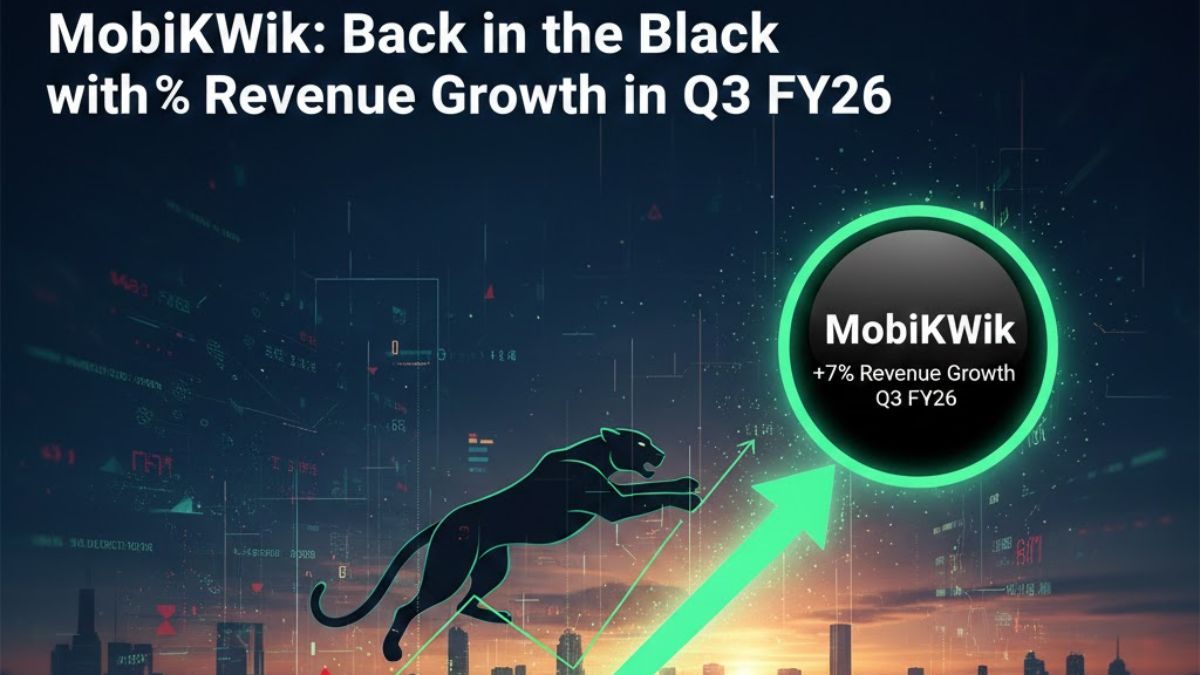
MobiKwik Back in the Black in the third quarter of the financial year 2025–26 signals a major turnaround for the Indian fintech pioneer after prolonged losses in recent quarters. The Gurugram-based digital payments and financial services platform reported a 7% year-on-year rise in revenue from operations to ₹289 crore in Q3 FY26. Up from approximately ₹269 crore in the same quarter last financial year.
The growth, though modest, was enough to drive a return to profitability, with the company posting a net profit of ₹4 crore. Its first quarterly profit in several periods after deep losses, reversing a ₹55 crore loss in Q3 FY25 and losses in Q2 FY26. The swing into the black was credited to disciplined cost management, tighter operating controls and improved unit economics across both payments and lending businesses. EBITDA also swung positive at ₹15 crore. Contribution profit grew sharply, reflecting a sharper margin profile across core services.
MobiKwik’s payments GMV hit a record high. Surpassing ₹48,000 crore, and UPI transactions surged over three-fold year-on-year, placing it among India’s fastest-growing UPI platforms. The company’s user base expanded to 186.6 million users with over 4.79 million merchants on the platform. Cost discipline played a central role, with fixed costs declining as a percentage of revenue and overall operating expenses moderating. Leaders cited tighter cost control, operating efficiency, margin expansion and thoughtful scaling as key drivers of the turnaround. This financial performance comes amid ongoing efforts to strengthen fintech offerings. Streamline business units and expand payment footprints across Tier-II and Tier-III cities. MobiKwik Back in the Black reflects a business that is finding balance between growth and profitability in India’s highly competitive payments space.
1. MobiKwik Back in the Black: The Full Picture
1.1 What Happened in Q3 FY26
In the third quarter of FY26,MobiKwik achieved a milestone that felt both long-awaited and hard-earned. The fintech platform reported profitability after years of operating in the red. Posting a net profit of ₹4 crore. The company moved decisively away from the ₹55 crore loss it had registered in Q3 FY25.
This turnaround was anchored by a 7% increase in revenue from operations. Reaching ₹289 crore, fueled primarily by growth in payments and financial services. Notably, MobiKwik’s payments gross merchandise value (GMV) crossed ₹48,000 crore. A record high, and a tangible measure of the trust and adoption its platform commands. UPI transactions on the platform more than tripled over the year, reflecting not just scale, but real user engagement. Contribution profit surged, signaling that the company was not just earning more, but earning more efficiently. This quarter’s performance was not the result of luck. It was the outcome of deliberate choices, operational discipline, and a deep understanding of how the Indian consumer interacts with digital finance.
1.2 How Profitability Was Achieved
The story of MobiKwik’s return to profit is one of careful financial management rather than dramatic revenue spikes. Fixed costs dropped from 42% to 38% of total income, and operating expenditures were trimmed in a sustained effort to rationalize spending. By optimizing cost structures and improving unit economics, the company was able to widen contribution margins while keeping growth initiatives intact.
EBITDA for the quarter stood at approximately ₹15 crore, a stark contrast to the heavy losses of the previous year. Leadership credits this achievement to disciplined scaling, targeted investments, and relentless focus on operational efficiency. It is a reminder that profitability in fintech is rarely accidental—it is earned through meticulous planning. An understanding of customer behavior, and an unflinching commitment to sustainable business practices.
1.3 Why This Matters
MobiKwik’s profitability milestone carries implications beyond a single quarterly report. For the company, it validates years of cost rationalization, operational restructuring, and strategic investments. For the Indian fintech ecosystem, it signals resilience and adaptability amid fierce competition from Paytm. PhonePe, Google Pay, and other digital-first platforms. Users and investors, it marks a shift in perception: MobiKwik is no longer just a growth story. It is a fintech player capable of balancing scale with financial sustainability, charting a course toward long-term stability.
2. How MobiKwik Works: Platform and Products
2.1 Core Business Model
MobiKwik’s evolution reflects a vision of simplifying financial transactions for millions of Indians. Initially a mobile wallet, the platform expanded to include UPI services. Credit products, Buy-Now-Pay-Later (BNPL) offerings like ZIP EMI, payment gateway integrations, and other financial services. Its revenue streams are diverse: transaction fees, commissions on payments, interest from lending products, and platform fees collected from merchants. The genius of MobiKwik’s model lies in its integration of convenience, trust, and scale. By blending everyday payments with financial services, it has positioned itself as more than a transaction tool. It is a financial companion for users navigating India’s increasingly digital economy.
2.2 Payments and Wallet Services
At its core, MobiKwik thrives on enabling seamless payments. Users link bank accounts, wallets, or UPI handles to make instant payments for utilities, tickets, e-commerce, and merchant transactions. The platform caters to a wide demographic spectrum, emphasizing convenience, speed, and cashless access to everyday needs. Cashback incentives, loyalty rewards, and promotional offers complement the technical infrastructure, not as gimmicks, but as thoughtful engagement tools that encourage regular usage and foster habit formation. Every transaction reflects a small human decision—trusting the platform to be reliable, fast, and secure. For MobiKwik, each completed payment is a testament to user confidence earned over years of iteration and service refinement.
2.3 Financial Services and Lending
Beyond payments, MobiKwik has built a carefully curated suite of financial services. Its ZIP EMI product enables users to split larger purchases into installments, making credit accessible to a wider population. Earlier challenges with credit cost and risk were mitigated through disciplined underwriting, improved net financial services margins, and better risk management practices. The recent improvement in lending performance directly contributed to profitability, underscoring how strategic product diversification—payments, lending, and BNPL—can create a complementary ecosystem that benefits both users and the company.
3. Background: Founders, Funding, and Strategic Evolution
3.1 Founding Story and Leadership
Founded in 2009 by Bipin Preet Singh and Upasana Taku, MobiKwik began as a solution to a simple but pressing problem: how to make digital payments easy and accessible in a rapidly digitizing India. Over the years, the platform grew from a mobile wallet into a full-scale fintech ecosystem, competing with giants like Paytm, PhonePe, and Google Pay. Leadership evolution reflects a growing maturity. From entrepreneurial beginnings to managing a publicly listed company, the focus has shifted to sustainable growth, product diversification, and operational efficiency. Decisions are increasingly guided by data, insights, and the long-term goal of creating a resilient, scalable financial services platform.
3.2 Funding and IPO
MobiKwik’s journey to profitability was supported by strategic funding and public market entry. After raising capital through successive investment rounds, the company listed publicly in December 2024. The IPO not only provided growth capital but also introduced market accountability, reinforcing a discipline that has contributed to recent profitability. Public listing marked the transition from ambitious startup to a mature fintech enterprise, capable of sustaining growth while navigating the complexities of India’s competitive digital finance landscape.
4. Challenges and What MobiKwik Solves
4.1 The Payment Access Problem
India’s digital economy has long been a paradox: enormous potential paired with fragmented access to financial tools. For millions of users and small merchants, traditional banking methods were cumbersome, cash remained pervasive, and mobile payment solutions were either piecemeal or inconsistent. MobiKwik stepped into this landscape not just as a wallet or payment app, but as a unifying platform. By integrating UPI, mobile wallets, QR code payments, and value-added financial services, the company created a seamless experience that bridged gaps in accessibility and usability.
Behind every transaction lies a human story: a shopkeeper in a Tier-III town receiving payments instantly, a young professional paying utility bills without queuing, a family purchasing groceries or splitting payments through ZIP EMI. MobiKwik’s platform is designed to meet these everyday needs with empathy and technical precision, transforming convenience into trust.
4.2 Merchant Adoption and Ecosystem Inclusion
For small businesses, going digital often felt daunting due to costs, complexity, and uncertainty. MobiKwik lowered these barriers through an easy onboarding process and minimal hardware requirements, making digital payments feasible even for micro and small enterprises. This approach helped expand its merchant network to 4.79 million, reaching into smaller towns where digital adoption had previously lagged.
The impact is tangible: merchants experience faster payments, reduced cash handling risks, and integration into a larger digital ecosystem. Each new merchant onboarded is more than a number—it represents broader inclusion, empowerment, and the ability to participate fully in India’s growing digital economy.
4.3 Addressing Financial Services Gaps
MobiKwik’s ZIP EMI and other short-term credit products fill a critical gap in India’s financial landscape, where formal credit penetration remains uneven. By enabling flexible payments, the platform allows users to access products and services they might otherwise defer or forgo. This accessibility doesn’t just help individuals—it stimulates overall transaction volume, increasing engagement across both users and merchants. The human impact is clear: financial tools become more democratic, opening opportunities for households and small businesses to manage cash flow, plan expenses, and participate confidently in a digital-first economy.
5. Industry Growth and Competitive Landscape
5.1 India’s Payments Revolution
India’s digital payments ecosystem has evolved at a breakneck pace, becoming one of the fastest-growing sectors globally. Government initiatives like UPI, combined with rising internet penetration and fintech innovation, have fueled a dramatic shift from cash to app-based payments. MobiKwik has been at the heart of this transformation, alongside giants such as PhonePe, Google Pay, and Paytm.
Consumers today expect speed, integration, and convenience. They gravitate toward platforms offering instant payments, bundled financial services, and loyalty incentives. MobiKwik has leveraged these trends by creating a platform where everyday transactions are not just easy, but rewarding—a digital experience that keeps users returning and builds long-term engagement.
5.2 Competitive Pressures and Differentiators
Competition in India’s fintech space is intense, with well-capitalized rivals constantly expanding into payments, credit, and merchant solutions. Yet MobiKwik has carved a distinct identity by focusing on flexible credit offerings, robust merchant support, and deep penetration into Tier-II and Tier-III markets. Its recent profitability, following years of investment, signals an approach that balances growth with financial discipline—a differentiator from peers who may prioritize market share over operational sustainability.
6. Key Metrics and Performance Indicators
6.1 User and Merchant Growth
By the close of Q3 FY26, MobiKwik had grown its user base to an impressive 186.6 million and expanded its merchant network to 4.79 million. These numbers are more than just milestones—they represent countless moments of trust, convenience, and connection between the platform and its users. Every digital transaction reflects a human choice: a shopkeeper in a small town accepting instant payments, a college student splitting bills seamlessly, or a family using the ZIP EMI feature to make ends meet without friction.
Behind the raw statistics lies a story of persistence and understanding. MobiKwik has worked to build trust with users who were once hesitant to embrace digital payments, particularly in Tier-II and Tier-III cities. Each merchant onboarded into the ecosystem becomes a node of inclusion, enabling broader economic participation and fostering financial literacy in communities that previously relied heavily on cash. These metrics therefore reflect not only adoption but a subtle human transformation: an entire generation learning to transact, save, and borrow in the digital era.
6.2 Payments and GMV Trends
In Q3 FY26, payments gross merchandise value (GMV) on MobiKwik surpassed ₹48,000 crore—a record high that demonstrates both the breadth and depth of engagement across the platform. Every rupee transacted is more than a figure; it is the manifestation of trust, habit, and reliance on a system that seamlessly connects millions of users and merchants.
While quarterly revenue growth may fluctuate, GMV tells a richer story: it indicates that users are actively engaging, merchants are transacting consistently, and the platform’s infrastructure is robust enough to handle this scale. It signals healthy usage patterns and sustainable volume flows, which are essential for a digital payments business to convert scale into profit. In essence, these numbers are proof of human confidence in the platform, and they mark MobiKwik’s evolution from a nascent wallet app into a core facilitator of India’s digital financial ecosystem.
7. Learning for Startups and Entrepreneurs
MobiKwik’s return to profitability offers profound lessons for emerging ventures. First, growth and investment must be balanced with operational discipline. Heavy spending without attention to unit economics risks prolonged losses; startups must learn to marry ambition with efficiency.
Second, diversifying revenue streams—such as adding financial services alongside core payments—can strengthen resilience and long-term viability. Third, understanding your users and merchants at a human level is crucial: technology is only part of the equation; empathy, reliability, and convenience drive loyalty. Finally, leadership decisions grounded in data, thoughtful scaling, and iterative improvements can turn years of losses into sustainable profitability, illustrating that fintech success is as much about human insight as it is about financial engineering. products — can create resilience during periods of slow topline growth. Third, public market expectations demand transparent execution and sustainable profitability pathways. Finally, focusing on underserved markets and refining product-market fit can help smaller players remain competitive against larger incumbents.
The Startups News
TheStartupsNews.com is a dedicated news and startups stories platform covering the latest trends, insights, and stories from the Indian and global startup ecosystem. News like MobiKwik Back in the Black resonates with the publication’s mission to analyse the financial health of tech startups, the impact of business strategies and the evolving competitive landscape in fintech. By tracking quarterly results, growth metrics, strategic pivots and profitability milestones, the platform helps founders and ecosystem players understand what it takes for startups to navigate tough markets and drive meaningful outcomes.
About foundlanes.com
foundlanes.com is India’s leading startup idea and deep-dive platform built for founders, operators, and serious entrepreneurs. We go beyond surface-level advice to deliver grounded, research-backed, and experience-driven startup content.
Every guide on foundlanes.com is designed to help readers think clearly, act strategically, and build sustainably. This cloud kitchen startup guide is part of our mission to document real business pathways in India’s evolving startup ecosystem.