News Summary
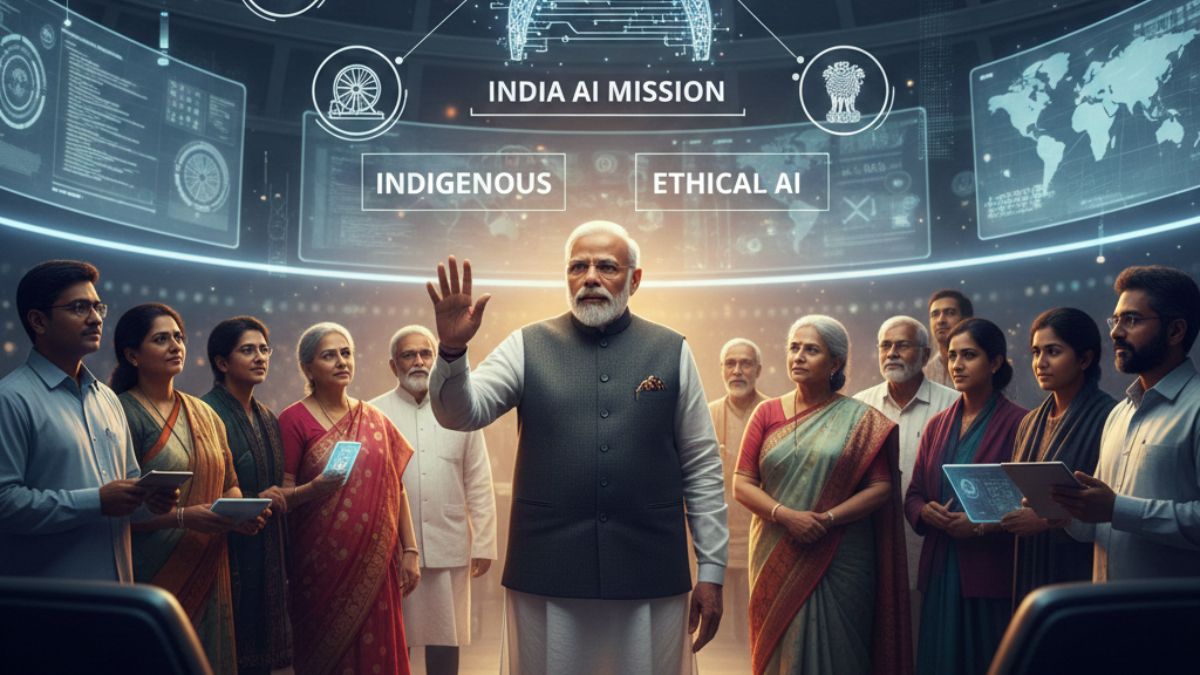
Prime Minister Narendra Modi is driving India’s push toward Ethical AI Under India AI Mission, emphasising homegrown artificial intelligence that is ethical, inclusive, and globally competitive. Modi recently held a roundtable with 12 Indian AI startups selected under the IndiaAI Mission’s Foundation Model pillar. He stressed the need for Made in India, Made for the World AI models that are transparent, unbiased, and accessible to all sections of society, with special focus on local languages and affordability.
The IndiaAI Mission, backed by the Union Cabinet with a budget allocation of over ₹10,300 crore over five years, aims to strengthen India’s AI ecosystem through infrastructure talent development. Startup financing. Ethical AI frameworks and democratized access to computing resources. This strategic push is part of a broader national ambition to add substantial value to India’s economy. Which AI could boost significantly by 2035 and to position India as a global AI leader.
Homegrown startups such as Sarvam AI, Gnani.ai, Soket AI. And Gan.ai are developing indigenous large language models and AI tools tailored for India’s linguistic diversity and real-world problems. Sarvam AI, for example. Is building a sovereign AI ecosystem with multilingual agents and foundational models that serve domestic and global needs.
Modi’s vision for Ethical AI Under India AI Mission also includes creating frameworks that prevent bias and protect privacy while promoting innovation. With initiatives like the AI Impact Summit 2026 on the horizon. India is laying the groundwork to demonstrate how ethical. Locally developed artificial intelligence can address socio‑economic challenges and unlock broad societal benefit.
1. Introduction to Ethical AI Under India AI Mission
India’s journey into artificial intelligence is no longer just a technological experiment. It has become a reflection of the nation’s values, ambitions, and hopes for the future. The Ethical AI Under India AI Mission is a bold statement from the government that AI should serve people. Not just profit margins. It represents a vision where technology is intertwined with responsibility, empathy, and inclusivity—an AI that understands the country’s diversity. Respects its cultures, and uplifts its communities. This mission is not about copying global trends; it is about creating something profoundly Indian, yet globally relevant.
Prime Minister Narendra Modi, in his recent engagements with AI startups. Has articulated a vision that goes beyond algorithms and code. AI, he insists, must be a force that touches real lives—bridging educational gaps. Improving healthcare access in remote villages, and giving voice to the languages and dialects that often go unheard. The emotional weight of this vision lies in its human-centric focus. AI should not remain a tool for elites in urban centers but a partner in empowerment for millions across India. This approach resonates deeply with India’s digital ethos of accessibility. Fairness, and societal upliftment, marking a deliberate pivot from technology as a luxury to technology as a right.
1.1 A Vision for Indigenous AI
At the heart of this mission is a drive for self-reliance. The IndiaAI Mission is not merely building AI models; it is crafting India’s technological identity on the global stage. By nurturing indigenous foundational models. The government is signaling that India will no longer be dependent on foreign AI systems that may not reflect local nuances, languages, or ethics. This vision is both practical and deeply patriotic. It acknowledges India’s unique challenges—over 22 officially recognized languages. Thousands of dialects. And a spectrum of socio-economic realities—and seeks to address them through technology designed for Indians, by Indians. The mission is fostering a new breed of startups and researchers. Giving them resources. Infrastructure, and mentorship to develop AI solutions that resonate with local realities while holding their own on the global stage.
1.2 Ethical, Inclusive, and Transparent AI
What truly sets this initiative apart is its uncompromising ethical stance. The IndiaAI Mission emphasizes fairness, transparency, and accountability, ensuring that AI systems are not just powerful but principled. It is a mission rooted in human values, where technology is not neutral but responsible. By embedding these principles, the government hopes to prevent misuse, curb bias, and make AI accessible to every Indian—urban or rural, affluent or underprivileged.
The human impact of this approach is profound. Imagine a farmer in a remote village receiving crop advisory in his native language through an AI agent, or a schoolchild in a small town accessing personalized learning tools designed for their cultural context. This is not science fiction; it is the mission’s promise. Through ethical AI, India aims to create technologies that do more than automate—they empower, include, and inspire. The initiative blends ambition with empathy, ensuring that as India steps into the future of AI, it does so with its conscience intact and its people at the center.
2. IndiaAI Mission: Background and Strategy
When the Union Cabinet approved the IndiaAI Mission in March 2024, it wasn’t just a policy announcement. It was a declaration of India’s intent to claim its space in the global AI landscape with pride, purpose, and responsibility. With a monumental budget of over ₹10,300 crore. The mission was envisioned as a holistic ecosystem that would empower researchers, startups, and innovators. To build AI that is not only technologically advanced but socially meaningful. This initiative goes beyond infrastructure or funding; it carries the weight of a nation’s aspirations. Reflecting a desire to create AI that resonates with India’s diversity and values.
The mission is carefully structured around multiple pillars, each designed to solve a unique challenge in India’s AI journey. From building robust computing infrastructure to nurturing ethical frameworks. From seeding startups with risk capital to upskilling the next generation of AI professionals. The mission embodies a multi-dimensional strategy that is as ambitious as it is human-centric.
2.1 Objectives of IndiaAI
The objectives of IndiaAI reflect both pragmatism and vision.
First, it seeks to democratize AI access. For decades, cutting-edge AI remained confined to labs and elite institutions. Today, with expanded GPU infrastructure across research hubs, universities, and startups. Computing power is reaching the hands of those who can translate ideas into tangible solutions. This is a deeply human goal: ensuring that a bright student in a small town. Or a startup in a tier-2 city. Can access the same resources as global tech giants.
Second, the mission provides risk capital and support for startups. In India, innovation often meets the hurdle of financial risk. By providing funding, mentorship, and strategic guidance. IndiaAI reduces this barrier, giving passionate entrepreneurs the freedom to experiment, fail, and eventually succeed. This has led to tangible results—startups developing AI models for regional languages. Healthcare diagnostics, and agriculture advisory have emerged, empowered by mission resources.
2.2 Building indigenous large language and multimodal AI models
Third, the mission is committed to building indigenous large language and multimodal AI models. Unlike imported AI models that may overlook local nuances. These models are designed with India’s linguistic, cultural, and contextual realities in mind. They can understand dozens of Indian languages, respond sensitively to social cues. And address problems that are unique to India’s population. The result is technology that feels familiar, useful, and humane.
Fourth, IndiaAI champions ethical standards and inclusive AI frameworks. This is not just a regulatory checkbox—it is a moral compass. AI systems must be transparent, fair, and accountable. They must protect privacy and avoid bias, ensuring that no citizen is left behind. The human impact is profound: ethical AI decisions in healthcare, finance. Or governance can literally change lives, especially for marginalized communities.
Finally, the mission focuses on education and skill development, fostering a generation that doesn’t just use AI but shapes it. By training tens of thousands of students and professionals. IndiaAI ensures that the future of AI is not imported—it is homegrown.
2.3 Economic Potential
The economic implications of this mission are staggering. Government projections estimate that AI could contribute up to $1.7 trillion to India’s economy by 2035. This is not just numbers on a spreadsheet—it represents millions of new jobs. Startups transforming local economies, And traditional industries becoming more efficient and innovative. From farmers using predictive analytics to optimize crop yields to doctors employing AI-assisted diagnostics in remote villages. The economic benefits are inseparable from human impact. AI becomes not just a tool of wealth creation but a vehicle for empowerment, equity, and progress.
2.4 Infrastructure and Resources
Behind this vision lies an unprecedented expansion of computing infrastructure. Tens of thousands of high-performance GPUs are now available across the country, enabling researchers and startups to train complex models on Indian datasets. For the first time, India has the technical sovereignty to create AI that reflects its realities. AI that is built by Indians, for Indians, yet capable of competing on the global stage.
The human stories embedded in this infrastructure are compelling. A researcher in Bengaluru can now train a multilingual model to help rural students learn in their mother tongue. A small startup in Pune can develop AI solutions for local healthcare diagnostics without worrying about prohibitive computing costs. This is where technology meets humanity—the machinery of innovation enabling real people to solve real problems. The IndiaAI Mission, therefore, is not just a government project. It is a canvas for human ingenuity, resilience, and empathy, charting a course where AI serves society. Respects values, and empowers lives across India.
3. Homegrown Startups Transforming AI in India
India’s AI landscape is no longer just a collection of research labs and policy papers—it is alive with startups daring to imagine technology that serves people first. Under the IndiaAI Mission, a new generation of Indian AI startups is stepping into the spotlight, building foundational models and tools that are not just technically advanced but profoundly human. These innovators are creating AI that speaks the languages of millions, understands local contexts, and solves problems that are uniquely Indian. They are the beating heart of India’s quest for indigenous, ethical AI, transforming abstract ambition into tangible reality.
3.1 Sarvam AI
In the bustling tech corridors of Bengaluru, Sarvam AI is quietly reshaping how India thinks about artificial intelligence. More than a startup, it is a vision of sovereignty in AI—a platform where technology is not imported but created, curated, and calibrated for India’s unique social and linguistic landscape. Sarvam builds conversational agents, APIs, and large language models that speak multiple Indian languages, capable of understanding nuances and cultural context.
3.1.1 Working Model:
Sarvam’s infrastructure combines voice and text-based generative AI, designed to serve enterprises, governments, and social applications. Its models can guide students through learning materials in regional languages. Assist farmers with crop advisories, and help healthcare professionals deliver advice to rural communities.
3.1.2 Revenue Model:
Sarvam’s monetization strategy reflects a careful balance between commercial viability and social responsibility. Through enterprise API subscriptions, the company enables businesses to integrate powerful language AI into their operations at scale. Custom AI integrations allow Sarvam to work closely with organizations, tailoring solutions to specific industry and regional needs. In parallel, licensing its models to government and public-sector institutions ensures that critical services—such as education, healthcare, and citizen support—can reach wider populations. This diversified revenue approach sustains long-term growth while preserving Sarvam’s core belief that technology should generate value not just for markets, but for society at large.
3.1.3 Founders:
Led by researchers who once pioneered Indian language AI within academic and research institutions, Sarvam’s founders bring both intellectual depth and lived experience to the company’s mission. Their early work involved grappling with the complexities of Indian scripts, dialects, and speech patterns long before such problems attracted mainstream attention. That grounding shaped a dual vision that continues to guide Sarvam today: to push the boundaries of cutting-edge artificial intelligence while remaining deeply connected to everyday Indian realities. For them, success is not measured only by model performance, but by whether their AI genuinely improves lives across cities, towns, and villages.
3.1.4 Products and Services:
From voice-enabled agents to sophisticated multilingual translation tools, Sarvam’s offerings are built to confront one of India’s most persistent digital divides: language. For decades, advanced technology largely served English-speaking users, leaving millions excluded from its benefits. Sarvam changes that equation. Its AI systems listen, understand, and respond in Indian languages with cultural sensitivity and contextual awareness. This allows students to learn in their mother tongue, small business owners to use digital tools confidently, and citizens to access essential services without language barriers. In doing so, Sarvam’s technology restores dignity, inclusion, and opportunity to users long overlooked by the digital economy.
3.1.5 Problems Solved:
Sarvam is bridging the linguistic and technological divide, giving millions who were previously left out a seat at the table of AI innovation. Imagine a grandmother in Uttar Pradesh receiving medical guidance in her dialect, or a small entrepreneur in Tamil Nadu interacting with AI in Tamil—the human impact is profound, and Sarvam makes it possible.
3.2 Gnani.ai
While Sarvam focuses on language and inclusivity, Gnani.ai is redefining human-AI interactions through voice. Multilingual, intelligent, and responsive, Gnani.ai’s agents are more than software—they are companions that bridge communication gaps for enterprises and customers alike.
3.2.1 Working Model:
Gnani.ai builds AI agents capable of handling complex voice and text interactions in multiple Indian languages. Their systems automate customer engagement, streamline service operations, and reduce costs without compromising personalization or empathy.
3.2.2 Revenue Model:
Revenue is generated through enterprise licensing, particularly in telecom, finance, and customer support. Each AI agent is not just a product but a tool that enables companies to reach a broader, more linguistically diverse customer base.
3.2.3 Founders:
Gnani.ai was founded by a team of pioneers in speech technology and artificial intelligence, whose combined experience spans decades of research, innovation, and real-world application. The leadership team includes engineers and AI specialists who have dedicated their careers to making machines understand the nuances of human communication—intonation, dialect, and contextual meaning. Their vision goes beyond building technology; they aim to create AI that can connect with people naturally, respectfully, and empathetically. Under their guidance, Gnani.ai has become a bridge between complex AI systems and the human experience, making multilingual communication accessible to millions across India.
3.2.4 Products:
Gnani.ai’s suite of products is designed to make human-computer interaction feel intuitive and natural. Their speech recognition systems can accurately interpret diverse Indian languages and dialects, even capturing subtle nuances in pronunciation and tone. The text-to-speech tools transform written content into lifelike, expressive voice outputs, allowing AI to communicate in a way that feels engaging and empathetic. Additionally, their AI avatars act as intelligent, multilingual conversational partners, capable of understanding context, responding thoughtfully, and maintaining fluid dialogue across languages. Together, these tools bridge the gap between technology and humans, making AI a truly accessible companion for millions.
3.2.5 Problems Solved:
Gnani.ai tackles a practical challenge: in a country with hundreds of languages and dialects, customer support often fails due to language barriers. By enabling automated yet empathetic communication, Gnani.ai ensures businesses can connect with people in the language they understand best.
3.3 Soket AI & Gan.ai
The story doesn’t end with Sarvam or Gnani. Soket AI and Gan.ai are building the next layer of India’s AI ecosystem: foundational models capable of supporting a multitude of applications from education to governance.
3.3.1 Working Model:
Soket AI focuses on open-source models optimized for Indian linguistic datasets, making tools accessible to researchers, startups, and developers across the country. Gan.ai develops parameter-rich, multilingual AI systems designed for real-world Indian contexts, combining technical sophistication with cultural relevance.
3.3.2 Problems Solved:
Both startups address a critical gap: the lack of high-quality AI models tuned to India’s languages, social dynamics, and sector-specific needs. Their work empowers applications that improve education access, government service delivery, and enterprise communication in ways foreign AI often cannot.
3.3.3 Revenue Model and Funding:
While initial development is supported by IndiaAI Mission funding, both Soket AI and Gan.ai are building commercial pathways through enterprise partnerships, licensing, and collaborations—blending public support with sustainable business strategies.
Together, these startups form the living embodiment of Ethical AI Under India AI Mission. They demonstrate that artificial intelligence can be more than a technological achievement; it can be a mirror of empathy, culture, and national identity. For millions of Indians, these innovations are no longer abstract; they are tools that touch everyday life, transform opportunities, and offer hope for a more inclusive, technologically empowered future.
4. Industry Growth Trends
India’s artificial intelligence ecosystem is experiencing a transformative surge. One that carries with it not only economic potential but also profound human significance. The AI revolution in India is no longer confined to elite urban tech hubs—it is reaching tier-2 cities. Remote towns, and underserved communities. This growth is fueled by a combination of government vision. Private innovation, and the energy of a young, dynamic workforce eager to shape the future. The IndiaAI Mission has acted as a catalyst, providing infrastructure, funding, and mentorship, allowing startups to develop solutions that are culturally aware, linguistically diverse, and ethically grounded.
In real terms, this growth is measurable. Indian AI startups are attracting global venture capital, forming strategic partnerships, and delivering products that tackle everyday challenges—like multilingual virtual assistants for rural banks or AI-driven healthcare diagnostics for villages lacking specialists. While India’s share of global AI investment is still smaller compared to the United States or China, the trajectory is clear: with targeted public funding, supportive regulatory frameworks, and a surge of local innovation, India is steadily carving its place on the world stage. The story is not just about numbers—it is about lives touched, opportunities created, and barriers broken.
4.1 Talent and Innovation
At the heart of India’s AI boom is its talent. The mission recognizes that machines alone do not innovate—people do. By investing in skill development programs, research fellowships, and AI-focused educational initiatives, IndiaAI is creating a new generation of innovators capable of bridging the gap between traditional service-oriented work and high-tech research.
This human capital transformation is visible in the labs and offices of startups across Bengaluru, Pune, and Hyderabad. Young engineers are developing models that can understand multiple Indian languages. Data scientists are fine-tuning algorithms to be inclusive and unbiased. Researchers are creating AI tools that can impact social sectors like agriculture, education, and healthcare. The real-life stories are inspiring: a college graduate in Lucknow is now training conversational agents that can guide farmers in local dialects, while a small Hyderabad startup is enabling AI-driven learning modules for schools in rural Telangana. Here, innovation is not abstract—it is intimately connected to human lives.
4.2 Ethical and Inclusive Development
Growth, however, without conscience can be dangerous. Recognizing this, the IndiaAI Mission embeds ethical principles and governance pillars into the very DNA of AI development. Every model, application, and framework is expected to uphold fairness, transparency, and accountability. This is particularly critical in India’s context, where technology must serve diverse populations, respect cultural sensitivities, and avoid deepening existing inequalities.
The human impact is tangible. AI-driven platforms developed under these guidelines help ensure that marginalized communities have equal access to services, whether in banking, healthcare, or education. Citizens can trust that AI is not biased against them, that decisions are explainable, and that technology serves their interests rather than undermining them. By combining technical sophistication with ethical foresight, India is fostering an AI ecosystem that is not only powerful but also humane, sustainable, and socially responsible.
In essence, India’s AI growth story is more than investment charts and innovation indexes—it is a narrative of hope, empowerment, and inclusion. It is the story of a nation that dares to harness technology not just for profit or prestige, but for people, for progress, and for the promise of a better tomorrow.
5. Competitor Landscape
India’s AI ecosystem is vibrant and fiercely dynamic, shaped not only by government-backed initiatives like the IndiaAI Mission but also by a host of private innovators who are racing to redefine technology’s role in everyday life. Companies like Haptik, NeuralGarage, and a wave of emerging startups are driving competition by developing conversational AI, generative tools, and specialized applications. These players are agile, responsive, and highly tuned to market demands, often serving enterprises, telecoms, and financial institutions with products that streamline customer engagement and automate complex workflows.
The presence of such competitors demonstrates the robustness of India’s AI landscape. Haptik, for instance, has revolutionized conversational interfaces for enterprise clients, enabling seamless interaction across multiple channels and languages. NeuralGarage is pushing the boundaries of generative AI, helping brands and startups rapidly create content and intelligent automation solutions. Together, they represent the growing sophistication and diversity of India’s AI industry, where talent, innovation, and entrepreneurial courage intersect.
5.1 The IndiaAI Mission offers participating startups a distinctive advantage
Yet, the IndiaAI Mission offers participating startups a distinctive advantage. By emphasizing foundational models and ethical AI frameworks, the mission ensures that its supported ventures are not merely chasing commercial gains—they are creating AI that is principled, culturally aware, and built for long-term societal impact. Access to government-backed infrastructure, advanced GPU clusters, and regulatory guidance positions these startups to scale faster, refine their models, and deploy solutions across sectors that competitors may not fully reach.
The human element in this competitive landscape is equally compelling. Founders and researchers supported under the mission are driven not just by ambition but by a vision to create tools that resonate with India’s linguistic, social, and economic diversity. They are solving problems that matter: enabling a teacher in a small village to provide AI-assisted learning in the local language, helping a farmer get precise crop advice in real-time, or providing accessible AI-driven health solutions in regions where specialists are scarce. The emotional and social impact of these solutions is what sets mission-supported startups apart, creating a narrative of competition that is not only about market share but also about improving lives, building trust, and delivering technology with conscience.
In this ecosystem, competition fuels innovation, but the IndiaAI Mission creates a space where ethical responsibility and national purpose converge with technological excellence, giving participating startups an edge that is as moral as it is strategic.
6. The Startups News
TheStartupsNews.com is dedicated to covering the latest developments in the global and Indian startup ecosystem. In the current landscape of AI innovation, it highlights trends where Indian firms are tapping into deep‑tech opportunities and scaling products from local markets to global reach. As the IndiaAI Mission advances, TheStartupsNews.com provides insights on emerging founders, funding trends, and strategic pivots shaping AI startup trajectories.
Learning for Startups and Entrepreneurs
For founders and entrepreneurs, India’s emphasis on Ethical AI Under India AI Mission offers several lessons. First, aligning innovation with local needs strengthens adoption and impact. Second, ethical frameworks and inclusive design practices can enhance trust and market reach. Third, government support in early‑stage deep tech innovation is a force multiplier, especially when combined with private sector agility. Finally, building for scale and diversity, such as supporting local languages, can unlock new user segments.
Conclusion
The push for Ethical AI Under India AI Mission marks a significant shift in India’s technology strategy. By fostering indigenous AI development that is ethical, inclusive, and globally relevant, India is charting a path toward technology sovereignty and broad societal impact. With solid public investment, strong startup innovation, and ethical governance, the nation’s AI ecosystem is poised for accelerated growth.
The FoundLanes View
At foundlanes, Culture Circle’s journey stands out not just for its headline-grabbing numbers but for what it reveals about building modern Indian startups—where trust, verification, and transparency can drive rapid adoption, even as losses widen. The Culture Circle 10x revenue growth reflects a clear market insight executed at speed, alongside the inevitable pressure of scaling through heavy spending on technology, hiring, and marketing. Stories like this matter because they show entrepreneurship as it truly unfolds: fast, demanding, and full of trade-offs, where short-term financial strain is often the price paid for long-term relevance and scale.