
Summary
When Qure.ai began its journey, the idea felt like a bold bet on a future where artificial intelligence could make healthcare faster, more accurate, and more accessible. The startup builds artificial intelligence tools that interpret medical images such as X-rays, CT scans, and ultrasounds. Its products are designed to assist radiologists, clinicians, and public-health systems in diagnosing diseases with the help of deep learning. The company was founded to address a global shortage of radiologists, long diagnosis delays, and stark inequalities in access to quality imaging. The founders believed that if AI could accurately read chest X-rays or head CTs, hospitals and screening programs could operate more efficiently and reach more patients.
Qure.ai was started by Prashant Warier and Pooja Rao
Qure.ai was started by Prashant Warier and Pooja Rao, two individuals who combined experience in machine learning, healthcare, and research. Their goal was to use deep learning to automate interpretation of medical imaging at a level that could meet global clinical standards. The company is headquartered in Mumbai, a city that has emerged as a strong base for India’s healthtech and AI ecosystem. Qure.ai was incorporated in 2016 after early work in image recognition showed that convolutional neural networks could detect abnormalities in X-rays with surprising accuracy. As deep learning evolved, the founders saw an opportunity to build AI systems trained on large, diverse medical datasets sourced from hospitals around the world.
The startup works by training neural networks on millions of labelled medical images. These models are then deployed inside hospitals, screening centers, and public-health programs, where they provide instant interpretations of scans. Qure.ai’s suite of products includes tools for detecting tuberculosis, lung disease, stroke, and head trauma. The software integrates with existing radiology workflows and can run on the cloud or on-premises servers. Qure.ai has raised funding from several institutional investors, including HealthQuad and Accel, along with support from other global funds. The company’s revenue figures are not publicly disclosed, but it works with governments, large hospital networks, and global health agencies.
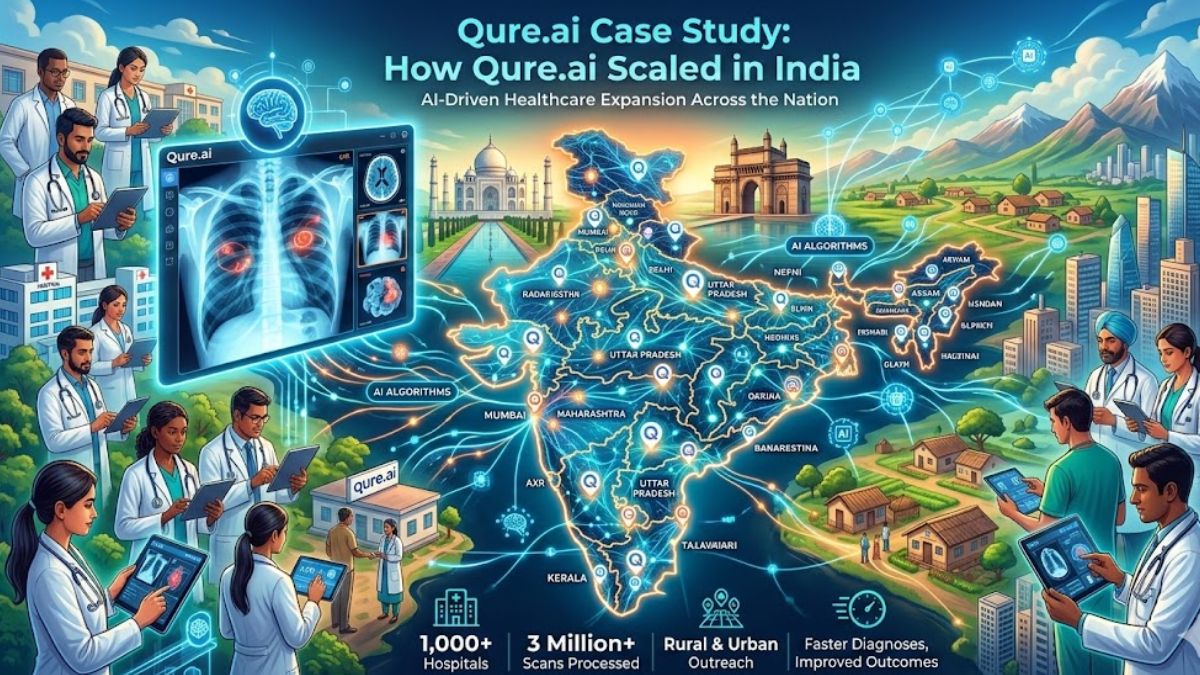
This Qure.ai Case Study goes deep into the company’s evolution, from its early research experiments to its large-scale deployments across India and dozens of international markets. It examines the founder journey, the product’s development cycles, and the operational decisions that helped the company scale. It also analyzes the competitive landscape, regulatory pathways, and the broader context of AI in medical imaging. Through verified public information, interviews, and data, this long-form feature breaks down how Qure.ai became one of India’s most recognized AI healthcare startups.
1. Origin Story and Early Background
Qure.ai’s story began with a simple but ambitious question. Could deep learning do more than classify images of cats and cars? Could it interpret medical scans with the precision of a trained radiologist? In 2015 and early 2016, deep learning had begun transforming industries such as speech recognition and autonomous driving. Yet its application in healthcare remained experimental. Radiology, with its heavy reliance on pattern recognition, felt like the natural next step.
The founders had followed the rapid progress of convolutional neural networks and realized that access to the right training data could unlock medical use cases. The availability of image archives from hospitals and diagnostic centers made it possible to train models on diverse pathologies. The challenge was not only technological. Healthcare required accuracy, explainability, regulatory approval, and trust from clinicians.
When Qure.ai was founded, most Indian startups had not yet ventured into AI-driven diagnostics at clinical scale. The focus was on telemedicine, appointment booking, consumer health apps, and wellness ecosystems. The idea of an AI system interpreting X-rays in real clinical settings was both futuristic and risky. But this gap also represented a massive opportunity, especially in India where radiologists were scarce in rural and semi-urban regions.
The early strategy was to build a robust research foundation. The team collected datasets from various geographies, ensuring that the model learned from differences in demographics, equipment types, and disease patterns. These early datasets came from collaborations and publicly available sources. The founders focused on chest X-rays because they were the most common imaging modality and played a critical role in diagnosing tuberculosis, pneumonia, and lung diseases.
This initial phase set the tone for how Qure.ai approached product development: research-heavy, clinically grounded, and validated through trials rather than assumptions. It was a methodical approach that allowed the company to build credibility in an industry where trust is paramount.
2. Founder Journey, Motivation, and Early Struggles
To understand Qure.ai’s rise, it is important to look closely at the people behind it. Both founders came from strong analytical backgrounds. Prashant Warier had worked in machine learning and data science across global organisations, while Pooja Rao had deep experience in neuroscience research and biostatistics. Their combined skill sets created a balance of scientific rigor and practical AI deployment capability.
What motivated them to start Qure.ai was a belief that healthcare inequality could be reduced through technology. They saw that millions of people lacked timely access to radiologists. Even in major hospitals, imaging loads had become overwhelming. Radiologists spent long hours reviewing scans, and errors caused by fatigue or time pressure were not uncommon. These were systemic challenges that software could help fix.
The early struggles were both technical and operational. The team needed access to large, well-labeled medical datasets. Unlike datasets in general computer vision, medical images required expert annotation. Radiologists had to be involved from the start. This meant building relationships with clinicians, convincing hospitals to share data, and ensuring strict compliance with privacy norms.
Another challenge was skepticism. Clinicians were wary of AI because early tools in the field had been oversold. The founders had to spend time explaining that AI was not meant to replace radiologists but augment them. They emphasized that the algorithm could help catch abnormalities quickly, highlight areas of concern, and reduce missed diagnoses.
Fundraising in the initial years was also difficult. Investors liked the idea but were unsure about regulatory hurdles, commercialization cycles, and global scalability. Healthtech startups typically have longer sales cycles and higher compliance costs. Qure.ai had to prove that hospitals and governments would adopt AI tools and pay for them. Despite these obstacles, the founders remained committed. Their ability to communicate clearly with both data scientists and physicians helped bridge two worlds that rarely collaborated. Their persistence in securing datasets, validating models, and pursuing clinical trials became the backbone of Qure.ai’s growth.
3. The Problem Identified in the Market
The problem that Qure.ai set out to solve was daunting in its scale. Medical imaging sits at the center of modern diagnostics. Every emergency room, outpatient department, and screening program relies on X-rays and CT scans for decision-making. Yet the number of trained radiologists has not kept pace with rising demand.
In many regions of India, radiologists are concentrated in urban centers. Smaller towns struggle. Even when X-rays are available, interpretation may be delayed by hours. Public-health programs screening for tuberculosis face similar bottlenecks. The wait times slow down diagnosis, increase patient drop-offs, and reduce the efficiency of treatment programs.
Globally, the situation is not very different. Countries in Africa, Southeast Asia, and Latin America face a severe shortage of specialists. Even developed regions such as Europe and the United States experience high imaging volumes and growing pressure on radiology departments. Stroke programs require rapid CT interpretation. Emergency rooms need quick triaging of trauma cases. In all these settings, delays can cost lives.
Qure.ai aimed to address this gap through AI-powered diagnostics. Their belief was that deep learning could detect patterns in imaging data with accuracy comparable to human readers. Even if the AI system was not perfect, providing instant preliminary reads could dramatically speed up care delivery.
The founders also saw that healthcare systems were becoming more open to digital adoption. Cloud-based healthcare software had improved. Hospitals were digitizing workflows through PACS systems. Public-health agencies were embracing technology to scale their programs. This created a fertile ground for AI adoption, provided the technology was reliable and validated. By focusing on medical imaging, Qure.ai entered a domain where the need was clear, the impact was measurable, and AI had strong potential for real-world benefit.
4. How the Product Was Built and Evolved
Qure.ai’s products were built through a blend of advanced deep learning research, clinical collaboration, and extensive data engineering. The company’s core product suite began with algorithms for interpreting chest X-rays. The first version of this tool was trained on hundreds of thousands of images. As the dataset expanded, model accuracy improved significantly.
The architecture relied on convolutional neural networks optimized for medical imaging. Unlike general-purpose image recognition models, these networks needed sensitivity to subtle abnormalities. They were trained to detect tuberculosis, lung opacities, consolidation, fractures, pleural effusion, and more. The team worked continuously on improving specificity so that clinicians would receive meaningful alerts rather than excessive false positives.
As chest imaging models matured, Qure.ai expanded into CT-based diagnostics. One of the major innovations was the development of an algorithm for detecting brain injuries on head CT scans. This product was designed to assist emergency departments that deal with trauma cases. Quick detection of bleeds can drastically improve outcomes for patients with head injuries. Another key product involved using AI for tuberculosis screening. The algorithm could classify chest X-rays as likely TB-positive or negative. Public-health agencies could use the system to triage patients efficiently. This became particularly important in regions where access to rapid molecular tests was limited.
The product evolved through rigorous clinical validation. Qure.ai collaborated with hospitals and research institutions to test model performance against radiologist interpretations. These studies were published in clinical journals, helping the startup gain credibility. In parallel, the engineering team worked on ensuring smooth integration with existing radiology systems.
Workflow integration became a differentiator. Instead of asking hospitals to adopt a new system, Qure.ai ensured that AI outputs appeared within the tools clinicians were already using. This reduced friction and improved adoption. Over time, the product suite expanded to cover multiple disease conditions. The team incorporated explainability tools such as heatmaps that highlighted relevant regions on images. These features helped clinicians trust the AI recommendations.
5. Early Traction, First Customers, and Validation Phase
Qure.ai’s early traction came from hospitals that wanted to experiment with AI-based diagnostics. Many institutions were curious about how AI could improve their radiology workflows. Early customers used the chest X-ray algorithm to triage patients, especially in emergency and high-volume settings. The instant preliminary reads helped reduce turnaround time for radiologists.
One of the turning points came when global health agencies and nonprofits began exploring the use of AI for tuberculosis screening. TB programs required scalable solutions, especially in rural and low-resource regions. Qure.ai participated in pilots where the AI tool was benchmarked against existing diagnostic standards. These pilots demonstrated that the algorithm could match radiologist-level performance and significantly improve screening throughput.
International recognition arrived through collaborations and validation studies. Research groups published comparisons showing strong performance. As the startup gained traction, more hospitals and screening camps adopted the product. The company worked with health departments in multiple countries to deploy AI-based TB screening. This public-health impact increased confidence among policymakers and clinicians.
Qure.ai also started receiving attention from large hospital networks in India. These institutions were looking for ways to improve turnaround times and reduce diagnostic variability. The company’s AI tools were integrated into their PACS systems, allowing radiologists to receive AI-annotated images instantly. Despite initial skepticism, clinical validation played a major role in building trust. The founders participated in conferences, discussions, and academic forums to present their findings. This methodical approach helped them build credibility in a highly regulated and evidence-driven industry.
6. Business Model and Revenue Approach
Qure.ai’s business model evolved with its product maturity. The company follows a software-based approach, offering its AI tools through annual or multi-year licensing agreements. Hospitals, diagnostic centers, and public-health programs pay subscription fees to use the software, which includes cloud hosting, model updates, and technical support. The subscription model helps customers reduce upfront capital expenditure. Instead of buying expensive new equipment, they can augment existing infrastructure with AI-powered interpretation. This lowered adoption barriers and allowed Qure.ai to scale quickly.
For large public-health deployments, the company collaborates with government agencies, nonprofits, and global health organizations. These contracts often involve screening programs where AI helps triage large populations. Qure.ai’s tools enable these programs to operate efficiently without requiring radiologists at every site.
The company also works with global pharmaceutical companies and research organizations. These collaborations typically involve disease burden studies, clinical trials, or screening initiatives. The AI system helps collect standardized data across geographies. Another revenue stream comes from partnerships with imaging equipment manufacturers and PACS vendors. Integrating AI tools with radiology hardware and software creates a seamless experience for hospitals and expands Qure.ai’s distribution network.
The business model focuses on long-term relationships rather than one-time sales. Healthcare contracts tend to be sticky, especially when AI tools become embedded within clinical workflows. This approach aligns with Qure.ai’s objective of creating sustained impact across health systems.
7. Funding History and Investor Involvement
Qure.ai raised capital to support its research, clinical validation, regulatory approvals, and global expansion. The startup attracted interest from investors who understood the potential of AI in healthcare. HealthQuad and Accel became two of its key institutional investors. Their support enabled the company to hire specialized talent, conduct clinical trials, and expand its product suite.
The funding announcements highlighted the company’s early traction and its ability to secure deployments across multiple countries. Investors saw strong potential in its AI tools, especially for tuberculosis screening and trauma care. The company did not rely heavily on aggressive marketing or consumer-facing campaigns. Instead, it focused on building relationships with clinicians and policymakers, which resonated with investors who valued long-term impact. Funding also supported regulatory pathways. Medical AI tools require approvals in various markets, and Qure.ai pursued these diligently. The company worked on certifications and compliance audits to meet international standards.
The investment allowed Qure.ai to build multiple teams across engineering, clinical research, operations, and sales. As the company expanded geographically, it added teams that could navigate local regulatory norms and healthcare processes. This expansion was critical for scaling in regions with complex public-health landscapes. While revenue numbers remain undisclosed, investor support and strategic partnerships indicate that Qure.ai is positioned as a global AI healthcare startup with strong operational maturity.
8. Go-to-Market Strategy and Distribution Channels
Qure.ai’s go-to-market strategy focused on building trust among clinicians. The company realized that AI would only be adopted if it seamlessly fit into existing workflows. This shaped its distribution channels and product positioning.
The first part of the strategy was integration with radiology workflows. The engineering team ensured that the AI outputs were compatible with major PACS systems. Hospitals could deploy the software without altering their infrastructure. The adoption process became less burdensome, making it easier for clinicians to try and eventually depend on the AI tools. The next part involved partnerships. Qure.ai collaborated with imaging equipment manufacturers and health system integrators. These partners helped distribute the product across multiple markets. Partnerships allowed Qure.ai to reach hospitals that already had existing vendor relationships.
Public-health agencies became another important channel. Qure.ai positioned itself as a solution for TB screening and community health programs. These initiatives required tools that could handle large volumes, operate in low-resource environments, and provide instant results. The AI system’s ability to run on portable X-ray units made it a natural fit.
For international expansion, Qure.ai pursued collaborations with global health organizations, nonprofits, and ministries of health. These partnerships helped the company understand local challenges and adapt its tools accordingly. Academic and clinical partnerships played a central role. Publishing validation studies and presenting at conferences helped the startup build credibility. Clinicians who engaged with the research became advocates for the product.
9. Brand Positioning and Messaging Evolution
Qure.ai positioned itself as a clinically validated AI partner for healthcare systems. Its messaging avoided the narrative that AI would replace radiologists. Instead, the brand emphasized augmentation, efficiency, and accessibility.
In the early years, the company highlighted its research achievements. The marketing narrative focused on peer-reviewed publications, accuracy benchmarks, and clinical comparisons. This research-driven positioning attracted early adopters from the medical community. As the company expanded, its messaging evolved to highlight real-world impact. For example, the brand showcased how its AI tools processed millions of scans across screening programs. It shared stories of rapid head injury detection in emergency settings and improved TB screening throughput in rural regions.
The company also emphasized global scalability. Qure.ai’s presence across dozens of countries helped position it as an international AI healthcare startup rather than a local Indian player. This strengthened its brand perception and attracted customers looking for proven solutions. Its messaging remained grounded in clinical transparency. Instead of hyping the potential of AI, Qure.ai communicated how its tools complemented radiologists. This balanced approach helped the startup navigate skepticism around AI’s role in healthcare.
10. Key Challenges, Failures, and Turning Points
Building AI for healthcare is not a linear journey. Qure.ai encountered multiple challenges related to validation, regulatory approvals, and customer adoption. One major challenge was ensuring that AI models generalized across populations. Training data from one region may not perform equally well in another due to differences in disease patterns, equipment types, and demographics. Qure.ai addressed this by collecting diverse datasets and conducting validation studies in different countries.
Another challenge came from skepticism among clinicians. In many early deployments, radiologists hesitated to rely on AI outputs. Convincing them required training sessions, hands-on demonstrations, and integration within their workflow. Over time, as radiologists saw improved efficiency, adoption improved.
Regulatory approvals became another turning point. Healthcare AI tools require certifications that take time and resources. Meeting these standards opened the door to new markets but required significant operational effort. During the early years, selling to hospitals was slow. Healthcare procurement cycles are long, and AI products require cross-department approvals. Qure.ai responded by focusing on public-health deployments where decision-making was more centralized.
The COVID-19 pandemic became an unexpected turning point. During this period, healthcare systems faced severe radiology bottlenecks. Qure.ai’s tools were used to analyze chest X-rays for triaging, helping hospitals manage high volumes. This accelerated adoption and introduced the product to new markets. Despite challenges, these turning points strengthened Qure.ai’s position and built resilience across its teams.
11. Operational Execution and Scaling Decisions
Scaling an AI healthcare startup demands strong operational discipline. Qure.ai built teams that could execute across engineering, clinical validation, regulatory compliance, and field deployment. One critical scaling decision was building region-specific teams. Healthcare ecosystems vary widely across geographies. By hiring domain experts with local experience, the company navigated regulatory requirements and established relationships with stakeholders.
The company also invested in customer support and deployment engineering. Hospitals needed assistance integrating the AI tools into their networks. Qure.ai established processes to ensure smooth installation, updates, and maintenance. Another operational strength was its clinical research function. The team collaborated with radiologists to refine model performance and interpret error cases. Continuous model improvement became a core part of the product lifecycle.
Scalability required optimized cloud infrastructure and on-premises deployment options. In regions with limited bandwidth, the ability to run models locally was essential. Qure.ai developed compact model versions that could run efficiently without compromising accuracy. The startup also built a robust sales pipeline tailored to healthcare. Instead of traditional software sales, the team engaged with clinicians, administrators, and government bodies. This required patience, trust-building, and educational outreach.
12. Competitive Landscape and Differentiation
By the late 2010s, AI for medical imaging had become a global field. Multiple startups and research groups were working on tools for radiology. Qure.ai faced competition from global players in AI-driven radiology tools, but it differentiated itself through a combination of clinical evidence, product design, and deployment flexibility.
Its strongest differentiator was the quality and quantity of its validation studies. Many AI startups showcased accuracy on limited datasets, but Qure.ai emphasized real-world performance across diverse populations. Clinical partners trusted the startup because of this transparency. Another differentiator was its success in public-health initiatives. Qure.ai became a recognized AI tool for tuberculosis screening. This focus on global health helped the startup work with ministries, nonprofits, and screening programs in multiple countries.
Deployment flexibility was another advantage. Hospitals appreciated that the software integrated with existing PACS systems without requiring major upgrades. Public-health programs valued the ability to run the AI locally in low-resource environments. Qure.ai positioned itself as a partner rather than a vendor. This relationship-driven approach helped the company grow in markets where healthcare decisions are influenced by trust and evidence.
13. Growth Metrics, Milestones, and Achievements
Qure.ai has reached several milestones across product development, clinical validation, and international expansion. While exact revenue numbers are not publicly available, the company’s deployments span dozens of countries across Asia, Africa, Europe, and Latin America. Its AI tools have processed millions of scans across public-health programs and hospitals. These deployments include tuberculosis screening initiatives, emergency departments, radiology workflows, and mobile health units. The company has secured funding rounds, expanded its teams globally, and built a strong network of clinical partners.
Qure.ai’s research contributions have been recognized in scientific journals and global health forums. Its validation studies have influenced how AI is perceived in the radiology community. Collaborations with global health agencies have strengthened its role as a trusted partner in tackling diseases such as tuberculosis. The company has also secured regulatory certifications and approvals in multiple regions, enabling it to scale into new markets. These achievements reflect both the product’s maturity and the company’s operational capability.
14. Team Building and Leadership Approach
Qure.ai’s team-building philosophy focuses on interdisciplinary collaboration. Healthcare AI requires expertise across machine learning, radiology, public health, and regulatory systems. The company hired specialists in each domain and ensured that product teams worked closely with clinical experts. Leadership played an active role in maintaining a research-driven culture. The founders encouraged publishing in clinical and technical journals, which strengthened the team’s credibility. This also helped attract talent interested in meaningful healthcare impact.
The company invested in continuous training for engineers and clinical specialists. Team members were encouraged to learn from error cases, participate in model audits, and collaborate with radiologists. This culture helped maintain model accuracy and clinical relevance. As Qure.ai expanded globally, the company hired region-specific experts who understood local healthcare ecosystems. This distributed leadership approach allowed the startup to operate effectively across continents.
15. Technology, Operations, and Product Architecture Insights
Qure.ai’s technology stack combines advanced deep learning models with scalable cloud infrastructure. The product architecture supports both on-cloud and on-premises deployment. This flexibility is critical in regions with limited connectivity.
The models rely on convolutional neural networks trained on large and diverse datasets. Data engineering plays a significant role, ensuring that images from different equipment types are normalized for training. The team uses continuous monitoring to ensure performance stability across updates. Explainability is built into the architecture. Heatmaps and region-specific annotations help clinicians interpret AI decisions. These visual cues improve trust and help radiologists verify findings quickly.
Operationally, the company maintains pipelines for data security, compliance, and anonymization. Healthcare regulations require strict handling of patient data. Qure.ai has built systems that adhere to global standards. The engineering team focuses on minimizing model latency. In emergency settings, delays reduce effectiveness. Optimizing inference time became a priority, especially for head CT models used in trauma care.
16. Regulatory, Legal, and Industry-Specific Hurdles
Operating in healthcare means navigating complex regulatory landscapes. Each country has its own guidelines for medical devices, and AI-based tools fall under similar categories. Qure.ai had to secure certifications and approvals across multiple regions. These processes required extensive documentation, validation, and model explainability. Some markets required clinical trials. Others required audits of the model development process. The company invested heavily in understanding these regulations and building compliance systems.
Another legal hurdle involved data privacy. Healthcare data is sensitive, and the company had to comply with frameworks similar to GDPR in many countries. This required strong internal protocols for encryption, anonymization, and data storage. Industry-specific hurdles included integration with legacy hospital systems. Many hospitals use outdated PACS systems that require custom interfaces. Qure.ai developed integration tools to bridge these gaps.
17. Current Status of Qure.ai
Today, Qure.ai is recognized as a global AI healthcare company with widespread deployments. It operates in numerous markets across Asia, Africa, Europe, and the Americas. Its AI tools support radiology workflows, public-health programs, and emergency care units. The startup continues to build new products while upgrading existing models. It works closely with clinicians, governments, and nonprofits to expand its reach. The company has become an established player in AI-driven medical imaging and remains one of India’s most globally recognized healthtech startups.
18. Future Outlook
The future of Qure.ai Case Study analysis shows a company positioned for long-term growth. As AI adoption in healthcare accelerates, Qure.ai stands to benefit from its head start, clinical credibility, and validated models. The startup is likely to expand deeper into emergency care, lung health, oncology, and chronic disease management. As computational power becomes more accessible, AI models will run faster and more efficiently in diverse environments. This aligns with Qure.ai’s mission to make diagnostics accessible to all.
Public-health systems will continue to adopt AI for large-scale screening. Qure.ai’s experience in tuberculosis programs positions it well for broader population health initiatives. International expansion will remain a core priority as healthcare systems seek scalable AI tools. The company may also explore partnerships with electronic health record platforms and telemedicine networks. Integrating imaging AI with broader clinical workflows could create end-to-end decision-support platforms.
As regulatory frameworks mature for AI in healthcare, Qure.ai will have opportunities to shape industry standards. With strong clinical foundations and global experience, the company is well positioned to influence how AI becomes part of mainstream diagnostics.
The Qure.ai Case Study reflects a startup that combined research, engineering, and healthcare insight to build AI tools with real-world impact. Its future looks promising as healthcare systems increasingly rely on artificial intelligence to improve access, accuracy, and efficiency.
About foundlanes.com
foundlanes.com documents and analyzes India’s startup ecosystem through long-form case studies, founder stories, and business deep dives. The platform focuses on factual reporting and editorial insight to help readers understand how startups are built, scaled, and sustained. Its content spans multiple sectors and highlights real operational lessons for entrepreneurs, investors, and industry followers.