Summary
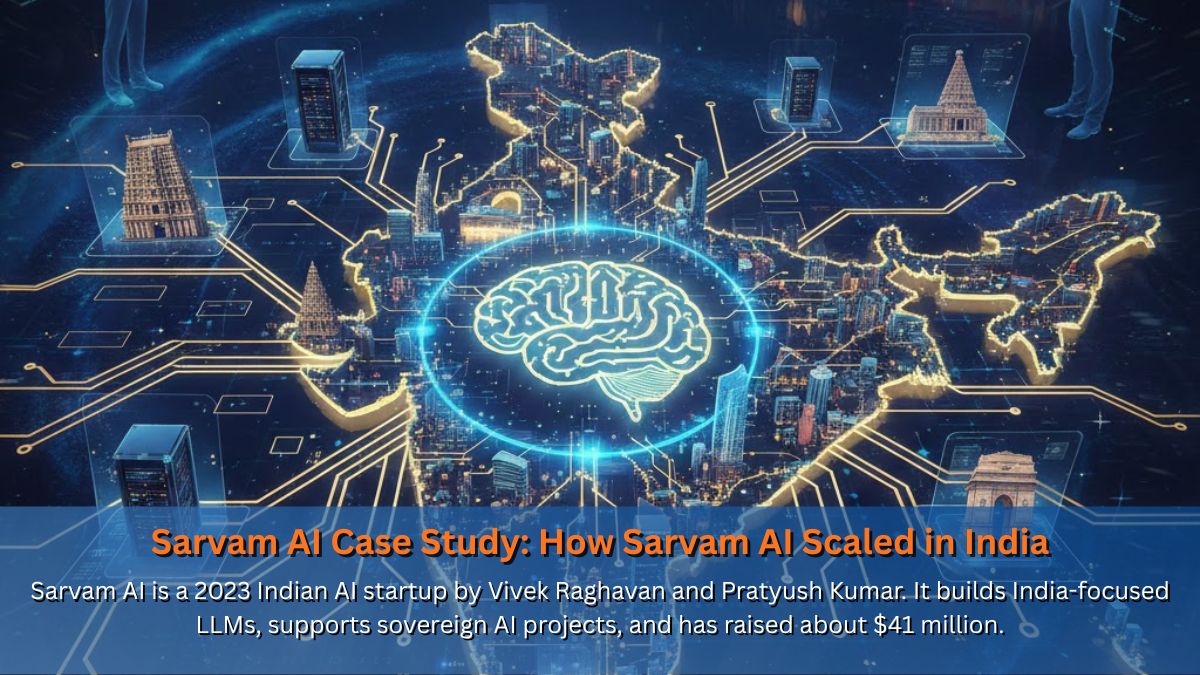
Sarvam AI is a Bengaluru-based Indian artificial intelligence startup building sovereign generative AI systems and Indian-language large language models (LLMs) tailored to local needs and enterprise use cases. Launched in July 2023 by Dr. Vivek Raghavan and Dr. Pratyush Kumar, the company grew from a research initiative into a fully operational AI lab developing foundational models, multimodal systems, and commercial products. It was created to solve a fundamental problem in the India AI ecosystem: the lack of powerful AI models that understand the country’s linguistic diversity, cultural context, and real-world applications.
From its earliest days as a small team of founders and researchers, Sarvam AI focused on building core technology that could handle Indian languages more accurately than global models. Over time, it expanded into enterprise products, secured venture backing of about $41 million, and became a key partner in India’s sovereign AI strategy including government-mandated projects and large-scale model launches. Today, Sarvam AI positions itself as a pioneer in India AI innovation, balancing research depth, commercial focus, and frugal infrastructure usage to scale in a market dominated by international AI giants.
1. The Founding Story of Sarvam AI
The story of Sarvam AI didn’t begin with big budgets or glossy boardrooms. It began in long research nights, small labs, and quiet academic hallways where two founders kept running into the same frustrating truth: India was being left out of the AI revolution. Both Vivek Raghavan and Pratyush Kumar were deeply involved with AI4Bharat, an effort focused on open-source AI for Indian languages. Their work exposed something most global engineers never had to think about the complete mismatch between mainstream AI models and India’s linguistic reality.
English-trained systems just couldn’t understand the way millions of Indians speak, write, or communicate. They stumbled over Hindi, Tamil, Bengali, and most regional languages. They often failed on mixed-language input, misread documents, and broke down on accent variations. Watching this play out again and again made the founders realize something bigger: India needed AI built for India, not repurposed from somewhere else.
That’s where “Sarvam” came from. A Sanskrit word meaning “all,” it captured their ambition to create AI that served every Indian, from metro cities to rural towns, in every language they use. The vision was bold but simple: develop sovereign AI technology locally, train it on Indian data, and make it accurate enough for real-world enterprise demands. This wasn’t a branding slogan. It reflected their belief that no global model would ever truly understand India unless someone here built it from scratch.
2. The Founders’ Journey and Motivation
What drove the founders wasn’t hype or the thrill of launching a startup. It was irritation mixed with inspiration. They had spent years studying natural language processing and machine learning, and they knew exactly where global AI models fell short. They saw how these systems failed at basic tasks when exposed to India’s realities legal documents with regional scripts, financial forms in mixed languages, heavily accented speech, or everyday code-mixing like “kal meeting shift kar dena.”
Instead of accepting that India would always rely on imported AI, they took the harder road: build foundational models themselves. They weren’t chasing superficial features or generic chatbots. They were designing technology that could:
- understand complex Indian documents
- read and extract data from multilingual formats
- handle regional accents with high accuracy
- generate natural-sounding Indian language speech
- work on enterprise workflows global AI couldn’t handle
Their early team was lean about forty researchers committed to research depth rather than flashy marketing. With limited compute and funding compared to global giants, they embraced “frugal innovation.” They learned how to stretch every GPU hour, optimize architectures, and extract performance far beyond what their budget should have allowed. This mindset didn’t just save money. It shaped the engineering culture of Sarvam: efficient, clever, and stubbornly determined to match global performance without global resources.
3. Identifying a Market Problem
India’s linguistic landscape is beautiful but brutally complex for AI. There are 22 official languages, hundreds of dialects, and daily code-mixing that most global datasets can’t even recognize. Add to that the challenges of handwritten scripts, regional phonetics, and informal communication styles, and you end up with a user base that mainstream AI models simply don’t know how to process. For Indian enterprises, this wasn’t a minor inconvenience. It was a roadblock. Banks couldn’t automate document verification. Telecom companies couldn’t handle support across districts. Government agencies struggled with speech recognition in regional accents. Global models would hallucinate meanings, mistranslate simple words, or ignore context entirely.
This gap was enormous. And it was growing. Sarvam recognized that India didn’t just need translation tools or language add-ons. It needed foundational models trained with Indian linguistic logic at their core. That meant datasets rooted in real Indian usage, context-heavy examples, and culturally grounded speech and text samples. Their mission became clear: build generative AI that genuinely works for India by understanding India.
This wasn’t just a business opportunity. It was a chance to unlock AI for millions who had been invisible to global systems. When technology understands people in their own language, it empowers them. And Sarvam set out to prove exactly that. If you’d like, I can also rewrite the remaining sections, create a full company profile, or shape this into a compelling thought-leadership article.
4. Building the Product and Technology Stack
From the outset, Sarvam AI focused on foundational model development the base layer upon which other capabilities would sit. Its early technology stack included several key components: The first milestone was Sarvam-1, a model optimized to handle multiple Indian languages with efficiency by training on custom datasets. Later generations included Sarvam-2B and models up to 105 billion parameters, demonstrating competitive performance with global benchmarks.
Two major launches in February 2026 marked a turning point. The company announced two foundational LLMs: a 30-billion-parameter model designed for real-time conversations and low compute cost and a 105-billion-parameter model tailored for complex reasoning, extensive context windows, and advanced enterprise applications. These models supported up to 128,000 tokens, enabling them to process long documents and multi-stage reasoning tasks.
Beyond LLMs, Sarvam also developed speech and vision models. Its speech-to-text system supported multiple Indian languages, and its vision-language models excelled at optical character recognition (OCR) and document intelligence crucial for industries like banking and insurance. The Sarvam Vision module demonstrated superior performance on complex Indian language scripts compared to some global models. Another notable product line included Sarvam Agents voice-enabled business agents integrated with platforms such as telephone and WhatsApp, supporting multilingual dialogue and enterprise workflows. These tools helped organisations automate customer interactions in local languages.
5. Early Traction and Validation
Sarvam’s earliest validation didn’t come from hype. It came from being tested, pushed, and measured in the real world. The first major breakthrough arrived when the Government of India’s IndiaAI Mission selected Sarvam AI to build the country’s first sovereign LLM ecosystem in April 2025. For a young company, this wasn’t just a contract. It was a national endorsement. It told the world that a homegrown team could shoulder a project of national importance and deliver frontier technology at Indian scale.
This partnership pushed Sarvam out of the shadows and onto the main stage. The team wasn’t just building a single model. They were developing an entire family of LLMs suited for advanced reasoning, real-time workloads, and even edge deployment. Each milestone strengthened the belief that an Indian company could operate at the same level as global AI labs.
By February 2026, the Sarvam-105B model was ready for public benchmarking. And this was the moment the company proved its point. Against global models like Gemini-27B and Mistral-32B, Sarvam delivered competitive performance. In several tests, it outperformed larger models built with far more compute. That was the validation enterprises were waiting for. It proved Sarvam wasn’t just “catching up.” It was innovating on its own terms, with efficiency and contextual accuracy that global models struggled to match.
5.1 Momentum grew quickly
Momentum grew quickly. At the India AI Impact Summit 2026, Sarvam demonstrated its AI-powered wearable tech, including the Sarvam Kaze smart glasses. For many attendees, it was the first time they saw Indian AI integrated into Indian hardware. The moment gained nationwide attention, especially when India’s Prime Minister personally interacted with the demo. That single interaction created a wave of trust, excitement, and legitimacy that money can’t buy.
This phase showed that Sarvam wasn’t just a research lab. It was becoming a national AI force.
6. The Business Model and Revenue Approach
Sarvam’s business model unfolded the way strong deep-tech businesses usually evolve: research first, then product, then revenue. In the early days, everything revolved around building the foundation large language models, multimodal stacks, and core capabilities that would become the engine behind every future product. Once these foundations took shape, monetization became both natural and scalable.
The company offered its models through APIs, letting developers experiment and enterprises integrate the technology into their own systems. This was powerful because it let a single core model serve hundreds of use cases: call centers, financial processing, healthcare transcription, legal workflows, and more.
6.1 Enterprise customizations formed the second revenue layer
Enterprise customizations formed the second revenue layer. Many Indian companies didn’t just want generic AI they wanted models tuned to their accents, document formats, regional workflows, and compliance needs. Sarvam’s India-first architecture made those adaptations easier and more accurate. Then came focused products.
Sarvam Agents became one of the earliest commercial successes. These voice-enabled agents handled customer service across telephony and messaging. Pricing followed usage, creating predictable, recurring revenue. Banks, telecom companies, and service platforms gravitated to them because they finally had AI that understood Indian voices without breaking down. Another line, A1, was designed for legal firms. It could draft documents, summarize large legal files, and extract structured data from messy multi-language paperwork. For law offices drowning in paperwork, this wasn’t a convenience. It was transformational.
The business model blended SaaS pricing, enterprise licensing, and API-based usage fees. Partnerships strengthened distribution. A key example was integration with Microsoft’s cloud ecosystem, which helped Sarvam reach thousands of developers who preferred infrastructure that was already enterprise-certified. By combining foundational research with practical commercial layers, Sarvam created a revenue engine that could scale without losing focus. It stayed true to its mission while proving that Indian-centric AI wasn’t just important it was profitable. If you want, I can continue rewriting the remaining sections in the same tone and depth.
7. Funding History and Investors
The company’s growth accelerated once strong institutional capital came in. In December 2023, it secured $41 million in Series A funding, led by Lightspeed Venture Partners with participation from Peak XV Partners and Khosla Ventures. This wasn’t just another fundraising headline. It was a moment when global investors publicly bet on India’s ability to build frontier AI, not just consumer tech.
That capital gave the company the freedom to think bigger. They hired specialized researchers, built deeper infrastructure, and finally had the breathing room to pursue their own roadmap instead of constantly worrying about cash cycles. Behind the scenes, teams finally had the tools and compute they needed, and you could feel the confidence shift. The investment wasn’t only money; it was validation that the work being done had global relevance.
8. Go-to-Market Strategy and Distribution Channels
The GTM approach blended engineering discipline with smart distribution. Instead of waiting for customers to stumble upon their models, the company placed its technology where builders already lived. Developers could access models on Hugging Face, making experimentation simple and organic. For enterprises, availability through Microsoft Azure created immediate trust and compatibility with existing systems.
Then came the government partnerships. Being integrated into national digital projects through the IndiaAI Mission gave the company an unusual distribution advantage. It wasn’t just serving clients; it was becoming part of core digital infrastructure. That visibility opened doors that standard marketing never could. When public sector deployments work well, word travels fast, and enterprises take notice.
9. Brand Positioning and Messaging Evolution
The brand didn’t emerge fully formed. In the beginning, the messaging leaned heavily on research, open-source contributions, and academic credibility. That phase helped earn respect in technical circles, but it wasn’t enough for enterprise adoption.
Over time, the company shifted its voice. The message became about reliability, real-world performance, and the ability to solve complicated India-specific problems at scale. The narrative also deepened around sovereignty. India wanted its own AI backbone, not just imported models, and the company leaned into that identity at the right moment. It wasn’t a marketing stunt. It came from a place of pride and responsibility, and that authenticity resonated across policy circles, conferences, and boardrooms.
This evolution from a promising research lab to a company shaping the country’s AI foundation didn’t happen overnight. It was the result of consistent delivery, technical wins, and a clear sense of purpose that people inside and outside the ecosystem could feel.
10. Challenges, Setbacks, and Turning Points
Sarvam’s growth has been anything but smooth. One of the biggest hurdles was compute. Training frontier models usually demands access to large GPU clusters, and India simply didn’t have enough of them when Sarvam started. Even as the government ramped up its subsidy programs, growing from 10,000 to nearly 40,000 GPUs, the gap was still very real. Teams often had to work long nights juggling limited compute windows, squeezing every bit of efficiency out of their training runs. Progress was possible, but it required patience and grit.
There was also the credibility challenge. The moment you build an AI model in 2025 or 2026, you’re automatically compared to giants like OpenAI, Google, Meta, and Anthropic. On paper, those companies had far more compute, deeper research teams, and longer track records. Instead of running away from the comparisons, Sarvam changed the frame. They focused on what mattered to India: accuracy in local languages, context relevance, better OCR for Indic scripts, and speech models that actually sounded like the people they were meant to serve. That shift became a turning point. It reframed the company from “a smaller competitor” into “a different kind of contender.”
11. Operational Execution and Scaling Decisions
Behind the scenes, the company operated with a discipline that came from necessity. Frugal innovation wasn’t a philosophy; it was survival. With limited compute and a lean research team, the engineers leaned on Mixture-of-Experts architectures, compression techniques, and task-oriented tuning to extract maximum value from every training cycle. Many of the breakthroughs didn’t come from massive scale. They came from clever work, late-night experiments, and a willingness to test unconventional ideas.
Focusing on domain specialization was another smart move. Instead of trying to match global models across every capability, Sarvam doubled down on areas where India needed real solutions: multilingual reasoning, accurate document parsing in regional scripts, and speech models fine-tuned to Indian accents and dialects. This choice earned them trust from enterprises and government departments who were tired of using generic global models that struggled with India’s diversity.
Scaling through partnerships was the final leg. By collaborating with cloud providers and platform ecosystems, the company avoided heavy infrastructure spending. This allowed them to widen access without ballooning operational complexity. It was expansion with a steady hand.
12. Competitive Landscape and Differentiation
The competition is intense. Global models from OpenAI, Google, Meta, and Anthropic dominate most benchmarks and developer mindshare. But Sarvam never tried to beat them at their own game. Their strength lies in owning the space that global players treat as an afterthought: Indian languages, local workflows, government integrations, and sovereign AI infrastructure. That strategy gives them a competitive moat. They shine where precision in local scripts matters. They outperform in voice scenarios where accents vary every 200 kilometers. understand linguistic nuance in a way that foreign models simply can’t, because India isn’t a “market segment” for Sarvam it’s the core design principle.
On the domestic front, they compete with regional players like Krutrim, but Sarvam’s advantage comes from a broader ecosystem. Government partnerships, enterprise-ready products, and their own model stack put them in a unique position. They’re not just another AI startup; they’ve become one of the few companies shaping what Indian AI can look like at scale. Through all the noise and comparisons, Sarvam’s differentiation is simple: global ambition built on Indian roots, with a focus on solving real problems for real users.
13. Team Building and Leadership Approach
Sarvam’s team didn’t grow the way most tech startups do. There was no rush to build a large headcount or fill an office with people just to look impressive. The founders were intentional. They kept the core small and dense with talent, bringing together researchers, engineers, linguists, and product minds who genuinely cared about building technology that understood India.
The leadership culture mixed the discipline of academia with the urgency of a startup. Research rigor wasn’t negotiable, but neither was practicality. Teams were encouraged to challenge assumptions, run rough experiments, break things, and rebuild smarter. A linguist might spend hours with a machine learning engineer explaining why a specific dialect behaves a certain way, or a researcher might sit with a product team to rethink how a model interacts with a real customer workflow. These moments became the glue that held the company together.
What truly defined Sarvam’s leadership approach was empathy. They understood that building AI for a diverse country meant respecting every voice, every script, and every variation. It showed up not just in the technology, but in how the team collaborated. People felt ownership because they weren’t just building a product they were building something that could change how a billion people interact with technology.
14. Regulatory and Industry-Level Hurdles
AI in India doesn’t exist in a vacuum. Every step intersects with regulation, especially around privacy, data handling, and localisation. Sarvam had to navigate this maze carefully. Being an Indian company gave them an advantage, but it didn’t eliminate the hard work. The team spent countless hours interpreting evolving policies, aligning model training workflows with data norms, and ensuring transparency in how information flowed through their systems.
Their involvement in national programs like the IndiaAI Mission helped anchor their approach. Working closely with policymakers offered clarity, but also responsibility. They had to meet expectations not just as a startup, but as a steward of sovereign AI infrastructure. The pressure was real. One misstep could have undermined public trust. Yet the team saw this as part of their mission if India needed secure, locally aligned AI systems, then Sarvam had to set the standard.
15. Milestones and Public Growth Metrics
Sarvam’s journey is marked by moments that felt bigger than the company itself. In 2023, they launched in Bengaluru and secured a $41 million Series A round led by top global investors. For a young deep-tech company in India, this wasn’t just capital. It was proof that serious technology could be built here, not just apps and marketplaces.
In 2025, they hit a defining milestone when the IndiaAI Mission selected them to help build India’s sovereign LLM ecosystem. This wasn’t a ceremonial partnership. It meant real responsibility: building models that could power national infrastructure. By 2026, Sarvam had rolled out its 30B and 105B parameter models. These weren’t prototypes. They were production-ready systems that held their own against established global models in key India-centric tasks. The launch demonstrated that cutting-edge AI could be built in India without billion-dollar budgets.
The same year, at the India AI Impact Summit, Sarvam revealed the Kaze smart glasses a moment that surprised even people who were closely following their work. Seeing an Indian AI company unveil advanced wearable technology wasn’t just exciting. It was symbolic. It signaled that India was no longer just catching up. building original, ambitious products.
While the company hasn’t shared revenue numbers, the signs of growth are visible in enterprise deployments, rising API usage, and increasing presence across industries like finance, legal, and telecom. You can feel the momentum not through spreadsheets, but through how often Sarvam’s technology is showing up in real conversations across India’s tech ecosystem. Through all of these milestones, one thing stands out: Sarvam’s growth has always been tied to purpose. Every decision, partnership, and product feels anchored in the belief that India deserves technology built for its people, its languages, and its future.
16. Technology and Operational Insights
Sarvam’s model architecture strategies include mixture-of-experts (MoE) designs, enabling large parameter counts with efficient compute. This efficiency is important for reducing cost and latency, particularly for real-time applications. Its multimodal systems combining text, speech, and vision help automate diverse workflows, from document digitization in banks to customer support bots in regional languages. The operational impact is measurable when workflows that once required manual intervention are now automated with higher accuracy and at lower cost.
17. Current Status of Sarvam AI
By early 2026, Sarvam AI isn’t just another rising startup. It has become one of the anchors of India’s AI movement. You can feel its presence everywhere in policy discussions, enterprise pilots, product showcases, and national digital infrastructure plans. What makes this moment powerful is that the company is no longer operating with the scrappy uncertainty of its early years. It has stepped into a phase where expectations are higher, responsibilities are deeper, and the impact is real. The team continues to refine its foundational models, pushing for better reasoning, stronger multilingual accuracy, and more natural speech performance across Indian languages. These aren’t incremental upgrades. Each release shows noticeable improvements in latency, context handling, and relevance for real-world Indian workflows, from document-heavy industries to customer-facing use cases.
On the enterprise side, Sarvam’s footprint is widening. More businesses are deploying its voice agents, integrating its document-processing tools, and relying on its APIs to solve problems global models simply don’t understand. The feedback loop is immediate. Enterprises often come back with on-ground insights from call centers, legal teams, or regional branches, and the Sarvam team uses those insights to improve models that reflect how India actually speaks, writes, and thinks.
17.1 The company’s involvement in sovereign AI programs has also deepened
The company’s involvement in sovereign AI programs has also deepened. It’s not a token participant. It’s working on long-term national infrastructure models that could one day power public services, education platforms, healthcare records, and citizen-facing applications. This puts Sarvam in a rare position: a private company building technology that may become part of India’s digital backbone.
Its recent demonstrations from high-parameter models to AI-driven wearables have shifted public perception. People no longer see Sarvam as a promising research outfit. They see it as a deeptech force that’s proving India can build advanced AI on its own terms. There’s a sense of pride around its progress, even among those who aren’t deeply technical. Right now, Sarvam stands at a point where ambition and ability finally match. The company is moving with the confidence of an organisation that has earned its place, while still holding the humility of a team that knows the journey ahead is long, complex, and meaningful.
18. Future Outlook and Roadmap
Looking ahead, Sarvam AI’s future strategy revolves around scaling adoption, enriching its model suite, and expanding global relevance from an Indian foundation. This includes ongoing research to improve reasoning capabilities, broader support for Indic languages, and deeper penetration into enterprise workflows. Sarvam’s future roadmap likely includes tighter integrations with Indian government platforms, expanded partnerships with cloud providers, and continuous enhancement of voice and vision AI modules.
From a strategic standpoint, the company aims not just to build models but to embed AI into India’s digital infrastructure, enabling services that are both locally relevant and globally competitive. For the India AI ecosystem, Sarvam represents a template for how startups can combine research ambition with commercial product execution. The future looks promising if it continues to balance innovation, frugal execution, and alignment with market needs a combination few AI startups globally have mastered.
About FoundLanes.com
foundlanes.com documents, analyses, and publishes in-depth startup case studies, founder journeys, and business insights for India’s startup ecosystem. It focuses on factual reporting and deep analysis of how companies innovate, grow, and scale. Our coverage helps readers understand not just what companies build, but how and why they succeed or struggle.